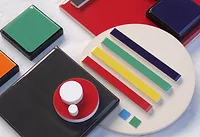
Color Management - CCI and X-Rite Provide Color Accuracy on the Factory Floor

As one of the world’s largest manufacturers of color cards and color systems, Chicago-based Color Communications Inc. (CCI) specializes in exact duplication of the colors consumers see when they apply paints and stains to the interior and exteriors of their homes. Over the past 35 years, CCI has produced billions of color merchandising products for companies around the globe, such as the paint chips offered by the paint manufacturers at home improvement retailers like Home Depot and Lowe’s to the paint samples in brochures and displays used in automotive showrooms enabling consumers to select the color of their new cars and trucks.
True to its reputation as an innovator, CCI has recently employed an X-Rite inexpensive in-line, non-contact spectrophotometer that provides laboratory accuracy in reading colors on the factory floor. The company estimates that the instrument will pay for itself in less than a year through savings in scrap, equipment downtime and labor costs.
CCI employs more than 500 people at its main Chicago facility and an Auckland, New Zealand plant. The company’s work is so precise that some color tools produced by CCI are used by its customers as standards for their internal color quality control.
“Customers come to us because they have a need for accurate color,” said Jerald Dimas, Vice President-Technical at CCI. “There is a premium cost to our product because of that accuracy. You can’t print colors using four-color process printing for an accurate representation. We use the actual paint in our process. That’s one of our competitive advantages: High-speed production with a high degree of accuracy.”
Ensuring Color Quality
To ensure color quality during a production run, CCI technicians take test samples by stopping the equipment, cutting the desired sample from the production roll and conducting spectrophotometer tests. A high-profile project for Akzo Nobel Coatings required more than 20,000 such measurements in the last eight months alone. The costs of quality add up quickly because part of the production run is spoiled by taking the sample, and the equipment remains idle during the testing process. In addition, quality control personnel spend time conducting the tests and transporting samples to and from the factory floor.By multiplying the resources expended to test one sample by the tens of thousands of tests it performs annually, CCI determined it had a great opportunity for cost savings and enhanced quality control practices.
To pursue this opportunity, CCI agreed to act as one of a number of beta test sites this past year for a new-generation spectrophotometer developed by X-Rite that can measure samples without destructive testing, match the accuracy of lab-confined spectrophotometers on a relative basis, and withstand the harsh environments of a factory floor.
Cost - A Key Factor
And there was one final key to make the system work for CCI: cost. By using innovations from a variety of industries, X-Rite offers the instrument at less than $20,000 a unit, nearly one-fifth the cost of other lab-bound or non-contact spectrophotometers. Michigan-based X-Rite, the world’s largest manufacturer of color measuring instruments, has begun introduction of the product worldwide following its successful trials at CCI.“When we first started looking at non-contact spectrophotometers, everything was in excess of $100,000,” Dimas said. “We were still looking at them to see if they could pay for themselves, but the cost really didn’t look that attractive at those prices. “With the VeriColor® Spectro, the return on investment is excellent. There isn’t a reason not to use this sort of equipment in the factory now.”
VeriColor Spectro System
CCI uses the VeriColor Spectro system to measure color at a distance of up to 4 inches from the sample, which Dimas said is more than adequate for his company’s needs and allows for versatility in mounting the instrument. Because the instrument does not employ destructive testing, CCI has been able to compile data as often as it wishes while the process is running. Under the destructive testing system, CCI conducts tests at the beginning, middle and end of the product run simply because of the resources required for each test.“We have a very active Six Sigma program here, and one of its tenets is to define and measure for constant improvement,” Dimas said. “We want to catch a problem at the source and, in order to catch it, we have to measure it.”
CCI has begun to correlate the process data that it collects from the VeriColor Spectro instrumentation with other quality control systems that monitor dwell and cure times, film thickness and substrate variations to “engineer the quality into our products,” Dimas said.
Dimas said the robust nature of the VeriColor Spectro in harsh environments was critical to CCI. The basic VeriColor Spectro instrument shows lab-quality reproducibility in temperature conditions ranging from 32 – 125 °F and can show the same reproducibility up to 167 °F with a special enclosure that uses compressed air to cool the system and keep optics clean. “A lot of spectrophotometers are very sensitive when it comes to temperature for reproducibility, and the VeriColor hasn’t shown that,” Dimas said.
Initial results indicate that the VeriColor Spectro will allow CCI to reduce the number of off-line samples from tens of thousands of trials to hundreds over the course of a year. For instance, the 20,000 off-line readings that were required for Akzo Nobel could be replaced with digital readings by using the VeriColor in the future.
“One of the reasons why we need something like this is because our industry is so demanding,” Dimas said. “It really depends on the norm in your industry. It is not uncommon for us to maintain our tolerances below a half unit or less. That is very, very tough to do.”
For more information, contact gryczan@seyferthpr.com.
Looking for a reprint of this article?
From high-res PDFs to custom plaques, order your copy today!