

Waterborne Coatings Aren't the Future -- They're the New Performance Benchmark
How Advances in Resin Architecture, Crosslinking Chemistry, and Production Efficiency Are Redefining the Modern Wood Finishing Industry
Over the last decade, the wood finishing landscape has undergone a clear and measurable shift. What began as a regulatory push toward lower-VOC materials has evolved into a performance-driven transition centered around durability, color stability, workflow efficiency, and predictable results. At Gemini Industries, this evolution has been visible firsthand, as modern waterborne coatings now bear almost no resemblance to the early generations many shops remember—slow drying, flat appearance, poor leveling, and inconsistent film formation.
Modern waterborne coatings, designed through advanced polymer engineering and refined resin architecture, routinely match or surpass solvent-based systems in clarity, hardness, chemical resistance, and non-yellowing performance. In many shops, they are already the preferred technology—not because they are required, but because they simply perform better.
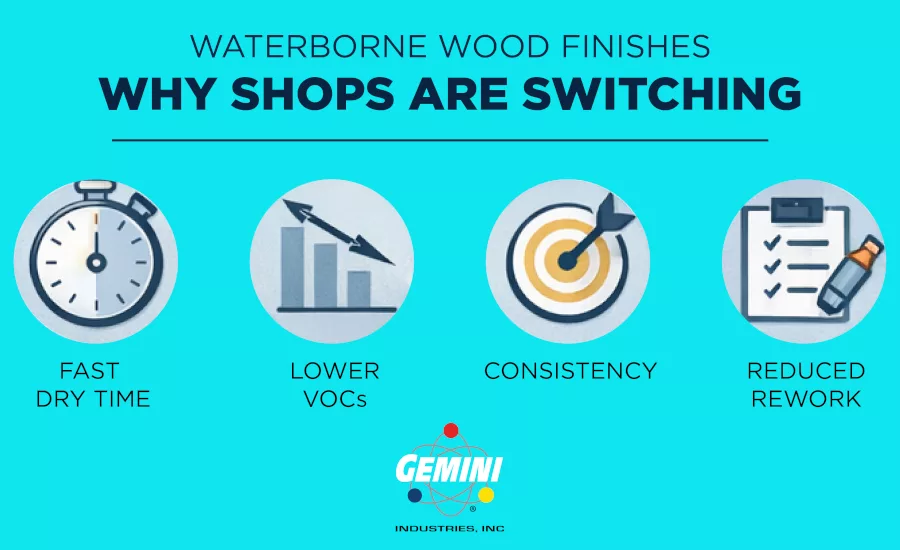
WHY SHOPS ARE SWITCHING: BEYOND VOC AND COMPLIANCE
The transition toward waterborne coatings is no longer driven primarily by air-quality regulations. Finishing managers cite three modern priorities: speed, consistency, and predictability. Waterborne technology now delivers advantages in each of these categories.
FASTER, MORE PREDICTABLE DRYING
Next-generation resin systems are designed with highly controlled film formation and curing kinetics. Consistent particle size distribution, optimized coalescence behavior, and integrated crosslinking functionality result in shorter and more predictable dry-to-handle and dry-to-stack times. These improvements allow modern waterborne coatings to dry significantly faster than older generations.
CLEANER, SAFER WORKING ENVIRONMENTS
The shift toward waterborne systems has significantly improved shop-floor environments. Reduced solvent content lowers airborne emissions, improves air quality, and decreases flammability risks. In addition, the elimination of free isocyanates and external crosslinkers in many self-crosslinking systems reduces worker exposure and simplifies safety compliance. The result is a cleaner operation with fewer handling hazards and less reliance on extensive ventilation or solvent recovery infrastructure.
LONG-TERM COLOR STABILITY AND NON-YELLOWING
One of the most significant advantages of waterborne technology—especially in North America’s booming white-cabinetry market—is its inherent resistance to yellowing. Traditional solvent-based coatings often amber with age, shift under UV exposure, or lose brightness over time. Additionally, modern waterborne topcoats maintain their clarity for the life of the finish.
REDUCED REWORK AND GREATER CONSISTENCY
Improved flow, leveling, and film uniformity in waterborne topcoats reduce common issues such as lap marks, pinholing, and inconsistent gloss. Single-component and self-crosslinking systems further reduce variability by eliminating mixing errors and pot-life constraints. The outcome is greater batch-to-batch consistency, fewer rejected parts, and a measurable reduction in rework and scrap rates.
Shops that switch to waterborne report more predictable film builds, less sagging, more uniform leveling, and fewer trapped solvents or moisture. These improvements directly affect production efficiency and profitability.
THE CHEMISTRY BEHIND TODAY’S WATERBORNE TECHNOLOGY
Modern waterborne coatings are the product of significant advancements in resin engineering. The performance comes from polymer design—not from the fact that the coatings are water-based.
Tailored polymer design. Advances in polymer science now allow chemists to design resins with specific chain lengths, branching patterns, and functional groups. These structural nuances influence crucial performance metrics like hardness, flexibility, adhesion, and chemical resistance. For example, resins with a controlled degree of branching can achieve high surface hardness without becoming brittle—a balance that was difficult in older systems.
Hybrid resins for multifunctionality. Combining different polymer families (such as polyurethane-acrylate hybrids) yields materials that leverage the strengths of each component. Hybrid architecture can offer rapid curing, UV resistance, excellent adhesion, and long-term durability—all in one package. The result? Wood finishes that are tougher, more adaptable, and longer-lasting.
POLYURETHANE DISPERSIONS (PUDs)
Polyurethane dispersions (PUDs) have become a cornerstone of modern wood coating technology, particularly in high-performance waterborne systems. Early generations of PUDs were often constrained by tradeoffs between hardness and flexibility or by limited chemical resistance. Today’s PUDs, however, leverage advanced resin architecture, optimized hard–soft segment balance, and integrated crosslinking functionality to deliver performance levels comparable to, and in some cases exceeding, traditional solventborne polyurethane systems.
Today’s PUDs deliver:
- High abrasion resistance
- Strong chemical durability
- Balanced hardness
- Excellent clarity
ACRYLIC–POLYURETHANE HYBRIDS
Hybrid systems combine acrylic clarity with polyurethane toughness, improving block resistance, leveling, mar resistance, and sandability.
SELF-CROSSLINKING POLYMERS
One of the most impactful developments in modern wood coatings is the advancement of self-crosslinking polymer systems. Self-crosslinking polymers are engineered with reactive functional groups built directly into the resin backbone. Under specific conditions—such as heat, moisture, or pH change—these polymers form crosslinks on their own, developing early hardness and improving chemical and moisture resistance without external catalysts.
Gemini Industries has observed that manufacturers transitioning to modern self-crosslinking PUD and acrylic hybrid systems often experience measurable reductions in dry-time variability and defect-related rework—particularly in cabinet and millwork applications where line speed and color consistency are critical.
Performance in waterborne and low-VOC formulations. Self-crosslinking binders are particularly well suited for waterborne wood coatings. Internal crosslinking chemistry supports excellent early water resistance, solvent resistance, and mar resistance—often without the need for high bake temperatures. This makes them ideal for flatline, spray, and roll-coat applications in industrial wood finishing.
Impact on production efficiency and sustainability. Because crosslinking occurs intrinsically within the polymer system, these coatings typically exhibit faster through-cure, reduced energy requirements, and fewer formulation components. The elimination of added crosslinkers also reduces worker exposure risks and supports compliance with evolving environmental and safety regulations.
RHEOLOGY MODIFIERS AND ADDITIVES
Modern rheology control minimizes grain raise, improves application feel, and provides smooth leveling for a high-end appearance.
WATERBORNE IS THE NEW STANDARD
Waterborne coatings have evolved from regulatory alternatives to high-performance, production-ready solutions. Modern resin architecture, hybrid polymer systems, and advanced additives have made waterborne coatings superior in clarity, color stability, durability, and consistency. At Gemini Industries, this shift underscores a broader industry reality: for shops that value predictable results, faster dry times, safer working environments, and long-term finish quality, waterborne technology is not the future—it is the new benchmark for professional wood finishing.
This article was sponsored by Gemini Industries, a U.S.-based manufacturer of industrial wood coatings serving cabinet manufacturers, millwork producers, and other woodworking professionals.
Looking for a reprint of this article?
From high-res PDFs to custom plaques, order your copy today!