Innovative Testing Technologies for Effect Finishes
Therefore, new generations of special-effect pigments can no longer sufficiently be described with traditional multi-angle color measurement quantifying the diffused light reflection at 3 to 5 angles. This paper presents new technologies that were developed to objectively describe the total impression of color – multi-angle color and effect changes (sparkle – graininess) as well as paint defects such as “cloudiness - mottling”.
 Credit: BYK-Gardner GmbH Credit: BYK-Gardner GmbH
|
| Figure 1 Click to enlarge |
Introduction
Special-effect coatings play a dominant role in a variety of applications (automotive, appliances, electronics, cosmetics, etc.) as they make an object distinctively appealing. Designers are looking for a new color, which not only makes the product look pretty, but actually underlines its styling resulting in a “living” color! Pigment manufacturers are developing new colors that not only change their look under different viewing angles, but also look different under different lighting conditions (i.e., sunny sky and cloudy sky). Again the goal is to make the product appear alive and exciting. In contrast to conventional solid colors, metallic finishes change their appearance with viewing and lighting conditions. Interference colors and special-effect colors show not only a lightness change with viewing angle, but also a chroma and hue change. And, in the latest development of special-effect pigments, additional special sparkling effects are created by changing the lighting conditions from cloudy to sunlight.
 Credit: BYK-Gardner GmbH Credit: BYK-Gardner GmbH |
| Figure 2 Click to enlarge |
On the other hand, color harmony, i.e., a uniform and consistent color, is essential to achieve the impression of a high-quality finish and avoid customer complaints. Most of the time a final product consists of several components produced by various suppliers, thus color uniformity is becoming more of a challenge to the entire supply chain.
Effect Coatings Color Measurement
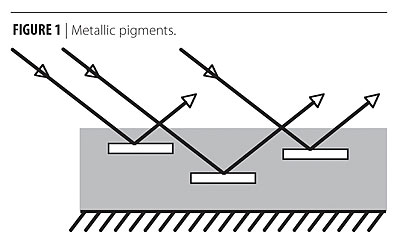
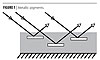
The first types of effect pigments used were aluminium flakes, creating a “metallic” look. Dependent on the viewing angle they show a light-dark flop. The larger the lightness difference is between the viewing angles, the more the curved profile of an object will be accentuated (Figure 1).
 Credit: BYK-Gardner GmbH Credit: BYK-Gardner GmbH |
| Figure 3 Click to enlarge |
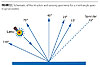
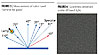
To objectively describe this light-dark flop effect, measurements have to be done at different angles (Figure 2). It was determined that a minimum of three and best five viewing angles are needed to provide sufficient information on the goniophotometric characteristics of a metallic finish. The measurement geometry for multi-angle measurement is specified by aspecular angles. The aspecular angle is the viewing angle measured from the specular direction in the illuminator plane.
 Credit: BYK-Gardner GmbH Credit: BYK-Gardner GmbH |
| Figure 4 Click to enlarge |
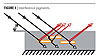
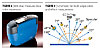
The angle is positive when measured from the specular direction toward the normal direction. Later, pearlescent pigments were introduced that show not only a lightness change with viewing angle, but also a chroma and hue change caused by the interference of light (Figure 3).
 Credit: BYK-Gardner GmbH Credit: BYK-Gardner GmbH |
| Figure 5 -6 Click to enlarge |
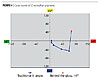
For the new generation of those pigments the color even travels over a wider range, i.e., through several quadrants in color space (Figure 4). Quite often the color shift can be noticed on the opposite side of the specular reflection (or “behind the gloss”). This effect can no longer sufficiently be described with traditional multi-angle color measurement quantifying the diffused light reflection at three or five angles.
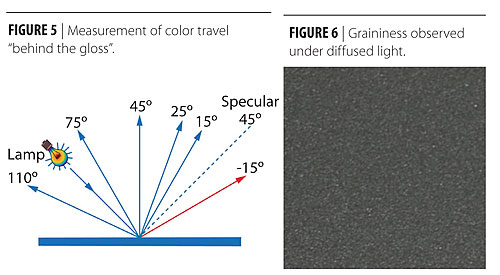
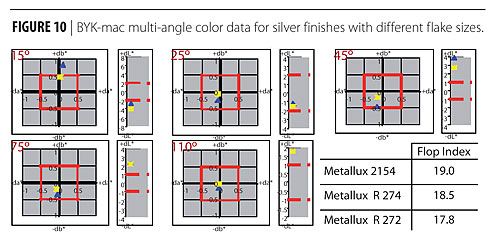
Research has shown that by adding at least one additional measurement angle at -15° “behind the gloss” correlation to the visual assessment can be improved tremendously (Figure 5).
 Credit: BYK-Gardner GmbH Credit: BYK-Gardner GmbH |
| Figure 7 Click to enlarge |
Effect Measurement of Effect Coatings
Metallic and interference pigments not only change their color impression dependent on the viewing angle, but also dependent on the lighting condition – direct sunlight versus cloudy sky. This effect cannot be captured with conventional multi-angle color instruments, because they measure the integral of the spectral reflection over the detected area and cannot distinguish between the basecoat color and the reflection of the effect pigments.
 Credit: BYK-Gardner GmbH Credit: BYK-Gardner GmbH |
| Figure 8-9 Click to enlarge |
Under diffused illumination (cloudy sky) a metallic finish can create a light/dark pattern depending on the aluminum flake size from very fine to very coarse (Figure 6). Commonly used terms to describe the phenomenon are graininess, coarseness, texture or salt and pepper. The effect is only obvious at a close distance and does not change with viewing angle. Graininess can vary with the flake size, the orientation of the flakes in the coating, and with agglomeration of flakes during the application process.
 Credit: BYK-Gardner GmbH Credit: BYK-Gardner GmbH |
| Figure 10 Click to enlarge |
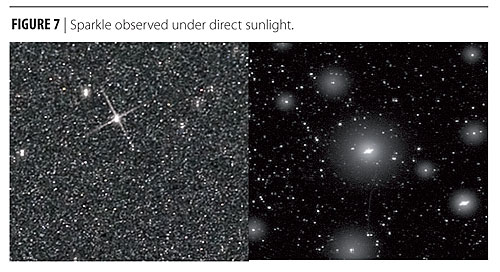
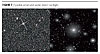
Under direct illumination (sunlight) the same metallic or effect finish can look completely different (Figure 7). Small light flashes can be seen with low to high intensity. This effect is also referred to as sparkle, micro-brightness, glint or diamonds. Sparkle is caused by the reflectivity of the flakes and therefore is influenced by the flake type (aluminum flake, mica, Xirallic®), the concentration level of the effect pigments, flake size or application method (bell/bell versus bell/pneumatic). In contrast to graininess, the sparkle effect is very dependent on the illumination angle.
Total Color Impression Measurement
 Credit: BYK-Gardner GmbH Credit: BYK-Gardner GmbH |
| Figure 11 Click to enlarge |
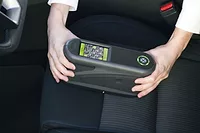
To characterize the impression of effect finishes under different viewing angles and illumination conditions, a new instrument is available from BYK-Gardner that combines the following characteristics.
- Multi-angle color measurement “before and behind the specular reflection” to give better insights on the true color travel capabilities of an effect color.
- Effect measurement of sparkle and graininess simulating the effect changes under cloudy sky and bright sunlight.
 Credit: BYK-Gardner GmbH Credit: BYK-Gardner GmbH |
| Figure 12 Click to enlarge |
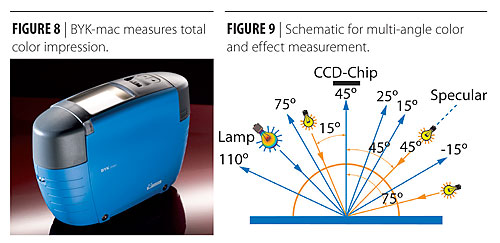
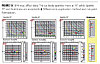
To measure sparkle and graininess, the instrument is equipped with a digital camera, which correlates to the spatial resolution of the human eye. The camera takes pictures under various lighting conditions. Diffused illumination by a white-coated hemisphere is used to simulate a cloudy sky condition for measuring graininess. Direct illumination at three angles is used to measure the sparkle impression under direct sunlight (Figures 8 and 9).
 Credit: BYK-Gardner GmbH Credit: BYK-Gardner GmbH |
| Figure 13 Click to enlarge |
In order to obtain numerical values that can be used for daily process control and QC purposes, the camera pictures are analyzed with algorithms that were established based on visual evaluations of a variety of automotive finishes together with several partners from the automotive, pigment and paint industry.
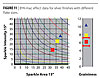
To allow a better differentiation, the impression of sparkle is described by a two-dimensional system: sparkle area and sparkle intensity. A sparkle tolerance model was developed, which allows setting a “Delta Sparkle” value for paint batch or part QC. The calculation of the “Delta Sparkle” value is related to the color difference calculation of Delta Ecmc and was tested by several automotive makers and paint suppliers in visual correlation studies.
 Credit: BYK-Gardner GmbH Credit: BYK-Gardner GmbH |
| Figure 14 Click to enlarge |
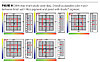
Graininess is evaluated by measuring the uniformity of light and dark areas and is summarized in one graininess value. A graininess value of zero would indicate a solid color, the higher the value the grainier or coarser the sample looks under diffused light.
Color and Effect Applications
Aluminum Flake Size Influence
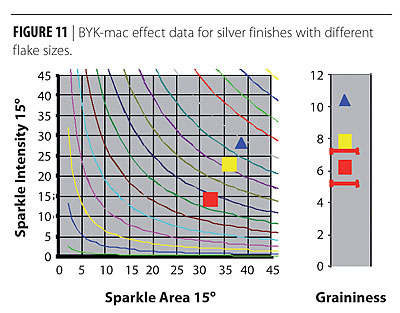
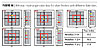
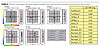
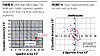
Silver finishes with three different aluminum flake sizes (25 µm, 34 µm, 54 µm) were compared for color and effect change. In multi-angle color measurement the flake size influence can be mainly seen in lightness changes (Figure 10 - Flop Index).
 Credit: BYK-Gardner GmbH Credit: BYK-Gardner GmbH |
| Figure 15-16 Click to enlarge |
Visually, the silver finish with the coarser aluminum pigments appears much more “grainy” under diffused lighting conditions and more “sparkling” under direct illumination. The BYK-mac measurement correlates with the visual judgment: sparkling area, sparkling intensity as well as the graininess are increasing with the flake size (Figure 11).
Application Method Influence on Flake Orientation
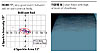
In order to increase paint efficiency, the application method for the basecoat is being changed to 100% electrostatic application. Especially on metallic finishes containing coarser aluminum flakes the flake orientation will be different – more non-parallel oriented flakes. The result can be less of a light-dark flop effect and more sparkling at low grazing illumination angle.
 Credit: BYK-Gardner GmbH Credit: BYK-Gardner GmbH |
| Figure 17-18 Click to enlarge |
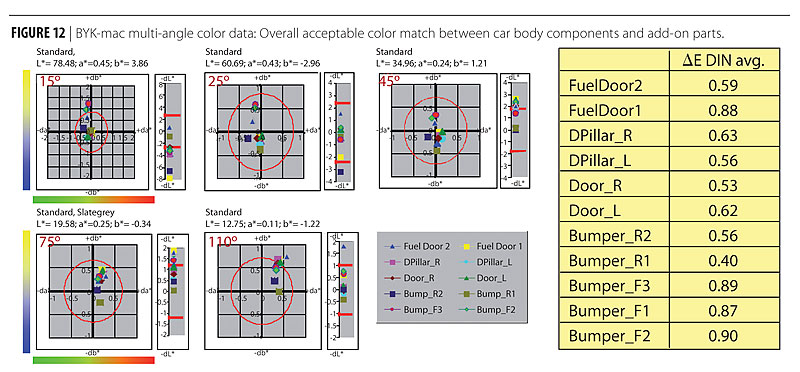
In another example the basecoat of the car body was applied 100% electrostatically and the bumpers were still painted with the traditional bell/pneumatic application. The total color difference using the color difference calculation Delta EDIN was acceptable evaluating on the averaged Delta EDIN value (Figure 12).
 Credit: BYK-Gardner GmbH Credit: BYK-Gardner GmbH |
| Figure 19 Click to enlarge |
Visually, one could see a difference mainly at a low grazing illumination angle, whereas the car body was sparkling considerably more than the bumper. The BYK-mac measurement data reflects the visual impression clearly evaluating the Sparkle 75° data. The Sparkle 75° measurement evaluates the aluminum flakes, which are non-parallel oriented; therefore the main changes can be seen in an increasing sparkle area (Figure 13).
Effect Pigment Type Influence on Color and Effect
A black effect finish with a concentration of 0.3% Xirallic was compared to the same finish with 0.3% Mica. In regard to traditional 5-angle color measurement the two finishes would be acceptable (Figure 14).
 Credit: BYK-Gardner GmbH Credit: BYK-Gardner GmbH |
| Figure 20 Click to enlarge |
Visually, there is a big difference when the panels are exposed to direct sunlight. The finish containing Xirallic has a much higher sparkling effect than the finish with Mica pigments. The sparkle measurement shows a clear difference at 15° illumination. The finish with the Xirallic pigments shows a much higher intensity value than the finish using Mica pigments (Figure 15).
Sparkle and Graininess for Daily QC
 Credit: BYK-Gardner GmbH Credit: BYK-Gardner GmbH |
| Figure 21 Click to enlarge |
Sparkle and graininess are essential parameters for automotive applications to achieve a harmonized look over the entire car body including add-on parts.
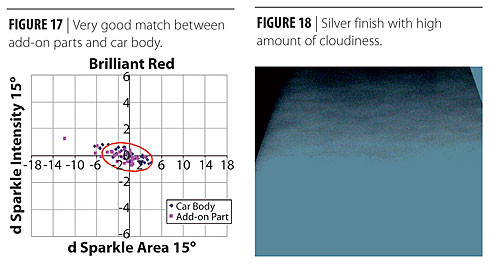
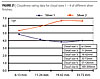
Figure 16 shows an example of an anthracite color with a poor sparkle match between add-on parts and car body: all measurements taken on the add-on parts were outside the sparkle tolerance ellipse.
Figure 17 on the other hand shows a very good match of a brilliant pearl red. All readings are within the sparkle tolerance.
The differences in Sparkle 15°, 45°, 75° and/or graininess can also assist in trouble shooting to determine whether the cause of a mismatch is due to formulation or process differences.
Color Measurement Outlook and Challenges of Tomorrow: Cloudiness
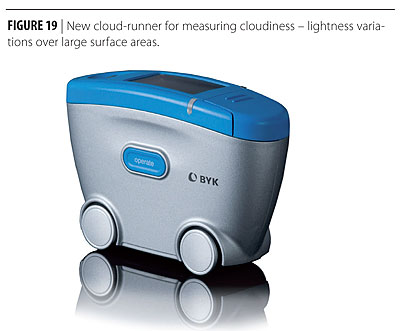
An additional factor influencing total color impression is an effect called cloudiness or mottling. Cloudiness is a lightness variation that is most obvious on light metallic finishes. It is a very undesirable effect that is quite obvious on large body panels. It can be caused by formulation as well as application variations. The main influencing parameter is flake disorientation, which can be caused, for example, by formulation incompatibilities or film thickness variations during the basecoat application. The result will be small and/or large clouds (lightness variations) resulting in an inhomogeneous appearance. Depending on the viewing distance, small clouds (close up evaluation) or large clouds (far distance evaluation) (Figure 18) can be seen.
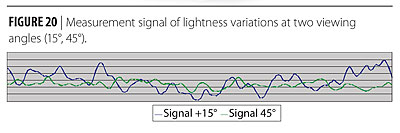
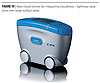
In order to objectively measure the mottling effect it is necessary to measure lightness variations over a large sample area. BYK-Gardner is introducing a new solution to scan the surface over a large area and objectively measure the lightness variations at three different viewing angles to simulate the visual evaluation of cloudiness (Figure 19).
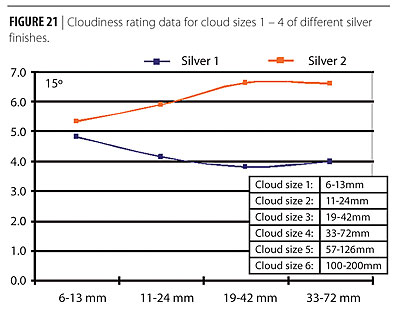
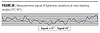
The measurement signal (Figure 20) is filtered via mathematical filter functions in different cloud sizes and a “rating” value calculated for each cloud size (Figure 21). The higher the rating value the more visible the mottling effect.
Currently, automotive companies are working on setting cloudiness values for batch approval and process control.
Conclusion
The introduction of more new effect pigments requires new innovative measurement technologies to capture the total color impression. It is no longer sufficient to measure the color impression only under different viewing angles, but also the effect of different lighting conditions needs to be evaluated. Colors that agree with each other when measured for 5-angle color can look very different due to sparkle and graininess differences. The objective measurement of the total color harmony of products with special effects coatings is now possible with the development of new innovative technologies implemented in the BYK-Gardner BYK-mac.
This instrument fills a need for effect measurement that has not been available until now. The BYK-mac uses multi-angle color measurement at six angles, and also uses multi-angle camera evaluation of sparkle and graininess to give a complete picture of the visual impression of the effect coating. The new sparkle and graininess measurement data can be used for trouble shooting to determine the cause of a mismatch as well as for daily quality control.
Looking for a reprint of this article?
From high-res PDFs to custom plaques, order your copy today!