
Book Review
The Rauch Guide to the U.S. Ink Industry, 2nd Edition
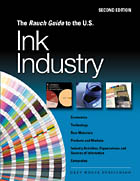
Publisher: Grey House Publishing, Millerton, NY 12546, 263 pages
Reviewed by: Dr. Darlene Brezinski
This second edition of the well-known Rauch Guide presents a comprehensive resource that covers the latest trends, economics and company information for the $4 billion U.S. ink industry. The first four handbook chapters contain detailed industry data. The final two chapters contain ink industry information resources and profiles of 200+ companies with contact information, product descriptions and sales volumes.
Section I, Economics and Government Regulations, details industry shipments and forecasts, a ranking of the largest U.S. merchant ink manufacturers in 2005, company performance and prices, a table of major acquisitions, a table of printing ink plants by employee size and state, operations, and expenditures. There are also numerous tables on operating ratios and operating margins, cost of materials, inventory trends, new capital and employment expenditures, productivity and wages, and product shipments by type by leading states. Employment/productivity and transportation/distribution is also discussed in this section, as well as packaging. There is also considerable discussion on government regulations and the current laws for air and water pollution, hazardous waste, toxic substances and safety. Foreign trade is included with tables for ink exports and imports by year and by leading countries. Tables of foreign production and global producers of ink and graphic arts materials are also included.
Section II, Technology, discusses ink manufacturing, printing processes, plates and other image carriers, printing presses, substrates, ink curing, coatings, and fountain solutions. As I am not familiar with the various printing processes, I found this section very informative. It discusses relief printing, letterpress, lithographic (planographic), gravure (Intaglio), combination, screen, digital and specialty printing. It was very easy reading and I learned what these various printing processes were and their differences. Prior to this reading, they were just familiar printing terms.
Section III, Raw Materials, obviously discusses the raw materials used in ink formulation: vehicles, pigments and additives. The discussion on vehicles includes oils, resins and solvents. There are also tables of solvent and pigment consumption by the printing ink industry. Major pigments and merchants are discussed, as well as additives used in printing inks.
Section IV, Products and Markets, includes types of inks, ink processes, ink producers and end uses. Again this section is replete with tables that contain marketing information on production and shipment of lithographic, flexographic, gravure, letterpress, and commercial screen printing inks by volume and value. There is also a discussion on energy-curable and waterborne inks. The section on end uses presents consumption data by end use category, value of printing shipments, a breakdown of ink for newsprint, and number and circulation data for newspapers.
Section V, Industry Activities, Organizations and Sources of Information includes: sources of statistical information; meetings, exhibitions and trade shows; trade associations and technical and professional societies; and trade and technical newsletters, journals, periodicals, forums and magazines.
Section VI, The Leading U.S. Ink Companies, describes the ink activities of the largest U.S. processors with annual sales at or above $25 million. The data includes company sales and employees, number of plants, types of products, and mergers and acquisitions. Contact information is included.
This is a very good and comprehensive guide to the ink industry and beneficial to those within the industry as well as suppliers to the ink sector. This edition has greatly enhanced statistical data and analysis, which is very helpful to marketing, sales and production. Trends can readily be seen as well. This is indeed a comprehensive guide, independently conducted and written - a great tool for the U.S. ink industry.
The Rauch Guide to the U.S. Ink Industry, Second Edition, 2006
Softcover ISBN 10: 1-59237-126-4; 263 pages; $595.00
E-mail: books@greyhouse.com • 800/562.2139
Included are tables with example ink formulations, consumption of raw materials, price trends, and raw material production.
Looking for a reprint of this article?
From high-res PDFs to custom plaques, order your copy today!