Light Booths, An Essential in Color Management
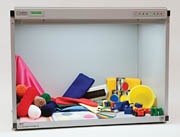
Color is an ever-present measure of quality, even in a subliminal sense. Whether it be automobiles, food, appliances, toys, etc. we perceive quality by the color of the product and how well the colors cover and match. If an automobile is repaired after an accident, do we first judge the quality of the repair job by the structure of the new part or its metal composition, or do we judge it by how well the color of the fender was matched to the door and hood? Unless the fit is horrible, the vast majority of people will judge the color first.
Too often in color, the lighting environment is taken for granted. We see a light source as "white" and are not concerned with its actual spectral output. If it appears white, it is white and therefore will render colors properly. Or so many people think. In actuality what we call "white light" can have heavy biases toward the red, yellow, green or blue portions of the spectrum. Unless viewed in conjunction with each other, we perceive all of them as "white light." But the human eye integrates the information too easily, and therein lies our problem. Because the eye adapts so well to the various white light sources, it does not take into account the color reflectivity differences of the various objects we see. When it comes to color matching, this can be a very big problem.
Seeing Color
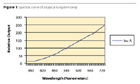
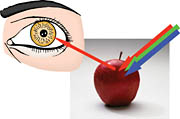
To see color we need an observer, an object and light. If the light is a true white light source, all the primary colors (red, green and blue) are reflected back as the sample dictates. We see an apple as red because it absorbs all colors but red, which is reflected to our eye. Yellow objects reflect both red and green, white objects reflect all colors, while black reflects no light (not to be confused with the gloss of a sample, which reflects a specular or mirror image of the light source). Unfortunately, the light we use to view an object has a large effect on how we see it. Taking a common "white light" source, such as a 100-watt tungsten light bulb, and viewing different shades of dark blue, we find it very difficult to judge small color differences. The tungsten lamp produces very little blue energy, as can be seen by the spectral curve of a typical tungsten lamp shown in Figure 1. Blue starts about 400 nm, green is about 500 nm and red starts at about 600 nm.If there is very little blue light coming from the light source, then there is very little blue light for the sample to reflect. The only thing worse would be to match two colors in complete darkness. You may find that the chances of a good color match are about the same!
Similar problems occur with various other light sources. The ability for a light source to render color well is rated on the Color Rendering Index, or CRI. A CRI of 100 is perfect, a CRI of 20 is very bad for evaluating color. Industry specifies a CRI of 90 or better for color evaluation applications. For color matching, another, more-stringent system is used to rate light sources.
If a light source has such a bias toward one color or another, why do we see white light? To live in a world of changing colors, the human visual system has adapted itself over thousands of years. We can see a piece of fruit in the yellowish light of early morning sun or at mid day when the quality of light is bluer, and still see a red apple. Even though colors shift under these different light sources, we can still see objects we need to see. But until recently, in an evolutionary sense, we have not had to actually match colors. And between then and now, we have become far more critical of color. Not only do we want the color to match between two painted parts, but also between fabrics, plastics, paint, etc. and under all light sources. And therein lies our biggest problem - it is called metamerism.
Metamerism is very well known in the world of color. Two samples, say one plastic, the other painted, may match in color under a specific light source, such as daylight for instance. But when another light source is used, incandescent for instance, the samples no longer match. The effect can be insignificant, or it can be dramatic. One thing is for certain, if the samples are of two different types, or the color is achieved using different dyes or pigments, there will be metamerism to some degree.
With this information now placed in front of us, it is easy to see why we need multiple-source lighting systems to properly view color. They allow us to determine metamerism and to confidently evaluate samples for color and color match under various light sources. So why aren't more people using them? Although used quite a bit, why do so many companies avoid the small expense of a lighting system? No company would think of going into business today without purchasing a computer. Why would a color-related company even think of trying to communicate color-related issues without first specifying the light sources the evaluations were or should be performed under?

Finding The Best Solution
Penny wise and pound foolish is an old English expression that still holds true today. Or could it be that the use and benefits of a visual color-matching system or light booth are just not fully understood? Perhaps both. The first is easy to refute. Most people look at the products they see for visual color matching and come away with the idea that there is only one source for them and that source sells an expensive product. In actuality there are many sources for light booths, and they come in various sizes and prices. The key is to know what you need. And the industry provides that information for us, if we know where to look.Industries have banded together, legally, for many years to come up with standardized product attributes. For instance, instead of buying tires for your Buick from GM alone, you can buy tires from virtually any manufacturer that makes tires because of standards. Tires are manufactured to specific size requirements. The rim type, size, height and width of a tire have all been standardized so tires from various manufacturers can fit a common or standardized rim. And the designations for these sizes have also been standardized so you can buy a tire from XYZ tire and from ABC tire, with the size and fit to the rim being the same.
Color technologies have also been standardized. The standard, ASTM D 1729-96 specifies the light sources to be used and minimum requirements for the daylight source to allow for effective color matching. The standard CIE/ISO 10526 describes standardized light sources. Table 1 contains a brief summary of the ASTM standard.
The important aspect to consider when looking for a quality light booth is whether it meets the specifications in the standard. Even if light booths of different technologies are used, if they meet the standards, the evaluation of samples within the booth will be the same. If the standards are met, then the differences in the light booths will only be the conveniences and features included with the specific light booth.
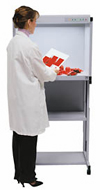
If the light booth meets the specifications, and there are a number that do, then the idea that light booths are expensive can be put to rest. Light booths that meet the specifications indicated above range in price from around $550 for the least expensive (and the smallest) to over $4,500 for the most expensive (but not the largest). It all depends on your needs and the size of the materials you are working with.
Color samples for paints, plastics and textiles such as let-down chips or spray out tests and other similar industry test samples are generally small, less than 3 inches square. For these applications, a small light booth, about 18 inches wide, will be the most practical solution for viewing color properly. This sized light booth will easily fit on a desk or credenza and be convenient for everyday use. They work as well in an office environment as they do in a lab. Controls on such booths are generally simple, using basic switches. Larger booths, up to 60 inches wide (152 cm) can include automatic sequencing systems to allow the user to pre-program a sequence of light sources. This helps to increase the efficiency and effectiveness of the visual color matching process or evaluation.
For even larger areas, most manufacturers offer their lighting systems as individual luminaires. These are suspended over a work surface. Although having the same features as the fixture on a booth, this option has the added benefit of allowing a company to create large custom viewing environments or rooms. Some systems can even link a controller luminaire to a series of satellite luminaires, allowing one controller to switch the lamps on all the luminaires. Using the luminaire approach does require the user to create their own standard surround condition. Walls and viewing surfaces must all be of the proper color, a neutral gray, commonly designated as "Munsell N7". Although it would seem that getting the right shade of paint would be easy, to get a truly neutral color gray, having no metameric effects, is not easy. Generally it cannot simply be found at the local paint store. One source for the paint is GTI Graphic Technology, of Newburgh, NY. The company can supply paint in the required Munsell N7 shade, in quart and gallon containers. It also sells complete light booth systems in various sizes.
Light Booth Maintenance
A light booth for color-matching and evaluation applications needs to be maintained differently from the conventional general lighting fixtures we find in the home or office. There are two basic attributes that need to be maintained - light intensity and color quality output. Maintenance does not have to be expensive, but it depends on the system you have. Systems that use older filter technology are the most expensive to maintain. These use high-intensity filament-type lamps and special glass filters, which change over time, actually becoming denser or bluer. To maintain proper color quality, the filters must be changed periodically. A filter set can cost over $700, and then the booth needs to be calibrated afterward to make certain it is within the original specifications. The cost of such a calibration, with filters and relamping other sources, can be well over $2,000. If filters are not needed, then you can subtract this expense. Calibrations usually need to be performed yearly to meet ISO 9000 conformance.On the other side of the cost spectrum there are light booths that use modern fluorescent technology. Fluorescent lamps have come a long way since they were first introduced over 60 years ago. Full-spectrum lamps are now available that offer cool and efficient light output, consistent color quality and require much less maintenance than their filter technology counter parts. The cost to relamp is generally less than $300 for the largest booths. Certified relamp kits, which include all the lamps within a booth and a Certificate of Conformance, are also offered by manufacturers such as GTI Graphic Technology, Inc., for only $100 more.
Other than relamping and calibration, booth maintenance includes making certain the reflectors are cleaned of dust and dirt that can accumulate over time. For some environments, where there is a great deal of dust in the environment (e.g., powder coating operations, paper making, printing press and textiles manufacturing operations) may require more frequent cleaning of the fixtures to ensure proper light and color output.
Communication is Key
Now with the two most common myths of standardized lighting put to rest, why companies still don't obtain and use a light booth is a mystery. Those that do finally install one find the experience liberating. When combined with the use of a light booth at their supplier or customer, the experience is almost enlightening. Where before supplier and customer would argue over what each was seeing, now they are able to specify a light source under which to view the sample and make their decisions accordingly. They can communicate far more effectively than they were able to in the past. Just having one booth in a company will help people understand what their supplier or customer is seeing. But like any tool, it must be used, and used properly. The higher the position of the person evaluating the sample, it seems, the less they feel they need a light booth. They are experienced, or are just too busy. But if truly experienced, they would know that experience cannot compensate for the physics of reflected light. You cannot make quality judgments on something you cannot see! As for too busy, are they too busy to make the product over? Too busy to save the expense of a wrong decision? There are many excuses for not using a light booth, or not using one properly. But if used regularly and used properly, each time a color decision needs to be made, the light booth will end up ¬paying for itself, many times over. Users that stop making the excuses and stop using the light booth only "when necessary" will benefit greatly from applying this discipline. And they will feel better for it. It's like the old joke, "Why do I keep hitting my head against the wall? Because it feels so good when I stop!"
References
- Resources on the Internet from GTI Graphic Technology, Inc. "Typical Procedure For Performing A Color Match With Standardized Lighting".
- "Various Light Sources and Their Use in Color Matching Applications". www.gtilite.com/ gti-technote-archive.htm.
Looking for a reprint of this article?
From high-res PDFs to custom plaques, order your copy today!