Inside the AI Shift in Coatings
Insights from the CTT Summit Keynote Panel

- How coatings manufacturers are using AI today to accelerate formulation, testing and scale-up decisions.
- What data foundations are required before AI can deliver value in coatings R&D.
- How AI tools are supporting knowledge transfer as experienced chemists retire.
- Where AI is improving productivity in formulation, tinting and additive development workflows.
- How companies are addressing data security, IP protection and private AI models.
- Why speed, internal data and recent experimentation are becoming key competitive differentiators.
For nearly a decade, the coatings industry has been preparing for an AI-driven future. Manufacturers built digital business units, appointed chief digital officers, migrated to cloud tools and invested in structured data systems long before artificial intelligence became mainstream. But at the 2025 Coatings Trends and Technologies (CTT) Summit, something felt different. After years of planning, theorizing and incremental progress, the industry finally had real, ground-level examples of AI in action.
“After all the discussions we’ve had about digitalization since 2016, this panel feels like we’re closing the loop,” said moderator Kristin Johansson, associate publisher and global sales manager of PCI. “We now have case studies showing what AI can do inside real labs.”
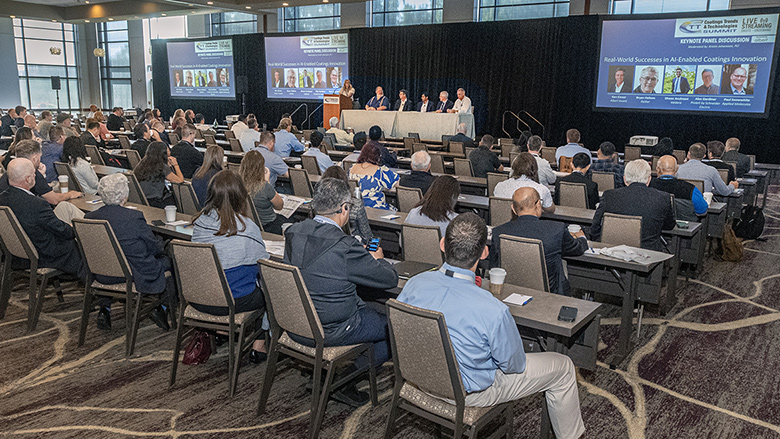
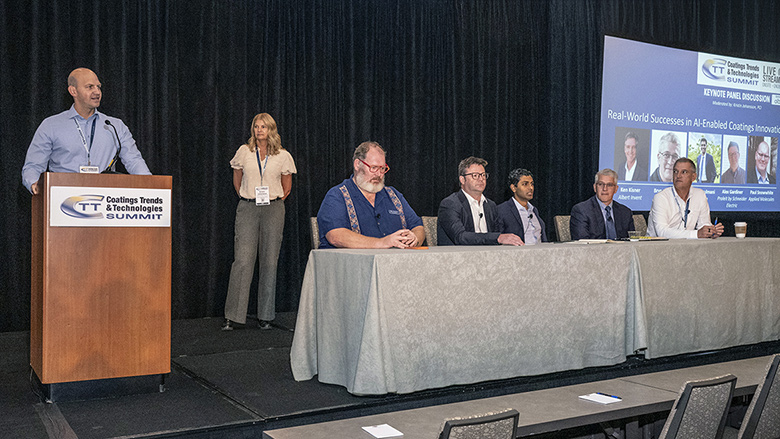
The keynote panel gathered five leaders shaping AI adoption across the coatings value chain:
- Ken Kisner, chief operating officer, Albert Invent
- Bryan Haltom, business manager, industrial colorants and additives, DyStar
- Dheev Arulmani, co-founder and chief operating officer, Valdera
- Alex Gardiner, software solutions sales executive, Proleit by Schneider Electric
- Paul Snowwhite, chief executive officer, Applied Molecules


What followed was one of the most substantive discussions the CTT Summit has hosted. It was an unfiltered look at what AI can do today, what it cannot, where companies are finding value and how the industry must prepare for the years ahead.
The Data Foundation: Where AI Actually Begins
The panel opened with a universal truth: no AI initiative succeeds without a strong data foundation. But what that foundation looks like varies from company to company.
Snowwhite described founding his first company out of frustration with inaccessible lab data. “I was frustrated trying to find data in my own laboratories,” he said. “Once we digitized, I realized how much efficiency came from simply having everything accessible. That foundation is what makes AI useful today.”
Kisner reinforced the idea that data must be structured across multiple layers. “You need a system of record for your materials, experiments and results,” he said. “On top of that sits the system of intelligence with your models and analytics. And on top of that is the system of work—where agents can perform tasks automatically as new data comes in.”
Arulmani emphasized urgency over perfection. “Perfection is the enemy of progress,” he said. “If you wait for the perfect dataset, you’ll never start. Your competitors won’t wait.”
As Kisner put it, “Your most valuable data is the data you didn’t collect today.”
That reality is already changing lab behavior. Panelists described scientists becoming more motivated to quantify results, capture subjective observations with metrics and record more detail in digital systems as they see how better data leads directly to better AI outcomes.
Overcoming Skepticism: Bringing People Along
Fear remains a major barrier to adoption.
“Half the chemists want to get started. Half are scared,” Kisner said. “Senior management worries about making the wrong investment. But at every level, education helps people understand that AI is an assistant. It does not replace them.”
 Credit: Robert Levy Photography
Once teams see even one clear win, momentum builds quickly. Encouragement, training and internal champions play an outsized role in early adoption.
Haltom shared how DyStar’s use of AI began not as a formal corporate initiative, but through one senior leader experimenting independently. “He created his own custom GPT and brought it into the lab,” Haltom said. “We tried it, and that was the tipping point. A single champion made all the difference.”
Real Use Cases: Where AI Is Delivering Results
The strongest portion of the discussion centered on tangible use cases. These projects moved beyond theory into measurable outcomes.
DyStar: Accelerating Defoamer Development
Haltom described a breakthrough that surprised even his team. DyStar spent nearly a year working on a new organically modified silicone defoamer, repeatedly reaching dead ends despite extensive synthesis work.
When the company introduced a custom GPT trained on polymer chemistry, progress accelerated. “Our synthesis chemist started generating structures he never would have arrived at otherwise,” Haltom said. “Within four months, after a year of minimal progress, we had some of the best candidates I’ve ever seen.”
 Credit: Robert Levy Photography
Reliability came from a continuous feedback loop, with experimental results fed back into the system so the model learned from validated outcomes.
Proleit by Schneider Electric: Transforming Automotive Tinting
Gardiner shared an application involving a large Indian automotive paint manufacturer. Traditionally, tinting required five to 10 iterations of drying, curing and testing.
“We built an AI tool that analyzes a wet sample without drying or curing,” Gardiner said. “It compares it to reference material in the database and suggests adjustments in seconds.”
The result was an 11% increase in productivity and a significant reduction in production bottlenecks.
Applied Molecules: AI as an Advanced DOE Engine
For Snowwhite, AI represents an evolution rather than a disruption.
“DOE might have been the Model A,” he said. “Now we have a Tesla.”
Applied Molecules uses AI to blend historical datasets, evaluate variables and accelerate both lab work and scale-up. In 3D printing materials, application data such as printer parameters and post-processing conditions are now incorporated directly into models.
“We solve the same problems as before,” Snowwhite said. “We just solve them faster.”
Valdera: AI-Driven Sourcing Intelligence
Arulmani described a use case outside the lab with direct implications for innovation: raw material discovery.
“We built AI trained specifically on suppliers, chemical specifications, formulation capabilities, production scale and market intelligence,” he said. “It helps companies find suppliers, qualify materials and understand risk far faster than humans can.”
This approach is particularly valuable in an industry defined by opacity, NDAs and overlapping supplier-customer relationships.
The Hard Part: Security and IP Protection
One of the most pointed moments came from the audience when a PPG representative raised concerns about exposing proprietary data to public AI tools.
“We’re not going to point something like ChatGPT at our NDA-controlled data,” the attendee said. “How are you protecting IP?”
Kisner said data security is central to every deployment decision. “You should own your encryption keys,” he said. “Vendors should not have access to your data unless you choose to share it.”
 Credit: Robert Levy Photography
Arulmani stressed the importance of understanding how models are trained. “The model you train internally becomes your IP,” he said. “You must ensure your data is not being used to improve a model that other customers can access.”
Snowwhite described a hybrid approach at Applied Molecules, where public AI tools are used only for already-published information. “Our proprietary R&D data stays in a private system,” he said. “It never becomes public.”
Talent in the AI Era: Retention and Knowledge Transfer
AI is not replacing chemists. In many cases, it is making technical roles more attractive.
“Our customers found that removing repetitive QC steps made technicians happier,” Gardiner said. “They stay longer because their jobs are more interesting.”
Kisner noted that younger chemists expect digital-first environments. “They grew up with smartphones,” he said. “A paper notebook is not how they want to work.”
He also highlighted AI’s role in knowledge transfer. At a previous organization, thousands of iPads were deployed alongside a digital R&D platform, allowing new chemists to access institutional knowledge immediately.
“With AI layered on top, they can find the right expert faster,” Kisner said. “It dramatically shortens the learning curve.”
Snowwhite added that AI-native environments are increasingly important for attracting talent. “It’s getting close to being as important as our location near the beach,” he said.
Competitive Advantage in the AI Era
Several themes emerged as panelists looked ahead.
Speed is becoming a differentiator. “Our customers want fast answers,” Snowwhite said. “If AI gets us there sooner, that’s the edge.”
Recent data matters more than legacy data. “What you created 10 years ago matters less than what you created in the last year or two,” Snowwhite said.
 Credit: Robert Levy Photography
Internal know-how is the real competitive edge. Kisner warned that general tools like ChatGPT can already generate basic paint formulas. “Everyone has access to global knowledge,” he said. “Your advantage is your internal data and how quickly you can use it.”
Kisner also described a future where regulatory intelligence is automated. Albert Invent has digitized hundreds of regulatory lists and built rule sets around them. “If a regulation changes, AI can flag at-risk products and even suggest compliant alternatives,” he said.
Advice for Companies Starting Their AI Journey
In a rapid-fire closing round, moderator Kristin Johansson asked each panelist to share one piece of advice for companies just beginning to adopt AI.
Snowwhite: Start with good data. Digitize everything, including R&D work, raw materials and measurements. Build teams with people who understand both the chemistry and the technology, and treat adoption as a step-by-step journey.
Haltom: Identify a champion. Put a curious stakeholder in the driver’s seat, let them work with a small team and focus on tangible projects that can show value quickly so others can see what is possible.
Arulmani: Start small and build momentum. Don’t wait for perfect data. Pilot something, learn from it, then iterate, because perfection can slow progress.
Gardiner: Crawl, walk, run. Aim for a couple early wins, then evangelize those results internally so the organization can connect AI to real outcomes.
Kisner: Stop the data leakage first. Focus on capturing today’s experiments in a structured way, then triage legacy data over time.
A New Era Begins
If the coatings industry spent the last decade preparing for AI, the next decade will be defined by how effectively companies use it. From accelerating formulation cycles to transforming supply chains to automating regulatory compliance, AI is no longer an exploratory tool. It is a competitive necessity.
The panelists agreed on one thing: coatings companies that digitize now, experiment now, and learn now will set the pace for the entire market.
And as Johansson closed the session, she reminded attendees that the conversation is far from over. “This is just the beginning,” she said. “AI is going to shape everything we do in the coatings world.”
The full keynote panel discussion “Real-World Successes in AI-Enabled Coatings Innovation,” from the 2025 Coatings Trends & Technologies Summit is available to watch as part of the CTT On-Demand series.
This discussion highlights how artificial intelligence is influencing business strategies, formulation workflows and data management across the paint and coatings industry.
Looking for a reprint of this article?
From high-res PDFs to custom plaques, order your copy today!