
Data, AI and the Future of the Coatings Industry
Steps Toward a Smart Paint Factory

Credit: metamorworks / iStock via Getty Images Plus
Artificial intelligence is currently omnipresent—in the media, at conferences, in politics and in the business environment. The advent of ChatGPT has generated significant public attention, even though artificial intelligence has existed for almost seven decades and is established as a field of computer science research.
In 1956, scientists from computer science, linguistics and philosophy coined the term "artificial intelligence" as part of the "Dartmouth Summer Research Project on Artificial Intelligence." At its core, the aim was to create machines that could demonstrate human abilities, such as reasoning, learning and processing language.
Since 1956, artificial intelligence has made significant progress, now used for applications like autonomous driving and the automated processing of credit card applications.
Can We Use AI for Making Better Decisions?
In their 2014 book, The Second Machine Age, Andrew McAfee and Erik Brynjolfsson put forward the thesis that the next industrial revolution will come from artificial intelligence.¹ Today, it seems we may already be in the middle of this revolution.
One thesis is that human decisions are flawed, especially in complex situations. The authors refer to the work of Daniel Kahneman and Amos Tversky, who pointed to many cognitive biases in their distinction between two systems in human decision making.² System 1 represents fast, intuitive decisions, while System 2 represents slow but careful decisions. Cognitive biases, such as a preference for negative news over positive news, often influence decisions.
In highly complex situations, computers can better evaluate data, identify trends, or detect anomalies. However, some scientists consider human intuition to be superior and question the theory of two decision-making systems. The following statements are general rules of thumb for decision making:
- In predictable situations with foreseeable risks, machines can outperform humans at making decisions. Example: evaluating X-rays in medicine.
- In unpredictable situations with high uncertainty, humans can judge better than machines. Example: an unforeseen negative campaign against a company.³
One of the most important disciplines of artificial intelligence is machine learning. “Deep learning” is based on artificial neural networks modeled after the brain’s structure. Neural networks are trained by showing the machine numerous examples, such as traffic signs displaying the speed limit (a process called “labeling”). With more examples, AI can calculate a probability, like determining the current speed limit as 70 miles per hour. However, algorithms can still make mistakes if presented with unfamiliar variations.
FIGURE 1 | Traffic sign on which the speed is not displayed in black and white, but vice versa. The AI cannot recognize it because it has only been trained for black and white.

Today’s artificial intelligence capabilities are impressive, but essential factors for its effectiveness, such as data availability, are often underestimated. Generally, it is estimated that 80% of an AI application’s success depends on data quality and quantity. ChatGPT, for example, was trained on hundreds of billions of words.⁴ However, it’s important to avoid the assumption that more data guarantees better results; success requires a deliberate and outcome-focused approach.
How AI Relates to the Coatings Industry
Artificial intelligence, like automation, is aimed at increasing productivity. In the coatings industry, we struggle with challenges such as raw material availability and quality, lengthy production and development processes and a shortage of skilled workers. A long-term vision might include “next day delivery,” where a paint factory can convert customer requests into products quickly and flexibly, compensating for raw material market volatility. This model was launched in 2022 with the “Smart Paint Factory Alliance” initiative (www.smartpaintfactory.com).
Currently, industry decision makers are overwhelmed by promises of AI’s potential. However, discussions should focus on outcomes rather than hype. AI is a tool, not a goal, though it has substantial potential in areas like research and development, production and quality control. For many companies, implementing AI is limited by messy or incomplete data.
A common misconception is that implementing AI is simple:
FIGURE 2 | The wrong assumption about how AI can be used with data.

In reality, data must first be prepared, transformed and supported by infrastructure—an “extract, transform, load” (ETL) process known as data engineering. Even the best data scientists are limited if they can’t access the data.
Likewise, the most powerful software cannot function if viscosities are measured with a stopwatch or production weights aren’t digitally recorded. Data engineering knowledge is rare, especially in small and medium-sized companies. Designing an AI system is akin to constructing a factory: input (raw materials) and output (finished product) are only as effective as the throughput (production process).
FIGURE 3 | The missing link between data and AI—data engineering.

Starting at the data level, we find some industry areas are not sufficiently prepared. Many laboratory measurement methods are analog or rely on Excel, and isolated solutions need integration. For instance, historical data from the 1990s, like automotive multiangle spectrophotometer values affected by contact pressure, may be unreliable for AI use.
Paint production faces similar issues; many production units lack digital data. Choices, like dissolver disc selection, are listed in production rules but not logged. Often, current consumption in milling processes and actual substance weights aren’t recorded.
Another issue is insufficient data on raw materials. Some coatings industry raw materials are poorly described, with limited or nonstandardized safety data sheets.
Practical Solutions for Research, Development and Production
In research and development, traditional measurement methods, which may be too inaccurate or insufficiently digitized, should be supplemented with newer methods, like digital paint color measurement or rheometers. Data engineering improves internal communication, while data quality and robust data pipelines are keys to success. Once these are in place, appropriate software solutions can be developed or integrated.
In production, solutions like automated weighing cells can record raw material weights digitally.
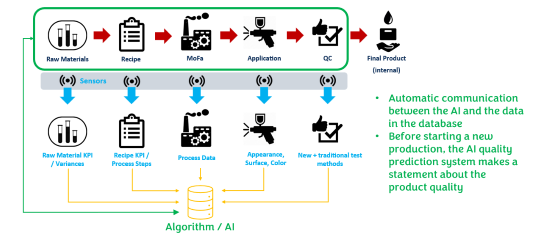
However, more data isn’t always beneficial. Another AI strategy involves reducing complexity, such as through a “modular factory,” where components (e.g., binder modules, master batches, slurries) are produced within tight tolerances in a compact, highly digitized and automated unit. One provider developed an AI solution predicting end-product quality with 89% accuracy based on raw material data.
FIGURE 4 | The landscape of an AI solution for paint production—modular factory in the center and a data-capturing system with a machine learning application.
Source: www.hemmelrath-technologies.de
Data Sharing and Moving Forward
In the realm of raw materials, closer collaboration with manufacturers could allow for more transparent data sharing. Chemical products often experience quality fluctuations, and knowledge of these can impact production processes. For instance, pigment changes can inform tinting paste production adjustments, while application properties knowledge can help paint shops optimize processes.
The Smart Paint Factory Alliance supports “data sharing.” While intellectual property concerns remain, technologies like the Digital Product Passport in Europe allow secure data exchange.5
Monetizing data exchange is another consideration.⁶ If downstream cost advantages arise, why not place a value on the data upstream? This approach could accelerate progress toward the “next day delivery” goal.
References
1 McAfee, A,; Brynjolfsson, E. (2014). The Second Machine Age. New York: W. W. Norton & Company.
2 Kahneman, D. (2011). Thinking, Fast and Slow. New York: Farrar, Straus and Giroux.
3 Gigerenzer, G. (2023). The Intelligence of Intuition. Cambridge, UK: Cambridge University Press.
4 Ng, A. (2024). www.coursera.org. Retrieved from Coursera: https://www.coursera.org/learn/ai-for-everyone
5 Europeam Union, P. O. (2024, September 27). European Data. Retrieved from European Union: https://data.europa.eu/en/news-events/news/eus-digital-product-passport-advancing-transparency-and-sustainability
6 Daniel Trauth, T. B. (2023). The Monetization of Technical Data. Heidelberg, Germany: Sprigner-Verlag GmbH.
Looking for a reprint of this article?
From high-res PDFs to custom plaques, order your copy today!