

Insights into Exterior Architectural Coating Degradation: Bridging Accelerated and Natural Weathering
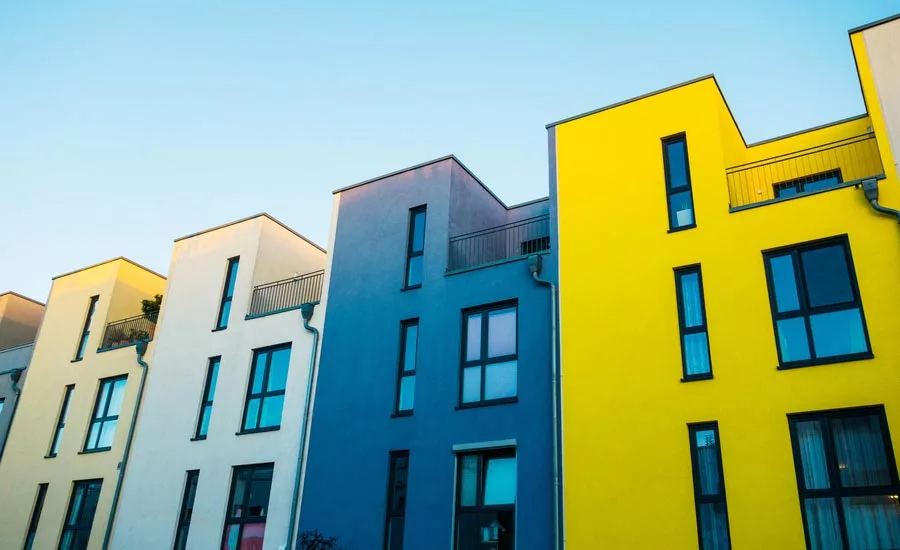
Durability is a crucial property of exterior architectural coatings, as these coatings are designed to protect and enhance the appearance of buildings over extended periods. However, durability is continuously challenged by exposure to environmental stressors, including — but not limited to — ultraviolet radiation, moisture, and temperature fluctuations. These factors can induce chemical and physical changes in the coating, leading to issues such as color fading, gloss loss, dirt pick-up, cracking, and microbial growth (Figure 1). The mechanisms behind these forms of degradation are multifaceted and depend on environmental conditions: UV light can degrade organic components within the coating; moisture can leach protective additives; pollution can deposit additional material on the surface; and temperature swings can cause mechanical stress. Furthermore, regional variability in real-world exposure makes it difficult to universally predict and optimize coating performance.

Figure 1. Exterior paint coatings are exposed to weather conditions that challenge their durability. Varying environmental conditions affect properties such as chalking, cracking, blistering, color fade, and gloss loss while also exacerbating dirt pick-up and mildew growth. Image: Dow.
The durability of exterior architectural coatings can be evaluated by natural or accelerated weathering. Natural (or exterior) weathering is the optimal method to determine durability of a paint, as it captures the full complexity of environmental influences. However, this approach is time-consuming and may take years to reveal certain durability properties such as color fade.
To simulate long-term exterior exposure in a shorter timeframe, accelerated weathering tests — such as QUV and Weather-Ometer — have been used. These tests simulate harsh conditions using cycles of ultraviolet light, moisture, and temperature in a compressed timeframe. While significantly reducing time needed to assess durability, the results may not always accurately reflect real-world conditions, leading to potential discrepancies between predicted and actual performance. Variations in substrate, UV spectrum, moisture levels, temperature, and the absence of real-world variables such as dirt can contribute to some of the discrepancies revealed. Despite these limitations, accelerated weathering tests remain valuable tools for initial screening and comparative analysis of exterior coatings. Additional research aimed at leveraging detailed insights from accelerated weathering tests to better predict natural weathering performance is crucial for developing durable exterior coatings.
Tools and Techniques
This study explores paint film degradation through accelerated aging to better understand the relevant degradation mechanisms and improve long-term performance. A comprehensive array of analytical tools and techniques was employed to investigate the degradation of paint films. A fully formulated blue semigloss exterior paint containing RHOPLEX™ Acrylic Resin-recognized for its durability-was aged for 4,500 hours of QUV exposure. This method simulates UV radiation and moisture through cycles of 8-hour UV exposure followed by 4-hour condensation.
- X-ray Photoelectron Spectroscopy (XPS) for elemental surface analysis
- Scanning Electron Microscopy (SEM) for surface morphology and topography
- Energy-Dispersive X-ray Spectroscopy (EDS) for elemental analysis
In addition to these techniques, color change (denoted by ΔL*) and gloss measurements at 60° were systematically recorded using spectrophotometry to monitor visual and reflective changes over time. These methods enabled the identification of degradation mechanisms and helped correlate surface changes with gloss and color loss.
Elucidation of Degradation
The exterior architectural paint subjected to accelerated aging exhibited distinct degradation behaviors. Comprehensive analysis provided valuable insights into changes in surface morphology and elemental composition over the course of the exposure. Initially, the paint maintained stable color and gloss until 750 hours, at which point noticeable degradation began. This was evidenced by an increase in lightness ΔL* and a substantial drop in gloss. The color continues to change for over 4,500 hours during accelerated weathering by lightening in color indicated by the increase in L*. However, no additional significant drops in gloss were observed after 750 hours.

Figure 2. Top row: Color change (ΔL*) and gloss of coating during accelerated aging. Bottom row: X-ray photoelectron spectra of C, Si, Ti, and Al of coating during accelerated aging. Source: Dow.
The visual changes in the film during degradation were characterized in relation to the elemental composition and surface morphology of the coating. The carbon, silicon, titanium, and aluminum content at the surface were tracked using XPS. Carbon was monitored to assess the erosion of organic material at the surface, while silicon, titanium, and aluminum content indicated inorganic components at the surface such as titanium dioxide (TiO2). During the first 500 hours of aging, a slight decrease in carbon and an increase in silicon were observed. Between 500 and 750 hours the carbon content increases while the silicon content exhibits a sharp decrease. After 750 hours the carbon content continuously decreases. Additionally, the titanium and aluminum content start to increase. Silicon signal continues to decrease until 2000 hours when it increases again. To compliment the elemental analysis provided by XPS, SEM was used to provide insight into surface morphology and topography. Titanium dioxide (TiO2) was evident by the small bright spots in the micrographs. Over the course of aging, SEM revealed an increase in the number of TiO2 particles near the surface. Additionally, between 500 and 750 hours the surface roughness increases and spherical pits are observed. Some of the pits contained a particle beneath the surface potentially serving as a starting site for pit formation.

Figure 3. Top row depicting scanning electron micrographs of the coating during accelerated aging. Bottom row: Scanning electron micrographs of the same area showing pitting and particles found beneath the pits at 750 hours. Right bottom image: Beam deacceleration showing surface topology. Left bottom image: No beam deacceleration showing underlying particles. Image: Dow.
The detailed elemental analysis suggests three distinct aging time zones. The initial phase (Zone 1) is characterized by a decrease in carbon signal due to the loss of organic material, and an increase in silicon signal, likely from material migrating to the surface or being revealed as the organic material degrades. SEM images confirm the increased presence of TiO2 particles on the surface with prolonged accelerated aging, consistent with the trends observed in the XPS data. As degradation progresses into the middle phase (Zone 2), a decrease in silicon signal, an increase in carbon signal, and an increase in L* are observed. The emergence of spherical pits between 500 and 750 hours of exposure correlates with the step-change decrease in gloss, followed by a plateau in gloss, as the surface roughness increases and individual pits become less distinct. The emergence of pits centered around underlying particles provides an explanation for observed variations in silicon and carbon signals during aging. In the final phase (Zone 3), the carbon signal continues to decline significantly, while titanium, aluminum, and silicon signals increase-indicating continued organic material degradation and exposure of titanium dioxide at the surface. These detailed observations underscore the complex interplay between particle composition, surface morphology, and aging behavior in the coatings studied. The findings in this simplified system not only enhance our understanding of the mechanisms driving surface degradation but also provide valuable guidance for the development of more durable coatings.

Photo: ImageDesign / Adobe Stock
Implications for Natural Weathering
In parallel with the examination of accelerated weathering, the same paint was exposed at an exterior exposure site for one year to enable comparison. On exterior exposure, the paint was applied to a wooden board positioned facing south at a 45-degree angle. The southern exposure at an angle maximizes the amount of sunlight the paint receives and is considered a harsher natural condition than what an exterior coating might typically experience on a building. Additionally, the coating experiences a full range of temperatures and humidity throughout the year in contrast to accelerated weathering. The wooden board is also a different substrate than the accelerated weathering, which is an aluminum panel. Comparative analysis revealed that one year of natural exposure more closely aligned with aging seen at 2,000 hours or more of QUV accelerated weathering, based on SEM and EDS analysis. Micrographs and elemental analysis revealed greater TiO2 on the surface in natural exposure as compared to accelerated exposure. Notably, no pits were observed on the naturally weathered surface-one of the early indicators of degradation seen in accelerated aging under the studied conditions. One complicating factor in natural weathering was the presence of dirt on the surface. This was evident in the change in color, which revealed a darkening of the surface, and in SEM micrographs, which revealed large particles on the surface not previously present in the accelerated weathering analysis. The impact of dirt on color, gloss, and overall durability of the coating remains a critical consideration when correlating accelerated aging results with real-world exposure.

Figure 4. Natural weathering of the coating after one year of exposure. Changes in color are depicted, along with scanning electron micrographs taken after one year. Energy-dispersive X-ray spectroscopy of titanium content is shown for the sample after one year of exterior weathering and after 1,000, 2,000, and 2,500 hours of accelerated weathering. Source: Dow.
The study underscores the complex interplay between elemental, morphological, and visual changes of an exterior architectural coating during aging. The assessment of a coating’s durability is further complicated by difference between natural and accelerated aging conditions. While accelerated weathering revealed three distinct degradation zones based on elemental and morphological changes, further research is needed to better correlate these findings with natural weathering conditions. Understanding the predictive capability of accelerated testing- particularly in identifying early-stage degradation markers-is essential for improving durability screening methods. Future efforts will focus on expanding the formulation space to include different colorants and sheens to determine the translatability of observed degradation mechanisms across different coating types.
Looking for a reprint of this article?
From high-res PDFs to custom plaques, order your copy today!