Closed-Loop Recycling

While the coatings industry has dedicated a great deal of research, wealth and commitment to developing environmentally acute products, the industry’s innovative formulations continue to be packaged in containers that create waste. In the stirring of an uncertain economy and planet, there is an opportunity for paint manufacturers to generate savings and reduce packaging costs that will affect not only their environmental footprint but also their bottom line.

Examining the Current Life Cycle of the Traditional Paint Container
The measurement of one’s sustainability is largely weighed in the Life Cycle Analysis (LCA) and environmental footprint throughout the development, manufacturing and finality of one’s product and/or service. While Figure 1 is not specific to paint containers or plastic, the elements are similar. When you measure the virgin inputs against the emissions and offsets, recycling is the only solution that omits N2O, CO2 and CH4 emissions and actually offsets fossil fuel use and increases forest carbon sequestration.LCAs characteristically become an “end of life” flow chart. The allowance of recycled content in packaging credits the virgin inputs, which dramatically increases the environmental value of the package and therefore the product. However, the general life cycle of a 100%-recycled paint container designed for recyclability is a continuous loop, allowing for minimal virgin inputs, minimal disposal and fractional greenhouse gas (GHG) affects. The largest factor in securing the circle is the manufacturer’s commitment to work with retailers, consumers and reprocessors to reclaim the containers and prepare them properly for recycling. Closed-loop recycling proves that a recyclable product is essentially a sustainable product.
While most municipal waste and recovery facilities agree that paint makes up the “largest volume waste collected by metropolitan household hazardous waste (HHW) programs”,2 it is common myth that used paint and the containers cannot be recycled and therefore the only disposal option is to landfill. While the EPA has recognized that latex paints are non-hazardous,2 the inevitable hazard of household paint is the contamination of residuals with mixed stream recycling programs, and thus many waste handlers determine latex paint and their containers as landfill only.
Despite the aggressive markets for plastic scrap, millions of gallon and five-gallon plastic containers that the coatings industry annually puts on the shelves and in the homes of American consumers are being buried, consuming natural resources and leaving the plastics industry starving for feedstock.
Two Industries Meet
Plastics recyclers all agree that their industry is starving for material.3 According to the Association of Post-Consumer Plastic Recyclers (APR), the plastics recycling industry operates at less than 70% capacity, the export markets are combating for material, and reclaimers are forced to source from all over the world while valuable material stateside is being shipped to China.4Simultaneously, as energy and material costs continue to rise, manufacturers are looking at their supply chains to reduce raw material and packaging material costs. In a Best Practices, LLC research and consulting project, a survey was conducted with executives and senior managers from 17 leading manufacturing companies representing the manufacturing, consumer products, chemical and energy industries, which included paint manufacturers. The metrics of the survey quantified that raw material, energy conservation and packaging costs were identified for cost reduction measures in order for the companies to remain competitive.5
The coatings industry continues to attribute uncontrollable packaging costs as a leading concern while improving its sustainability. Closed-loop recycling allows an industry to manage the quality, supply and cost of their raw materials.
The Value of Used Plastic Paint Containers
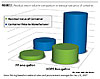
Each plastic paint container has a price tag, not simply going to the fill-line but coming off the store shelves. The plastics scrap market follows the trends of the prime markets. Looking at historical pricing and trade indexes such as ChemData, the shifts in market value for plastics are visible but steady. Recycling allows manufacturers to control raw material and packaging costs by not contributing to the volatile market conditions of prime resin.As with all traditional commodities, plastics are driven by demand. Plastics recyclers are ready and willing to pay fair market value for properly returned used paint containers. When the average cost of containers is compared to the residual value of the used container, the container’s packaging costs shows significant reduction. The residual value, should the container be reclaimed and processed properly for recycling, can account for over 30% of new container costs (Figure 2).
How Closed-Loop Recycling Works
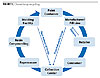
The key to a successful closed-loop system is a careful analysis of the existing logistics infrastructure and distribution patterns of the product. Paint manufacturers wanting to reclaim used containers will experience the most success by identifying and implementing reclamation opportunities within their internal organization. The recycler should supply specifications and simple guidelines in preparing the containers for efficient transport and processing.While most material will be generated from post-consumer programs, it is worth noting that scrap containers at any stage in the process can be sent directly to the reprocessor to enter the closed-loop system, thus eliminating container waste at the molder, manufacturer, distributor and retailer operations (Figure 3).
Case Studies in Closed-Loop Recycling
While the idea of assigning a value to a used container and calling for consumer action to return containers may seem all but improbable for coatings, the concept has been proven to work with great success in several other industries.In 1981, KW Plastics began a recycling program for automotive battery casings. The program was developed not necessarily to divert the casings from landfill but as a financially viable solution. The recycled resin was comparable to its virgin counterpart but of course with the economic advantages. Resin was sold back to the battery case molders and thus, a closed-loop recycling system was created. The automotive battery manufacturers quickly recognized the value of the recycled resin, and within five years a second plant was established to better serve West Coast customers’ demand. Subsequently, more than 80% of the battery casings circulating throughout the nation are recycled and made with KW Plastics resin.
Exchanging an old car battery for a new one is a common practice for today’s consumer, and an incentivizing deposit program further drives participation. At over 98%, today’s automotive batteries have the highest recycling rate of any commodity and the process remains a basic closed-loop system. The concept today is a common practice, with an extremely high success rate in spite of the idea being totally revolutionary less than 30 years ago.
Closed-loop recycling is making its way into other sectors such as e-waste, particularly ink cartridges. Consumers are given a direct opportunity from the brand owner to send the cartridges back for recycling. The result is an increase in green visibility with both their consumers and retailers while a steady incoming source of quality material has allowed the manufacturer to use recycled content, thus reducing their carbon footprint, and reducing their material costs.
Similar to the paint containers, ink cartridges and car batteries are not curbside-friendly recyclables. In spite of that, the manufacturers and brand owners proactively educated and partnered with their customers to reclaim, recycle and reuse their valuable packaging materials. As a result, the automotive battery and ink cartridge manufacturers have controlled their raw material quality and costs while offering their consumers a green alternative.
How Packaging Scorecards Will Affect the Coatings Industry
Retailers are now becoming more interested with the dynamics of packaging waste and looking at opportunities for savings. It is no secret that the millions of barrels of oil, trees, fuel and other natural resources all have an associated fiscal value. While the message is to reduce waste and footprints, the spreadsheets are proving the unquestionable reduction in packaging costs.Since Wal-Mart announced its commitment to reduce its packaging waste 5% by 2013, the Packaging Scorecard has become an immediate challenge and goal for consumer packaged goods (CPG) suppliers. Through the scorecard, vendors have learned that environmental savings create economic ones as well.
While the majority of the coatings industry is not directly involved in Wal-Mart’s sustainable scorecard initiative, the impact is resonating with retailers across the globe. As the green trend becomes more prominent, all manufacturers of consumer goods will be responsible and accountable to their customers and their retailers for the affects of their packaging choices.
Closed-Loop Recycling
Environmental Rewards and OpportunitiesThe environmental benefits of recycling are widely attributed to the conservation of natural resources. However, the EPA attributes recycling to not only protecting but strengthening the environment through climate change, energy savings and GHG/CO2 reduction, air emissions and water impacts.
When compared to production of virgin material, plastics’ recycling offers a net reduction in GHG emissions, which allows for tremendous credit in life cycle analysis and assessments of environmental footprint and stewardship.
Economic Rewards and Opportunities
The green savings that closed-loop recycling provides are not only environmental but also economic. The sum of reducing packaging costs and disposal costs, plus the residual value of recycled containers, amounts to a significant increase in profitability for the coatings industry.
Companies all over the globe realize that implementing methods to reduce their environmental impact accounts for significant positive impact to their bottom line. In fact, Wall Street has validated that sustainable management systems are of great value and great investment to our economy. The Dow Jones Sustainability Indexes (DJSI) were launched in 1999 to track the financial performance of the leading sustainability-driven companies worldwide and provide asset managers with benchmarks to manage sustainability portfolios.6
The DJSI is comprised of more than 300 companies that represent the top 10 percent of the largest 2500 companies from the Dow Jones World Index with the greatest social and environmental commitments. The DJSI, reviewed annually, consistently outperforms the Dow Jones World Index as well as others. The result is that the investment community validates that sustainable businesses are consistently financial successful which coincidentally affects consumer and employee evaluations.
The Future of Recycling for the U.S. Coatings Industry
Product Stewardship, National Post-Consumer Paint Management SystemIn harmony with the sustainability movement, the development of a paint recycling program for the United States is under assessment. The National Paint & Coatings Association (NPCA) has announced support and plans to work towards a Nationally Coordinated System for Post-Consumer Paint Management as part of the Paint Product Stewardship Initiative.
The NPCA has been engaged in dialogue relative to a national post-consumer recycling program, prompted by the Product Stewardship Institute (PSI) since 2003. Surveys have identified post-consumer waste as a top concern to state and local agencies. An EPA study estimated that approximately 10% of the 637 million gallons of paint sold annually becomes leftover paint, equal to about 64 million gallons per year.
As a result of the surveys and ongoing discussions, PSI convened a national dialogue, “the Paint Product Stewardship Initiative” (PPSI), which brings together EPA, recyclers, retailers, state and local governments and paint industry representatives.7 Currently, NPCA and PPSI have launched a pilot program in Minnesota as a statewide demonstrating project for managing post-consumer paint.
The Product Care model in Canada is one that NPCA and PPSI are exploring within the Minnesota project. Product Care is a non-profit organization, funded by their membership. The Canadian government requires that all companies that produce, brand or sell architectural paints must be a member of a product stewardship organization. Product Care members include retailers, manufacturers and brand owners. The members pay a fee per unit to Product Care, based on self reporting.
Product Care uses their money to maintain their operations in collecting, shipping, preparing and marketing the containers. They do not expect to make money and in fact, according to Mark Kurschner, Product Care President, “the residual paint has a negative value.” Currently, Product Care incinerates polypropylene containers for energy recovery.8
While these current projects only target the collection of diversion of post-consumer paint product rather than packaging in their programs, obviously the containers are additional byproduct of the waste streams. Recyclers are optimistic that should a national program to collect post-consumer paint be established, the program would acquire the critical mass of paint containers that could readily be prepared for recycling.
The infrastructure, technology, capacity and model for closed-loop recycling exists within the recycling industry; one must ask “why only reclaim and recycle paint, why not the containers as well?”
While paint manufacturers may find initial worth in allowing post-consumer paint management system(s) to supervise container reclamation, the restored value of the containers would be lost to the manufacturers. Closed-loop recycling encourages manufacturers to take advantage of the value in their own containers.<
Conclusion
Paint manufacturers must examine their packaging choices and realize the full value of their containers and the existing markets that have strong demands for their used containers. The coatings industry has the opportunity to control the life cycle of their paint containers while reducing cost and increasing profitability.Striving to be sustainable requires evaluation of the social, economic and environmental challenges and rewards of your packaging, product, processes and management. Closed-loop recycling has proven to be a sensible solution in the search to find sustainable packaging for the paint and coatings industry.
This paper was presented at the American Coatings Conference, Charlotte, NC, June, 2008.
Looking for a reprint of this article?
From high-res PDFs to custom plaques, order your copy today!