Painting & Coating Industry (PCI) logo Powder coating summit logo
search
cart
facebook twitter linkedin youtube
  • Sign In
  • Create Account
  • Sign Out
  • My Account
Painting & Coating Industry (PCI) logo Powder coating summit logo
  • NEWS
    • Latest News
    • Market Trends & Reports
    • Finishing News
    • Price Alerts
    • Subscribe to Newsletters
    • Global Top 10/ PCI 25
    • Weekly Featured Article
    • COATLE Word Game
  • PRODUCTS
    • Product News
    • Must See Products and Services
  • MATERIALS
    • Additives
    • Resins/Polymers
    • Pigments
    • Equipment
    • Distributors
  • TECHNOLOGIES
    • Adhesives
    • Architectural Coatings
    • Finishing Articles
    • Finishing Technologies
    • Finishing Equipment
    • Industrial Coatings
    • Nanotechnology
    • Powder Coatings
    • Solventborne
    • Special Purpose Coatings
    • Sustainability
    • UV Coatings
    • Waterborne
  • RESOURCES
    • Columns
      • Did you know?
      • Distribution Dive
      • Formulating With Mike
      • Innovation Insights
      • Powder Coating Perspectives
      • TiO2 Insider
    • Blogs
      • Editor's Viewpoint
      • Industry Insights
    • Coatings Supplier Handbook
    • Podcasts and Videos
      • COAT-IT! Podcast
      • Videos/PCI TV
    • PCI Store
    • Classifieds
    • eBooks
    • Sponsor Insights
    • White Papers
    • COATLE Word Game
  • EVENTS
    • Coatings Trends & Technologies Summit
    • Paint and Coatings Academy
    • Webinars
    • Calendar of Events
    • Lifetime Achievement Award
  • DIRECTORIES
    • Buyer's Guide
    • Equipment Directory
    • Materials Directory
  • EMAGAZINE
    • Current Issue
    • eMagazine Archive
    • China Issue Archive
    • Editorial Advisory Board
  • CONTACT
    • Contact Us
    • Advertise
    • Subscribe to eMagazine
    • Subscribe to Newsletters
  • SIGN UP!
Sponsored By
Siltech
Paint and Coating Resins & Polymers
Siltech logo
Siltech

Siltech develops, manufactures and markets a full line of unique organo-functional silicones. With over 35 years of experience, and two manufacturing facilities, we offer a broad portfolio of silicones.
        

The Fourth Dimension of Silicon: Siltech Q Resins

digital pigments
sankai / E+ via Getty Images
September 1, 2025

Silicone, or PDMS, is a linear, two-dimensional polymer. This well-known, widely used substance is a very low Tg liquid that is insoluble in both oil and water. Silicone materials typically impart wetting, shine, softness, and release when used in a formulation. They also impart flexibility, softness, haptic properties, and low surface energy to the network when reacted with another polymer.

In silicone chemists’ jargon, the end units of these silicones are M groups and the middle, repeat units are D groups. Other Si-O bond species are T and Q moieties. A pneumonic device for remembering the labels is that they refer to the number of Oxygen atoms attached to the Silicon atom. So, M and D refer to mono and “di” Oxygen bonds while the T and Q have three and four Oxygen bonds respectively.

In the CASE industry, we are also very familiar with T groups. Most often found in the guise of trialkoxy organofunctional silanes, these are used to improve adhesion. This is especially common when bonding organic and inorganic substances. The silane works by reacting some of the three Si-O bonds with the mineral-like species and the organofunctional groups with the organic substance. These are also commonly used to stabilize mineral dispersions, and to modify polymers providing enhanced properties from increased cross-link density. Other applications exist for trialkoxysilanes, but they all rely on the reactivity of the T group.
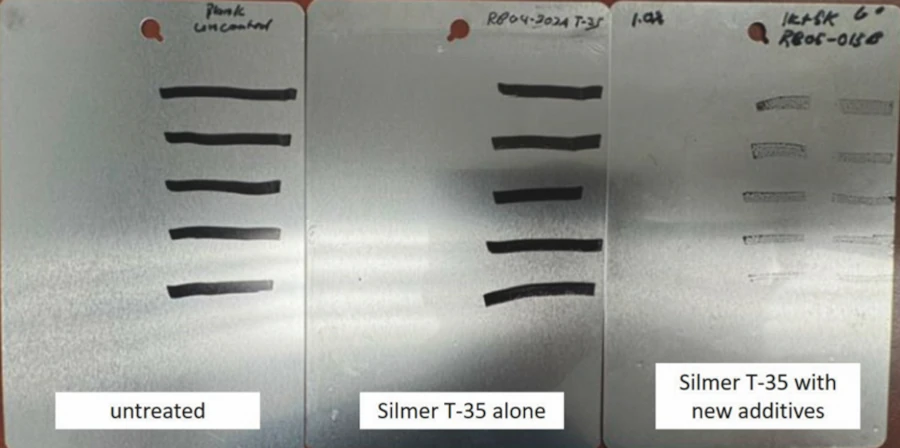
Silmer TMS polymers
Comparison of untreated vs. Silmer polymers Courtesy of Siltech

At Siltech we have a line of Silmer TMS polymers that are silicones modified with a trialkoxy silane either at the ends of the polymer or in the repeat units. These materials provide unique characteristics including secondary cure, stain repellence, and in some cases oil repellence. When combined with silicas super hydrophobic properties were observed. To read a good overview of these “evolved silanes” see Dr. Mike Gunther’s overviews on our website.

Less well known are species that have a high degree of Q character. This Q group is a structural unit in which the Si atom is bonded with all four bonds to Oxygen. Unlike the more easily accessible T networks, networks formed with a lot of Q character tend to be reasonably stable to hydrolysis and other reactions. It is one way to obtain much of the performance of a silicone without the ease of hydrolysis, which sometimes causes problems in a formulation.

These Q-based species have been used for years, but often travel incognito and in small percentages. MQ resins, in which the Q network is terminated with trimethylsiloxy groups have been used extensively for feel, transfer resistance, and cushion in cosmetics as well as anti-squeak and lubrication in industrial applications. Another very big application has been in antifoam compounds that require a high level of durability such as pulp and paper, laundry, and chemical processing applications. In these applications, the chemical stability of the MQ resin is a critical property to its success.

We at Siltech have spent years developing reproducible processes to make various Q resins that contain M, D and/or T groups. Unlike silicones, these materials are not allowed to react to a thermodynamic energy minimum. Instead, they are kinetic products and the rigor and precision of the process are critical to the reproducibility and consistency of the final product. In other words, these are tricky to make and difficult to copy.

After developing the processes, we searched for unique properties and applications of these materials. We have found that when used in a mixture, these Q resin species provide exceptional water repellence, stain repellence, release properties, and in some cases, oil repellency. They also provide tear resistance and strength when reacted into another resin system. This is often a complement to the properties brought by reacting two-dimensional silicones into a resin network.

As an example, using MDTQ resins in silicone networks such as elastomers, or sealants can restore some of the inherent deficiencies of these systems. Specifically, Silmer VQ and Silmer H resins systems are available with vinyl groups and Si-H bonds respectively. When used in addition cured elastomers these tend to bring strength and tear resistance. While silica can also do this, the Q resin approach works at lower use levels and retains the transparency of the final product.

Most recently and in the context of developing PFAS alternatives, we have been experimenting with the idea that these T and especially the Q containing resins can self-assemble and react in place providing super-hydrophobic properties. A succession of observations in which monofunctional Q resins or difunctional silicones gave oleophobicity led us to the theory that these species are assembling.
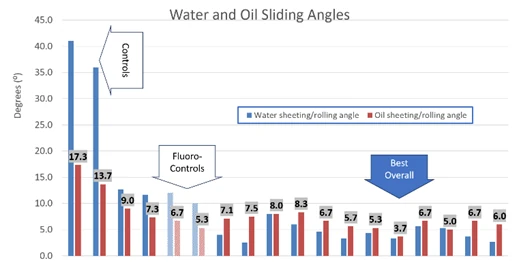
Water and Oil Sliding angles
Water and Oil Sliding angles Courtesy of Siltech

Very recent work has included a difficult to manufacture type of monofunctional silicone locked into Siltech T35, a Q resin matrix. This system has shown significant improvements in the receding contact angles of mineral oil as well as very good marker release over a fluorosilicone control.  

Future work will continue to improve on oleophobicity by fine-tuning this assembly approach. If you are interested in more detail, please contact us or come to see John Grande, one of our chemists, who is presenting this work at the Coatings Trends and Technologies Summit and the Western Coatings Symposium.

KEYWORDS: PFAS silicone silicones

Share This Story

Looking for a reprint of this article?
From high-res PDFs to custom plaques, order your copy today!

Recommended Content

JOIN TODAY
to unlock your recommendations.

Already have an account? Sign In

  • pci1022-Kinaltek-Lead-1170.jpg

    A Novel Pigment Production Technology

    Following an extensive R&D program that demonstrated...
    Paint and Coating Pigments
    By: Jawad Haidar and Nitin Soni
  • pci global top 10

    2025 Global Top 10: Top Paint and Coatings Companies

    The following is PCI’s annual ranking of the top 10...
    Global Top 10 and PCI 25
    By: Courtney Bassett
  • 2025 pci 25

    2025 PCI 25: Top Paint and Coatings Companies

    PCI's annual ranking of the top 25 North American paint...
    Global Top 10 and PCI 25
    By: Courtney Bassett
Manage My Account
  • eMagazine
  • Newsletters
  • Online Registration
  • Subscription Customer Service


Sponsored Content

Sponsored Content is a special paid section where industry companies provide high quality, objective, non-commercial content around topics of interest to the PCI audience. All Sponsored Content is supplied by the advertising company and any opinions expressed in this article are those of the author and not necessarily reflect the views of PCI or its parent company, BNP Media. Interested in participating in our Sponsored Content section? Contact your local rep!

close
  • colorful building exterior
    Sponsored byDow

    Insights into Exterior Architectural Coating Degradation: Bridging Accelerated and Natural Weathering

  • digital pigments
    Sponsored bySiltech

    The Fourth Dimension of Silicon: Siltech Q Resins

Popular Stories

Company News

What the AkzoNobel–Axalta Merger Means for the Future of Coatings

AkzoNobel and Axalta Headquarters

AkzoNobel and Axalta Announce $25 Billion Merger

Wacker logo

WACKER Plans More Than 1,500 Job Cuts


PCI Buyers Guide

Submit a Request for Proposal (RFP) to suppliers of your choice with details on what you need with a click of a button

Start your RFP

Browse our Buyers Guide for manufacturers and distributors of all types of coatings products and much more!

Find Suppliers

Events

September 4, 2025

N-Butylpyrrolidone (NBP) as a Green Solvent to Replace N-Methylpyrrolidone (NMP) in Industrial Coating Applications

ON DEMAND: EPA published a regulation proposal around N-methylpyrrolidone (NMP) in June 2024 to ban or limit NMP in many applications, such as paints and coatings and their removers. N-butylpyrrolidone (NBP) is a powerful and versatile solvent for a variety of industries looking for alternatives to substance of very high concern (SVHC)-listed solvents.

March 24, 2026

The Manufacturing & Automation eXchange (MAX)

MAX presents a rare opportunity to observe the full scope of manufacturing in one environment. From systems integration and materials handling to automation, quality, safety, and packaging, each discipline is represented through live, operational displays. By experiencing these technologies side by side, as they are on actual production floors, attendees gain a grounded understanding of how manufacturing functions align, overlap, and evolve in practice.

View All Submit An Event

Poll

Longest-running laboratory experiment

What is the longest-running laboratory experiment?
View Results Poll Archive

Products

Automotive Paints and Coatings, 2nd Edition

Automotive Paints and Coatings, 2nd Edition

Now in its second edition and still the only book of its kind, this is an authoritative treatment of all stages of the coating process.

See More Products
pci voices from the top ebook

PCI webinar
×

Keep the info flowing with our eNewsletters!

Get the latest industry updates tailored your way.

JOIN TODAY!
  • RESOURCES
    • Advertise
    • Contact Us
    • Directories
    • Store
    • Want More
  • SIGN UP TODAY
    • Create Account
    • eMagazine
    • Newsletters
    • Customer Service
    • Manage Preferences
  • SERVICES
    • Marketing Services
    • Reprints
    • Market Research
    • List Rental
    • Survey & Sample
  • STAY CONNECTED
    • LinkedIn
    • Facebook
    • Youtube
    • X (Twitter)
  • PRIVACY
    • PRIVACY POLICY
    • TERMS & CONDITIONS
    • DO NOT SELL MY PERSONAL INFORMATION
    • PRIVACY REQUEST
    • ACCESSIBILITY

Copyright ©2025. All Rights Reserved BNP Media.

Design, CMS, Hosting & Web Development :: ePublishing