Painting & Coating Industry (PCI) logo Powder coating summit logo
search
cart
facebook twitter linkedin youtube
  • Sign In
  • Create Account
  • Sign Out
  • My Account
Painting & Coating Industry (PCI) logo Powder coating summit logo
  • NEWS
    • Latest News
    • Market Trends & Reports
    • Finishing News
    • Price Alerts
    • Subscribe to Newsletters
    • Global Top 10/ PCI 25
    • Weekly Featured Article
    • COATLE Word Game
  • PRODUCTS
    • Product News
    • Must See Products and Services
  • MATERIALS
    • Additives
    • Resins/Polymers
    • Pigments
    • Equipment
    • Distributors
  • TECHNOLOGIES
    • Adhesives
    • Architectural Coatings
    • Finishing Articles
    • Finishing Technologies
    • Finishing Equipment
    • Industrial Coatings
    • Nanotechnology
    • Powder Coatings
    • Solventborne
    • Special Purpose Coatings
    • Sustainability
    • UV Coatings
    • Waterborne
  • RESOURCES
    • Columns
      • Did you know?
      • Distribution Dive
      • Formulating With Mike
      • Innovation Insights
      • Powder Coating Perspectives
      • TiO2 Insider
    • Blogs
      • Editor's Viewpoint
      • Industry Insights
    • Coatings Supplier Handbook
    • Podcasts and Videos
      • COAT-IT! Podcast
      • Videos/PCI TV
    • PCI Store
    • Classifieds
    • eBooks
    • Sponsor Insights
    • White Papers
    • COATLE Word Game
  • EVENTS
    • Coatings Trends & Technologies Summit
    • Paint and Coatings Academy
    • Webinars
    • Calendar of Events
    • Lifetime Achievement Award
  • DIRECTORIES
    • Buyer's Guide
    • Equipment Directory
    • Materials Directory
  • EMAGAZINE
    • Current Issue
    • eMagazine Archive
    • China Issue Archive
    • Editorial Advisory Board
  • CONTACT
    • Contact Us
    • Advertise
    • Subscribe to eMagazine
    • Subscribe to Newsletters
  • SIGN UP!
Paint and Coating EquipmentIndustrial CoatingsFinishing Articles

Smarter Dust Collection for Safer Blast Rooms
By Brandon Acker, President, Titan Abrasive Systems
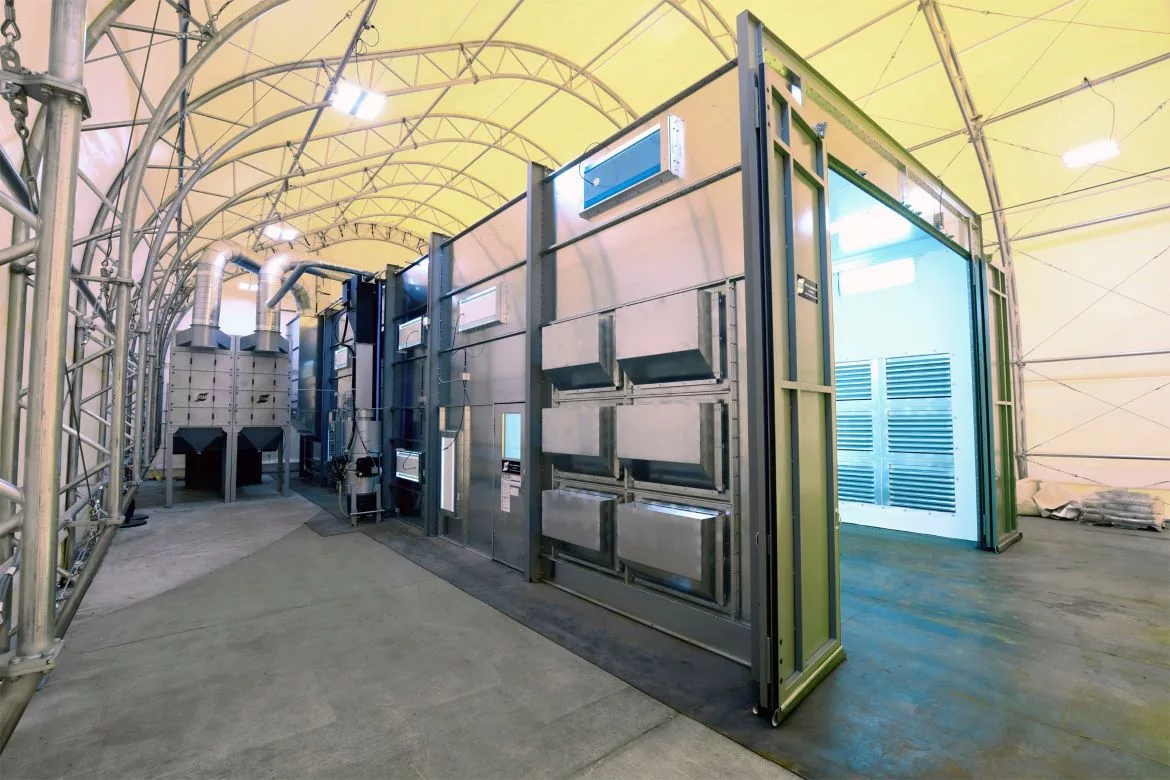
Titan Blast Room

Image courtesy of Titan Abrasive Systems. 

August 27, 2025

Abrasive blasting is a powerful surface preparation method used across industries, from aerospace to shipbuilding to automotive restoration. But as the uncle of the great Marvel superhero Spider-Man noted, “With great power comes great responsibility.” 

That responsibility involves protecting both people and equipment from the vast amounts of dust and airborne particulates generated by the abrasive blasting process. Consequently, a well-designed dust collection and ventilation system isn’t just a regulatory box to check: it’s an essential part of a safe and effective blasting operation.

Yet for all the complexity involved in selecting the right system, there’s surprisingly little detailed guidance available to shop owners and engineers. The following are eight of the most important considerations to keep in mind when evaluating dust collectors and ventilation setups for abrasive blasting rooms, helping you avoid costly mistakes, ensure peak performance, and protect the health and safety of your workers.

Know What You’re Working with – and On

The type of media used -- whether it’s steel grit, aluminum oxide, glass bead, or garnet -- plays a significant role in determining the quantity and characteristics of the dust generated. Some media, like silica-based sand (which is increasingly regulated), produce extremely fine dust that can pose serious respiratory risks. Others, like plastic media, may create lighter but still problematic particles.

In addition, the material being blasted (steel, aluminum, composites, or coated surfaces) will influence the kind of dust released during operations. For instance, coatings like lead-based paint or hexavalent chromium require specialized filtration to capture and safely contain toxic particulates.

Ultimately, your dust collection and ventilation system should be chosen based on both the media and the substrate. A system that works for steel blasting may not be sufficient for aluminum or coated surfaces.

Airflow is Critical

Effective dust collection hinges on airflow. You need a system that creates enough negative pressure to continuously pull dust away from the blasting area, but not so much that it stirs up turbulence and recirculates harmful particulates.

Typical airflow guidelines for blasting rooms fall between 50 and 100 feet per minute (FPM) of cross-draft velocity, depending on room size, media type, and production rate. The larger the room and the more aggressive the blasting, the more airflow required. Additionally, OSHA recommends a minimum of 100 cubic feet per minute (CFM) per square foot of booth face area for manual blasting operations.

Calculate your CFM needs based on the size of the blast room, the blasting media, and expected production rate. Undersized systems may lead to excessive dust buildup and significant health hazards.

Choose Your Dust Collector Wisely 

There are several types of dust collectors commonly used in abrasive blasting environments. Each comes with tradeoffs in performance, maintenance, and cost:

  • Cartridge Dust Collectors: These are compact, efficient systems using pleated filter cartridges to capture fine dust. They’re the most common type of dust collector used in abrasive blast rooms. Cartridge filters are easier and less time consuming to replace than bag filters. 
  • Baghouse Collectors: These use long fabric filter bags to collect dust and are most commonly found in woodworking and grain processing applications. They tend to have a larger footprint, due to the increased space required for the filter bags, and require more maintenance.  
  • Cyclone Collectors: Often used as a pre-filter, cyclones remove large, heavy particles before they reach the main dust collector, improving its lifespan and efficiency. For heavy-duty or continuous operations, a multi-stage system with a cyclone pre-filter and cartridge collector is often the best choice. 

Consider Automated Filter Cleaning

As dust accumulates on filters, airflow and suction power can drop, diminishing performance and raising the risk of airborne contaminants. Manual filter cleaning is not only time-consuming, but it can also expose workers to hazardous dust.

Systems with pulse-jet filter cleaning can automatically blow compressed air through the filters to keep them clean without interrupting operations. This feature greatly extends filter life and minimizes downtime, making it a smart investment for high-throughput blasting rooms. For these reasons, it’s advisable to look for systems with automated filter cleaning, especially for high-volume applications. 

Establish Proper Ventilation Flow

Dust collection alone isn’t enough; ventilation layout is equally critical. Poorly designed systems can create dead zones where dust lingers or flows back toward the operator. There are two common ventilation setups in blast rooms:

  • Crossdraft Systems: Air is introduced through inlets typically located in product entry doors or sidewalls at one end of the blast room and pulled out through exhaust ducts on the opposite wall. This creates a steady directional airflow across the room.
  • Full Downdraft Systems: Clean air is introduced through ceiling plenums and exits through floor-level grates or exhaust filters placed along the bottom of the sidewalls, carrying dust downward away from the operator’s breathing zone.

Downdraft systems offer superior air quality and dust removal but are more expensive to install and not commonly found in blast rooms.  

Account for Maintenance and Accessibility

Even the best dust collector won’t perform well if it’s difficult to maintain and/or hard to access. That’s why you should look for units with:

  • Easy access to filters.
  • Clear indicators for differential pressure or filter loading.
  • Convenient dust disposal systems, such as drum or hopper connections.

A system that’s easy to maintain is more likely to remain effective. Ask vendors about service intervals and routine upkeep requirements.

 Follow OSHA and NFPA Standards

Regulations governing abrasive blasting are strict, for good reason. Airborne particulates can contain hazardous substances, and dust accumulations can pose combustion risks. As a result, you should make sure that your system meets or exceeds:

  • OSHA standards for permissible exposure limits (PELs) to specific substances.
  • NFPA 484 and 654 for combustible dust control, especially when blasting materials like aluminum or magnesium.
  • EPA guidelines, if you’re venting to the outdoors.

Work with vendors who understand regulatory compliance. Don’t assume “off-the-shelf” systems meet the necessary safety standards. Some do, but many don’t -- and it might not be so easy to tell the difference. 

Think Long-Term: Scalability and Energy Efficiency

As your blasting operations grow, your dust collection needs may increase. Consider systems that can scale, either by adding more modules or expanding capacity. Energy efficiency should also be top of mind; look for systems with variable-speed drives, energy-efficient fans, and high-efficiency motors.

In other words, don’t just buy for today; buy for what your operation may look like five years from now and longer.

KEYWORDS: abrasion-resistant coatings abrasive equipment

Share This Story

Looking for a reprint of this article?
From high-res PDFs to custom plaques, order your copy today!

Brandon Acker, President, Titan Abrasive Systems

Recommended Content

JOIN TODAY
to unlock your recommendations.

Already have an account? Sign In

  • pci1022-Kinaltek-Lead-1170.jpg

    A Novel Pigment Production Technology

    Following an extensive R&D program that demonstrated...
    Paint and Coating Pigments
    By: Jawad Haidar and Nitin Soni
  • pci global top 10

    2025 Global Top 10: Top Paint and Coatings Companies

    The following is PCI’s annual ranking of the top 10...
    Global Top 10 and PCI 25
    By: Courtney Bassett
  • 2025 pci 25

    2025 PCI 25: Top Paint and Coatings Companies

    PCI's annual ranking of the top 25 North American paint...
    Global Top 10 and PCI 25
    By: Courtney Bassett
You must login or register in order to post a comment.

Report Abusive Comment

Manage My Account
  • eMagazine
  • Newsletters
  • Online Registration
  • Subscription Customer Service

More Videos

Sponsored Content

Sponsored Content is a special paid section where industry companies provide high quality, objective, non-commercial content around topics of interest to the PCI audience. All Sponsored Content is supplied by the advertising company and any opinions expressed in this article are those of the author and not necessarily reflect the views of PCI or its parent company, BNP Media. Interested in participating in our Sponsored Content section? Contact your local rep!

close
  • colorful building exterior
    Sponsored byDow

    Insights into Exterior Architectural Coating Degradation: Bridging Accelerated and Natural Weathering

  • digital pigments
    Sponsored bySiltech

    The Fourth Dimension of Silicon: Siltech Q Resins

Popular Stories

Company News

What the AkzoNobel–Axalta Merger Means for the Future of Coatings

AkzoNobel and Axalta Headquarters

AkzoNobel and Axalta Announce $25 Billion Merger

Wacker logo

WACKER Plans More Than 1,500 Job Cuts


PCI Buyers Guide

Submit a Request for Proposal (RFP) to suppliers of your choice with details on what you need with a click of a button

Start your RFP

Browse our Buyers Guide for manufacturers and distributors of all types of coatings products and much more!

Find Suppliers

Events

September 4, 2025

N-Butylpyrrolidone (NBP) as a Green Solvent to Replace N-Methylpyrrolidone (NMP) in Industrial Coating Applications

ON DEMAND: EPA published a regulation proposal around N-methylpyrrolidone (NMP) in June 2024 to ban or limit NMP in many applications, such as paints and coatings and their removers. N-butylpyrrolidone (NBP) is a powerful and versatile solvent for a variety of industries looking for alternatives to substance of very high concern (SVHC)-listed solvents.

March 24, 2026

The Manufacturing & Automation eXchange (MAX)

MAX presents a rare opportunity to observe the full scope of manufacturing in one environment. From systems integration and materials handling to automation, quality, safety, and packaging, each discipline is represented through live, operational displays. By experiencing these technologies side by side, as they are on actual production floors, attendees gain a grounded understanding of how manufacturing functions align, overlap, and evolve in practice.

View All Submit An Event

Poll

Longest-running laboratory experiment

What is the longest-running laboratory experiment?
View Results Poll Archive

Products

Automotive Paints and Coatings, 2nd Edition

Automotive Paints and Coatings, 2nd Edition

Now in its second edition and still the only book of its kind, this is an authoritative treatment of all stages of the coating process.

See More Products
pci voices from the top ebook

PCI webinar

Related Articles

  • EQUIPMENT: Guyson Introduces Dust Collector for Pressure-Blast Cabinets - Posted 1/16/07

    See More
  • Cartridge Filters for Dust Collection in Powder Coating

    Cartridge Filters for Dust Collection in Powder Coating

    See More
  • Titan Blast Room

    How to Kill a Blast Room in 7 Easy Steps

    See More

Related Products

See More Products
  • adhesives.jpg

    Adhesives for Wood and Lignocellulosic Materials

See More Products

Events

View AllSubmit An Event
  • March 19, 2025

    Revolutionizing Paints & Coatings: AI-Driven Innovations for Smarter Formulations

    On Demand Learn how to overcome challenges like balancing complex performance criteria, navigating regulatory constraints, and reducing experimental workload. Discover how leveraging the data you already have can optimize resources, cut costs, and streamline compliance.
  • October 30, 2025

    Novel Spherical Calcium Silicate Anti-Corrosion Pigment for Protective Coatings

    ON DEMAND: This presentation introduces a novel spherical calcium silicate as an effective anti-corrosion pigment for protective coatings. The modified spherical silica was synthesized using a unique patented manufacturing process, allowing to produce AC pigments with increased effectiveness for passivation, as well as easier and more even dispersion.
View AllSubmit An Event
×

Keep the info flowing with our eNewsletters!

Get the latest industry updates tailored your way.

JOIN TODAY!
  • RESOURCES
    • Advertise
    • Contact Us
    • Directories
    • Store
    • Want More
    • Manufacturing Division
  • SIGN UP TODAY
    • Create Account
    • eMagazine
    • Newsletters
    • Customer Service
    • Manage Preferences
  • SERVICES
    • Marketing Services
    • Reprints
    • Market Research
    • List Rental
    • Survey & Sample
  • STAY CONNECTED
    • LinkedIn
    • Facebook
    • Youtube
    • X (Twitter)
  • PRIVACY
    • PRIVACY POLICY
    • TERMS & CONDITIONS
    • DO NOT SELL MY PERSONAL INFORMATION
    • PRIVACY REQUEST
    • ACCESSIBILITY

Copyright ©2025. All Rights Reserved BNP Media.

Design, CMS, Hosting & Web Development :: ePublishing