Painting & Coating Industry (PCI) logo Powder coating summit logo
search
cart
facebook twitter linkedin youtube
  • Sign In
  • Create Account
  • Sign Out
  • My Account
Painting & Coating Industry (PCI) logo Powder coating summit logo
  • NEWS
    • Latest News
    • Market Trends & Reports
    • Finishing News
    • Price Alerts
    • Subscribe to Newsletters
    • Global Top 10/ PCI 25
    • Weekly Featured Article
    • COATLE Word Game
  • PRODUCTS
    • Product News
    • Must See Products and Services
  • MATERIALS
    • Additives
    • Resins/Polymers
    • Pigments
    • Equipment
    • Distributors
  • TECHNOLOGIES
    • Adhesives
    • Architectural Coatings
    • Finishing Articles
    • Finishing Technologies
    • Finishing Equipment
    • Industrial Coatings
    • Nanotechnology
    • Powder Coatings
    • Solventborne
    • Special Purpose Coatings
    • Sustainability
    • UV Coatings
    • Waterborne
  • RESOURCES
    • Columns
      • Did you know?
      • Distribution Dive
      • Formulating With Mike
      • Innovation Insights
      • Powder Coating Perspectives
      • TiO2 Insider
    • Blogs
      • Editor's Viewpoint
      • Industry Insights
    • Coatings Supplier Handbook
    • Podcasts and Videos
      • COAT-IT! Podcast
      • Videos/PCI TV
    • PCI Store
    • Classifieds
    • eBooks
    • Sponsor Insights
    • White Papers
    • COATLE Word Game
  • EVENTS
    • Coatings Trends & Technologies Summit
    • Paint and Coatings Academy
    • Webinars
    • Calendar of Events
    • Lifetime Achievement Award
  • DIRECTORIES
    • Buyer's Guide
    • Equipment Directory
    • Materials Directory
  • EMAGAZINE
    • Current Issue
    • eMagazine Archive
    • China Issue Archive
    • Editorial Advisory Board
  • CONTACT
    • Contact Us
    • Advertise
    • Subscribe to eMagazine
    • Subscribe to Newsletters
  • SIGN UP!

Successful Use of Fumed Silica in Liquid Systems

October 1, 2001
Hydrophilic and hydrophobic AEROSIL fumed silica grades are used in many liquid systems for viscosity control, anti-sag and anti-settling behavior, and for general rheological enhancement. To optimize efficiency and consistency of the behavior for all fumed silica grades, the following conditions are important for success.
    1. Finding desired addition level
    2. Applying proper dispersion
    • Equipment and design features
    • Tip speed considerations
    • Length of shearing time
    • Temperature build-up
    • Sequence of addition
    • Masterbatch vs. direct addition
    • Grind values vs. dispersion
    • Preventing under/over shearing
    3. Completing the formulation


Finding the Desired Addition Level

In non-polar to semi-polar systems, hydrophilic AEROSIL 130, 200, 300, 380 grades are used routinely for rheological improvement. In semi-polar to polar systems, hydrophobic AEROSIL R972, R974, R812, R812S, R202 and R805 grades are used. In many systems, hydrophobic grades are slightly less efficient but impart other properties to the film such as water resistance, improved leveling, and suspension of pigments with less viscosity increase and improved corrosion resistance.

Whatever the use, loading levels in most coating and ink applications are relatively low. In the final formulation, < 1.0% by weight (based on total system) is usually suggested as a starting point. Loading levels for anti-settling properties may approach 1.5% if the formulation contains high loadings of other pigments and heavy fillers. For adhesive and sealant applications, loading levels are typically higher, in most cases 4-8% by weight (based on total system), because the desired thickening and thixotropy is higher. The actual percentage is dependent on the initial viscosity condition of the system, the desired condition, the desired length of storage stability and the polarity of the final formulation. The optimum loading is determined by trial and error and is very system specific.

Courtesy of Degussa Corp.
Figure 1

Applying the Proper Dispersion

To maximize fumed silica efficiency and to ensure performance consistency, proper dispersion is required. Low shear dispersion with a propeller or stirring blade is insufficient shear for all AEROSIL grades and in general for all fumed silica. Peripheral velocity (tip speed) for this type of mixing is typically 5-20 ft/sec. At these rates, minimal energy is used to wet the fumed silica. Using this low shear rate, resulting thickening performance can be very inconsistent, batch-to-batch. Other results of low shear rate are loss of efficiency, whereby more AEROSIL fumed silica needs to be added, poor grind behavior, settling, and poor storage stability.

High shear dispersion (HSD) using an aggressive saw-tooth type blade is the minimum shear that is required for AEROSIL grades with surface areas of 90-200 (both hydrophilic and hydrophobic). Higher surface area fumed silica grades usually require more energy intensive equipment for optimizing dispersion. Peripheral velocity for HSD equipment should be more than 30 ft/sec. For most industrial applications, Degussa suggests tip speeds above 30 ft/sec (9-10 m/sec), for sufficient shear.
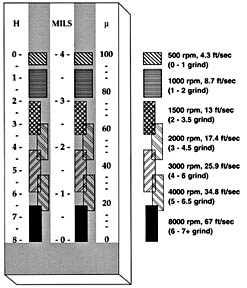
Courtesy of Degussa Corp.
Figure 2
A crucial aspect for adequate dispersion includes the blade:vessel ratio (see Figure 1). The blade:vessel diameter should be 1:2-1:3. With this ratio, a strong vortex should be observed straight down to the dispersing blade. When the ratio approaches 1:4, material often clings to the sides of the tank and a small vortex is noticed. When a vortex is observed, where only the shaft is visible, wet-in of powders takes longer. The blade should be positioned 0.5-1 D from the bottom of the mixing tank. The blade should be positioned where four mixing zones are created; the top two mixing zones are pulled down into the dissolver blade and the bottom two mixing zones are pulled up into the dissolver blade, according to INSCO Blade Shop literature. Blade sharpening and tightening of belts should be part of routine maintenance. Both contribute to efficiency and consistency of dispersion. It is also best to have an rpm/torque read-out on the equipment, instead of an variable resistor with arbitrary settings from 1-10. This is to ensure the shaft is revolving at the same shear rate batch to batch.

Courtesy of Degussa Corp.
Figure 3
High intensity mills, sand mills, media mills and roller mills are sufficient and suggested for high surface area AEROSIL (>300 m2/g grades) and for all applications requiring the highest thickening efficiency and anti-sag properties, best grind values and highest clarity. Performance of all fumed silica grades normally improves with increasing shear forces.

Length of dispersing time should be kept to a minimum to prevent excessive temperature buildup. For most systems, longer dispersing times result in lower mixing viscosity due to the higher mixing temperatures. Extended dispersion at higher temperatures (normally defined as 20degF higher than what is normal for the batch) may do more harm than good to most systems. This is due to higher temperatures resulting in faster wetting of pigments. This is an environment where overdispersion of fumed silica may occur.

Overdispersion results when fumed silica aggregates are broken down past an optimum aggregate size. Aggregates then become so homogeneously dispersed, that the distance between adjacent aggregates becomes too great, and aggregate-to-aggregate interaction is reduced. This results in a total loss of thickening and thixotropy. A normal observation by a plant worker may be that the batch went "water thin." This behavior may occur in manufacturing sites where time and temperature of batches are not frequently monitored and operators take extended breaks, leaving batches unattended.

Courtesy of Degussa Corp.
Figure 4
Optimum mixing time and temperature are system specific and must be established for each formulation. Results from testing show that once sufficient energy is put into the system (rpm/tip speed), processing time becomes less critical (see Figures 2-7). Also, slight changes in processing procedures or parameters have less of an impact on the consistency of the final product, with sufficient shear rate. When insufficient energy is put into systems, all changes in processing can drastically affect the efficiency of fumed silica and the consistency of the final product.

Specific time should be allotted for wet-in of fumed silica packed in paper bags. Wet-in time is considered the time required for the fumed silica to be wetted by the vehicle. At this stage, low shear mixing is often used. Once all the fumed silica is wetted (brought under the surface of the liquid), the mixing speed is increased and dispersion begins. Fumed silica should be wetted in as quickly as possible. It should be added into a vortex, with the mixer running at a slow speed. The time it takes bags to be broken and material wet-in can be operator dependent. Different operators can be faster or slower at this point. If time is not allowed for each of these periods, some batches may receive more or less dispersion time depending on the operator.

Courtesy of Degussa Corp.
Figure 5
The sequence of AEROSIL addition is crucial in many processes. Tests show that fumed silica should be one of the first components added, after the resin or vehicle is introduced into the batch vessel. Some resins show preferential wetting of fumed silica. In these cases, it is best to disperse fumed silica into the better wetting resin, then bring the rest of the formulation into this mixture.

In water-reducible systems, sequence of addition is especially crucial for hydrophobic AEROSIL grades. It is suggested that the fumed silica be added into the vehicle first, without the water adjustment. Once the fumed silica is wetted in, the other pigments, fillers and additives can be added. If water encapsulates unwetted hydrophobic fumed silica, further dispersion becomes very difficult.

Courtesy of Degussa Corp.
Figure 6
In emulsion systems, both AEROSIL 200 and R972 are successfully used for improving pigment suspension and anti-sag properties. Incorporation is suggested at the highest resin solids state, preferably higher than 38-40%. Incorporation of hydrophobic grades becomes very difficult once the resin solids drop below 30%. After wet-in and proper dispersion, final letdowns with water can be conducted.

Dispersion of fumed silica in the pigment grind portion is always recommended. Making concentrated masterbatches of AEROSIL fumed silica, pigments and fillers has proven to give the best long-term storage stability and higher overall thickening and thixtropy vs. direct addition into the letdown. We do not recommend that fumed silica be added into the letdown or as a post-add in powder form due to lower shear forces used for mixing. If post-adjustments are needed, it is suggested that users take a 5-gal pail of the final system, disperse fumed silica under HSD conditions in this vessel, then return this concentrate to the batch.

Courtesy of Degussa Corp.
Figure 7
Under-shear is more common than over-shear, due to inadequate energy input during the dispersing stage. However, as mentioned previously, over-shear may occur in cases where very long dispersing times are used or where very high temperatures in the process are generated, which gives added wetting characteristics to the resins. In these instances, more fumed silica is needed to increase rheology. Once over-dispersion has occurred, it is very difficult to "bring it back" without adding more fumed silica.

Completing the Formulation

After dispersion is complete, remaining components can be added under letdown or lower shear mixing conditions. At this point, necessary applications tests need to be conducted to ensure that the loading level and dispersion process was adequate to meet performance requirements. Long term stability testing is also needed to ensure a proper dispersion procedure is established. Poor long-term stability can be an indication that dispersion, loading level and/or sequence of addition have not been optimized.

For more information on fumed silica, contact Degussa Corp., Akron Technical Center, 3500 Embassy Parkway, Suite 100, Akron, OH 44333; phone 888/SILICAS; visit www.aerosil.com; or Circle Number 137.

Links

  • Degussa Corp.

Share This Story

Looking for a reprint of this article?
From high-res PDFs to custom plaques, order your copy today!

Recommended Content

JOIN TODAY
to unlock your recommendations.

Already have an account? Sign In

  • pci1022-Kinaltek-Lead-1170.jpg

    A Novel Pigment Production Technology

    Following an extensive R&D program that demonstrated...
    Paint and Coating Pigments
    By: Jawad Haidar and Nitin Soni
  • pci global top 10

    2025 Global Top 10: Top Paint and Coatings Companies

    The following is PCI’s annual ranking of the top 10...
    Global Top 10 and PCI 25
    By: Courtney Bassett
  • 2025 pci 25

    2025 PCI 25: Top Paint and Coatings Companies

    PCI's annual ranking of the top 25 North American paint...
    Paint and Coating Market Reports
    By: Courtney Bassett
You must login or register in order to post a comment.

Report Abusive Comment

Manage My Account
  • eMagazine
  • Newsletters
  • Online Registration
  • Subscription Customer Service

More Videos

Sponsored Content

Sponsored Content is a special paid section where industry companies provide high quality, objective, non-commercial content around topics of interest to the PCI audience. All Sponsored Content is supplied by the advertising company and any opinions expressed in this article are those of the author and not necessarily reflect the views of PCI or its parent company, BNP Media. Interested in participating in our Sponsored Content section? Contact your local rep!

close
  • colorful building exterior
    Sponsored byDow

    Insights into Exterior Architectural Coating Degradation: Bridging Accelerated and Natural Weathering

  • digital pigments
    Sponsored bySiltech

    The Fourth Dimension of Silicon: Siltech Q Resins

Popular Stories

Company News

What the AkzoNobel–Axalta Merger Means for the Future of Coatings

AkzoNobel and Axalta Headquarters

AkzoNobel and Axalta Announce $25 Billion Merger

Wacker logo

WACKER Plans More Than 1,500 Job Cuts


PCI Buyers Guide

Submit a Request for Proposal (RFP) to suppliers of your choice with details on what you need with a click of a button

Start your RFP

Browse our Buyers Guide for manufacturers and distributors of all types of coatings products and much more!

Find Suppliers

Events

September 4, 2025

N-Butylpyrrolidone (NBP) as a Green Solvent to Replace N-Methylpyrrolidone (NMP) in Industrial Coating Applications

ON DEMAND: EPA published a regulation proposal around N-methylpyrrolidone (NMP) in June 2024 to ban or limit NMP in many applications, such as paints and coatings and their removers. N-butylpyrrolidone (NBP) is a powerful and versatile solvent for a variety of industries looking for alternatives to substance of very high concern (SVHC)-listed solvents.

March 24, 2026

The Manufacturing & Automation eXchange (MAX)

MAX presents a rare opportunity to observe the full scope of manufacturing in one environment. From systems integration and materials handling to automation, quality, safety, and packaging, each discipline is represented through live, operational displays. By experiencing these technologies side by side, as they are on actual production floors, attendees gain a grounded understanding of how manufacturing functions align, overlap, and evolve in practice.

View All Submit An Event

Poll

Longest-running laboratory experiment

What is the longest-running laboratory experiment?
View Results Poll Archive

Products

Automotive Paints and Coatings, 2nd Edition

Automotive Paints and Coatings, 2nd Edition

Now in its second edition and still the only book of its kind, this is an authoritative treatment of all stages of the coating process.

See More Products
pci voices from the top ebook

PCI webinar

Related Articles

  • pci0810-Evonik-sm.jpg

    The Use of Aqueous Pre-Dispersed Fumed Silica to Improve Film Formation in Waterborne Coatings

    See More
  • pci0111-Nis-lg.jpg

    Current and Impending Developments in Silica Nanoparticle Use in UV-Curable Systems

    See More
  • GreenTechnologies-100560492.jpg

    Industry Leaders Join Task Force to Make Better Use of Unrecovered Polymers in Liquid Formations

    See More

Related Products

See More Products
  • durability.jpg

    Increasing the Durability of Paint and Varnish Coatings in Building Products and Construction 1st Edition

  • princ-&-apps-of-emulsion-po

    Principles and Applications of Emulsion Polymerization

  • corrosion of linings.jpg

    Corrosion of Linings & Coatings: Cathodic and Inhibitor Protection and Corrosion Monitoring

See More Products
×

Keep the info flowing with our eNewsletters!

Get the latest industry updates tailored your way.

JOIN TODAY!
  • RESOURCES
    • Advertise
    • Contact Us
    • Directories
    • Store
    • Want More
    • Manufacturing Division
  • SIGN UP TODAY
    • Create Account
    • eMagazine
    • Newsletters
    • Customer Service
    • Manage Preferences
  • SERVICES
    • Marketing Services
    • Reprints
    • Market Research
    • List Rental
    • Survey & Sample
  • STAY CONNECTED
    • LinkedIn
    • Facebook
    • Youtube
    • X (Twitter)
  • PRIVACY
    • PRIVACY POLICY
    • TERMS & CONDITIONS
    • DO NOT SELL MY PERSONAL INFORMATION
    • PRIVACY REQUEST
    • ACCESSIBILITY

Copyright ©2025. All Rights Reserved BNP Media.

Design, CMS, Hosting & Web Development :: ePublishing