Painting & Coating Industry (PCI) logo Powder coating summit logo
search
cart
facebook twitter linkedin youtube
  • Sign In
  • Create Account
  • Sign Out
  • My Account
Painting & Coating Industry (PCI) logo Powder coating summit logo
  • NEWS
    • Latest News
    • Market Trends & Reports
    • Finishing News
    • Price Alerts
    • Subscribe to Newsletters
    • Global Top 10/ PCI 25
    • Weekly Featured Article
    • COATLE Word Game
  • PRODUCTS
    • Product News
    • Must See Products and Services
  • MATERIALS
    • Additives
    • Resins/Polymers
    • Pigments
    • Equipment
    • Distributors
  • TECHNOLOGIES
    • Adhesives
    • Architectural Coatings
    • Finishing Articles
    • Finishing Technologies
    • Finishing Equipment
    • Industrial Coatings
    • Nanotechnology
    • Powder Coatings
    • Solventborne
    • Special Purpose Coatings
    • Sustainability
    • UV Coatings
    • Waterborne
  • RESOURCES
    • Columns
      • Did you know?
      • Distribution Dive
      • Formulating With Mike
      • Innovation Insights
      • Powder Coating Perspectives
      • TiO2 Insider
    • Blogs
      • Editor's Viewpoint
      • Industry Insights
    • Coatings Supplier Handbook
    • Podcasts and Videos
      • COAT-IT! Podcast
      • Videos/PCI TV
    • PCI Store
    • Classifieds
    • eBooks
    • Sponsor Insights
    • White Papers
    • COATLE Word Game
  • EVENTS
    • Coatings Trends & Technologies Summit
    • Paint and Coatings Academy
    • Webinars
    • Calendar of Events
    • Lifetime Achievement Award
  • DIRECTORIES
    • Buyer's Guide
    • Equipment Directory
    • Materials Directory
  • EMAGAZINE
    • Current Issue
    • eMagazine Archive
    • China Issue Archive
    • Editorial Advisory Board
  • CONTACT
    • Contact Us
    • Advertise
    • Subscribe to eMagazine
    • Subscribe to Newsletters
  • SIGN UP!
Paint and Coatings AdditivesArchitectural CoatingsWaterborne Coatings

New Janus Particle Additives

For Creating Novel, Water-Resistant and Self-Stratified Coatings
By Shan Jiang Ph.D., Yifan Li, Rebecca Mort
pci0421-Iowa-Lead-900.jpg
April 14, 2021

The coating industry has dramatically changed since the 1950s, when organic solvent-based coatings were gradually replaced with waterborne emulsion latex polymer coatings. Waterborne coatings offer great advantages for health and the environment, but still present challenges in terms of coating performance, including water resistance, stability and surface hardness. The major obstacles to overcoming these challenges lie within the contradictions of desired properties before and after drying. For example, it is beneficial for latex particles to be attracted to water (hydrophilic) to maintain a stable dispersion prior to applying a coating to a surface. However, the opposite is desired after a coating has been applied and dried, when water repellence (hydrophobicity) is required. Therefore, a solution that can create a hydrophobic surface after drying while remaining predominantly hydrophilic in dispersion is needed to make waterborne coating technology more versatile.

Another example is the influence of glass transition temperature of the resin (Tg). For improving the film formation during the drying process, low Tg is desired. However, for improving surface hardness after paint is dried, high Tg is required. One potential solution is to stratify a layer of high-Tg binder particles to the surface of the coating layer to boost the hardness, while maintaining the majority of the bulk binder particles with lower Tg for good film formation properties. The recent development of novel Janus particles additives offers promise of addressing these challenges through a unique self-stratification process.

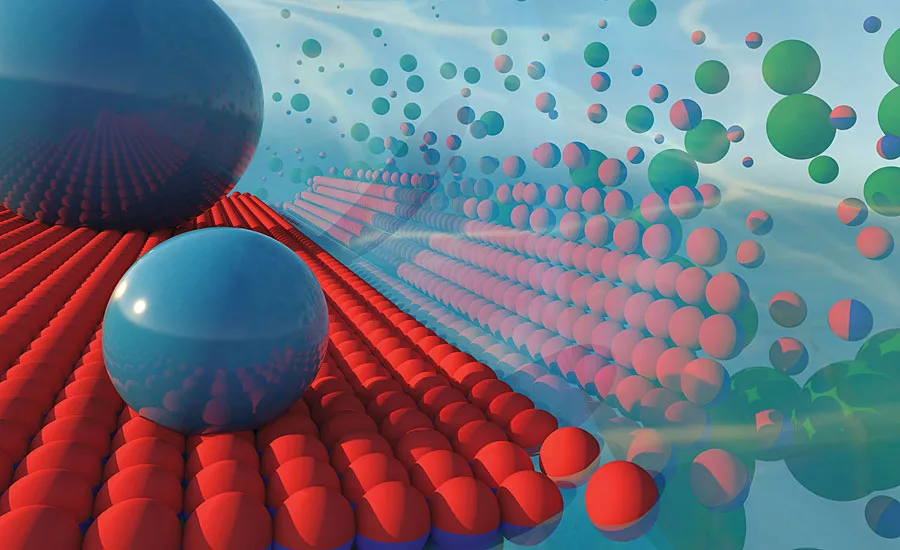
Recent research conducted at Iowa State University has developed an innovative coating additive made from amphiphilic Janus particles that can alter the surface properties of a waterborne coating system.¹ Janus particles are named after the ancient Roman god, having different chemical compositions on each side of a single particle. This means that one side of a particle is hydrophilic while the opposite side is hydrophobic. Figure 1 shows the Janus particle structure. When mixed with hydrophilic binder particles, the Janus particles rapidly migrate to the surface of a coating – a process called “active self-stratification.” Once stratified, the hydrophilic half of the Janus particles will continue to adhere to the binder that makes up the rest of the coating. The hydrophobic half then faces the air interface, creating a perfect monolayer on the surface of the dried coating. As a result, the surface of the coating has different properties (water resistance) than the bulk. Therefore, this new additive offers a cost-effective and scalable solution to directly alter the surface properties of a coating layer without changing the bulk materials. This will help address many of the challenges in the current waterborne coating technology.
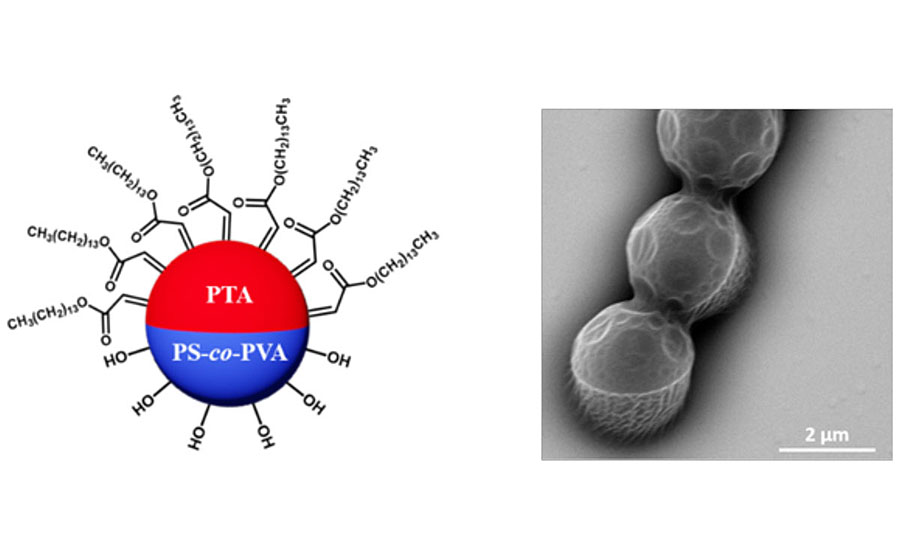
Illustration of Janus particle surface chemistry (left) and scanning electron microscope (SEM) image of Janus particles (right).
FIGURE 1 » Illustration of Janus particle surface chemistry (left) and scanning electron microscope (SEM) image of Janus particles (right).


Experiment

We discovered the unique “active self-stratification” behaviors of Janus particles and successfully created durable hydrophobic coatings. The novelty of our synthesis lies within the fine control over the Janus particle size and morphology by changing the solvent and surfactant concentration used for seeded emulsion polymerization, enabling us to obtain amphiphilic Janus particles with different sizes. Thus, when mixing Janus particle additives with binder particles or commercial primers, a self-stratifying effect is achieved. Janus particles vigorously accumulate at the air-water interface in fast kinetics, with their hydrophobic sides orienting towards air. Since the hydrophilic side of Janus particles adheres strongly to the binder particles, this new system addresses the weak adhesion issue of conventional hydrophobic coatings. Our method of synthesis is compatible with the economical and scalable emulsion polymerization technique, which has been broadly adopted in the coatings industry.

As shown in Figure 2, with our approach the Janus particles are formulated as a straightforward drop-in additive that can be directly applied to the waterborne latex coating system. This means our method is fully compatible with current commercial products. The advantages are obvious – there is no need to completely redesign the current coating system, and manufacturers can quickly adapt the new method by simply adding Janus particles in their product lines.
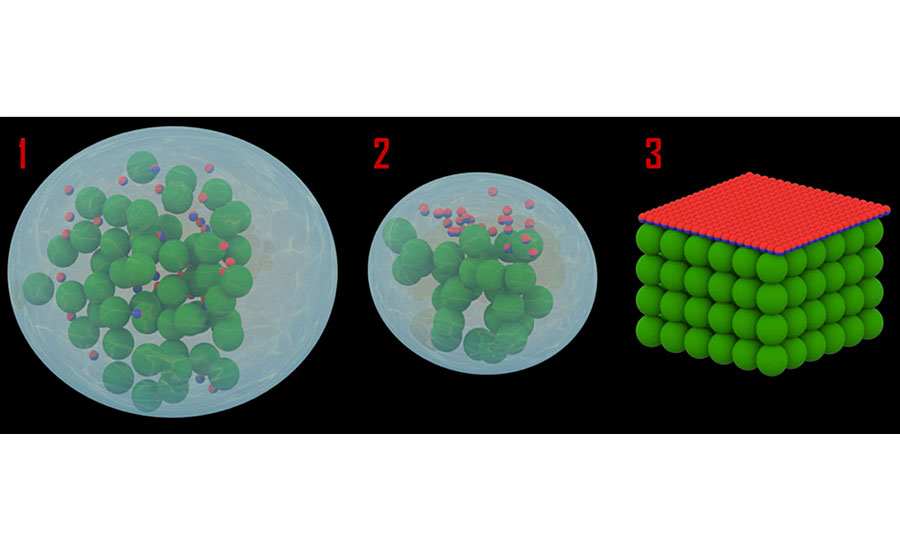
Schematic representation of self-stratified hydrophobic coating formation.
FIGURE 2 » Schematic representation of self-stratified hydrophobic coating formation.

After the mixed coating is fully dried under ambient environment, we can see from Figure 3 that Janus particles exclusively cover the surface and change the surface-related coating properties (Figure 3c). The coating matrix was converted from fully hydrophilic surface (water contact angle ~ 0°), which is made from primer particles to the fully hydrophobic surface (water contact angle ~ 120°). The bulk materials of the coating film remain intact, highlighting the potential advantages of our technology: there is no need to use a typical two-coat system to enhance the coatings properties, which costs additional time, effort and materials.²
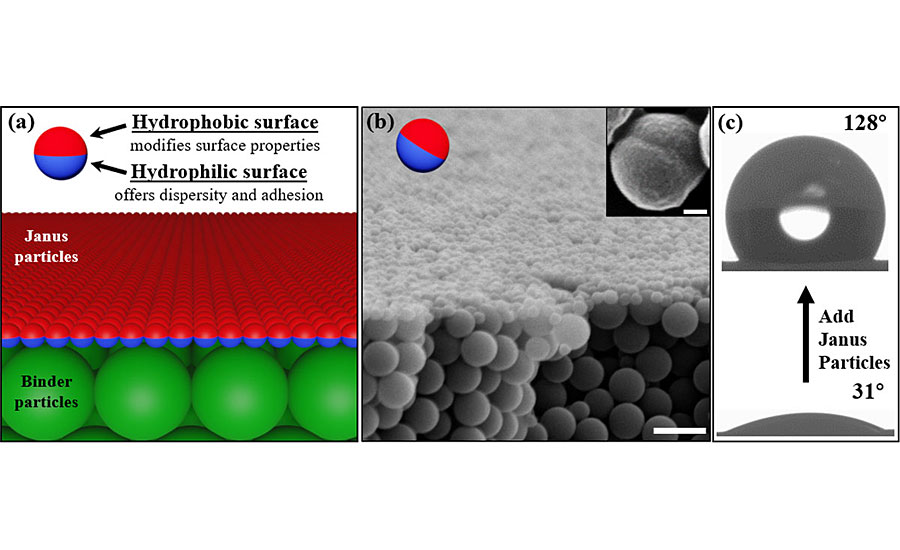
Schematic diagram for the coating structures; b) SEM image of the cross-section view of coating structures. Scale bar is 2 μm. Inset shows the asymmetric morphology of a typical Janus particle. Scalebar is 100 nm; c) Contact angles of the coating surface before and after adding the Janus particles.
FIGURE 3 » Schematic diagram for the coating structures; b) SEM image of the cross-section view of coating structures. Scale bar is 2 μm. Inset shows the asymmetric morphology of a typical Janus particle. Scalebar is 100 nm; c) Contact angles of the coating surface before and after adding the Janus particles.


Performance Test

The goal of this study is to verify adding Janus particles will not affect the original properties of the coating matrix. Organic solvents (EtOH/THF) were used to rinse the surface of the coating films. Coating films formed by homogeneous hydrophobic particles (with the same surface chemistry as the Janus particles) and binder particles were chosen as a control. Images of the cross-sections of the coating films after rinsing in Figure 4 clearly demonstrate that the self-stratified coating surface maintains its structure integrity, and surface hydrophobicity is unchanged. The resistance highlights the completeness of the densely packed monolayer of amphiphilic Janus particles formed during the self-stratification process and the strong adhesion offered by the phosphate binder particles. In comparison, the control sample that does not possess the stratified structures (Figure 4b) was destroyed in rinsing with solvent (Figure 4d). Since the hydrophobic homogeneous particles randomly dispersed within the binder matrix, they acted as the defects and significantly weakened the coating integrity and adhesion.
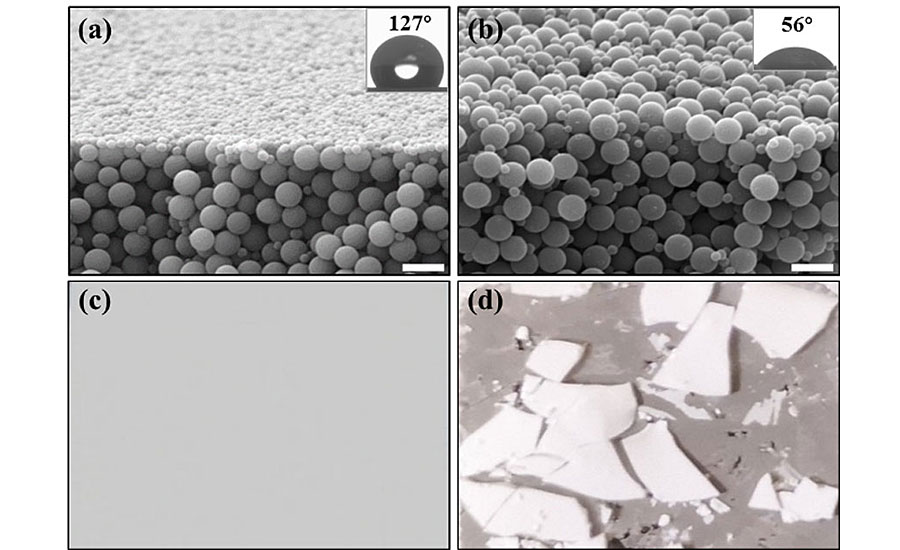
SEM images and photos of the dried coating films after rinsing: a) films formed with Janus particles; b) films with hydrophobic particles; c) Photo of the coating film added with Janus particles after rinse; d) Photo of the coating film added with homogeneous particles after rinse. Scale bars are all 2μm.
FIGURE 4 » SEM images and photos of the dried coating films after rinsing: a) films formed with Janus particles; b) films with hydrophobic particles; c) Photo of the coating film added with Janus particles after rinse; d) Photo of the coating film added with homogeneous particles after rinse. Scale bars are all 2μm.

To further test the performance of Janus particles with commercial coating products, Janus particles were applied to a common commercial primer. The successful stratification demonstrates the easy integration of our method into existing products. Janus particles (15% by dry weight) were directly added to the commercial primer. Figure 5 clearly shows self-stratification of Janus particles at the surface of the commercial primer coating. Since the primer binder particles have a glass transition temperature much lower than the room temperature, they form a continuous film after the coating film is dried. Most of the coating surfaces were covered with self-stratified Janus particles, and the contact angle was increased from 0° to 105°. Force characterization also suggests that the surface formed after addition of Janus particles is less tacky, since Janus particle additive has a much higher Tg than bulk binder particles.
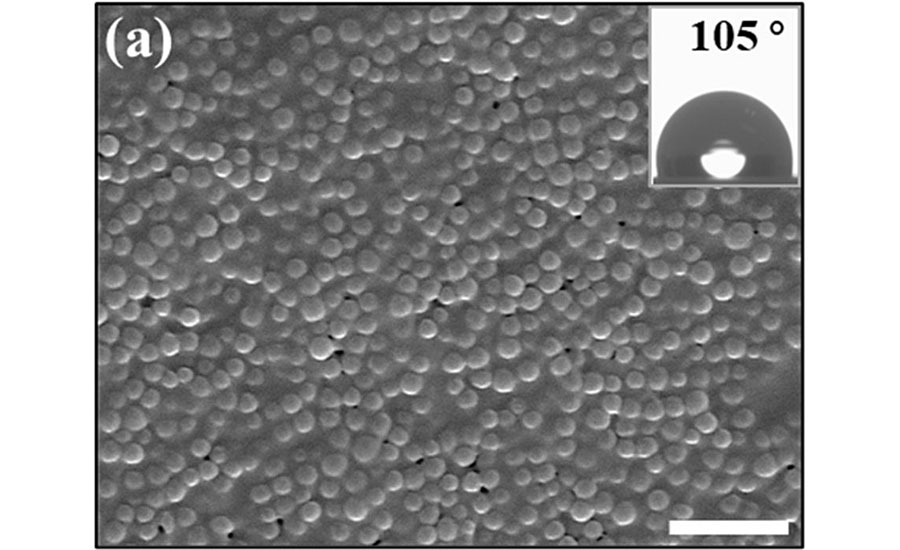
SEM images of coating films formed by commercial primer binder added with Janus particles. Scale bar is 2 μm.
FIGURE 5 » SEM images of coating films formed by commercial primer binder added with Janus particles. Scale bar is 2 μm.


Conclusion

In this study, we demonstrate a new coating additive made from Janus particles. These particles can be produced in large quantity with cost-effective emulsion polymerization. Even better, these additive particles can be applied directly to current waterborne coating systems. With a relatively small quantity of Janus particles, they can self-stratify quickly to the surface and create durable hydrophobic coatings with strong adhesion. The approach demonstrated here is economical and commercially scalable. The successful application of Janus particles in commercial coating products showcases the versatility and effectiveness of our approach, and opens a new front for functionalized coatings, which may find broad applications different coating related products.


References

¹ Li, Y.; Liu, F.; Chen, S.; Tsyrenova, A.; Miller, K.; Olson, E.; Mort, R.; Palm, D.; Xiang, C.; Yong, X.; Jiang, S. Self-Stratification of Amphiphilic Janus Particles at Coating Surfaces. Materials Horizons. 2020; 7(8):2047-55.


² Jiang, S.; Van Dyk, A.; Maurice, A.; Bohling, J.; Fasano, D.; Brownell, S. Design Colloidal Particle Morphology and Self-Assembly for Coating Applications. Chemical Society Reviews. 2017; 46(12):3792-807.


KEYWORDS: hydrophobic coatings Latex Resins

Share This Story

Looking for a reprint of this article?
From high-res PDFs to custom plaques, order your copy today!


Shan Jiang, Ph.D., Assistant Professor; Materials Science and Engineering, Iowa State University, Ames, IA
Yifan Li, Ph.D. Candidate; Materials Science and Engineering, Iowa State University, Ames, IA
Rebecca Mort, Ph.D. Candidate, Materials Science and Engineering, Iowa State University, Ames, IA

Recommended Content

JOIN TODAY
to unlock your recommendations.

Already have an account? Sign In

  • pci1022-Kinaltek-Lead-1170.jpg

    A Novel Pigment Production Technology

    Following an extensive R&D program that demonstrated...
    Paint and Coating Pigments
    By: Jawad Haidar and Nitin Soni
  • pci global top 10

    2025 Global Top 10: Top Paint and Coatings Companies

    The following is PCI’s annual ranking of the top 10...
    Global Top 10 and PCI 25
    By: Courtney Bassett
  • 2025 pci 25

    2025 PCI 25: Top Paint and Coatings Companies

    PCI's annual ranking of the top 25 North American paint...
    Global Top 10 and PCI 25
    By: Courtney Bassett
You must login or register in order to post a comment.

Report Abusive Comment

Manage My Account
  • eMagazine
  • Newsletters
  • Online Registration
  • Subscription Customer Service

More Videos

Sponsored Content

Sponsored Content is a special paid section where industry companies provide high quality, objective, non-commercial content around topics of interest to the PCI audience. All Sponsored Content is supplied by the advertising company and any opinions expressed in this article are those of the author and not necessarily reflect the views of PCI or its parent company, BNP Media. Interested in participating in our Sponsored Content section? Contact your local rep!

close
  • colorful building exterior
    Sponsored byDow

    Insights into Exterior Architectural Coating Degradation: Bridging Accelerated and Natural Weathering

  • digital pigments
    Sponsored bySiltech

    The Fourth Dimension of Silicon: Siltech Q Resins

Popular Stories

Company News

What the AkzoNobel–Axalta Merger Means for the Future of Coatings

AkzoNobel and Axalta Headquarters

AkzoNobel and Axalta Announce $25 Billion Merger

Wacker logo

WACKER Plans More Than 1,500 Job Cuts


PCI Buyers Guide

Submit a Request for Proposal (RFP) to suppliers of your choice with details on what you need with a click of a button

Start your RFP

Browse our Buyers Guide for manufacturers and distributors of all types of coatings products and much more!

Find Suppliers

Events

September 4, 2025

N-Butylpyrrolidone (NBP) as a Green Solvent to Replace N-Methylpyrrolidone (NMP) in Industrial Coating Applications

ON DEMAND: EPA published a regulation proposal around N-methylpyrrolidone (NMP) in June 2024 to ban or limit NMP in many applications, such as paints and coatings and their removers. N-butylpyrrolidone (NBP) is a powerful and versatile solvent for a variety of industries looking for alternatives to substance of very high concern (SVHC)-listed solvents.

March 24, 2026

The Manufacturing & Automation eXchange (MAX)

MAX presents a rare opportunity to observe the full scope of manufacturing in one environment. From systems integration and materials handling to automation, quality, safety, and packaging, each discipline is represented through live, operational displays. By experiencing these technologies side by side, as they are on actual production floors, attendees gain a grounded understanding of how manufacturing functions align, overlap, and evolve in practice.

View All Submit An Event

Poll

Longest-running laboratory experiment

What is the longest-running laboratory experiment?
View Results Poll Archive

Products

Automotive Paints and Coatings, 2nd Edition

Automotive Paints and Coatings, 2nd Edition

Now in its second edition and still the only book of its kind, this is an authoritative treatment of all stages of the coating process.

See More Products
pci voices from the top ebook

PCI webinar

Related Articles

  • IndustryNews-493850587.jpg

    Janus Particles Could Hold the Key to More Sustainable Coatings

    See More
  • Whitehouse Scientific Tests New Particle Size Standard

    See More
  • pci0623-Evonik-1372277590-1170.jpg

    New Insights into Coating Additives to Improve Durability of Waterborne Coatings

    See More
×

Keep the info flowing with our eNewsletters!

Get the latest industry updates tailored your way.

JOIN TODAY!
  • RESOURCES
    • Advertise
    • Contact Us
    • Directories
    • Store
    • Want More
  • SIGN UP TODAY
    • Create Account
    • eMagazine
    • Newsletters
    • Customer Service
    • Manage Preferences
  • SERVICES
    • Marketing Services
    • Reprints
    • Market Research
    • List Rental
    • Survey & Sample
  • STAY CONNECTED
    • LinkedIn
    • Facebook
    • Youtube
    • X (Twitter)
  • PRIVACY
    • PRIVACY POLICY
    • TERMS & CONDITIONS
    • DO NOT SELL MY PERSONAL INFORMATION
    • PRIVACY REQUEST
    • ACCESSIBILITY

Copyright ©2025. All Rights Reserved BNP Media.

Design, CMS, Hosting & Web Development :: ePublishing