Painting & Coating Industry (PCI) logo Powder coating summit logo
search
cart
facebook twitter linkedin youtube
  • Sign In
  • Create Account
  • Sign Out
  • My Account
Painting & Coating Industry (PCI) logo Powder coating summit logo
  • NEWS
    • Latest News
    • Market Trends & Reports
    • Finishing News
    • Price Alerts
    • Subscribe to Newsletters
    • Global Top 10/ PCI 25
    • Weekly Featured Article
    • COATLE Word Game
  • PRODUCTS
    • Product News
    • Must See Products and Services
  • MATERIALS
    • Additives
    • Resins/Polymers
    • Pigments
    • Equipment
    • Distributors
  • TECHNOLOGIES
    • Adhesives
    • Architectural Coatings
    • Finishing Articles
    • Finishing Technologies
    • Finishing Equipment
    • Industrial Coatings
    • Nanotechnology
    • Powder Coatings
    • Solventborne
    • Special Purpose Coatings
    • Sustainability
    • UV Coatings
    • Waterborne
  • RESOURCES
    • Columns
      • Did you know?
      • Distribution Dive
      • Formulating With Mike
      • Innovation Insights
      • Powder Coating Perspectives
      • TiO2 Insider
    • Blogs
      • Editor's Viewpoint
      • Industry Insights
    • Coatings Supplier Handbook
    • Podcasts and Videos
      • COAT-IT! Podcast
      • Videos/PCI TV
    • PCI Store
    • Classifieds
    • eBooks
    • Sponsor Insights
    • White Papers
    • COATLE Word Game
  • EVENTS
    • Coatings Trends & Technologies Summit
    • Paint and Coatings Academy
    • Webinars
    • Calendar of Events
    • Lifetime Achievement Award
  • DIRECTORIES
    • Buyer's Guide
    • Equipment Directory
    • Materials Directory
  • EMAGAZINE
    • Current Issue
    • eMagazine Archive
    • China Issue Archive
    • Editorial Advisory Board
  • CONTACT
    • Contact Us
    • Advertise
    • Subscribe to eMagazine
    • Subscribe to Newsletters
  • SIGN UP!
Architectural CoatingsIndustrial CoatingsManufacturing Equipment

Bead Maintenance in Stirred Mills

By Ken Raby
GettyImages-499512886-1170x658.jpg

Credit: leekhoailang / iStock via Getty Images Plus

November 12, 2024

A significant investment is required to operate any stirred milling process. The technology is employed to meet exacting quality demands, primarily relating to achieving a particular particle size distribution in a specific product. However, these demands can also be defined by other criteria, such as color strength, gloss and reactivity.

Evaluation of a particular process can be theoretical, experimental or practical, but usually results in defining the “specific energy,” or the energy required to process a unit volume of the product.

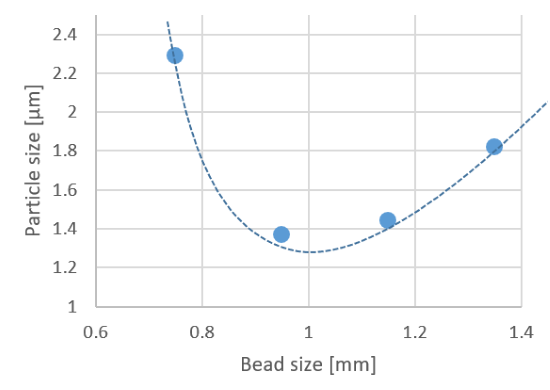
The mill supplies the energy for the process, while the media transfers that energy to the product to affect the grind. Each mill type specifies the minimum bead charge required, typically between 75% and 85% of the mill volume. Filling above this range will result in increased wear and mill temperature; operating below this range will reduce milling efficiency, and product particle size will increase, as shown in Figure 1.

FIGURE 1 | Particle size versus bead size. 

Saint Gobain figure 1.png

Specifying the type of bead to be used is more complex and relates to both the size and density of the media. Higher density results in higher bead impact intensities, which consequently improve the achieved grind. Generally, the highest density media that allows for good mill operation is recommended.

Bead size selection is influenced by various factors, including the target size reduction ratio and the formulation’s rheological properties. For each process, there will be an optimum bead size—1 mm in the example detailed in Figure 2.

FIGURE 2 | Effect of filling ratio. 
Saint gobain figure 2.png

If beads are too large, energy is wasted on excessively intense impacts; if they are too small, impacts lack the energy needed to break target particles. These factors are defined and controlled at the start of a milling operation to ensure acceptable performance.

Stirred milling provides the intense, aggressive environment necessary to break down target particles. However, this environment also causes wear on the mill and media. Wear on mill liners and discs requires periodic maintenance, typically defined in the machine’s operating manuals.

But what about the media?

Mill Volume Control – Topping Up
 There are many types of beads used in stirred mills, with ceramic-based products being the most widely adopted. Ceramic media are inert, nonabrasive, and cost effective. A technologically advanced grade is based on engineered yttria-stabilized zirconia, with a density of 6.0 g/cc. The best options are mono-sized. Wear rates depend on formulation and operating conditions; for this example, a wear rate of 0.02% per hour results in a 10% media loss after 500 hours. Another 500 hours will decrease the mill volume below 70%, reducing efficiency.

To maintain grind parameters, mill volume must be adjusted by topping up the mill to replace the worn bead. Topping up can be regulated through power draw, product quality, operating hours, or visual observation.

The objective is to keep the mill volume within the 75%-85% range, avoiding overfilling while providing practical topping-up intervals. Eventually, the question arises of how long this practice can continue safely. The endpoint is when bead size approaches the separator system size—after about 4,000 hours in the given example with a 1 mm bead and a screen or gap set at 2½ times smaller. Running the mill beyond this point is not recommended, as beads will become trapped, pressure will increase and the separator could be damaged.

A second, equally important consideration is the effect of a charge with a continuously reducing bead size on grind quality.

Media Size Control
 In a simplified case, if bead size decreases by 10% every 500 hours and losses are made good with new bead additions at the same interval, bead charge evolution may resemble Table 1.

TABLE 1 | Bead charge evolution. 

Saint Gobain Table 1.png

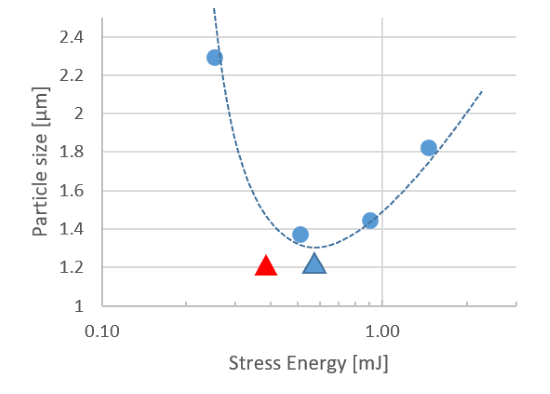
After 2,000 hours, the average bead size in the mill is approximately 30% smaller than that of the new beads. Topping up has not maintained the optimum bead size, which significantly impacts grind quality and mill efficiency. Beads must provide a minimum stress intensity to break target particles, as illustrated in Figure 3.

FIGURE 3 | Particle size versus stress intensity. 
Saint gobain Figure 3.png

The original process target would be to have bead size in the optimum range at the base of the curve. A 30% deviation from this point would likely push efficiency into the lower range of the curve.

Conclusions
There are limits to maintaining an effective media charge in a stirred mill. One critical point is dictated by the mill itself: media must remain at sizes safely above the separator system size. This is the extreme limit of the process. Other factors, such as maintaining bead charge volume and bead size, should prompt action before the mill is compromised. Topping up maintains bead volume but eventually fails to provide the necessary bead size for efficient grind. At this point, a more significant action, such as replacing the entire charge or screening out ineffective beads, is required.

Determining when to take this action is key to a proficient maintenance program. Monitoring mill output allows for a reactive approach, where action is taken after quality or throughput decline. This method can be costly due to productivity loss before remediation. Bead audits, which involve taking small samples to assess the bead mix, allow proactive decisions about charge replacement. Typically, bead condition is assessed after a set operating time, with future charges reviewed at similar intervals.

A rule of thumb is to use a bead charge evolution table to set a maximum top-up level, depending on product sensitivity. A good starting point is a maximum top-up level of 30%, keeping average bead size above 70% of the original and stress intensity at acceptable levels. In the given example, this equates to an operating time of up to 2,000 hours. After this period, the charge should be replaced. The used charge can be sieved at an appropriate level, and the beads can be used for future topping up.

Note that beads are often sold in size ranges (e.g., 0.8-1.0 mm or 1.0-1.2 mm); this must be considered when creating a maintenance plan. Bead options vary, with each formulation having a specific wear rate. Lower-density beads typically wear faster than the zirconia media in this example, so wear rates must be factored into the maintenance plan.

For more information, visit www.zirpro.com.

KEYWORDS: bead mills Innovations innovations in coatings milling

Share This Story

Looking for a reprint of this article?
From high-res PDFs to custom plaques, order your copy today!


Ken Raby is North American sales manager for Walther Trowal GmbH and Co., Grand Rapids, MI. For more information about the tumble spraying technology, call 616.455.8940, e-mail k.raby@walther-trowal.com.

Recommended Content

JOIN TODAY
to unlock your recommendations.

Already have an account? Sign In

  • pci1022-Kinaltek-Lead-1170.jpg

    A Novel Pigment Production Technology

    Following an extensive R&D program that demonstrated...
    Paint and Coating Pigments
    By: Jawad Haidar and Nitin Soni
  • pci global top 10

    2025 Global Top 10: Top Paint and Coatings Companies

    The following is PCI’s annual ranking of the top 10...
    Paint and Coating Market Reports
    By: Courtney Bassett
  • 2025 pci 25

    2025 PCI 25: Top Paint and Coatings Companies

    PCI's annual ranking of the top 25 North American paint...
    Paint and Coating Market Reports
    By: Courtney Bassett
You must login or register in order to post a comment.

Report Abusive Comment

Manage My Account
  • eMagazine
  • Newsletters
  • Online Registration
  • Subscription Customer Service

More Videos

Sponsored Content

Sponsored Content is a special paid section where industry companies provide high quality, objective, non-commercial content around topics of interest to the PCI audience. All Sponsored Content is supplied by the advertising company and any opinions expressed in this article are those of the author and not necessarily reflect the views of PCI or its parent company, BNP Media. Interested in participating in our Sponsored Content section? Contact your local rep!

close
  • colorful building exterior
    Sponsored byDow

    Insights into Exterior Architectural Coating Degradation: Bridging Accelerated and Natural Weathering

  • digital pigments
    Sponsored bySiltech

    The Fourth Dimension of Silicon: Siltech Q Resins

Popular Stories

Company News

What the AkzoNobel–Axalta Merger Means for the Future of Coatings

AkzoNobel and Axalta Headquarters

AkzoNobel and Axalta Announce $25 Billion Merger

Wacker logo

WACKER Plans More Than 1,500 Job Cuts


PCI Buyers Guide

Submit a Request for Proposal (RFP) to suppliers of your choice with details on what you need with a click of a button

Start your RFP

Browse our Buyers Guide for manufacturers and distributors of all types of coatings products and much more!

Find Suppliers

Events

September 4, 2025

N-Butylpyrrolidone (NBP) as a Green Solvent to Replace N-Methylpyrrolidone (NMP) in Industrial Coating Applications

ON DEMAND: EPA published a regulation proposal around N-methylpyrrolidone (NMP) in June 2024 to ban or limit NMP in many applications, such as paints and coatings and their removers. N-butylpyrrolidone (NBP) is a powerful and versatile solvent for a variety of industries looking for alternatives to substance of very high concern (SVHC)-listed solvents.

March 24, 2026

The Manufacturing & Automation eXchange (MAX)

MAX presents a rare opportunity to observe the full scope of manufacturing in one environment. From systems integration and materials handling to automation, quality, safety, and packaging, each discipline is represented through live, operational displays. By experiencing these technologies side by side, as they are on actual production floors, attendees gain a grounded understanding of how manufacturing functions align, overlap, and evolve in practice.

View All Submit An Event

Poll

Longest-running laboratory experiment

What is the longest-running laboratory experiment?
View Results Poll Archive

Products

Automotive Paints and Coatings, 2nd Edition

Automotive Paints and Coatings, 2nd Edition

Now in its second edition and still the only book of its kind, this is an authoritative treatment of all stages of the coating process.

See More Products
pci voices from the top ebook

PCI webinar

Related Articles

  • Tumble Spraying Plastics

    See More
  • CB Mills: Bead Mills

    See More
  • bead mills

    Scalability of Agitated Bead Mills

    See More

Related Products

See More Products
  • laser tech.jpg

    Laser Technology: Applications in Adhesion and Related Areas

  • durability.jpg

    Increasing the Durability of Paint and Varnish Coatings in Building Products and Construction 1st Edition

See More Products

Related Directories

  • Glen Mills Inc.

    Grinding equipment, micromedia (beads) of glass, ceramic, steel, also sample dividers, blenders, and mills.
×

Keep the info flowing with our eNewsletters!

Get the latest industry updates tailored your way.

JOIN TODAY!
  • RESOURCES
    • Advertise
    • Contact Us
    • Directories
    • Store
    • Want More
    • Manufacturing Division
  • SIGN UP TODAY
    • Create Account
    • eMagazine
    • Newsletters
    • Customer Service
    • Manage Preferences
  • SERVICES
    • Marketing Services
    • Reprints
    • Market Research
    • List Rental
    • Survey & Sample
  • STAY CONNECTED
    • LinkedIn
    • Facebook
    • Youtube
    • X (Twitter)
  • PRIVACY
    • PRIVACY POLICY
    • TERMS & CONDITIONS
    • DO NOT SELL MY PERSONAL INFORMATION
    • PRIVACY REQUEST
    • ACCESSIBILITY

Copyright ©2025. All Rights Reserved BNP Media.

Design, CMS, Hosting & Web Development :: ePublishing