Painting & Coating Industry (PCI) logo Powder coating summit logo
search
cart
facebook twitter linkedin youtube
  • Sign In
  • Create Account
  • Sign Out
  • My Account
Painting & Coating Industry (PCI) logo Powder coating summit logo
  • NEWS
    • Latest News
    • Market Trends & Reports
    • Finishing News
    • Price Alerts
    • Subscribe to Newsletters
    • Global Top 10/ PCI 25
    • Weekly Featured Article
    • COATLE Word Game
  • PRODUCTS
    • Product News
    • Must See Products and Services
  • MATERIALS
    • Additives
    • Resins/Polymers
    • Pigments
    • Equipment
    • Distributors
  • TECHNOLOGIES
    • Adhesives
    • Architectural Coatings
    • Finishing Articles
    • Finishing Technologies
    • Finishing Equipment
    • Industrial Coatings
    • Nanotechnology
    • Powder Coatings
    • Solventborne
    • Special Purpose Coatings
    • Sustainability
    • UV Coatings
    • Waterborne
  • RESOURCES
    • Columns
      • Did you know?
      • Distribution Dive
      • Formulating With Mike
      • Innovation Insights
      • Powder Coating Perspectives
      • TiO2 Insider
    • Blogs
      • Editor's Viewpoint
      • Industry Insights
    • Coatings Supplier Handbook
    • Podcasts and Videos
      • COAT-IT! Podcast
      • Videos/PCI TV
    • PCI Store
    • Classifieds
    • eBooks
    • Sponsor Insights
    • White Papers
    • COATLE Word Game
  • EVENTS
    • Coatings Trends & Technologies Summit
    • Paint and Coatings Academy
    • Webinars
    • Calendar of Events
    • Lifetime Achievement Award
  • DIRECTORIES
    • Buyer's Guide
    • Equipment Directory
    • Materials Directory
  • EMAGAZINE
    • Current Issue
    • eMagazine Archive
    • China Issue Archive
    • Editorial Advisory Board
  • CONTACT
    • Contact Us
    • Advertise
    • Subscribe to eMagazine
    • Subscribe to Newsletters
  • SIGN UP!

Pigment Characterization in the Printing Ink and Coatings Industry
March 1, 2005
The coatings and printing ink industries have been around for centuries and, as such, have developed a variety of methods to characterize their products. Many of these methods have been codified in ASTM Method D 5010-03, Standard Guide for Testing Printing Ink and Related Materials.1 This is an exhaustive list of over 100 tests that are used to characterize ink-related materials. (ASTM volumes D 6.01 - 6.04 are related to coatings.) While this compilation contains many types of methods, some of the most common ones revolve around particle size determination. These tests can be characterized as either direct or indirect procedures, with both types addressing the same issues. Direct methods actually determine particle size, while indirect methods measure performance that is determined by particle size.

Particle size measurement is a collection of very old and very modern analytical techniques. It originated thousands of years ago with sieving as a method of characterizing the efficiency of crushing operations. Since this beginning, many methods of making this determination have evolved.2 During this evolution, the test procedures have become quicker, easier and more repeatable. This has led to ever wider adaptation of these methods, even to the point of on-line measurements.3 These developments have paralleled many of those in the printing ink and coatings industries. This has resulted in their adoption in this important industrial application.

Particle size measurement is unique among analytical techniques, and it has earned the separate classification as one of several physical test methods. In more straightforward analytical tests, a number, such as weight percent sulfur4 in a sample, is determined. This result is a direct determination of the sulfur contamination level of a hydrocarbon sample, for example. It is a well-understood number and can be used by regulatory agencies for enforcement.5 The data from physical tests on the other hand are more indirect and require additional determinations to become relevant.6 This critical difference requires a great deal of additional work and data interpretation.

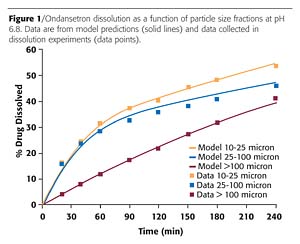
In a typical application, the particle size determination is made and the result is then correlated to a physical property representing the final end use of the material being analyzed. An example of this would be the testing of active pharmaceutical ingredients to be blended into tablets. The particle size is important to measure, but it only has relevance when it is correlated to a parameter such as drug release rate.7 This represents the only meaningful way for this data to be applied. An example of this is illustrated in Figure 1.

A more general example is illustrated in Figure 2.8 In this case, the particle size has already been correlated to a "desired" physical product. The preparation of this graph required the preparation of a large number of samples of differing particle sizes. Each of the discrete sizes is then made into a final formulation and that product is used in its intended application. This final product is then characterized for the desired performance property. This requires two tests to be performed several times in order to produce one actual determination. After this is complete, an acceptable range of the physical property is selected and the limits of the particle size are determined from the graph.

The complexity of this approach has led to many industries simply adopting the direct performance test itself and skipping the particle size measurement. This has previously been referred to as the indirect particle sizing method. The printing ink industry is surely no exception as Method D 5010-03 clearly illustrates. These performance-based, indirect methods are listed in Table 1.1
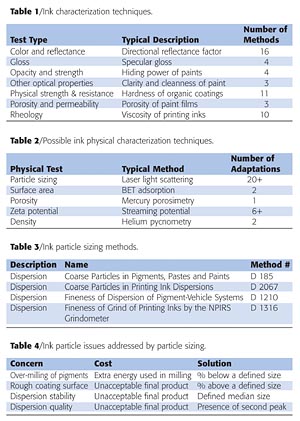
While these tests are important in their own right, they are basically "Pass-Fail" tests. They cannot identify the root cause of the poor performance of the final formulation. To obtain this sort of in-depth knowledge of the product, some form of a physical test method will be required in addition to the correlation study.

Physical tests can take on many forms, as is illustrated in Table 2. These all may be applicable to printing inks, but, for this discussion, only particle size will be addressed. With over 20 different techniques already in use, this is quite a challenge.

In this industry, particle-sizing methods already exist, as is shown in Table 3. As can be seen, these methods are centered around a particular aspect of the particle size distribution and not the entire distribution. In many cases, a few large particles do create major problems for the users of printing ink. In order to avoid these types of problems, these basic tests were developed. While they are critical, they only address a very narrow aspect of particle size analysis. Some of the newer tools available are capable of addressing these issues plus a host of other concerns. This typical feature is the measurement of the entire particle size distribution.

A partial list of these newer issues and possible benefits are listed in Table 4. As can be seen, in order to address these and other issues, the full particle size distribution is required. Currently, one of the most popular methods of obtaining this information is by the use of laser light scattering technology. This represents a quick (< 5 minutes), easy (computer-based operation) and repeatable (± small percentages) way to determine an entire distribution. The potential benefits suggest that it should be widely adopted in the printing ink industry. The power of the technique can be illustrated by a few examples of applications from this marketplace.

In Example 1 shown in Figure 310, the power to predict hiding power is illustrated very clearly. A desired hiding power coating can be "dialed in" by proper control of the percentages of fines below 0.3 mm. There is a bit of uncertainty in both measurements, but a tolerable range can be selected and controlled. This represents a clear example of a test requiring less than 5 minutes replacing a very involved test that requires a great deal of additional time. It comes from the combination of ASTM Methods D 2805 and B 822. It is a powerful, predictive tool.

Another example involving pigment gloss strength is depicted in Figure 4.10 In this example, the gloss strength is established by controlling the percentage of large particles over 1. 0mm. This would typically represent proper management of a milling operation. This is yet another example of the power of physical tests such as particle size distribution measurement to predict performance. It represents a combination of ASTM D 523 plus B 822.

These examples serve to show trends that exist in many mature industries. In the early years of development of the technology, performance tests tend to be dominant. As time passes, a deeper understanding of the properties that affect this performance evolves. As characteristics that affect these properties are better understood, process parameters can be better controlled. This ultimately leads to more consistent, higher-quality products. This evolutionary process takes a great deal of time and money. The result is new or improved products that have a huge commercial payoff following their development. The printing ink industry is leading the way in such an evolutionary process. These new developments will continue into the future.

For more information, call 800/446.7422 or visit www.horibalab.com.

References

1 This guide is under the jurisdiction of the ASTM Committee D01 on Paint and Related Coatings, Materials and Applications, and is the direct responsibility of Subcommittee D01.56 on Printing Inks.

2 Pohl, M. Selecting a particle size analyzer: Factors to consider. Powder and Bulk Engineering February 1990, pages 26-29.

2 Pohl, M. Particle Sizing: A quick look at new and improved methods. Powder and Bulk Engineering February 2004, pages 21-27.

3 Pohl, M. Technology Update: Particle sizing moves from the lab to the process. Powder and Bulk Engineering February 1998, pages 39-46.

4 Test Method D-7039 can be viewed at the ASTM website, www.astm.org, or contact ASTM Customer Service @ astm.org. This test method is under the jurisdiction of ASTM Committee D02 on Petroleum Products and Lubricants and is the direct responsibility of Subcommittee D02.03 on Elemental Analysis.

5 U.S. EPA 40 CFR Parts 9, 69, et al., Tuesday, June 29, 2004, page 38957.

6 Allen, T. Particle Size Measurement, 4th ed., Chapman and Hall, 1990, page 484.

7 Friend, D.R. et al., Mathematical Modeling of a Novel Controlled-Release Dosage Form, Drug Delivery Technology 2001; 1:36-43.

8 Pohl, M.C. "Practical Applications of Particle Sizing," Annual Fine Particle Society Meeting, 1993, Las Vegas.

9 Pohl, M.C. in Powder Metallurgy, vol 7, ASM Handbook, American Society for Metals, 1998, page 250.

10 Frock, H.N. "Particle Size Characterization Technical Seminar," Irvine, CA, February 3-5, 2003.

Links

  • Horiba Instruments, Inc.

Share This Story

Looking for a reprint of this article?
From high-res PDFs to custom plaques, order your copy today!


Recommended Content

JOIN TODAY
to unlock your recommendations.

Already have an account? Sign In

  • pci1022-Kinaltek-Lead-1170.jpg

    A Novel Pigment Production Technology

    Following an extensive R&D program that demonstrated...
    Paint and Coating Pigments
    By: Jawad Haidar and Nitin Soni
  • pci global top 10

    2025 Global Top 10: Top Paint and Coatings Companies

    The following is PCI’s annual ranking of the top 10...
    Global Top 10 and PCI 25
    By: Courtney Bassett
  • 2025 pci 25

    2025 PCI 25: Top Paint and Coatings Companies

    PCI's annual ranking of the top 25 North American paint...
    Paint and Coating Market Reports
    By: Courtney Bassett
You must login or register in order to post a comment.

Report Abusive Comment

Manage My Account
  • eMagazine
  • Newsletters
  • Online Registration
  • Subscription Customer Service

More Videos

Sponsored Content

Sponsored Content is a special paid section where industry companies provide high quality, objective, non-commercial content around topics of interest to the PCI audience. All Sponsored Content is supplied by the advertising company and any opinions expressed in this article are those of the author and not necessarily reflect the views of PCI or its parent company, BNP Media. Interested in participating in our Sponsored Content section? Contact your local rep!

close
  • colorful building exterior
    Sponsored byDow

    Insights into Exterior Architectural Coating Degradation: Bridging Accelerated and Natural Weathering

  • digital pigments
    Sponsored bySiltech

    The Fourth Dimension of Silicon: Siltech Q Resins

Popular Stories

Company News

What the AkzoNobel–Axalta Merger Means for the Future of Coatings

AkzoNobel and Axalta Headquarters

AkzoNobel and Axalta Announce $25 Billion Merger

Wacker logo

WACKER Plans More Than 1,500 Job Cuts

pci academy

PCI Buyers Guide

Submit a Request for Proposal (RFP) to suppliers of your choice with details on what you need with a click of a button

Start your RFP

Browse our Buyers Guide for manufacturers and distributors of all types of coatings products and much more!

Find Suppliers

Events

September 4, 2025

N-Butylpyrrolidone (NBP) as a Green Solvent to Replace N-Methylpyrrolidone (NMP) in Industrial Coating Applications

ON DEMAND: EPA published a regulation proposal around N-methylpyrrolidone (NMP) in June 2024 to ban or limit NMP in many applications, such as paints and coatings and their removers. N-butylpyrrolidone (NBP) is a powerful and versatile solvent for a variety of industries looking for alternatives to substance of very high concern (SVHC)-listed solvents.

March 24, 2026

The Manufacturing & Automation eXchange (MAX)

MAX presents a rare opportunity to observe the full scope of manufacturing in one environment. From systems integration and materials handling to automation, quality, safety, and packaging, each discipline is represented through live, operational displays. By experiencing these technologies side by side, as they are on actual production floors, attendees gain a grounded understanding of how manufacturing functions align, overlap, and evolve in practice.

View All Submit An Event

Poll

Longest-running laboratory experiment

What is the longest-running laboratory experiment?
View Results Poll Archive

Products

Automotive Paints and Coatings, 2nd Edition

Automotive Paints and Coatings, 2nd Edition

Now in its second edition and still the only book of its kind, this is an authoritative treatment of all stages of the coating process.

See More Products
pci case ebook

PCI webinar

Related Articles

  • NEWS

    Printing Ink Vehicle Definitions to Be Compiled in ASTM Terminology Standard

    See More
  • Market Forecasts

    Ceresana Examines Challenges in the Printing Inks Industry

    See More
  • EB Protocol for Printing and Painting Industry Expands the Harmonization of Health and Safety Requirements for Radiation Technology in Europe

    See More

Related Products

See More Products
  • biological.jpg

    Biological and Biomedical Coatings Handbook: Processing and Characterization

  • thin films.jpg

    Thin Films and Coatings: Toughening and Toughness Characterization

  • durability.jpg

    Increasing the Durability of Paint and Varnish Coatings in Building Products and Construction 1st Edition

See More Products

Related Directories

  • Little Joe Industries

    Proof press to test print offset printing ink, automatic draw down machine for use with grind gauges.
  • Little Joe Industries

    Proof press to test print offset printing ink, automatic draw down machine for use with grind gauges to test particle size.
×

Keep the info flowing with our eNewsletters!

Get the latest industry updates tailored your way.

JOIN TODAY!
  • RESOURCES
    • Advertise
    • Contact Us
    • Directories
    • Store
    • Want More
    • Manufacturing Division
  • SIGN UP TODAY
    • Create Account
    • eMagazine
    • Newsletters
    • Customer Service
    • Manage Preferences
  • SERVICES
    • Marketing Services
    • Reprints
    • Market Research
    • List Rental
    • Survey & Sample
  • STAY CONNECTED
    • LinkedIn
    • Facebook
    • Youtube
    • X (Twitter)
  • PRIVACY
    • PRIVACY POLICY
    • TERMS & CONDITIONS
    • DO NOT SELL MY PERSONAL INFORMATION
    • PRIVACY REQUEST
    • ACCESSIBILITY

Copyright ©2025. All Rights Reserved BNP Media.

Design, CMS, Hosting & Web Development :: ePublishing