
Painting & Coating Industry (PCI) logo Powder coating summit logo
search
cart
facebook twitter linkedin youtube
  • Sign In
  • Create Account
  • Sign Out
  • My Account
Painting & Coating Industry (PCI) logo Powder coating summit logo
  • NEWS
    • Latest News
    • Market Trends & Reports
    • Finishing News
    • Price Alerts
    • Subscribe to Newsletters
    • Global Top 10/ PCI 25
    • Weekly Featured Article
    • COATLE Word Game
  • PRODUCTS
    • Product News
    • Must See Products and Services
  • MATERIALS
    • Additives
    • Resins/Polymers
    • Pigments
    • Equipment
    • Distributors
  • TECHNOLOGIES
    • Adhesives
    • Architectural Coatings
    • Finishing Articles
    • Finishing Technologies
    • Finishing Equipment
    • Industrial Coatings
    • Nanotechnology
    • Powder Coatings
    • Solventborne
    • Special Purpose Coatings
    • Sustainability
    • UV Coatings
    • Waterborne
  • RESOURCES
    • Columns
      • Did you know?
      • Distribution Dive
      • Formulating With Mike
      • Innovation Insights
      • Powder Coating Perspectives
      • TiO2 Insider
    • Blogs
      • Editor's Viewpoint
      • Industry Insights
    • Coatings Supplier Handbook
    • Podcasts and Videos
      • COAT-IT! Podcast
      • Videos/PCI TV
    • PCI Store
    • Classifieds
    • eBooks
    • Sponsor Insights
    • White Papers
    • COATLE Word Game
  • EVENTS
    • Coatings Trends & Technologies Summit
    • Paint and Coatings Academy
    • Webinars
    • Calendar of Events
    • Lifetime Achievement Award
  • DIRECTORIES
    • Buyer's Guide
    • Equipment Directory
    • Materials Directory
  • EMAGAZINE
    • Current Issue
    • eMagazine Archive
    • China Issue Archive
    • Editorial Advisory Board
  • CONTACT
    • Contact Us
    • Advertise
    • Subscribe to eMagazine
    • Subscribe to Newsletters
  • SIGN UP!

Advantages of Multi-Speed Viscosity Testing for Coatings

By David J. Moonay PhD
August 1, 2007
Figure 1


Coatings manufacturers use various methods for quality assurance/quality control or QA/QC. The devices are simple and low-cost. Data usually consists of one point, giving what essentially is a “go/no-go” test. However, greater competition in the markets, stricter customer demands for product tolerances and wider adherence to ISO (or other) standards, are driving the adoption of tests that provide more meaningful data at reasonable cost. Furthermore, the “one-point” tests are inherently limited, in that they cannot describe the material behavior over a range of shear rates that may be essential for proper product performance. Many coatings, for example, are sprayed onto substrates – requiring very low viscosity at very high shear rates – but then must stay on the substrates without further dripping – requiring fast structural recovery and, therefore, high viscosity at essentially zero shear rate. Thus, an automated, multi-speed, rheological or viscometric test is appropriate. These concepts are discussed and a solution presented within this article.

Viscosity is the resistance to flow. A practical definition of rheology is the study of flow. Coatings’ viscosity and rheology are important in ensuring acceptable products. In this article, we present data from the analysis of three commercially available, white interior house paints. Shear rate is the rate at which a material is sheared, that is, a force is transmitted perpendicular to the direction of flow, because of friction transmitted between infinitesimally-thin layers of fluid. Shear rate is determined by a combination of (1) geometry and (2) testing or application speed.

Paint sitting undisturbed in a can, on a shelf, seems to be unsheared. That is, there seems to be no motion imposed upon that paint. Therefore, the shear rate is essentially zero, and the corresponding viscosity is the “zero-shear-rate” viscosity. Solids settling, due to gravity, may occur over time, however. It is desired to have a viscosity high enough, under these conditions, so that either settling does not occur or at least occurs extremely slowly. QA/QC measurements would take a very long time to obtain if they ran at nearly zero shear rates, so they are run at somewhat faster rates, instead.

House paint, applied to a vertical wall, for example, must:

  • easily flow while being brushed onto the surface;
  • level within seconds after being brushed on, to give a nice, smooth appearance; and
  • stay on the surface without flowing off or dripping.
The viscosity, therefore, must be low at high-shear rates – during brushing or spraying, for example. It must also be low enough, at least for a brief time, so that leveling can occur. However, the viscosity must increase quickly and to a high enough value, once the material is at rest after leveling, to prevent dripping.

Figure 2

Rotational Viscometers

The data presented in this article were acquired with rotational viscometers – that is, instruments using rotating spindles contacting the test liquids. Three different paints were tested and are referred to as #1, #3 and #5, respectively. Different instruments may have different geometries. A cone-and-plate or cone-plate viscometer is shown in Figure 1.

This geometry allows convenient access to and cleaning of the sample, and requires a small volume of material, depending upon the cone spindle diameter and angle. Larger cones with lower angles provide more surface area in contact with the sample and, therefore, provide more sensitivity for lower viscosities. Smaller cones with larger angles allow more viscous – that is, higher-viscosity – liquids to be tested.
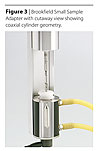


Figure 3

High-Shear-Rate Testing

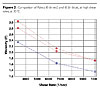
Data from high-shear-rate testing, using cone-plate geometry, are presented in Figure 2. Each paint was tested with a Brookfield CAP 2000+L Viscometer, first by increasing and then by decreasing the shear rate. Paint #5 is significantly more viscous than Paint #3, over the speed range tested. Furthermore, there is more hysteresis in #5’s data. That is, the viscosities in the increasing-speed ramp lie higher than those in the decreasing-speed ramp. This indicates thixotropy – the fluid’s structure takes time to rebuild after being sheared. The data in Figure 2 are plotted as Poise (1 P is equal to 100 centipoises, or 100 cP) and, therefore, range from about 120 to 310 cP. Also, S.I. units users may note that 1 cP equals 1 mPa·s or milliPascal-second.

Figure 4

Moderate-Shear-Rate Testing

Another commonly used geometry is coaxial- or concentric-cylinder. This is sometimes referred to as Couette or Searle geometry. Strictly speaking, Couette’s viscometer had a rotating outer cylinder with a stationary inner cylinder, and Searle’s instrument had a rotating inner cylinder with a stationary outer cylinder. This geometry is also convenient to use because it requires relatively low sample volumes, depending upon the spindle and sample chamber combination selected, and allows fairly easy sample access, as well. The Brookfield Small Sample Adapter system  (Searle geometry), on a typical viscometer, is shown in Figure 3.

Representative data for paints #5 and #1 are shown in Figure 4, at low to moderate shear rates, at 25 ºC, using the Brookfield Small Sample Adapter. The SC4-21 spindle was used with the SC4-13RPY chamber on a Brookfield RDVII+Pro Viscometer.
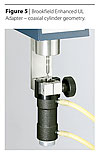


Figure 5

Low-Shear-Rate Testing

Larger-sized coaxial cylinder geometries are suitable for measuring low-viscosity materials, particularly at low to moderate speeds or shear rates. The Brookfield Enhanced UL Adapter (Searle geometry) is shown in Figure 5.

Although not used as often, low shear rate data, such as those shown in Figure 6, may provide insights into behavior that may be similar to settling or leveling.

Paint #5 is not only more viscous than paint #1 at all shear rates, but it is several times more viscous at shear rates below 0.5 s-1, when tested with the Brookfield Enhanced UL Adapter on a Brookfield RVDV-III+ Rheometer. This may suggest possibly greater long-term stability and resistance to settling, while the canned product sits on the shelf.

This also suggests that another property may be worth investigating:  the yield stress – that is, the stress required to make a solid material flow like a liquid. This solid-like behavior would provide even greater resistance to settling of suspended solids in a coating during storage. A number of mathematical models were developed over the years, to try to better fit data observed in various materials. Figure 7 shows the fit of the Herschel-Bulkley model to the data for Paint #5.

This equation is used to estimate the yield stress, based upon the flow curve; it is as follows:

                                                    (1)

            where τ  =  shear stress, dyne/cm2,
            η  =  consistency index, cP,
            g ·  =  shear rate, s-1; strictly speaking, in this equation, (s-1)(1/n),
            n  =  consistency index
            τ0  =  yield stress, dyne/cm2.
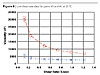


Figure 6

The apparent viscosity is used, because, as you can see from the graphs, the measured viscosity changes with shear rate. The “H-B” model gives a very good fit to the data in Figure 7; the coefficient of fit or “CoF” is 99.9 out of 100. The calculated yield stress in this case is not very high; 17.2 dyn/cm2 – probably a good thing for a paint that should be fairly easily brushed onto a wall by a homeowner!

Readers probably noticed that Figure 2 data were taken at 20 °C, while other figures present data at 25 °C. This was done on purpose – so that we could remind our audience to always try to keep their temperatures consistent when comparing various coatings, because even a 5 °C increase in temperature may significantly reduce the viscosity of a given material under given shear rates.

In conclusion, testing your products over a range of shear rates (multiple speeds), rather than at one rate, will allow you to gain a better understanding of your material’s performance, whether it’s settling or being rapidly applied.
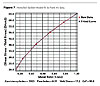


Figure 7

Acknowledgement

The author thanks George H. Aronson (Technician) and Ross Zinkowski (Summer Student – Engineering Intern) for performing the experiments and graphing the data.

For more information, contact David J. Moonay, Ph.D., Sales Engineer – Rheology Laboratory Supervisor, at Brookfield Engineering Labs., Inc., 11 Commerce Blvd., Middleboro, MA, 02346; phone 508/946.6200, ext. 144; or visit www.brookfieldengineering.com.

Share This Story

Looking for a reprint of this article?
From high-res PDFs to custom plaques, order your copy today!


David J. Moonay, Ph.D. | Brookfield Engineering Labs, Inc., Middleboro, MA

Recommended Content

JOIN TODAY
to unlock your recommendations.

Already have an account? Sign In

  • pci1022-Kinaltek-Lead-1170.jpg

    A Novel Pigment Production Technology

    Following an extensive R&D program that demonstrated...
    Paint and Coating Pigments
    By: Jawad Haidar and Nitin Soni
  • pci global top 10

    2025 Global Top 10: Top Paint and Coatings Companies

    The following is PCI’s annual ranking of the top 10...
    Global Top 10 and PCI 25
    By: Courtney Bassett
  • 2025 pci 25

    2025 PCI 25: Top Paint and Coatings Companies

    PCI's annual ranking of the top 25 North American paint...
    Paint and Coating Market Reports
    By: Courtney Bassett
You must login or register in order to post a comment.

Report Abusive Comment

Manage My Account
  • eMagazine
  • Newsletters
  • Online Registration
  • Subscription Customer Service

More Videos

Sponsored Content

Sponsored Content is a special paid section where industry companies provide high quality, objective, non-commercial content around topics of interest to the PCI audience. All Sponsored Content is supplied by the advertising company and any opinions expressed in this article are those of the author and not necessarily reflect the views of PCI or its parent company, BNP Media. Interested in participating in our Sponsored Content section? Contact your local rep!

close
  • colorful building exterior
    Sponsored byDow

    Insights into Exterior Architectural Coating Degradation: Bridging Accelerated and Natural Weathering

  • digital pigments
    Sponsored bySiltech

    The Fourth Dimension of Silicon: Siltech Q Resins

Popular Stories

Company News

What the AkzoNobel–Axalta Merger Means for the Future of Coatings

AkzoNobel and Axalta Headquarters

AkzoNobel and Axalta Announce $25 Billion Merger

Wacker logo

WACKER Plans More Than 1,500 Job Cuts


PCI Buyers Guide

Submit a Request for Proposal (RFP) to suppliers of your choice with details on what you need with a click of a button

Start your RFP

Browse our Buyers Guide for manufacturers and distributors of all types of coatings products and much more!

Find Suppliers

Events

September 4, 2025

N-Butylpyrrolidone (NBP) as a Green Solvent to Replace N-Methylpyrrolidone (NMP) in Industrial Coating Applications

ON DEMAND: EPA published a regulation proposal around N-methylpyrrolidone (NMP) in June 2024 to ban or limit NMP in many applications, such as paints and coatings and their removers. N-butylpyrrolidone (NBP) is a powerful and versatile solvent for a variety of industries looking for alternatives to substance of very high concern (SVHC)-listed solvents.

March 24, 2026

The Manufacturing & Automation eXchange (MAX)

MAX presents a rare opportunity to observe the full scope of manufacturing in one environment. From systems integration and materials handling to automation, quality, safety, and packaging, each discipline is represented through live, operational displays. By experiencing these technologies side by side, as they are on actual production floors, attendees gain a grounded understanding of how manufacturing functions align, overlap, and evolve in practice.

View All Submit An Event

Poll

Longest-running laboratory experiment

What is the longest-running laboratory experiment?
View Results Poll Archive

Products

Automotive Paints and Coatings, 2nd Edition

Automotive Paints and Coatings, 2nd Edition

Now in its second edition and still the only book of its kind, this is an authoritative treatment of all stages of the coating process.

See More Products
pci voices from the top ebook

PCI webinar

Related Articles

  • viscosity

    Viscosity Testing for Bayferrox Pigments

    See More
  • Joseph Koleske Honored For Editing of Manual on Testing of Coatings

    See More
  • GettyImages-1317219870-1170.jpg

    Performance Advantages of Glass Bubbles in Energy-Related Coatings Applications

    See More

Related Products

See More Products
  • durability.jpg

    Increasing the Durability of Paint and Varnish Coatings in Building Products and Construction 1st Edition

  • corrosion of linings.jpg

    Corrosion of Linings & Coatings: Cathodic and Inhibitor Protection and Corrosion Monitoring

  • intelligent.jpg

    Intelligent Coatings for Corrosion Control 1st Edition

See More Products
×

Keep the info flowing with our eNewsletters!

Get the latest industry updates tailored your way.

JOIN TODAY!
  • RESOURCES
    • Advertise
    • Contact Us
    • Directories
    • Store
    • Want More
    • Manufacturing Division
  • SIGN UP TODAY
    • Create Account
    • eMagazine
    • Newsletters
    • Customer Service
    • Manage Preferences
  • SERVICES
    • Marketing Services
    • Reprints
    • Market Research
    • List Rental
    • Survey & Sample
  • STAY CONNECTED
    • LinkedIn
    • Facebook
    • Youtube
    • X (Twitter)
  • PRIVACY
    • PRIVACY POLICY
    • TERMS & CONDITIONS
    • DO NOT SELL MY PERSONAL INFORMATION
    • PRIVACY REQUEST
    • ACCESSIBILITY

Copyright ©2025. All Rights Reserved BNP Media.

Design, CMS, Hosting & Web Development :: ePublishing