
Distributors Play a Critical Role in the Supply Chain

In the ever-changing coatings industry, distributors play an important role in the supply chain. From just-in-time procurement strategies to risk management, distributors can bring real value to customers. In today’s economic environment, distributors are being relied on heavily as our customers are more likely to order smaller volumes of products on a more frequent basis. Established partnerships with distributors provide for continuity and trust of supply. The following discussion highlights some of the challenges that distributors face, as well as benefits that they can offer to both customers and suppliers.
Challenges
Chemical distributors are facing a wide variety of challenges. First and foremost, similar to most of our customers and manufacturing partners, we are experiencing unprecedented price increases for materials, energy and transportation. Unfortunately we have little control over our number-one cost, which is raw materials. This is driven by our suppliers and their exposure to global market factors, including the price of oil at ~ $120/barrel. We can certainly pull selling and administrative costs out of the system and implement some controls on freight expenses by establishing strong relationships with local carriers, innovative consolidation and the utilization of third-party logistics providers; but we need to get savvier in finding new ways to bring real value to the customer base. Manufacturers are driving increases through and customers are pushing back. As this happens, distributors are faced with reduced profitability or walking away from business.Fortunately for our sake, most distributors do not have the cost structures that most manufacturers have. This is largely a result of the size and scope of our operations. We are quick to act and more willing to take entrepreneurial risks that manufacturers cannot.
Industry consolidation on both the customer and supplier side greatly affects the long-term viability of distribution companies. As the North American coatings industry has consolidated over the past decade, there are far fewer coatings manufacturers for distributors to supply. From a distributor’s perspective, this problem is compounded by the fact that the top tier coatings companies are often times handled as “house” accounts for our manufacturers. This consolidation is expected to continue, as small and mid-size coatings manufacturers need to realize economies of scale to compete.
Some of the smaller coating manufacturers with a retail presence are beginning to displace their own products by selling well-recognized national brands at their owned and operated stores. The increasing operations, human resource and marketing costs prohibit these customers from making small batches of paint, when they can simply order cases to stock the shelves. If this trend continues, distributors will be faced with a further cannibalization of our sales.
Nearly every distributor in every industry touts its ability to offer outstanding customer service and promotes its fantastic sales relationships. If everyone offers this, then it cannot be a competitive advantage. Distributors need to strive to offer a complementary range of products that meet the needs of their customers at the right price, with the right quality, in the right package, at a lead-time acceptable to their clients. The ability of a distributor to differentiate is value driven. What can a supplier do to increase the value that can be offered to a customer? It’s critical to understand a customer’s process, product mix, cost structures and competitive landscape before you can offer solutions. Developing a consultative sales force that sells multiple layers in an organization allows you to identify value and provide tailored solutions.
What is the Value of Distributors?
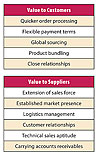
A Customer PerspectiveCustomers may sometimes think, “Why do I need to buy from a middle man when I can just go direct at a lower cost?” There are several answers to this question, but the most straightforward is that either the buyer or seller in a direct relationship will have to perform the function of the distributor. This adds cost to the equation, as can be seen in several key areas.
Distributors can typically offer a greater level of flexibility than manufacturers. This includes quicker turnaround times on orders, often in as little as two hours. Most manufacturers today supply orders based on 7- to 30-day lead-times, excluding the transit time to import products to the United States. With just-in-time manufacturing principals in place at many customer’s facilities and ever changing production schedules, customers do not have the luxury of waiting four to eight weeks for materials to arrive. With customers focused on increasing inventory turns and improving working capital and revenue through operational efficiencies, the distribution channel is critical to maintain inventory strategically located near the customer base. Tony Carignano, Sales Manager Americas Technical Sales & Market Development, Solutia Inc., states “Successful distributors can move at a velocity unmatched by most multinational chemical manufacturers. In today’s economic environment, customers have come to demand immediate shipment of materials. The infrastructure of manufacturers strives to optimize process efficiencies and distributors are relied on heavily to meet the logistics needs of the customers.”
This flexibility also extends to financial considerations such as extended payment terms and consignment programs. Publicly traded, multi-billion dollar chemical manufacturers often times are not willing to extend payment terms and rarely consider consignment programs. International suppliers often demand payment prior to shipment delivery. Agile, privately held distributors have more flexibility to implement programs that bring a greater level of value to the customer.
From a sourcing standpoint, distributors greatly reduce risk for their customers. As our industry continues to expand globally, small and mid-size customers have to take advantage of global sourcing to realize cost benefits and technology advancements. However, customers of this size often times do not have the resources available to visit facilities that are located thousands of miles away to qualify materials, audit plants, manage international logistics and establish the supply relationship. Furthermore, it is cost prohibitive for customers to buy full container quantities of products when they only need a few thousand pounds per month. Good distributors can fill this role by bridging this “international gap” through a systematic approach of identifying new sources for products, conducting regular plant audits, having local representatives active in developing countries, and importing full container quantities of products and selling pallet or bag quantities.
One of the most prevalent advantages that distributors can offer is in the area of product bundling. Customers have the ability to purchase several items from one supplier, greatly reducing administrative and freight costs. Most successful distributors offer a complementary portfolio of products that can be combined in less than truckload quantities. If a customer requires resin, additives, pigment and containers, they can combine these on one order, from one supplier, and pick them up on the day they are needed for a production batch.
Finally, due to their geographic proximity, distributors can maintain close relationships with customers to gain an in-depth understanding of their processes, formulations and competitive advantages. Most distributors visit customers on a much higher frequency than manufacturers can. This is prevalent in today’s economy where the cost of business travel has skyrocketed. Customers don’t have to wait weeks to see someone in case of emergency; distributors can be in your plant by the end of the shift. Additionally, this level of relationship affords the distributor the opportunity to bring innovative end products that can generate new revenue and profitability. Because of their vast range of market knowledge, distributors can often times help the customer better tailor their research dollars.
A Supplier Perspective
In addition to the benefits already highlighted, distributors offer unique advantages to suppliers. Effective sales channel management will lead to greater profitability, increased market share and higher customer satisfaction. Distributors can be viewed as an extension of a supplier’s sales force in markets where it is not economically viable to establish a permanent facility or direct staff. This outsourcing of the sales function results in lower costs and allows the manufacturer to concentrate on R&D and manufacturing disciplines. With rising health care costs, travel expenses and language barriers, etc., some manufacturers simply would not be able to access the North American market without local distribution partners.
Furthermore, due to their established market presence, distributors can typically develop business in a much shorter timeframe than suppliers new to a market. The ability to gather market intelligence is more likely to be achieved by a distributor than a new face. Continuity of long-standing geographic coverage creates business relationships that are built on trust and mutual dependency. Where a direct sales force is employed, distributors can still offer an advantage because of these relationships.
With the explosion of the internet, manufacturers throughout the world can be easily identified. Establishing the logistics flow is a more complex challenge. Navigating through a sea of federal, state and local regulations can affect the transport of certain products and provide hurdles that cannot be readily overcome. Additionally, the ability to provide samples, custom labels or contract packaging are all services that most distributors offer. With facilities equipped to handle hazardous goods, distributors certified in the NACD’s Responsible Distribution ProcessSM are qualified to safely and efficiently deal with damages, spills or other unexpected occurrences.
Distributors are often the first call when chemists are working to develop new formulations. Our wide breadth of knowledge based on experience supplying multiple components to the formulation is an asset for our partners. Distributors are able to cross fertilize from one product group to another and one industry to the next.
There are significant financial advantages to working with a distributor. Notwithstanding the tax benefit of not establishing a local presence, distributors carry the receivables. Manufacturers are set up to optimize production capacity and do not want to sell a couple of bags or single pallets to 100 different customers who speak different languages, want custom labeling and need immediate delivery. Furthermore, when it’s time to get paid, contacting one distributor is much more cost effective than trying to collect from multiple customers.
Conclusion
Although there are significant challenges that distributors face, today’s economic environment affords an opportunity for significant growth. Distributors offer several advantages to both customers and suppliers, and we play a critical role in the supply chain.For more information, contact Michael F. McKenna, Business Development Manager, at 1-877-Maroon1, e-mail mmckenna@marooninc.com or visit www.marooninc.com.
National Association of Chemical Distributors, Responsible Distribution ProcessSM, www.nacd.com.
Looking for a reprint of this article?
From high-res PDFs to custom plaques, order your copy today!