Painting & Coating Industry (PCI) logo Powder coating summit logo
search
cart
facebook twitter linkedin youtube
  • Sign In
  • Create Account
  • Sign Out
  • My Account
Painting & Coating Industry (PCI) logo Powder coating summit logo
  • NEWS
    • Latest News
    • Market Trends & Reports
    • Finishing News
    • Price Alerts
    • Subscribe to Newsletters
    • Global Top 10/ PCI 25
    • Weekly Featured Article
    • COATLE Word Game
  • PRODUCTS
    • Product News
    • Must See Products and Services
  • MATERIALS
    • Additives
    • Resins/Polymers
    • Pigments
    • Equipment
    • Distributors
  • TECHNOLOGIES
    • Adhesives
    • Architectural Coatings
    • Finishing Articles
    • Finishing Technologies
    • Finishing Equipment
    • Industrial Coatings
    • Nanotechnology
    • Powder Coatings
    • Solventborne
    • Special Purpose Coatings
    • Sustainability
    • UV Coatings
    • Waterborne
  • RESOURCES
    • Columns
      • Did you know?
      • Distribution Dive
      • Formulating With Mike
      • Innovation Insights
      • Powder Coating Perspectives
      • TiO2 Insider
    • Blogs
      • Editor's Viewpoint
      • Industry Insights
    • Coatings Supplier Handbook
    • Podcasts and Videos
      • COAT-IT! Podcast
      • Videos/PCI TV
    • PCI Store
    • Classifieds
    • eBooks
    • Sponsor Insights
    • White Papers
    • COATLE Word Game
  • EVENTS
    • Coatings Trends & Technologies Summit
    • Paint and Coatings Academy
    • Webinars
    • Calendar of Events
    • Lifetime Achievement Award
  • DIRECTORIES
    • Buyer's Guide
    • Equipment Directory
    • Materials Directory
  • EMAGAZINE
    • Current Issue
    • eMagazine Archive
    • China Issue Archive
    • Editorial Advisory Board
  • CONTACT
    • Contact Us
    • Advertise
    • Subscribe to eMagazine
    • Subscribe to Newsletters
  • SIGN UP!
FT Archives

Technical Paper Abstract : Summer 2000

November 8, 2003
Summer 2000 Vol. 2 No. 2

Subject: Powder coating that cures by ultraviolet light is a new technology that combines many of the advantages of conventional thermosetting powder coatings with those of liquid UV-curable coatings.

Preparation, handling and spraying procedures for a UV-curable powder formulation are similar to those for a thermosetting powder formulation. But in UV-curable powder coatings, melting/flow-out and curing are two separate processes. Upon exposure to heat, UV-curable powder coatings melt and flow into a smooth film. Cross-linking occurs when the molten film is exposed to UV light.

Absence of thermal cure during melting of UV-curable powder coatings allows optimum flow-out, resulting in smooth finishes even at relatively low temperatures (90 to 140°C). This low-temperature flow-out, combined with rapid curing, makes UV-curable powder coating an ideal method for coating several types of heat-sensitive substrates.
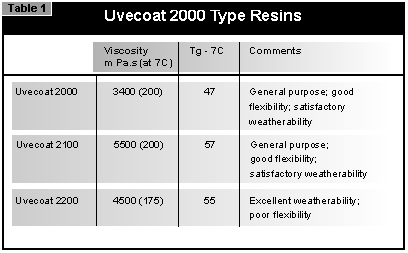
UCB has developed a number of UV-curable powder systems in its research laboratories. These systems illustrate potential applications for various substrates. Formulations based on Uvecoat 1000 resins are especially suitable for the coating of wood composites, such as medium-density fiberboard. The Uvecoat 2000 resins are designed for use on metal surfaces and are available in several types (Table 1).

The use of UV-curable powders for metal substrates opens up a range of potential applications. It is now possible to coat metallic objects that may contain heat sensitive parts, such as electrical wires, plastic parts, rubber seals, etc. Compared to conventional powder coatings, the use of UV-curable powders on heavy metal parts or blanks offers potential savings in energy and production costs. The production of UV-curable powder coatings based on Uvecoat 2000 resins on metal surfaces has been tested. Properties such as film flexibility, corrosion and weathering resistance are covered in this paper.

UV-curable powders are also advantageous in the coating and curing of large-mass parts. With convection heating, long oven times are necessary to achieve a high enough temperature to fully cure the coating. Infrared heating has decreased the time for coating and curing large-mass parts. UV-curable powder coatings can further reduce curing time and increase energy savings.

Preassembled components may contain subassemblies made from various substrates, including some that are heat sensitive. An example of this is an object containing both metal and plastic parts, such as a motor containing electric wiring. In the past, subcomponents had to be individually painted and assembled so the heat-sensitive components would not be subjected to the heat needed to cure metal parts. The use of UV-curable powders allows the manufacturer to fully assemble a component and then apply a coating without damaging any heat-sensitive subassemblies. Because temperature require-ments are lower, the coating of heat-sensitive alloys also becomes possible with this new technology. The fast heating and curing cycle increases productivity for technologies, including the coating of blanks.

Irradiation of the molten film with UV light cross-links the UV-curable powder coatings. This activates the photoinitiator(s), causing the molten Uvecoat-based formulations described in this paper to react and form a network by a free-radical polymerization mechanism. Uvecoat 2000 resins used as binder in the studied formulations are polyesters containing (meth) acrylic double bonds. This type of cross-linking chemistry is also used in traditional liquid UV-curable coating technology. The main characteristics of the tested resins are listed in Table 1.
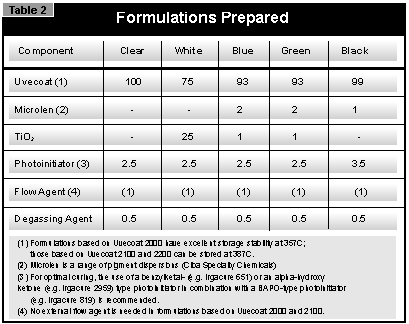
The formulations used in this study are listed in Table 2. They were prepared using conventional powder production methods on a twin-screw extruder. They were applied electrostatically to yellow (Cr + 6) chromated aluminum and electrolytic chromium-coated steel (ECCS) test panels. Clearcoats were applied at 50 to 90 microns (2 to 3.6 mils), and pigmented coatings were applied at 50 to 70 microns (2 to 2.8 mils).

Medium-wave infrared (IRM) radiation and/or convection heat can be used to heat the powder to melt and flow. For UCB's tests, a combination of IRM and convection was used; the convection oven temperature was set at 90 to 110°C for dark formulations and 100 to 140°C for lighter formulations. A typical heating cycle was as follows:

  • IR zone settings: 100%, 100%, 100% 100%. Time: 15 sec.
  • Combi-zone settings: 40%, 30%, 20%. Time: 40 sec.
  • Convection-zone setting: 110ºC. Time: 60 sec.
Differential photocalorimetry measurements have shown 110°C is the optimum temperature for cross-linking.

The molten film is subsequently exposed to UV light. For clear formulations, both surface and in-depth cure are achieved by irradiating with two mercury vapour lamps (160 W/cm) at a line speed of 3 m/min (9.8 fpm). This corresponds with a UV dose of ±2000 mJ/cm~ (UV-A). For pigmented formulations, best results are obtained by irradiating with, successively, a Gallium-doped mercury vapour lamp (160 W/cm) and a mercury vapor lamp (160 W/cm), also at a line speed of 3 m/min; this corresponds with a UV dose of ±4000 mJ/cm~ (UV-V).

UV-curable powder coatings based on Uvecoat 2000 resins exhibit a high-gloss (60 degrees > 90). Depending on the heating cycle used, smooth to very smooth finishes can be achieved.

Adhesion was evaluated by doing a cross-cut test in accordance with ISO 2409. When taking into account the recommended coating thickness, clearcoats and pigmented systems exhibit a good to very good adhesion.
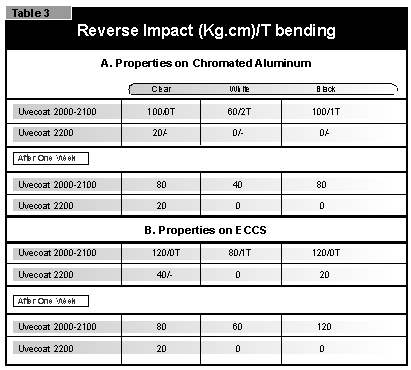
Flexibility of the three systems was tested in a clear, white and black formulation on the substrates previously mentioned. Flexibility was evaluated by doing an impact and T-bending resistance test (falling ball test method according to ASTM D2794 for impact resistance and T-bending according to ASTM D4145). Tests are performed at a temperature of 22 ±2°C after a one-hour relaxation period. Impact resistance is tested after aging one week. Flexibility of Uvecoat 2000- and 2100-based formulations is comparable on different types of substrates (Table 3). Impact resistance of formulations containing Uvecoat 2200 as the binder is very low, except for clears where there is some degree of flexibility.

The quality of the metal pretreatment is as important as the properties of the coating to avoid delamination and blistering due to the formation of corrosion under the coating. For the UCB study, yellow chromated aluminum and electrolytic chromium-coated steel were used.
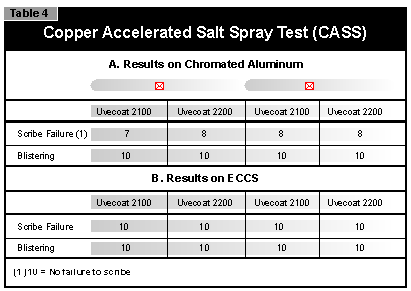
Corrosion resistance was tested on the clear and white formulation using a copper accelerated salt spray test according to ASTM B368. This test used a 5% salt solution containing CuII chloride and glacial acetic acid; exposure time was 240 hours. In Table 4, both scribe failure (delamination next to the scribe) and formulation of blisters are rated. All UV-curable powder systems tested exhibit good corrosion resistance on chromated aluminum and electrolytic chromium-coated steel.

Weathering Resistance

UCB has considerable experience in testing outdoor durable thermosetting powder coatings. The QUV-A test is a valuable accelerated-weathering method to forecast the durability of new polyester resins. UV-A bulbs provide a close reproduction of the solar spectrum to around 350 nm, which correlates to natural exposure in Florida.

Using this accelerated-weathering test, the different Uvecoat systems were tested in a white RAL 9010 formulation and compared with a standard outdoor durable TGIC-based system. The cycle used is in accordance with ASTM G53-88. Panels were subjected to the alternate effects of condensation (4 hours at 50°C) and the damaging effects of sunlight simulated by the fluorescent UVA lamps (340 nm/I = 0.77 W/m2/nm) (8 hours at 60°C).

Gloss was measured at a 60-degree angle as a function of exposure time. The results show that the Uvecoat 2000-based formulation (Uvecoat 2100-based system performs in a comparable way) performs less well than the standard, but that the formulation based on Uvecoat 2200 performs extremely well.

The TGIC control showed a 50% reduction in gloss after about 3,100 hours of exposure, while the Uvecoat 2000/2100 system shows the same loss of gloss at about 1,800 hours. For the Uvecoat 2200 system, gloss is still higher than 75% of the original value after 6,000 hours.

In 1998, some pigmented formulations based on Uvecoat 2200 were sent to Florida for natural exposure (45-degree angle facing south). Blue, green and white formulations are shown in Table 2, and the percent of original gloss is compared with a white standard durable thermosetting powder system. After 18 months of exposure, all Uvecoat 2200-based systems exhibit a relative gloss of more than 95% and color difference (DE) is lower than 2. At the same time, the relative gloss of the standard had decreased to about 75%.

Based on these preliminary results, UCB states that UV-curable powder coatings based on Uvecoat 2200 have excellent weathering resistance and are well suited for outdoor applications.

Share This Story

Looking for a reprint of this article?
From high-res PDFs to custom plaques, order your copy today!


Recommended Content

JOIN TODAY
to unlock your recommendations.

Already have an account? Sign In

  • pci1022-Kinaltek-Lead-1170.jpg

    A Novel Pigment Production Technology

    Following an extensive R&D program that demonstrated...
    Paint and Coating Pigments
    By: Jawad Haidar and Nitin Soni
  • pci global top 10

    2025 Global Top 10: Top Paint and Coatings Companies

    The following is PCI’s annual ranking of the top 10...
    Global Top 10 and PCI 25
    By: Courtney Bassett
  • 2025 pci 25

    2025 PCI 25: Top Paint and Coatings Companies

    PCI's annual ranking of the top 25 North American paint...
    Global Top 10 and PCI 25
    By: Courtney Bassett
You must login or register in order to post a comment.

Report Abusive Comment

Manage My Account
  • eMagazine
  • Newsletters
  • Online Registration
  • Subscription Customer Service

More Videos

Sponsored Content

Sponsored Content is a special paid section where industry companies provide high quality, objective, non-commercial content around topics of interest to the PCI audience. All Sponsored Content is supplied by the advertising company and any opinions expressed in this article are those of the author and not necessarily reflect the views of PCI or its parent company, BNP Media. Interested in participating in our Sponsored Content section? Contact your local rep!

close
  • colorful building exterior
    Sponsored byDow

    Insights into Exterior Architectural Coating Degradation: Bridging Accelerated and Natural Weathering

  • digital pigments
    Sponsored bySiltech

    The Fourth Dimension of Silicon: Siltech Q Resins

Popular Stories

Company News

What the AkzoNobel–Axalta Merger Means for the Future of Coatings

AkzoNobel and Axalta Headquarters

AkzoNobel and Axalta Announce $25 Billion Merger

Wacker logo

WACKER Plans More Than 1,500 Job Cuts


PCI Buyers Guide

Submit a Request for Proposal (RFP) to suppliers of your choice with details on what you need with a click of a button

Start your RFP

Browse our Buyers Guide for manufacturers and distributors of all types of coatings products and much more!

Find Suppliers

Events

September 4, 2025

N-Butylpyrrolidone (NBP) as a Green Solvent to Replace N-Methylpyrrolidone (NMP) in Industrial Coating Applications

ON DEMAND: EPA published a regulation proposal around N-methylpyrrolidone (NMP) in June 2024 to ban or limit NMP in many applications, such as paints and coatings and their removers. N-butylpyrrolidone (NBP) is a powerful and versatile solvent for a variety of industries looking for alternatives to substance of very high concern (SVHC)-listed solvents.

March 24, 2026

The Manufacturing & Automation eXchange (MAX)

MAX presents a rare opportunity to observe the full scope of manufacturing in one environment. From systems integration and materials handling to automation, quality, safety, and packaging, each discipline is represented through live, operational displays. By experiencing these technologies side by side, as they are on actual production floors, attendees gain a grounded understanding of how manufacturing functions align, overlap, and evolve in practice.

View All Submit An Event

Poll

Longest-running laboratory experiment

What is the longest-running laboratory experiment?
View Results Poll Archive

Products

Automotive Paints and Coatings, 2nd Edition

Automotive Paints and Coatings, 2nd Edition

Now in its second edition and still the only book of its kind, this is an authoritative treatment of all stages of the coating process.

See More Products
pci voices from the top ebook

PCI webinar

Related Articles

  • Technical Paper Abstract : Fall 2000

    See More
  • Patent Watch: Summer 2000

    See More
  • Technical Paper Abstracts: Fall 1999

    See More

Related Products

See More Products
  • pci september 2019

    PCI September 2019 Issue

  • Nanocoatings_150x225.gif

    Nanocoatings: Principles and Practice

See More Products
×

Keep the info flowing with our eNewsletters!

Get the latest industry updates tailored your way.

JOIN TODAY!
  • RESOURCES
    • Advertise
    • Contact Us
    • Directories
    • Store
    • Want More
    • Manufacturing Division
  • SIGN UP TODAY
    • Create Account
    • eMagazine
    • Newsletters
    • Customer Service
    • Manage Preferences
  • SERVICES
    • Marketing Services
    • Reprints
    • Market Research
    • List Rental
    • Survey & Sample
  • STAY CONNECTED
    • LinkedIn
    • Facebook
    • Youtube
    • X (Twitter)
  • PRIVACY
    • PRIVACY POLICY
    • TERMS & CONDITIONS
    • DO NOT SELL MY PERSONAL INFORMATION
    • PRIVACY REQUEST
    • ACCESSIBILITY

Copyright ©2025. All Rights Reserved BNP Media.

Design, CMS, Hosting & Web Development :: ePublishing