Electronic Proportioning

Electronic proportioners offer a number of benefits. The systems can provide accurate two- and three-component proportioning, including the ability to handle single and multiple color applications. Furthermore, they offer the ability to handle a wide range of operating ratios with a high degree of ratio accuracy at various flow rates. These proportioners are also versatile enough to allow for both air spray and air-assisted applications, including the use of electrostatics. Electronic proportioners can be used with a variety of plural-component materials, including solventborne, waterborne and water-reducible urethanes, epoxies, and acid-catalyzed paints. For these reasons, electronic proportioners have become standard operating systems in many finishing operations around the world.
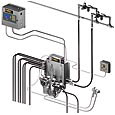
Figure 1. A typical electronic proportioning system includes two key pieces of hardware: the controller (above left) and the fluid panel (center).
Other Methods
There are other methods of proportioning plural-component materials, such as hand or mechanical proportioning. However, both of these methods have drawbacks. One of the major limitations to hand mixing is in material handling and disposal. Plural-component materials must be mixed in batches, which usually results in increased waste. Leftover material cannot be saved, and unused material disposal is expensive. In addition to material handling issues, hand proportioning does not offer a high degree of ratio consistency and can therefore cause the finish quality to be inconsistent from batch to batch.Compared to hand proportioning, electronic proportioners mix material on demand, resulting in minimal waste. The only wasted material is the paint from the system integrator to the applicator, which generally results in less than 500 cubic centimeters (cc) of wasted paint in a typical application. Electronic proportioners also can control ratio accuracy to 1%.
Mechanical proportioners can provide on-demand mixing and can handle large volumes of material. However, they do not have an inherent ratio verification process, and they cannot offer ratio accuracy beyond 10% due to mechanical limitations caused by the effect of mechanical wear and pump cavitation. They are also generally slow and difficult to flush if a color change is required. Conversely, electronic proportioners offer a reliable ratio verification process, as well as a calibration function to compensate for mechanical wear. They also offer an easy color change option that can minimize color change downtime.
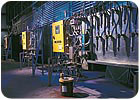
The fluid meters and valves work together to control the flow of the individual materials to the systems integrator.
Hardware
A typical electronic proportioning system includes two key pieces of hardware (see Figure 1). The first is the controller, which offers an easy-to-use interface for placing the system in standby, mix, purge or color selection modes. The controller is also used for reading and clearing alarms, printing reports or monitoring live production.The second key piece of hardware is the fluid panel. This panel contains the fluid meters and the dosing valves for the base and the catalyst components used in plural-component paints. The fluid meters and valves work together to control the flow of the individual materials to the systems integrator. Once the materials have been injected into the integrator at the proper ratio, the integrated material is moved through a static mixer to complete the mixing process. The solvent flush and air purge valves for clearing the mixed material from the system, as well as the color selecting valves, are also located on this piece of hardware.
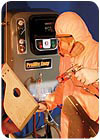
Electronic proportioners mix material on demand, resulting in minimal waste.
Basic Operation
When a proportioning system is initially installed, it is programmed with the user’s color and ratio information. After the information is programmed, the operator simply enters the recipe number on the controller, turns the controller to mix and begins production. If the recipe calls for a 4:1 mix ratio, the system will dispense four parts of the base material and one part of the catalyst material. In other words, for every 50 cc dispensed, the controller will allow 40 cc of the base component and 10 cc of catalyst. The system completes this operation by counting pulses from the fluid meter and opening and closing the dispense valves accordingly. Each meter pulse represents a specific amount of material that has passed through the system.After each cycle, the system verifies ratio accuracy. When accuracy has been confirmed, the system mixes another 50 cc batch. This continuous process occurs without spikes or surges to the material dispense rate.
When the operator calls for a color change, the system opens the solvent color flush valve to introduce solvent into the system. The solvent flushes out the previous resin color from the color change valve up to the dosing valves. Once the old resin color has been flushed from the system, the new resin color is introduced. However, before the new color can be sprayed, the mixed material line must also be thoroughly flushed of the old color. The system first uses air to push a majority of the old mixed material out of the fluid line. It then uses alternating short pulses of air and solvent, called the “air-solvent chop,” to create a turbulent flow for improved cleaning of the mixed material line while conserving solvent. After the line is thoroughly cleaned, the hose is filled with solvent. Once the flushing procedure is complete, the new color can then be loaded to the applicator.
To ensure proper and consistent flushing and loading of new colors, the flush procedure can be automated. All the operator needs to do is choose the color on the operator station, place the gun in a gun flush box and press the enter key. The system will than perform a preprogrammed flush procedure. If the system does not have a gun flush box, then the gun must be triggered into a grounded metal container, and the operator will need to watch for the new color.
Most problems and off-ratio incidents are detected by the proportioner’s ratio monitoring system. Depending on how the system is programmed, the system will either automatically stop production or it will simply sound an alarm alerting the operator to an off-ratio condition. The controller will describe the problem on the display panel by either an error code or a text message, depending on the system. Among the functions monitored by an electronic system are material pot life, off-ratio errors and purge errors.
An Affordable Option
Most electronic proportioners are easy to operate and contain state-of-the-art diagnostics that can keep manufacturing processes running smoothly and efficiently. They provide definite advantages over hand proportioning and mechanical proportioners. The range of electronic porportioners available today makes them affordable for most industrial finishing applications.Links
Looking for a reprint of this article?
From high-res PDFs to custom plaques, order your copy today!