The Low-VOC Future: New Opportunities in Tinting System Design

Editor’s Note: This article is the second installment in a four-part series on Integrated Tinting Systems.
In the past, retailers were fined for selling paint that exceeded the legal VOC limits. Limits are set both for ready-to-use paint and for the colorants used in the tinting of base paints. In 2011, the South Coast Air Quality Management District (SCAQMD) introduced a regulation to reduce VOC levels in colorants for architectural coatings (excluding maintenance coatings, which are not water-based) to 50 g/L effective January 1, 2014. The VOC limit for colorants used for tinting solvent-based industrial maintenance coatings remains at 600 g/L.
Action is therefore required by paint producers to convert their tinting systems to low- or no-VOC colorants. Most U.S. paint producers operate a standardized, universal, 12-colorant tinting system, for which VOC-free alternatives are readily available to pour over the existing set. While this sounds easy and convenient, paint producers are well advised to seek the support of tinting systems experts with many years of experience in low-VOC tinting system conversions. European legislation started setting VOC limits for colorants as early as 1999, which is why there are companies that have been carrying out successful conversions for more than a decade.
Certainly for the professional end user, paint properties are as important as color accuracy. Professional users demand consistency in gloss levels, dry times and application characteristics such as viscosity, brush feel or sag resistance. These properties can all be affected by colorants, particularly colorants that contain a higher percentage of water such as is found in low- or no-VOC colorants.
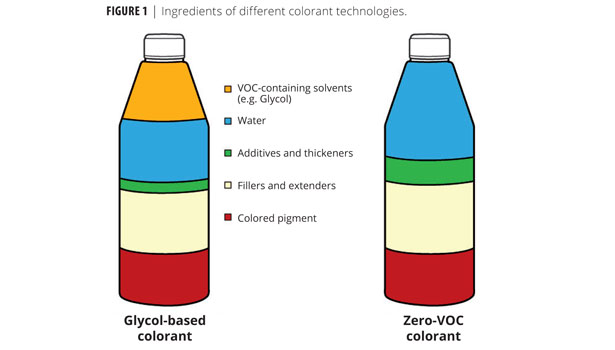
Low- or no-VOC colorants may be coloristically identical to their glycol-containing counterparts, however, they will behave differently in the dispensing equipment and in the base paint. This may only become apparent months after the pour-over conversion; after the freshly introduced colorant has been in the machine for a period of time. Paint producers frequently start to notice clogged-up nozzles or deteriorating colorant quality in the canisters. This is because VOC-free colorants no longer contain the glycol that acted as both a lubricant and a preservative. What’s more, the additive package in low- and no-VOC colorants has also been altered to achieve the necessary VOC levels. These chemical adaptations will inevitably perform differently in the base paint and may become noticeable in the performance of the tinted product (Figure 1).
Any potential long-term problems resulting from these differences can be best managed by choosing the right colorant provider who can take long-term responsibility for the functionality of the complete system. Such a partner should be able to provide support for the tinting system as a whole, including colorants, equipment, color formula development, database management and color control software. Importantly, when trouble happens in the field, paint retailers need an extensive, professional service team equipped to diagnose and resolve tinting system problems, quickly and accurately, regardless of origin.
Colorants that Deliver a Competitive Advantage
Because the mandatory conversion to a low-VOC future necessitates a colorant technology change, this is the ideal time for paint producers to look beyond the standard 12-colorant offering for tinting system solutions that deliver sustainable advantages. Having the exact same colorant set as your competitor may give a sense of security; it does not offer a competitive advantage. Working with a partner who can design a system tailored for your unique business objectives will elevate the performance of your tinting system from “staying alive” to “soaring above.”
Increasing Color Space
Each tinting system has a maximum achievable color space: in other words, the hues and shades that can be created by mixing together the different colorants within the set. Paint retailers aim to offer the widest possible range to satisfy every conceivable customer demand. However, most U.S. paint vendors offer exactly the same color space because they use identical sets of 12 universal colorants. A paint manufacturer able to tempt customers with a larger, more differentiated color offering will have a clear competitive advantage. By modernizing a colorant set to include some of the newer pigment options, paint producers can expand their available color space while achieving technical superiority versus conventional pigment types. As an example, Red 254 is a clean shade, able to reach important trend colors in the red range, at a good price performance ratio. Selectively altering just a couple of well-chosen colorants can provide paint manufacturers with a broader color space in key ranges such as yellow/orange or vibrant reds while still maintaining a 12-colorant set.
For producers seeking an even more dramatic increase in color space, expanding from a 12-colorant set to a 16-colorant set can provide the richness and variety of colors that will help attract discerning customers such as designers and architects.
This sort of change requires careful planning and partnership with your tinting solutions provider, as it has impact downstream on the entire tinting system operation. Implementation of an expanded tinting system isn’t easy, but it is also not easily duplicated. Therefore, forward-looking producers and retailers can expect a sustainable competitive advantage in color.
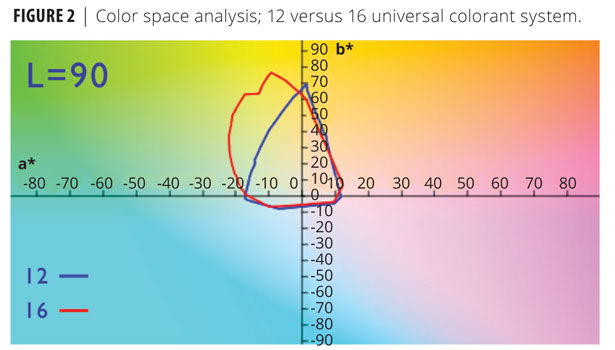
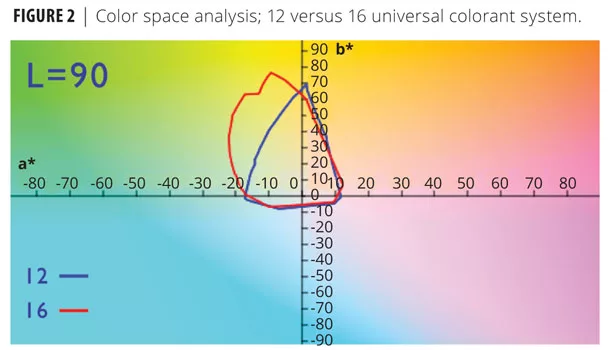
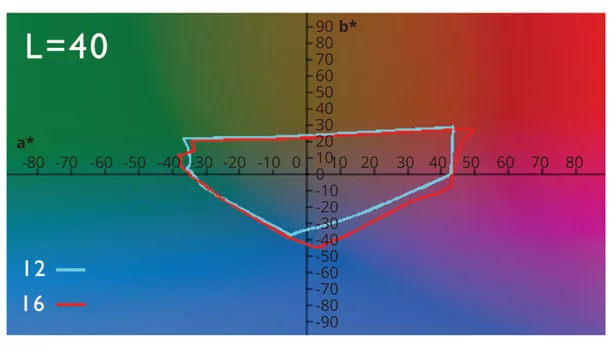
Figure 2 compares the standard 12 colorants used in the United States to a 16-colorant system optimized to enhance color space. It shows three slices along the L (lightness) axis:
• L = 90: Here we see that the 16-colorant system allows for approximately 50% greater color space in the yellow/green quadrant. This is particularly beneficial to paint manufacturers looking to expand color space in the pastel region.
• L = 65: We see a noticeable increase in color space in two quadrants with this 16-colorant system. It shows approximately 15% additional color space in the yellow/green region and about 10% increased color space in the yellow/red quadrant. This allows paint shops to offer brighter, cleaner oranges, reds, yellows and greens.
• L = 40: In the darker region, it is sometimes difficult to match custom shades with the standard 12-colorant system. Dark violets and rich blues are growing in popularity, and this chart shows that the 16-colorant system allows an additional 35% - 40% color space in the red/blue quadrant to achieve these popular colors.
Benefits of High- and Low-Strength Colorants
Colorant types can be differentiated in terms of pigment load. Low black, for example, may contain 5% pigment, medium black 15% and high black 30%. Obviously, less colorant of a high-strength variety is needed to achieve the same, or greater, richness of color than would be the case with a low-strength colorant. High-strength colorants therefore create a more economical system when highly saturated colors are important to a paint manufacturer’s business. Additionally, creating a highly saturated color using a standard colorant system requires adding a very high colorant load to the base paint. The result can often have a negative effect on paint properties such as gloss level, dry time and application characteristics.
There are equally good reasons for adding low-strength colorants to a tinting system. They are invaluable for manu-facturers with a high demand for tinting pastel shades. Smaller store keepers using manual dispensers, in particular, may find it difficult to compete with the big boxes that can offer sample sizes of all colors. Manual dispensers dispense in minimum units of 1/48 of a fluid ounce, which is well below the precision achievable with modern automatic dispensing equipment. The dispensable unit size is simply too large to achieve accurate lighter shades, especially in small containers such as sample sizes. Low-strength colorants are therefore an extremely useful addition to a colorant set to improve tinting accuracy.
Even retailers with modern, high-precision dispensers find that formulating pastel shades with low-strength colorants enhances both accuracy and reproducibility. This is because it minimizes the negative consequences of poorly maintained dispensing equipment that can cause mis-tints, which are particularly noticeable in light or pastel shades. Using low-strength formulations for slower-moving colorants can also improve turn over, keeping the colorant in the canisters fresh and, therefore, limiting the chances of mold growth and clogging.
Depending on the individual needs of the paint manufacturer, a colorant set utilizing a combination of high- and low-strength colorants may be the optimal solution to increase competitiveness and reduce cost.
Façade Applications
There are special productlines, for example façade coatings, where the colorants need to be fine-tuned for optimal product performance. Specialized façade tinting systems are formulated to have lower surfactant amounts and therefore less impact on the physical properties, such as viscosity and water resistance, of these very thick materials. Colorants that are optimized for use in these highly alkaline product technologies are extremely durable and stand up well to exterior exposure without fading. That is because façade systems are manufactured with inorganic pigments, which have larger particle sizes than organic pigments and won’t break down or wash out like organic materials. Façade colorants also have high chemical resistance and weather better than their organic counterparts.
Technology-Specific Colorants for High-Performance Coatings
In order to achieve the best technical performance in high-performance coatings, compatibility between base product and colorant system needs to be optimized. One method of optimizing compatibility is to formulate the colorants with the same resins and solvent system that is found in the base paint. Even in color formulas that require a large pigment load, such as deep or highly saturated colors, technology-specific colorants help protect the paint’s performance characteristics.
Importantly, colorants formulated with resins require base paints formulated and filled to accept those resins. In this way, paint manufacturers have a higher level of color control since they can ensure that their products will be tinted with the specified colorants.
Resins are particularly beneficial in specialist applications; for example epoxy-based products, such as those used for floor coatings. Adding an epoxy resin to the colorant will make the colorant link in with the chemical composition of the base material and improve its physical properties. However, epoxy resins only work with epoxy coatings. Again, the use of resins therefore needs to be matched carefully to the base formulation and designed to achieve the producer’s business objectives.
In-Plant Tinting Solutions
In-plant tinting with liquid colorants is an excellent way of adding color to base paints in large batches that achieves much more accurate, repeatable and reliable results than pastes or dispersions. The amount of colorants to be added can be either controlled gravimetrically, just like traditional pastes, or volumetrically, which enhances the speed of the operation while maintaining a high level of accuracy. Point-of-sale (POS) tinting typically serves a large color space for a wide variety of paint products that are dispatched in small amounts. In-plant tinting, in contrast, typically deals with fewer colors but larger amounts of paint.
There are tailor-made colorant ranges specifically designed for in-plant use, which are available in both solvent- and water-based technologies, such as the Solvasperse and Hydrasperse lines from CPS Color. These in-plant systems generally offer a more competitive price in the end tint than equivalent point-of-sale product lines. The high concentration of these colorants provides a lower overall tinting cost, while the high turnover associated with in-plant equipment ensures that the less desirable effects of high concentrated colorants, namely tip-drying and clogging of canisters, are avoided. In-plant tinting also deals with a more finite color range than POS tinting. Manufacturers who maintain a strong ready mix assortment find in-plant colorants to be an economical and highly efficient way to support these programs since they ensure a good balance between price and performance.
Tinting During Filling
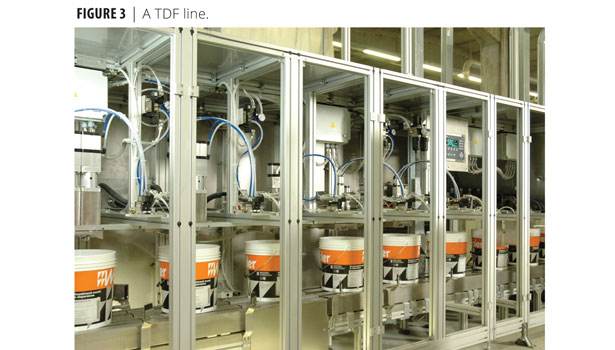
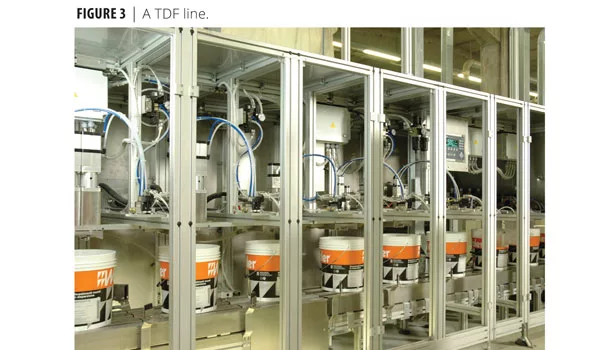
Tinting during filling (TDF) is an innovative way to produce and fill tinted paint directly into the final packaging, treating each can as an individual batch. Dispensing the right amount of base paint and colorants directly into the can eliminates many further steps in the production process, such as cleaning and rinsing of movable tanks. Tinting during filling is more economical and efficient than producing small batches of tinted paint product in the factory through traditional production methods.
Small batches of frequently used colors, such as those in new home construction, or specified colors for large construction jobs, are ideal candidates for TDF. Producing these colors in a traditional production process requires smaller, inefficient batch sizes, which create a drain on production and quality control lab resources. Exact color specifications are highly controlled even when multiple pails are required to complete an order. This high level of accuracy is achieved through a combination of both gravimetrically and volumetrically controlled dispensing mechanisms. In addition, TDF lines minimize color inconsistencies as human errors are eliminated from the automated process (Figure 3).
TDF lines allow manufacturers to produce the right amount of any color, just-in-time, reducing finished goods stock. This is important for large construction jobs, where often the original color spec may change after the job has begun, creating wasted paint that has to be disposed of or reworked. By placing a TDF line in a central distribution center, the delivery speed of the final product to the end user is improved, and order lead times are minimized.
Conclusions
Converting to a low- or no-VOC system requires careful analysis of the needs of the individual business, aligning business objectives with system capabilities. Working with a partner who has experience in converting customers from glycol-containing systems to VOC-free colorant systems will ensure a smooth transition. Additionally, choosing a partner with the comprehensive resources necessary to implement a truly integrated tinting system will prepare the business for current and future regulations, while providing a system that will serve the paint manufacturers’ business needs for years to come. Such a partner can also help find a solution that is more powerful and cost-effective than the previous system. When looking for a new set of VOC-free colorants, best price may not equal best value.
In the next article in this series, we will explore the contribution made by equipment within the tinting system. Choosing the right dispensers, mixers and shakers to match your colorant set while best serving your customers’ needs will further enhance your business competitiveness.
For additional information, contact Bart Wilbanks, Technical Account Manager, Colorants, CPS Color, at 800/728.8408, ext. 240.
Looking for a reprint of this article?
From high-res PDFs to custom plaques, order your copy today!