Painting & Coating Industry (PCI) logo Powder coating summit logo
search
cart
facebook twitter linkedin youtube
  • Sign In
  • Create Account
  • Sign Out
  • My Account
Painting & Coating Industry (PCI) logo Powder coating summit logo
  • NEWS
    • Latest News
    • Market Trends & Reports
    • Finishing News
    • Price Alerts
    • Subscribe to Newsletters
    • Global Top 10/ PCI 25
    • Weekly Featured Article
    • COATLE Word Game
  • PRODUCTS
    • Product News
    • Must See Products and Services
  • MATERIALS
    • Additives
    • Resins/Polymers
    • Pigments
    • Equipment
    • Distributors
  • TECHNOLOGIES
    • Adhesives
    • Architectural Coatings
    • Finishing Articles
    • Finishing Technologies
    • Finishing Equipment
    • Industrial Coatings
    • Nanotechnology
    • Powder Coatings
    • Solventborne
    • Special Purpose Coatings
    • Sustainability
    • UV Coatings
    • Waterborne
  • RESOURCES
    • Columns
      • Did you know?
      • Distribution Dive
      • Formulating With Mike
      • Innovation Insights
      • Powder Coating Perspectives
      • TiO2 Insider
    • Blogs
      • Editor's Viewpoint
      • Industry Insights
    • Coatings Supplier Handbook
    • Podcasts and Videos
      • COAT-IT! Podcast
      • Videos/PCI TV
    • PCI Store
    • Classifieds
    • eBooks
    • Sponsor Insights
    • White Papers
    • COATLE Word Game
  • EVENTS
    • Coatings Trends & Technologies Summit
    • Paint and Coatings Academy
    • Webinars
    • Calendar of Events
    • Lifetime Achievement Award
  • DIRECTORIES
    • Buyer's Guide
    • Equipment Directory
    • Materials Directory
  • EMAGAZINE
    • Current Issue
    • eMagazine Archive
    • China Issue Archive
    • Editorial Advisory Board
  • CONTACT
    • Contact Us
    • Advertise
    • Subscribe to eMagazine
    • Subscribe to Newsletters
  • SIGN UP!
Paint and Coatings AdditivesArchitectural Coatings

Ground Calcium Carbonate Versus Feldspathic Minerals

By Stephen Raper, David Skelhorn
pci0412-Imerys-F1-615.jpg
Credit: Imerys North American Performance Minerals
pci0412-Imerys-F10-615.jpg
Credit: Imerys North American Performance Minerals
pci0412-Imerys-F2-615.jpg
Credit: Imerys North American Performance Minerals
pci0412-Imerys-F3-615.jpg
Credit: Imerys North American Performance Minerals
pci0412-Imerys-F4-615.jpg
Credit: Imerys North American Performance Minerals
pci0412-Imerys-F5-615.jpg
Credit: Imerys North American Performance Minerals
pci0412-Imerys-F6-615.jpg
Credit: Imerys North American Performance Minerals
pci0412-Imerys-F7-615.jpg
Credit: Imerys North American Performance Minerals
pci0412-Imerys-F8-9-615.jpg
Credit: Imerys North American Performance Minerals
pci0412-Imerys-T1-615.jpg
Credit: Imerys North American Performance Minerals
pci0412-Imerys-T10-615.jpg
Credit: Imerys North American Performance Minerals
pci0412-Imerys-T2-615.jpg
Credit: Imerys North American Performance Minerals
pci0412-Imerys-T3-615.jpg
Credit: Imerys North American Performance Minerals
pci0412-Imerys-T4-615.jpg
Credit: Imerys North American Performance Minerals
pci0412-Imerys-T5-615.jpg
Credit: Imerys North American Performance Minerals
pci0412-Imerys-T6-615.jpg
Credit: Imerys North American Performance Minerals
pci0412-Imerys-T7-615.jpg
Credit: Imerys North American Performance Minerals
pci0412-Imerys-T8-615.jpg
Credit: Imerys North American Performance Minerals
pci0412-Imerys-T9-615.jpg
Credit: Imerys North American Performance Minerals
pci0412-Imerys-F1-615.jpg
pci0412-Imerys-F10-615.jpg
pci0412-Imerys-F2-615.jpg
pci0412-Imerys-F3-615.jpg
pci0412-Imerys-F4-615.jpg
pci0412-Imerys-F5-615.jpg
pci0412-Imerys-F6-615.jpg
pci0412-Imerys-F7-615.jpg
pci0412-Imerys-F8-9-615.jpg
pci0412-Imerys-T1-615.jpg
pci0412-Imerys-T10-615.jpg
pci0412-Imerys-T2-615.jpg
pci0412-Imerys-T3-615.jpg
pci0412-Imerys-T4-615.jpg
pci0412-Imerys-T5-615.jpg
pci0412-Imerys-T6-615.jpg
pci0412-Imerys-T7-615.jpg
pci0412-Imerys-T8-615.jpg
pci0412-Imerys-T9-615.jpg
April 2, 2012
Feldspathic minerals are much more costly than ground calcium carbonate, yet they are used in interior formulations because they are perceived to have better physical properties such as scrub and burnish resistance. These improvements are thought to be a result of the increased hardness of the feldspathic materials. But are these improvements real? Paint formulators who were interviewed believe these physical property improvements are real, but no one had ever verified these perceived differences. Similarly, it is generally thought that exterior durability is better using feldspathic minerals rather than calcium carbonates.

This article summarizes extensive physical and optical testing of these two types of materials in several interior flat paints. It was found that most of the advantages attributed to the feldspar were in fact not borne out by the data. In general, calcium carbonate can replace feldspar with no loss and, in most cases, with an improvement in physical properties. This study found that replacing the feldspathic minerals with ground calcium carbonate resulted in overall formulation cost savings but gave comparable physical and exterior durability properties.

Introduction

Calcium carbonate is a mineral substance and may be aragonite, calcite, vaterite, chalk, limestone, marble or travertine. In the United States, commercial material is mostly calcite and is either limestone (sedimentary) or marble (metamorphic). The materials used in this study were high-whiteness, marble-based products. Marble is a metamorphic rock.

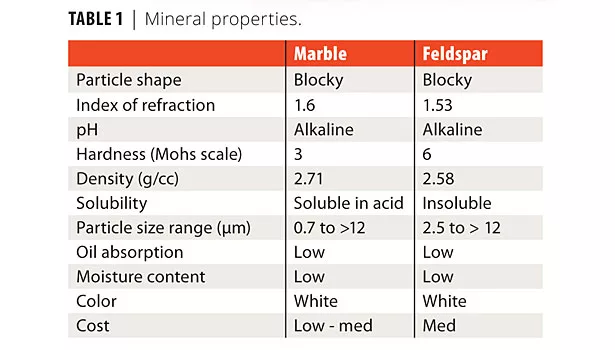
Feldspar is the mineral name given to a group of minerals distinguished by the presence of aluminum (Al) and the silica ion (SiO4) in their chemistry. This group includes aluminum silicates of soda (sodium oxide), potassium (potassium oxide) or lime (calcium oxide). Feldspar is the single most abundant mineral group on earth. These materials vary widely in chemistry, depending on local formation conditions. Some feldspathoids are silica free – e.g., nepheline syenites. Feldspars are igneous rocks. Figure 1 shows the structure of calcium carbonate and nepheline syenite. Table 1 shows the pigment properties.

Minerals with higher hardness are thought to bring improved abrasion and burnish resistance to most paint formulations, although they are more difficult to disperse and lead to faster wear on processing (disperser blades) and application equipment (pumps and spray tips).

Mineral additives with an index of refraction close to that of the resin (most latex resins are ~1.5) tend to give lower haze in clears, but they also have lower opacity and tint strength.

This research was conducted to compare opacity, abrasion resistance and burnish resistance of feldspar and ground calcium carbonate commonly used in interior flat paints. Additional work was completed in an exterior paint formulation to assess weatherability and acid rain resistance.

Experimental

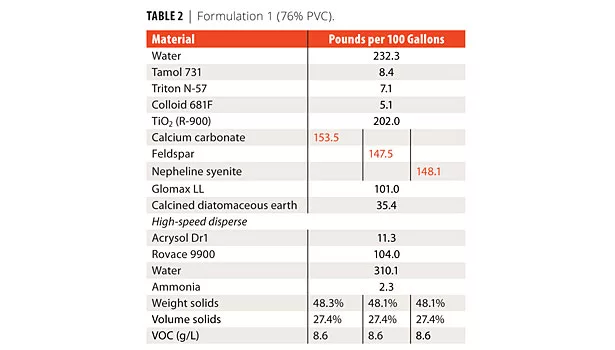
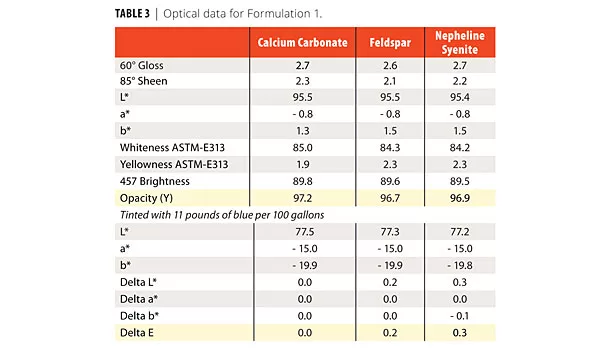
Seven interior formulations were developed: a) 76% PVC; b) 53% PVC; c-f) four tint base formulations in 63% PVC; and g) a 40% PVC exterior formulation. In Formulation 1, the calcium carbonate was replaced by two different feldspars on an equal volume basis in a 76% PVC paint (Tables 1 and 2). Optical properties for all of the formulations were the same.

Using the same protocol as in Formulation 1, a low-VOC, 53% PVC interior flat paint was produced and tested for optical properties (Formulation 2, Tables 4 and 5). Table 5 is the optical data for Formulation 2. Scrub results are shown in Figure 2. The calcium carbonate performed much better.

Four additional formulations were produced in 65% PVC tint bases. In each formulation the calcium carbonate was replaced by nepheline syenite on an equal volume basis (Table 6). As in the first two formulations, optical properties were found to be the same regardless of mineral selection (Table 7).

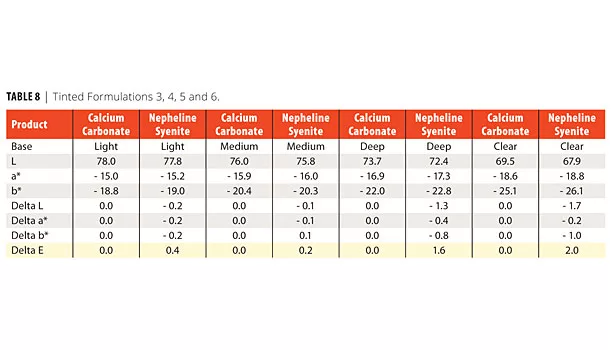
Tint strength of each of the above formulations is shown in Table 8. Tint is very close regardless of mineral selection in both light and medium tint bases. The carbonate formulations show a higher whiteness in both the deep and clear bases.

Sheen of the medium base increased after burnishing using the Imerys burnish tester (Figure 3). The carbonate shows slightly better burnish. With the other bases, the burnish of the calcium carbonate was slightly better or equal to the nepheline syenite.

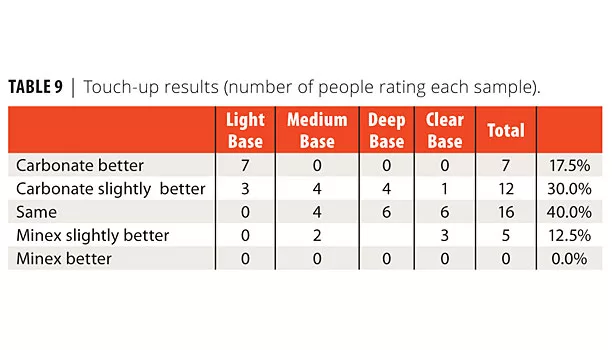
Touch up was also done on these paints. The blue tinted paints were rolled on upson board. After 24 h dry, each paint was topcoated by brushing with the same paint. The touch up was evaluated by 10 people in the lab (Table 9). The numbers are the number of people that rated each sample. Overall, the carbonate showed better touch-up appearance.

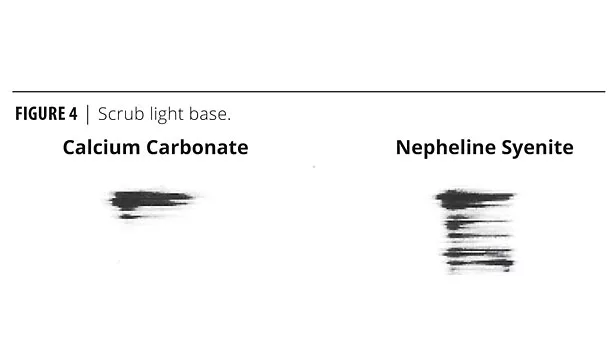
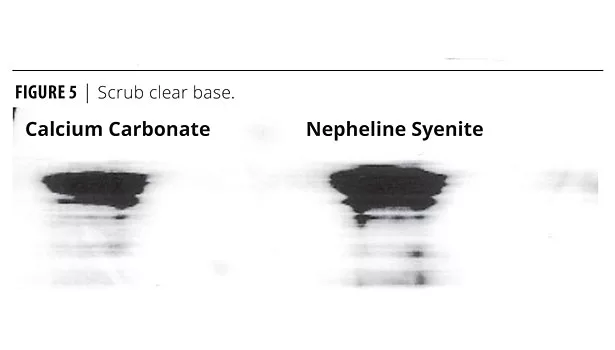
Figures 4 and 5 show relative abrasion resistance (scrub resistance) measured side by side. The data clearly shows the calcium carbonate-based formulations provide superior performance, which is contrary to conventional expectations.

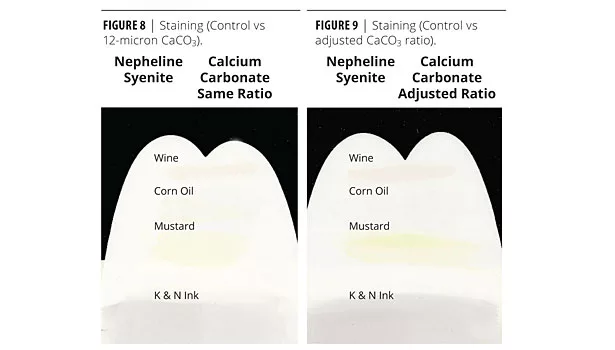
Formulation 7 was a commercial formulation that contained an 11-micron nepheline syenite and and a 7-micron calcium carbonate. In the first reformulation, the nepheline syenite was replaced with 12-micron calcium carbonate. The sheen was low so the ratio of the two calcium carbonates was adjusted in the second reformulation (Table 10). Scrub and staining results are shown in Figures 6-9.

Traditionally, nepheline syenite is considered to perform better in exterior paint formulations, mainly because of its perceived benefits in weathering acid rain conditions. This view was tested by simulating acid rain using the salt fog cabinet and QUV.

A 40% PVC paint formulation was tinted to a light green, and separate panels were made using a 12-micron calcium carbonate, a 1-micron coated calcium carbonate and and a 2-micron nepheline syenite.

Three panels of each were placed in the salt fog cabinet using deionized water adjusted to a pH 4 (acid rain is usually 4 to 5.5) using sulphuric acid. Three additional panels of each were placed in the QUV under UVA conditions. The last three panels were subjected to 50% acid rain and 50% QUV. Color change after exposure is reported in Figures 10a-c.

The QUV showed that the nepheline syenite had a color change early and then leveled off with the calcium carbonates with more even weathering. Given the conditions, these data are very close and do not support the expectation of large differences between these two minerals used in this mode.

Although exposure of the calcium carbonate to acid (pH 4) showed some color difference, the film itself showed no sign of degradation. The color difference found appears to be the result of mild iron oxide leaching from the system but, again, the anticipated early destruction of the carbonate-based film did not materialize, even under this aggressive environment.

Conclusions

The marble-based calcium carbonate performed similarly to the feldspathic materials in interior architectural formulations when compared at equivalent particle size and volume loadings. Opacity, abrasion resistance and burnish resistance were evaluated across a wide range of PVCs and resins.

In simulated exterior conditions, the calcium carbonate did not show the expected early failure, even after a significant time under continuous, very low pH conditions.

Based on these data, marble-based calcium carbonate can be used to replace feldspars to reduce cost while maintaining – and even improving, in some cases – physical performance. 


References

1. Webmineral.com

For more information, e-mail Steve.raper@imerys.com.


This paper is based on a presentation given at the 39th annual Waterborne Symposium, February 13-17, 2012, New Orleans.

KEYWORDS: Thickeners

Share This Story

Looking for a reprint of this article?
From high-res PDFs to custom plaques, order your copy today!


Raper is Group Leader for Architectural and Industrial Coatings for Imerys North American Performance Minerals in Marietta, GA

Skelhorn is Imerys Coatings Technical Service Manager for Imerys − North American Performance Minerals in Marietta, GA

Recommended Content

JOIN TODAY
to unlock your recommendations.

Already have an account? Sign In

  • pci1022-Kinaltek-Lead-1170.jpg

    A Novel Pigment Production Technology

    Following an extensive R&D program that demonstrated...
    Paint and Coating Pigments
    By: Jawad Haidar and Nitin Soni
  • pci global top 10

    2025 Global Top 10: Top Paint and Coatings Companies

    The following is PCI’s annual ranking of the top 10...
    Paint and Coating Market Reports
    By: Courtney Bassett
  • 2025 pci 25

    2025 PCI 25: Top Paint and Coatings Companies

    PCI's annual ranking of the top 25 North American paint...
    Global Top 10 and PCI 25
    By: Courtney Bassett
You must login or register in order to post a comment.

Report Abusive Comment

Manage My Account
  • eMagazine
  • Newsletters
  • Online Registration
  • Subscription Customer Service

More Videos

Sponsored Content

Sponsored Content is a special paid section where industry companies provide high quality, objective, non-commercial content around topics of interest to the PCI audience. All Sponsored Content is supplied by the advertising company and any opinions expressed in this article are those of the author and not necessarily reflect the views of PCI or its parent company, BNP Media. Interested in participating in our Sponsored Content section? Contact your local rep!

close
  • colorful building exterior
    Sponsored byDow

    Insights into Exterior Architectural Coating Degradation: Bridging Accelerated and Natural Weathering

  • digital pigments
    Sponsored bySiltech

    The Fourth Dimension of Silicon: Siltech Q Resins

Popular Stories

Company News

What the AkzoNobel–Axalta Merger Means for the Future of Coatings

AkzoNobel and Axalta Headquarters

AkzoNobel and Axalta Announce $25 Billion Merger

Wacker logo

WACKER Plans More Than 1,500 Job Cuts


PCI Buyers Guide

Submit a Request for Proposal (RFP) to suppliers of your choice with details on what you need with a click of a button

Start your RFP

Browse our Buyers Guide for manufacturers and distributors of all types of coatings products and much more!

Find Suppliers

Events

September 4, 2025

N-Butylpyrrolidone (NBP) as a Green Solvent to Replace N-Methylpyrrolidone (NMP) in Industrial Coating Applications

ON DEMAND: EPA published a regulation proposal around N-methylpyrrolidone (NMP) in June 2024 to ban or limit NMP in many applications, such as paints and coatings and their removers. N-butylpyrrolidone (NBP) is a powerful and versatile solvent for a variety of industries looking for alternatives to substance of very high concern (SVHC)-listed solvents.

March 24, 2026

The Manufacturing & Automation eXchange (MAX)

MAX presents a rare opportunity to observe the full scope of manufacturing in one environment. From systems integration and materials handling to automation, quality, safety, and packaging, each discipline is represented through live, operational displays. By experiencing these technologies side by side, as they are on actual production floors, attendees gain a grounded understanding of how manufacturing functions align, overlap, and evolve in practice.

View All Submit An Event

Poll

Longest-running laboratory experiment

What is the longest-running laboratory experiment?
View Results Poll Archive

Products

Automotive Paints and Coatings, 2nd Edition

Automotive Paints and Coatings, 2nd Edition

Now in its second edition and still the only book of its kind, this is an authoritative treatment of all stages of the coating process.

See More Products
pci voices from the top ebook

PCI webinar

Related Articles

  • pci0420-Imerys-864852412.jpg

    Optimized Processing to Reduce Crystalline Silica in Ground Calcium Carbonate

    See More
  • keyboard with currency symbols on keys

    Huber Announces Price Increase for Industrial Ground Calcium Carbonate

    See More
  • CompanyNews-95996740.jpg

    Huber Carbonates Breaks Ground on Calcium Carbonate Expansion

    See More

Related Products

See More Products
  • hetrophase.jpg

    Heterophase Polymerization: Basic Concepts and Principles

  • composite.jpg

    Composite Materials: Properties, Characterisation, and Applications

  • 9780080447087.jpg

    Handbook of Adhesives and Sealants, Volume 2

See More Products

Events

View AllSubmit An Event
  • September 4, 2025

    Organo-Siloxane Surfactant as Substitute for Forever Chemicals - Reactive Versus Nonreactive

    ON DEMAND: Perfluorinated and Polyfluorinated Surfactants (PFAS) have been called “forever chemicals,” and there is interest in replacing them with nonfluorinated surfactants.
  • October 30, 2025

    Novel Spherical Calcium Silicate Anti-Corrosion Pigment for Protective Coatings

    ON DEMAND: This presentation introduces a novel spherical calcium silicate as an effective anti-corrosion pigment for protective coatings. The modified spherical silica was synthesized using a unique patented manufacturing process, allowing to produce AC pigments with increased effectiveness for passivation, as well as easier and more even dispersion.
View AllSubmit An Event
×

Keep the info flowing with our eNewsletters!

Get the latest industry updates tailored your way.

JOIN TODAY!
  • RESOURCES
    • Advertise
    • Contact Us
    • Directories
    • Store
    • Want More
  • SIGN UP TODAY
    • Create Account
    • eMagazine
    • Newsletters
    • Customer Service
    • Manage Preferences
  • SERVICES
    • Marketing Services
    • Reprints
    • Market Research
    • List Rental
    • Survey & Sample
  • STAY CONNECTED
    • LinkedIn
    • Facebook
    • Youtube
    • X (Twitter)
  • PRIVACY
    • PRIVACY POLICY
    • TERMS & CONDITIONS
    • DO NOT SELL MY PERSONAL INFORMATION
    • PRIVACY REQUEST
    • ACCESSIBILITY

Copyright ©2025. All Rights Reserved BNP Media.

Design, CMS, Hosting & Web Development :: ePublishing