Painting & Coating Industry (PCI) logo Powder coating summit logo
search
cart
facebook twitter linkedin youtube
  • Sign In
  • Create Account
  • Sign Out
  • My Account
Painting & Coating Industry (PCI) logo Powder coating summit logo
  • NEWS
    • Latest News
    • Market Trends & Reports
    • Finishing News
    • Price Alerts
    • Subscribe to Newsletters
    • Global Top 10/ PCI 25
    • Weekly Featured Article
    • COATLE Word Game
  • PRODUCTS
    • Product News
    • Must See Products and Services
  • MATERIALS
    • Additives
    • Resins/Polymers
    • Pigments
    • Equipment
    • Distributors
  • TECHNOLOGIES
    • Adhesives
    • Architectural Coatings
    • Finishing Articles
    • Finishing Technologies
    • Finishing Equipment
    • Industrial Coatings
    • Nanotechnology
    • Powder Coatings
    • Solventborne
    • Special Purpose Coatings
    • Sustainability
    • UV Coatings
    • Waterborne
  • RESOURCES
    • Columns
      • Did you know?
      • Distribution Dive
      • Formulating With Mike
      • Innovation Insights
      • Powder Coating Perspectives
      • TiO2 Insider
    • Blogs
      • Editor's Viewpoint
      • Industry Insights
    • Coatings Supplier Handbook
    • Podcasts and Videos
      • COAT-IT! Podcast
      • Videos/PCI TV
    • PCI Store
    • Classifieds
    • eBooks
    • Sponsor Insights
    • White Papers
    • COATLE Word Game
  • EVENTS
    • Coatings Trends & Technologies Summit
    • Paint and Coatings Academy
    • Webinars
    • Calendar of Events
    • Lifetime Achievement Award
  • DIRECTORIES
    • Buyer's Guide
    • Equipment Directory
    • Materials Directory
  • EMAGAZINE
    • Current Issue
    • eMagazine Archive
    • China Issue Archive
    • Editorial Advisory Board
  • CONTACT
    • Contact Us
    • Advertise
    • Subscribe to eMagazine
    • Subscribe to Newsletters
  • SIGN UP!
Paint and Coatings AdditivesArchitectural Coatings

Micronized Powders for Coatings and Inks
By Tobias Niederleitner
Micronized Powders for Coatings and Inks
January 5, 2018

Micronized additives are widely used in coating and printing ink industries for surface modification. Improved scratch and rub resistance, controlled matting effects and reduced slip properties are only some of the properties that can be adjusted by the addition of micronized waxes. So far mainly commercially available synthetic waxes have played an important role. Recently, the market requirements have changed into the direction of more sustainable additives that provide similar results. In this context Clariant has launched micronized waxes and additives for printing inks and coatings that are not only based on renewable sources but even provide performance benefits compared to standard types.

These micronized innovations are based on renewable raw materials in different particle size distributions (CERIDUST 8330 TP for printing inks, and CERIDUST 8090 TP and CERIDUST 8091 TP for wood coatings). They support customers’ ambitions to offer more sustainable solutions to industrial markets without compromising performance.


Wood Coating Applications

The main difference between CERIDUST 8091 TP and CERIDUST 8090 TP for wood coating applications is the particle size distribution. The coarse fraction generates rougher surfaces, which gives the impression of untreated, natural wood. With the elimination of these coarse particles, formulators can create a soft and smooth-touch surface modification.

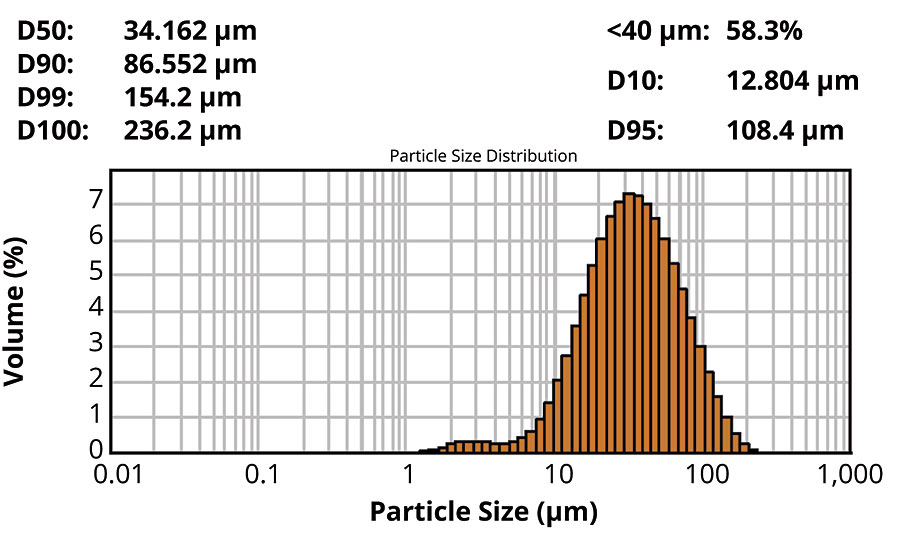
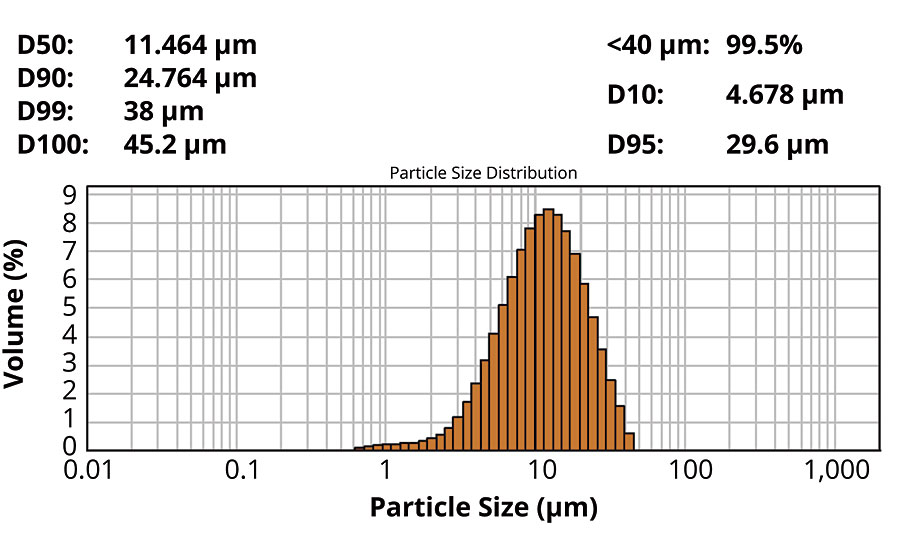
Figures 1 and 2 illustrate the particle size distributions of both grades generating a completely different surface appearance. CERIDUST 8090 TP has a mean particle size distribution of 34 µm (Figure 1), whereas CERIDUST 8091 TP is further modified by grinding to a d50 value that is three times lower.
Particle size distribution of CERIDUST 8090 TP; test method QM-AA-112

FIGURE 1 » Particle size distribution of CERIDUST 8090 TP; test method QM-AA-112.
Particle size distribution of CERIDUST 8091 TP; test method QM-AA-112

FIGURE 2 » Particle size distribution of CERIDUST 8091 TP; test method QM-AA-112.

The coarser renewable-based version CERIDUST 8090 TP for wood coatings creates a protected and smooth surface with the pleasant feel of untreated wood. At the same time it increases the coefficient of friction in combination with outstanding scratch resistance performance in water-based formulations. Figure 3 shows comparative tests of standard commercially available micronized waxes and the micronized renewable polymer that is forming the natural wood touch. The additive is outperforming the micronized waxes in terms of scratch resistance performance.

Scratch resistance performance [N] of CERIDUST 8090 TP measured by an Erichsen hardness testing pencil Model 318; wax content 4%

FIGURE 3 » Scratch resistance performance [N] of CERIDUST 8090 TP measured by an Erichsen hardness testing pencil Model 318; wax content 4%.

In Figure 4, the values for the coefficient of friction are illustrated. With the addition of the micronized polymer, formulators can achieve an antislip effect in a water-based polyurethane lacquer. The compared materials are standard, commercially available micronized waxes with different chemical and physical characters.
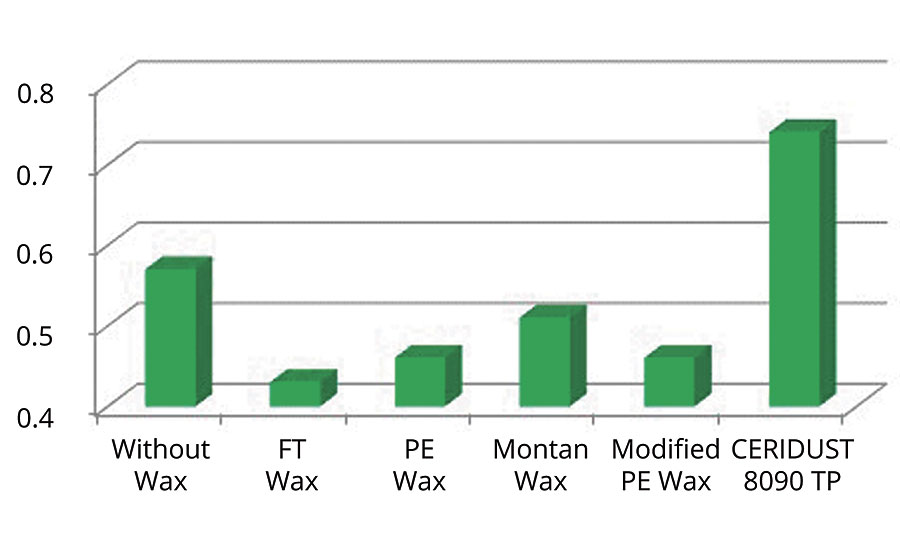
Determination of coefficient of friction in water-based 1K PU system; wax content 4%; (internal method determined with the friction/peel-tester from von Thwing-Albert Instruments Company; leather surface).

FIGURE 4 » Determination of coefficient of friction in water-based 1K PU system; wax content 4%; (internal method determined with the friction/peel-tester from von Thwing-Albert Instruments Company; leather surface).

The fine grind of the new renewable-based polymer CERIDUST 8091 TP combines smoothness with very high scratch resistance. The high matting efficiency, together with the above-mentioned properties, enables the manufacturer to formulate more sustainable coatings with top quality. Figure 5 demonstrates the scratch resistance performance in a water-based PU system.

Scratch resistance performance [N] of CERIDUST 8091 TP measured by an Erichsen hardness testing pencil Model 31; wax content 4%

FIGURE 5 » Scratch resistance performance [N] of CERIDUST 8091 TP measured by an Erichsen hardness testing pencil Model 31; wax content 4%

CERIDUST 8091 TP, similar to CERIDUST 8090 TP, increases the coefficient of friction. The values and comparison material can be found in Figure 6.
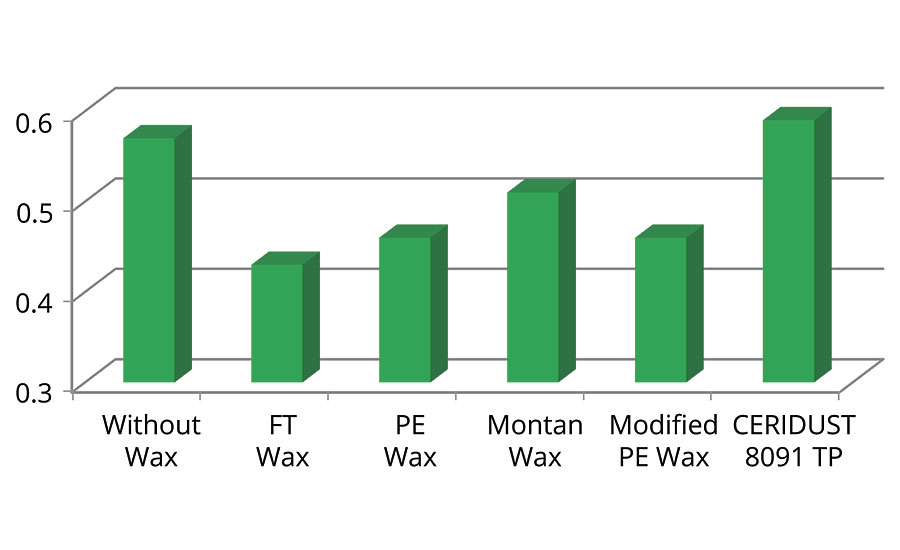
Determination of coefficient of friction in water-based 1K PU system; wax content 4%; (internal method determined with the friction/peel-tester from von Thwing-Albert Instruments Company; leather surface).

FIGURE 6 » Determination of coefficient of friction in water-based 1K PU system; wax content 4%; (internal method determined with the friction/peel-tester from von Thwing-Albert Instruments Company; leather surface).

Starch is another renewable-based additive commonly used in coatings. Comparative tests (Figure 7) show that starch and even blends of starch with standard waxes cannot compete with the new CERIDUST products regarding scratch resistance. On the other hand, blending these new renewable-based CERIDUST products with standard waxes keeps the benefit of excellent scratch resistance and lowers the coefficient of friction. CERIDUST 8090 TP and CERIDUST 8091 TP together with the PE wax blends of them showed the best performance in terms of scratch resistance in a water-based PU. The coefficient of friction, increased with pure renewable polymers, can be lowered with addition of PE wax (Figure 8).

Scratch resistance performance [N] of other renewable polymers and blends with PE wax measured by an Erichsen hardness testing pencil Model 31; wax content 4%
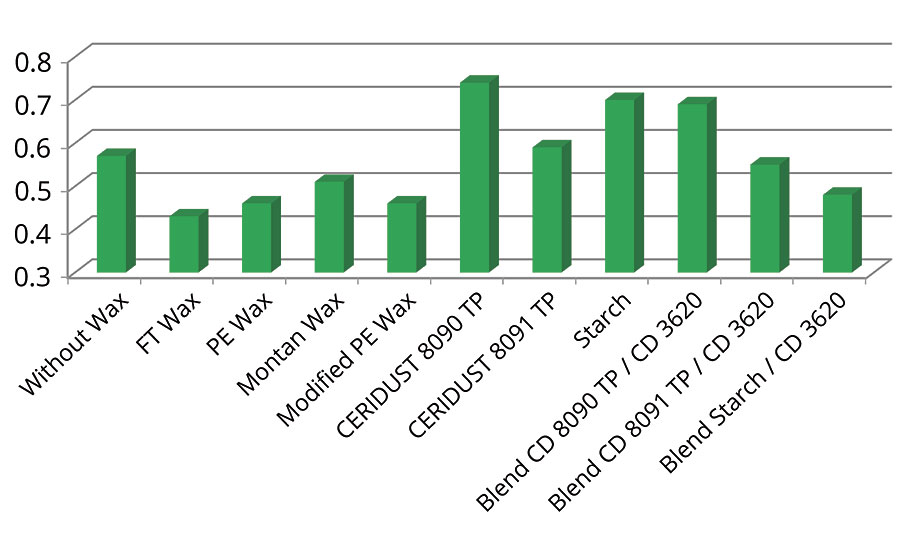
FIGURE 7 » Scratch resistance performance [N] of other renewable polymers and blends with PE wax measured by an Erichsen hardness testing pencil Model 31; wax content 4%

Determination of coefficient of friction in water-based 1K PU system renewable polymers and blends with PE wax; wax content 4%; (internal method determined with the friction/peel-tester from von Thwing-Albert Instruments Company; leather surface).

FIGURE 8 » Determination of coefficient of friction in water-based 1K PU system renewable polymers and blends with PE wax; wax content 4%; (internal method determined with the friction/peel-tester from von Thwing-Albert Instruments Company; leather surface).

Another very important property in wood coatings is the matting effect. The comparison data of renewable polymers, standard waxes and blends of both can be found in Figure 9. The performance of CERIDUST 8091 TP is similar to standard waxes. Only the coarse renewable polymer and starch are not matting that strongly.
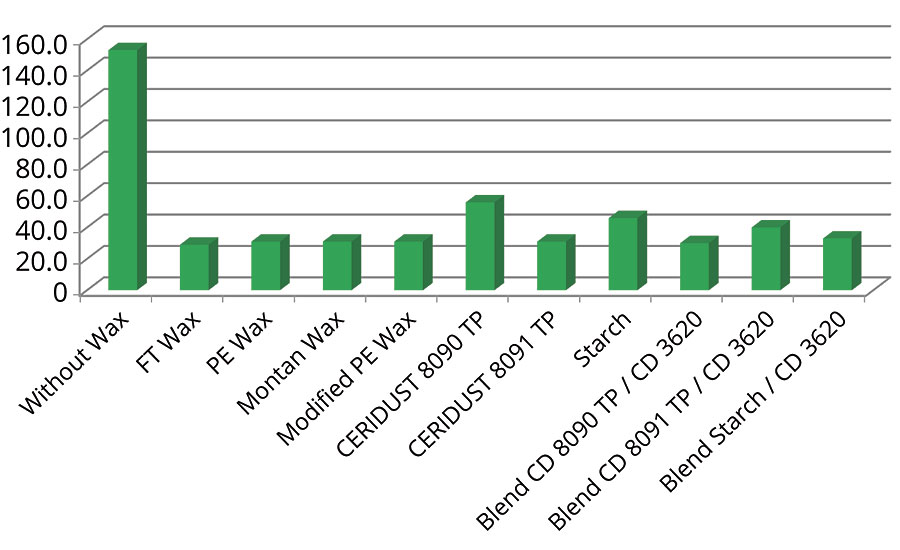
Gloss performance of renewable polymers and blends with PE wax in water-based 1K PU system measured with MICRO-TRI-GLOSS

FIGURE 9 » Gloss performance of renewable polymers and blends with PE wax in water-based 1K PU system measured with MICRO-TRI-GLOSS.

The efficiency of the renewable polymers and also the above-mentioned properties like smoothness or natural wood touch compared with very high scratch resistance enable the manufacturer to formulate more sustainable coatings with no compromise on the performance.


Printing Ink Applications

CERIDUST 8330 TP for printing ink applications is based on a different sustainable raw material compared to the other two CERIDUST products. This polymer is easier to grind and therefore, with a mean particle size distribution of approximately 5µm, is finer than the other renewable products. Its mix of flexible, but still tough, polymeric characteristics makes it a powerful rub resistance additive for ink systems. Even dosage reduction in comparison to standard waxes is possible. The product can be used in liquid as well as in pasty ink systems. Due to its higher density, it is necessary to make sure that the additive is well dispersed before using the ink (especially in liquid inks). Table 1 shows comparison tests of standard micronized waxes and CERIDUST 8330 TP in three different ink systems.
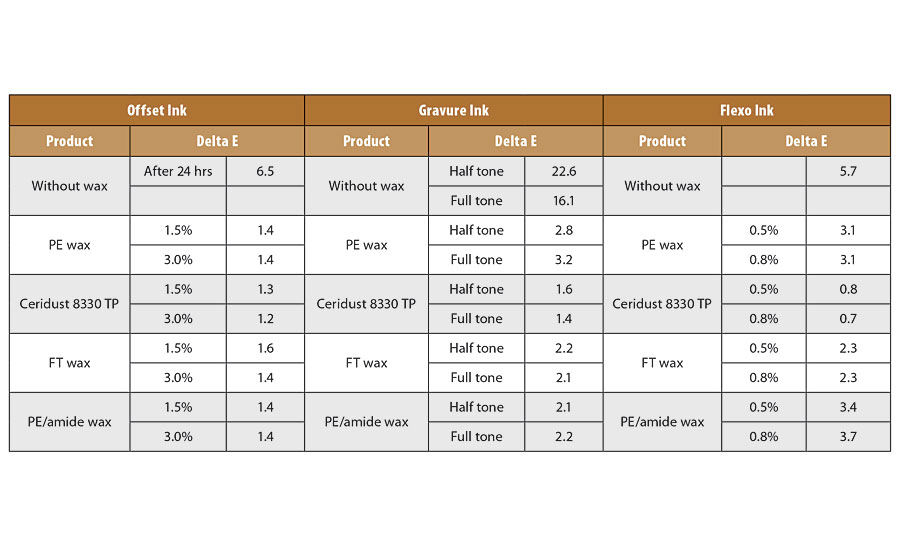
Rub resistance performance of CERIDUST 8330 TP and standard micronized waxes in different printing ink systems; conditions: 50 cycles after 24 hrs, loading 48 g/cm2

TABLE 1 » Rub resistance performance of CERIDUST 8330 TP and standard micronized waxes in different printing ink systems; conditions: 50 cycles after 24 hrs, loading 48 g/cm2

In all three systems, CERIDUST 8330 TP shows the best performance. Especially in flexographic ink, it outperforms standard micronized waxes and achieves a color difference value below 1.

Printing ink producers now have the choice to either reduce the additive dosage or to improve the performance of their formulations. In addition to the performance boost, they now have the possibility to formulate with renewable raw materials.


For more information, email Tobias.Niederleitner@clariant.com or visit http://www.clariant.com/additives.

KEYWORDS: Inks Renewable Technology Waxes for Coatings wood coatings

Share This Story

Looking for a reprint of this article?
From high-res PDFs to custom plaques, order your copy today!


Tobias Niederleitner is Technical Manager for Clariant Produkte (Deutschland) GmbH, Gersthofen, Germany

Recommended Content

JOIN TODAY
to unlock your recommendations.

Already have an account? Sign In

  • pci1022-Kinaltek-Lead-1170.jpg

    A Novel Pigment Production Technology

    Following an extensive R&D program that demonstrated...
    Paint and Coating Pigments
    By: Jawad Haidar and Nitin Soni
  • pci global top 10

    2025 Global Top 10: Top Paint and Coatings Companies

    The following is PCI’s annual ranking of the top 10...
    Global Top 10 and PCI 25
    By: Courtney Bassett
  • 2025 pci 25

    2025 PCI 25: Top Paint and Coatings Companies

    PCI's annual ranking of the top 25 North American paint...
    Paint and Coating Market Reports
    By: Courtney Bassett
You must login or register in order to post a comment.

Report Abusive Comment

Manage My Account
  • eMagazine
  • Newsletters
  • Online Registration
  • Subscription Customer Service

More Videos

Sponsored Content

Sponsored Content is a special paid section where industry companies provide high quality, objective, non-commercial content around topics of interest to the PCI audience. All Sponsored Content is supplied by the advertising company and any opinions expressed in this article are those of the author and not necessarily reflect the views of PCI or its parent company, BNP Media. Interested in participating in our Sponsored Content section? Contact your local rep!

close
  • colorful building exterior
    Sponsored byDow

    Insights into Exterior Architectural Coating Degradation: Bridging Accelerated and Natural Weathering

  • digital pigments
    Sponsored bySiltech

    The Fourth Dimension of Silicon: Siltech Q Resins

Popular Stories

Company News

What the AkzoNobel–Axalta Merger Means for the Future of Coatings

AkzoNobel and Axalta Headquarters

AkzoNobel and Axalta Announce $25 Billion Merger

Wacker logo

WACKER Plans More Than 1,500 Job Cuts

pci academy

PCI Buyers Guide

Submit a Request for Proposal (RFP) to suppliers of your choice with details on what you need with a click of a button

Start your RFP

Browse our Buyers Guide for manufacturers and distributors of all types of coatings products and much more!

Find Suppliers

Events

September 4, 2025

N-Butylpyrrolidone (NBP) as a Green Solvent to Replace N-Methylpyrrolidone (NMP) in Industrial Coating Applications

ON DEMAND: EPA published a regulation proposal around N-methylpyrrolidone (NMP) in June 2024 to ban or limit NMP in many applications, such as paints and coatings and their removers. N-butylpyrrolidone (NBP) is a powerful and versatile solvent for a variety of industries looking for alternatives to substance of very high concern (SVHC)-listed solvents.

March 24, 2026

The Manufacturing & Automation eXchange (MAX)

MAX presents a rare opportunity to observe the full scope of manufacturing in one environment. From systems integration and materials handling to automation, quality, safety, and packaging, each discipline is represented through live, operational displays. By experiencing these technologies side by side, as they are on actual production floors, attendees gain a grounded understanding of how manufacturing functions align, overlap, and evolve in practice.

View All Submit An Event

Poll

Longest-running laboratory experiment

What is the longest-running laboratory experiment?
View Results Poll Archive

Products

Automotive Paints and Coatings, 2nd Edition

Automotive Paints and Coatings, 2nd Edition

Now in its second edition and still the only book of its kind, this is an authoritative treatment of all stages of the coating process.

See More Products
pci case ebook

PCI webinar

Related Articles

  • Sustainability and Bio-based

    Lower-Carbon Micronized Waxes Enhance Performance in Coatings and Inks

    See More
  • Micronized Montan Wax as Dispersing Aid for Powder Coatings

    See More
  • Micronized Wax to Enhance Surface Protection of Water-Based Wood Coatings.jpg

    Micronized Wax to Enhance Surface Protection of Water-Based Wood Coatings

    See More

Related Products

See More Products
  • Kevin-Biller-PC-BOOK.jpg

    Powder Coatings - Foundation for the Novice Formulator (ebook)

  • intelligent.jpg

    Intelligent Coatings for Corrosion Control 1st Edition

See More Products
×

Keep the info flowing with our eNewsletters!

Get the latest industry updates tailored your way.

JOIN TODAY!
  • RESOURCES
    • Advertise
    • Contact Us
    • Directories
    • Store
    • Want More
    • Manufacturing Division
  • SIGN UP TODAY
    • Create Account
    • eMagazine
    • Newsletters
    • Customer Service
    • Manage Preferences
  • SERVICES
    • Marketing Services
    • Reprints
    • Market Research
    • List Rental
    • Survey & Sample
  • STAY CONNECTED
    • LinkedIn
    • Facebook
    • Youtube
    • X (Twitter)
  • PRIVACY
    • PRIVACY POLICY
    • TERMS & CONDITIONS
    • DO NOT SELL MY PERSONAL INFORMATION
    • PRIVACY REQUEST
    • ACCESSIBILITY

Copyright ©2025. All Rights Reserved BNP Media.

Design, CMS, Hosting & Web Development :: ePublishing