Painting & Coating Industry (PCI) logo Powder coating summit logo
search
cart
facebook twitter linkedin youtube
  • Sign In
  • Create Account
  • Sign Out
  • My Account
Painting & Coating Industry (PCI) logo Powder coating summit logo
  • NEWS
    • Latest News
    • Market Trends & Reports
    • Finishing News
    • Price Alerts
    • Subscribe to Newsletters
    • Global Top 10/ PCI 25
    • Weekly Featured Article
    • COATLE Word Game
  • PRODUCTS
    • Product News
    • Must See Products and Services
  • MATERIALS
    • Additives
    • Resins/Polymers
    • Pigments
    • Equipment
    • Distributors
  • TECHNOLOGIES
    • Adhesives
    • Architectural Coatings
    • Finishing Articles
    • Finishing Technologies
    • Finishing Equipment
    • Industrial Coatings
    • Nanotechnology
    • Powder Coatings
    • Solventborne
    • Special Purpose Coatings
    • Sustainability
    • UV Coatings
    • Waterborne
  • RESOURCES
    • Columns
      • Did you know?
      • Distribution Dive
      • Formulating With Mike
      • Innovation Insights
      • Powder Coating Perspectives
      • TiO2 Insider
    • Blogs
      • Editor's Viewpoint
      • Industry Insights
    • Coatings Supplier Handbook
    • Podcasts and Videos
      • COAT-IT! Podcast
      • Videos/PCI TV
    • PCI Store
    • Classifieds
    • eBooks
    • Sponsor Insights
    • White Papers
    • COATLE Word Game
  • EVENTS
    • Coatings Trends & Technologies Summit
    • Paint and Coatings Academy
    • Webinars
    • Calendar of Events
    • Lifetime Achievement Award
  • DIRECTORIES
    • Buyer's Guide
    • Equipment Directory
    • Materials Directory
  • EMAGAZINE
    • Current Issue
    • eMagazine Archive
    • China Issue Archive
    • Editorial Advisory Board
  • CONTACT
    • Contact Us
    • Advertise
    • Subscribe to eMagazine
    • Subscribe to Newsletters
  • SIGN UP!
Industry News

Scientists Develop Coating Technique to Improve Refrigeration Efficiency
coatings research and development
August 16, 2019

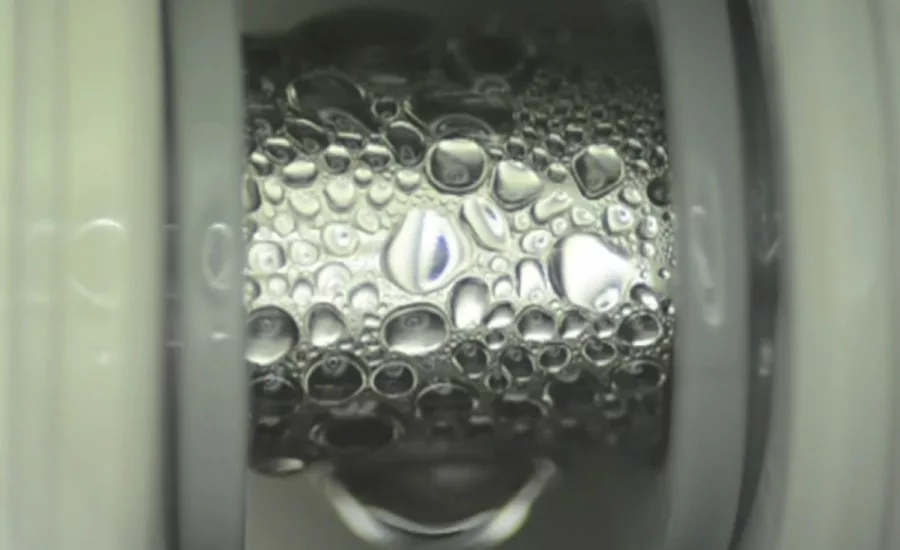
CAMBRIDGE, MA — Unlike water, liquid refrigerants and other fluids that have a low surface tension tend to spread quickly into a sheet when they come into contact with a surface. But for many industrial processes, it would be better if the fluids formed droplets, which could roll or fall off the surface and carry heat away with them.

Now, researchers at MIT have made significant progress in promoting droplet formation and shedding in such fluids. This approach could lead to efficiency improvements in many large-scale industrial processes including refrigeration, thus saving energy and reducing greenhouse gas emissions.

The new findings are described in the journal Joule, in a paper by graduate student Karim Khalil, Professor of Mechanical Engineering Kripa Varanasi, Professor of Chemical Engineering and Associate Provost Karen Gleason, and four others.

Over the years, Varanasi and his collaborators have made great progress in improving the efficiency of condensation systems that use water, such as the cooling systems used for fossil-fuel or nuclear power generation. But other kinds of fluids -- such as those used in refrigeration systems, liquification, waste heat recovery, and distillation plants, or materials such as methane in oil and gas liquifaction plants -- often have very low surface tension compared to water, meaning that it is very hard to get them to form droplets on a surface. Instead, they tend to spread out in a sheet, a property known as wetting.

But when these sheets of liquid coat a surface, they provide an insulating layer that inhibits heat transfer, and easy heat transfer is crucial to making these processes work efficiently. "If it forms a film, it becomes a barrier to heat transfer," Varanasi says. But that heat transfer is enhanced when the liquid quickly forms droplets, which then coalesce and grow and fall away under the force of gravity. Getting low-surface-tension liquids to form droplets and shed them easily has been a serious challenge.

In condensing systems that use water, the overall efficiency of the process can be around 40%, but with low-surface-tension fluids, the efficiency can be limited to about 20%. Because these processes are so widespread in industry, even a tiny improvement in that efficiency could lead to dramatic savings in fuel, and therefore in greenhouse gas emissions, Varanasi says.

By promoting droplet formation, he says, it's possible to achieve a four- to eightfold improvement in heat transfer. Because the condensation is just one part of a complex cycle, that translates into an overall efficiency improvement of about 2%. That may not sound like much, but in these huge industrial processes even a fraction of a percent improvement is considered a major achievement with great potential impact. "In this field, you're fighting for tenths of a percent," Khalil says.

Unlike the surface treatments Varanasi and his team have developed for other kinds of fluids, which rely on a liquid material held in place by a surface texture, in this case they were able to accomplish the fluid-repelling effect using a very thin solid coating -- less than a micron thick (one millionth of a meter). That thinness is important, to ensure that the coating itself doesn't contribute to blocking heat transfer, Khalil explains.

The coating, made of a specially formulated polymer, is deposited on the surface using a process called initiated chemical vapor deposition (iCVD), in which the coating material is vaporized and grafts onto the surface to be treated, such as a metal pipe, to form a thin coating. This process was developed at MIT by Gleason and is now widely used.

The authors optimized the iCVD process by tuning the grafting of coating molecules onto the surface, in order to minimize the pinning of condensing droplets and facilitate their easy shedding. The process could be carried out on location in industrial-scale equipment, and could be retrofitted into existing installations to provide a boost in efficiency. The process is "materials agnostic," Khalil says, and can be applied on either flat surfaces or tubing made of stainless steel, copper, titanium, or other metals commonly used in evaporative heat-transfer processes that involve these low-surface-tension fluids. "Whatever material you come up with, it tends to be scalable with this process," he adds.

The net result is that on these surfaces, condensing fluids such as liquid methane will readily form small droplets that quickly fall off the surface, making room for more to form, and in the process shedding heat from the metal to the droplets that fall away. Without the coating, the fluid would spread out over the whole surface and resist falling away, forming a kind of heat-retaining blanket. But with it, "the heat transfer improves by almost eight times," Khalil says.

One area where such coatings could play a useful role, Varanasi says, is in organic Rankine cycle systems, which are widely used for generating power from waste heat in a variety of industrial processes. "These are inherently inefficient systems," he says, "but this could make them more efficient."

The research was supported by the Shell-MIT Energy Initiative partnership.

Share This Story

Looking for a reprint of this article?
From high-res PDFs to custom plaques, order your copy today!


Recommended Content

JOIN TODAY
to unlock your recommendations.

Already have an account? Sign In

  • pci1022-Kinaltek-Lead-1170.jpg

    A Novel Pigment Production Technology

    Following an extensive R&D program that demonstrated...
    Paint and Coating Pigments
    By: Jawad Haidar and Nitin Soni
  • pci global top 10

    2025 Global Top 10: Top Paint and Coatings Companies

    The following is PCI’s annual ranking of the top 10...
    Global Top 10 and PCI 25
    By: Courtney Bassett
  • 2025 pci 25

    2025 PCI 25: Top Paint and Coatings Companies

    PCI's annual ranking of the top 25 North American paint...
    Global Top 10 and PCI 25
    By: Courtney Bassett
You must login or register in order to post a comment.

Report Abusive Comment

Manage My Account
  • eMagazine
  • Newsletters
  • Online Registration
  • Subscription Customer Service

More Videos

Sponsored Content

Sponsored Content is a special paid section where industry companies provide high quality, objective, non-commercial content around topics of interest to the PCI audience. All Sponsored Content is supplied by the advertising company and any opinions expressed in this article are those of the author and not necessarily reflect the views of PCI or its parent company, BNP Media. Interested in participating in our Sponsored Content section? Contact your local rep!

close
  • colorful building exterior
    Sponsored byDow

    Insights into Exterior Architectural Coating Degradation: Bridging Accelerated and Natural Weathering

  • digital pigments
    Sponsored bySiltech

    The Fourth Dimension of Silicon: Siltech Q Resins

Popular Stories

Company News

What the AkzoNobel–Axalta Merger Means for the Future of Coatings

AkzoNobel and Axalta Headquarters

AkzoNobel and Axalta Announce $25 Billion Merger

Wacker logo

WACKER Plans More Than 1,500 Job Cuts


PCI Buyers Guide

Submit a Request for Proposal (RFP) to suppliers of your choice with details on what you need with a click of a button

Start your RFP

Browse our Buyers Guide for manufacturers and distributors of all types of coatings products and much more!

Find Suppliers

Events

September 4, 2025

N-Butylpyrrolidone (NBP) as a Green Solvent to Replace N-Methylpyrrolidone (NMP) in Industrial Coating Applications

ON DEMAND: EPA published a regulation proposal around N-methylpyrrolidone (NMP) in June 2024 to ban or limit NMP in many applications, such as paints and coatings and their removers. N-butylpyrrolidone (NBP) is a powerful and versatile solvent for a variety of industries looking for alternatives to substance of very high concern (SVHC)-listed solvents.

March 24, 2026

The Manufacturing & Automation eXchange (MAX)

MAX presents a rare opportunity to observe the full scope of manufacturing in one environment. From systems integration and materials handling to automation, quality, safety, and packaging, each discipline is represented through live, operational displays. By experiencing these technologies side by side, as they are on actual production floors, attendees gain a grounded understanding of how manufacturing functions align, overlap, and evolve in practice.

View All Submit An Event

Poll

Longest-running laboratory experiment

What is the longest-running laboratory experiment?
View Results Poll Archive

Products

Automotive Paints and Coatings, 2nd Edition

Automotive Paints and Coatings, 2nd Edition

Now in its second edition and still the only book of its kind, this is an authoritative treatment of all stages of the coating process.

See More Products
pci voices from the top ebook

PCI webinar

Related Articles

  • A Novel Technique to Improve Hiding In Titanium Dioxide Pigmented Architectural Coatings

    See More
  • Engineers at The Australian National University

    Scientists in Australia Develop Robust Superhydrophobic Coating

    See More
  • EPFL

    Scientists Develop Coating Capable of Absorbing Heat

    See More

Related Directories

  • Stonebridge Coatings Laboratory Inc.

    Stonebridge Coatings Laboratory, Inc., is an independent testing lab serving the paint, coatings, and related industries, offering formulation, product development, testing, problem-solving, competitive benchmarking, failure analysis, reverse engineering, and more. Stonebridge assists in identifying customer needs, developing a plan to address them, implementing the work, and communicating the outcome. Stonebridge is an ISO 17025 Accredited laboratory.
  • ChemQuest Group Inc.

    ChemQuest and our affiliated ChemQuest Technology Institute and Powder Coating Research are widely recognized for our expertise in business strategy and external technology development for paints and coatings. Our team includes former senior managers and business owners, including Ph.D. scientists, with a minimum of 25 years of experience in specialty chemicals.
×

Keep the info flowing with our eNewsletters!

Get the latest industry updates tailored your way.

JOIN TODAY!
  • RESOURCES
    • Advertise
    • Contact Us
    • Directories
    • Store
    • Want More
    • Manufacturing Division
  • SIGN UP TODAY
    • Create Account
    • eMagazine
    • Newsletters
    • Customer Service
    • Manage Preferences
  • SERVICES
    • Marketing Services
    • Reprints
    • Market Research
    • List Rental
    • Survey & Sample
  • STAY CONNECTED
    • LinkedIn
    • Facebook
    • Youtube
    • X (Twitter)
  • PRIVACY
    • PRIVACY POLICY
    • TERMS & CONDITIONS
    • DO NOT SELL MY PERSONAL INFORMATION
    • PRIVACY REQUEST
    • ACCESSIBILITY

Copyright ©2025. All Rights Reserved BNP Media.

Design, CMS, Hosting & Web Development :: ePublishing