Painting & Coating Industry (PCI) logo Powder coating summit logo
search
cart
facebook twitter linkedin youtube
  • Sign In
  • Create Account
  • Sign Out
  • My Account
Painting & Coating Industry (PCI) logo Powder coating summit logo
  • NEWS
    • Latest News
    • Market Trends & Reports
    • Finishing News
    • Price Alerts
    • Subscribe to Newsletters
    • Global Top 10/ PCI 25
    • Weekly Featured Article
    • COATLE Word Game
  • PRODUCTS
    • Product News
    • Must See Products and Services
  • MATERIALS
    • Additives
    • Resins/Polymers
    • Pigments
    • Equipment
    • Distributors
  • TECHNOLOGIES
    • Adhesives
    • Architectural Coatings
    • Finishing Articles
    • Finishing Technologies
    • Finishing Equipment
    • Industrial Coatings
    • Nanotechnology
    • Powder Coatings
    • Solventborne
    • Special Purpose Coatings
    • Sustainability
    • UV Coatings
    • Waterborne
  • RESOURCES
    • Columns
      • Did you know?
      • Distribution Dive
      • Formulating With Mike
      • Innovation Insights
      • Powder Coating Perspectives
      • TiO2 Insider
    • Blogs
      • Editor's Viewpoint
      • Industry Insights
    • Coatings Supplier Handbook
    • Podcasts and Videos
      • COAT-IT! Podcast
      • Videos/PCI TV
    • PCI Store
    • Classifieds
    • eBooks
    • Sponsor Insights
    • White Papers
    • COATLE Word Game
  • EVENTS
    • Coatings Trends & Technologies Summit
    • Paint and Coatings Academy
    • Webinars
    • Calendar of Events
    • Lifetime Achievement Award
  • DIRECTORIES
    • Buyer's Guide
    • Equipment Directory
    • Materials Directory
  • EMAGAZINE
    • Current Issue
    • eMagazine Archive
    • China Issue Archive
    • Editorial Advisory Board
  • CONTACT
    • Contact Us
    • Advertise
    • Subscribe to eMagazine
    • Subscribe to Newsletters
  • SIGN UP!
Paint and Coatings AdditivesArchitectural CoatingsIndustrial CoatingsSpecial Purpose CoatingsIndustry News

EPA Finalizes Prohibitions and Regulatory Restrictions for Methylene Chloride
By Nancy B. Beck PhD, Director of Regulatory Science, Javaneh S. Tarter, Senior Attorney, Hunton Andrews Kurth LLP, Gregory R. Wall, Partner, Hunton Andrews Kurth LLP, Matthew Z. Leopold, Partner, Hunton Andrews Kurth LLP, Paul T. Nyffeler PhD, Senior Attorney, Hunton Andrews Kurth LLP
image of EPA Logo
Photo courtesy of Environmental Protection Agency (EPA).

Photo courtesy of Environmental Protection Agency (EPA).

June 19, 2024

On May 8, the United States Environmental Protection Agency (EPA) published its final risk management rule for methylene chloride that prohibits the majority of known uses of methylene chloride. Methylene chloride has been widely used in a variety of paint and coatings removal products, and is also used in many industrial, commercial, and consumer applications. Methylene chloride is one of the ten chemicals that EPA has evaluated and determined to pose an unreasonable risk to human health for certain conditions of use. Methylene chloride was the first solvent on which EPA proposed to take action under the amended Toxic Substances Control Act (TSCA). This broad rulemaking supplements EPA’s existing prohibition of the manufacture, processing, and distribution of methylene chloride for use in consumer paint and coating removers, which was promulgated in 2019.

This rule was developed under Section 6 of TSCA which requires that EPA assess and address unreasonable risks from chemicals currently in commerce. When unreasonable risks are identified, TSCA requires that EPA take regulatory action to the extent feasible to ensure that the chemical substance no longer presents such risk. 

In 2020, EPA determined that 52 of the 53 uses evaluated for methylene chloride, including industrial and commercial use in paints and coatings and paint and coating removers, contributed to unreasonable risk. As described here in our previous article about the proposed methylene chloride rule, in May of 2023, EPA proposed to prohibit the manufacture, processing, and distribution of methylene chloride for all consumer uses and also proposed to prohibit most industrial and commercial uses. EPA proposed that only ten uses would be allowed to continue so long as employers implement strict workplace controls as part of a workplace chemical protection program (WCPP). The WCPP included a strict existing chemical exposure limit (ECEL) of 2 ppm, which is significantly lower than the Occupational Safety and Health Authority (OSHA) permissible exposure limit (PEL) of 25 ppm.

EPA received nearly 40,000 public comments on the proposed rule and made significant changes to the final rule. While the final rule still relies on an ECEL of 2 ppm and prohibits the manufacture, processing, and distribution of methylene chloride for all consumer uses and most industrial and commercial uses, EPA has made some important revisions based on stakeholder comments. These changes, described below, demonstrate the importance of stakeholder engagement with EPA as the agency works to finalize other chemical-specific regulations under TSCA.

First, in response to comments that provided information on the time needed to transition away from methylene chloride to other replacement chemistries, EPA extended most implementation deadlines. A comparison of the proposed and final prohibition dates is provided below.
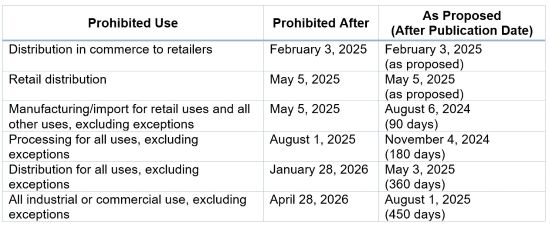
EPA Table 1.jpg

Notably, EPA is allowing the manufacturing, processing, distribution, and use of methylene chloride for paint and coating removal for refinishing of wooden furniture, decorative pieces, and architectural fixtures of artistic, cultural, or historic significance until 2029. EPA has provided this extension based on information provided by commenters who noted that there were limited alternatives available today, and these alternatives come with additional risks, including flammability concerns. 

EPA will also allow, until May 8, 2029, the manufacture, import, processing, distribution, and use of methylene chloride for industrial or commercial use for adhesives and sealants in aircraft, space vehicles, and turbine applications for structural and safety-critical non-structural applications. And EPA finalized, as proposed, a critical use exemption, expiring in 2034, for the manufacture, import, distribution, and use of methylene chloride for certain industrial or commercial uses in an emergency by NASA or its contractors. 

Second, in response to information provided from users of methylene chloride, including exposure levels, monitoring data, and additional details about how methylene chloride is used, EPA revised the rule to allow for additional uses to continue under a worker protection program. EPA originally proposed to prohibit these uses. These additional industrial and commercial uses include: use as a processing aid (e.g., as a heat transfer fluid and as a separator in lithium-ion battery production); use in rubber and plastic (e.g., polycarbonate) product manufacturing; use in paint and coating removal from safety-critical, corrosion-sensitive components of aircraft and spacecraft; use as a solvent that becomes part of a formulation or mixture when the solvent is reclaimed; and use as a bonding agent for solvent welding. 

Third, EPA revised the rule to provide companies more time to meet the workplace protection requirements. Now, companies will have until May 5, 2025—one year, not 180 days—before initial monitoring is required, and compliance with the ECEL is not required until August 1, 2025. Establishment of exposure control plans will not be required until October 30, 2025. EPA is giving federal agencies until November 2026 until they must begin complying with the WCPP.

Finally, based on public comments, EPA established a 0.1% de minimis threshold, which means that products containing less than 0.1% methylene chloride by weight are exempted from all restrictions. Stakeholders argued that this threshold was necessary to ensure consistency with OSHA requirements and to prevent regulation of products where methylene chloride is only an impurity or unintentionally present.  

As EPA continues to work on its robust agenda for evaluating existing chemicals, the methylene chloride rule provides a roadmap for the types of restrictions and programs the agency could follow when addressing identified risks of other chemicals. Additional risk management rules expected to be released in the coming months are listed below: 
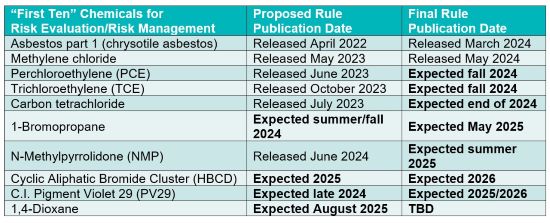
EPA Table 2.jpg


KEYWORDS: chemical regulation chemical safety Environmental Protection Agency EPA Regulations

Share This Story

Looking for a reprint of this article?
From high-res PDFs to custom plaques, order your copy today!

Nancy B. Beck, PhD, DABT, Director of Regulatory Science

Javaned S. Tarter, Senior Attorney, Hunton Andrews Kurth LLP

Javaneh S. Tarter, Partner, Hunton Andrews Kurth LLP

Matthew Z. Leopold, Partner, Hunton Andrews Kurth LLP

Paul T. Nyffeler, PhD, Senior Attorney, Hunton Andrews Kurth LLP

Recommended Content

JOIN TODAY
to unlock your recommendations.

Already have an account? Sign In

  • pci1022-Kinaltek-Lead-1170.jpg

    A Novel Pigment Production Technology

    Following an extensive R&D program that demonstrated...
    Paint and Coating Pigments
    By: Jawad Haidar and Nitin Soni
  • pci global top 10

    2025 Global Top 10: Top Paint and Coatings Companies

    The following is PCI’s annual ranking of the top 10...
    Paint and Coating Market Reports
    By: Courtney Bassett
  • 2025 pci 25

    2025 PCI 25: Top Paint and Coatings Companies

    PCI's annual ranking of the top 25 North American paint...
    Global Top 10 and PCI 25
    By: Courtney Bassett
You must login or register in order to post a comment.

Report Abusive Comment

Manage My Account
  • eMagazine
  • Newsletters
  • Online Registration
  • Subscription Customer Service

More Videos

Sponsored Content

Sponsored Content is a special paid section where industry companies provide high quality, objective, non-commercial content around topics of interest to the PCI audience. All Sponsored Content is supplied by the advertising company and any opinions expressed in this article are those of the author and not necessarily reflect the views of PCI or its parent company, BNP Media. Interested in participating in our Sponsored Content section? Contact your local rep!

close
  • colorful building exterior
    Sponsored byDow

    Insights into Exterior Architectural Coating Degradation: Bridging Accelerated and Natural Weathering

  • digital pigments
    Sponsored bySiltech

    The Fourth Dimension of Silicon: Siltech Q Resins

Popular Stories

Company News

What the AkzoNobel–Axalta Merger Means for the Future of Coatings

AkzoNobel and Axalta Headquarters

AkzoNobel and Axalta Announce $25 Billion Merger

Wacker logo

WACKER Plans More Than 1,500 Job Cuts


PCI Buyers Guide

Submit a Request for Proposal (RFP) to suppliers of your choice with details on what you need with a click of a button

Start your RFP

Browse our Buyers Guide for manufacturers and distributors of all types of coatings products and much more!

Find Suppliers

Events

September 4, 2025

N-Butylpyrrolidone (NBP) as a Green Solvent to Replace N-Methylpyrrolidone (NMP) in Industrial Coating Applications

ON DEMAND: EPA published a regulation proposal around N-methylpyrrolidone (NMP) in June 2024 to ban or limit NMP in many applications, such as paints and coatings and their removers. N-butylpyrrolidone (NBP) is a powerful and versatile solvent for a variety of industries looking for alternatives to substance of very high concern (SVHC)-listed solvents.

March 24, 2026

The Manufacturing & Automation eXchange (MAX)

MAX presents a rare opportunity to observe the full scope of manufacturing in one environment. From systems integration and materials handling to automation, quality, safety, and packaging, each discipline is represented through live, operational displays. By experiencing these technologies side by side, as they are on actual production floors, attendees gain a grounded understanding of how manufacturing functions align, overlap, and evolve in practice.

View All Submit An Event

Poll

Longest-running laboratory experiment

What is the longest-running laboratory experiment?
View Results Poll Archive

Products

Automotive Paints and Coatings, 2nd Edition

Automotive Paints and Coatings, 2nd Edition

Now in its second edition and still the only book of its kind, this is an authoritative treatment of all stages of the coating process.

See More Products
pci voices from the top ebook

PCI webinar

Related Articles

  • Judge's mallet on magnetic resonance background together with laboratory samples and protective glasses. Selective focus

    EPA Finalizes Prohibitions and Regulatory Restrictions for Methylene Chloride

    See More
  • GettyImages-1434052762-1170.jpg

    EPA’s New Approach to Risk Management for Chemicals Under Toxic Substances Control Act (TSCA)

    See More
  • ResinsPolymers-123469626.jpg

    EPA Announces Action on Methylene Chloride

    See More

Related Products

See More Products
  • Kevin-Biller-PC-BOOK.jpg

    Powder Coatings - Foundation for the Novice Formulator (ebook)

  • intelligent.jpg

    Intelligent Coatings for Corrosion Control 1st Edition

  • adhesives.jpg

    Adhesives for Wood and Lignocellulosic Materials

See More Products
×

Keep the info flowing with our eNewsletters!

Get the latest industry updates tailored your way.

JOIN TODAY!
  • RESOURCES
    • Advertise
    • Contact Us
    • Directories
    • Store
    • Want More
  • SIGN UP TODAY
    • Create Account
    • eMagazine
    • Newsletters
    • Customer Service
    • Manage Preferences
  • SERVICES
    • Marketing Services
    • Reprints
    • Market Research
    • List Rental
    • Survey & Sample
  • STAY CONNECTED
    • LinkedIn
    • Facebook
    • Youtube
    • X (Twitter)
  • PRIVACY
    • PRIVACY POLICY
    • TERMS & CONDITIONS
    • DO NOT SELL MY PERSONAL INFORMATION
    • PRIVACY REQUEST
    • ACCESSIBILITY

Copyright ©2025. All Rights Reserved BNP Media.

Design, CMS, Hosting & Web Development :: ePublishing