
Biocides: A Necessary Tool for Managing Biofouling

Need to Know
- Biocidal antifouling coatings remain the most effective tool for controlling marine biofouling and reducing fuel consumption and greenhouse gas emissions in shipping.
- Copper oxide continues to dominate antifouling formulations due to its broad-spectrum efficacy, established regulatory acceptance and predictable environmental fate in marine sediments.
- Alternative biocides such as tralopyril and medetomidine offer targeted performance benefits but often require co-biocides or copper combinations to achieve full protection.
- Regulatory pressure on antifouling biocides is increasing globally, but current evidence suggests high-performance coatings deliver net environmental benefits when assessed holistically.
- Biocide-free antifouling technologies remain limited by performance tradeoffs and unresolved environmental questions related to silicone and fluorinated chemistries.
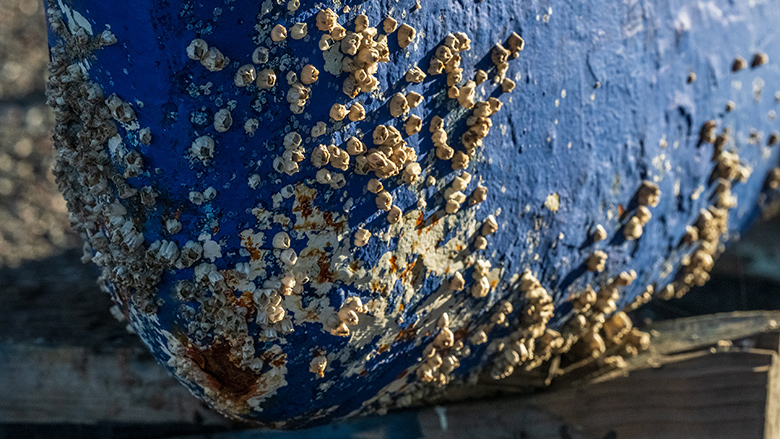
The prevention of biofouling is a hot topic in shipping generally and for regulators in particular. Biocidal antifouling coatings containing active substances that control the growth of unwanted organisms can and do make a huge contribution to combating the global issue, but the biocides themselves are under scrutiny even though the industry still considers biocides a key contributor to sustainable shipping.
Throughout maritime history, ship operators have been engaged in a struggle with nature that has seen them attempting to reduce or eliminate the impact of biofouling on the operation of their vessels. Today there are multiple options available, with antifouling coatings containing biocides the most popular and effective across the shipping industry. But questions are being asked about their sustainability in a world where ESG standards and regulation are forcing operators to think harder about the choices they need to make.
“Biofouling – the accumulation of marine organisms on the hull of a ship – reduces the efficiency of the vessel, causing it to slow down or to use more fuel to maintain operational speed. That is a problem regardless of the owner’s operating strategy. Whether operating directly on the owner’s account or through charterers, it reduces profitability,” said Morten Sten Johansen, global category director, Jotun.
Controlling biofouling has become even more important with the IMO EEDI regulations in 2013 for new vessels and the EEXI regulations for existing vessels in 2023, along with the CII operational limits on CO₂ emissions. With these in place, owners are no longer combating biofouling purely for their own operation and economic reasons but also to meet mandatory requirements aimed at reducing greenhouse gas emissions across the shipping industry.
To add to the complexity of the problem, protecting biodiversity by way of reducing or eliminating the transfer of invasive species has come onto the radar of many national governments and the International Maritime Organization. Populations of invasive species in non-native waters can be facilitated in many ways, but the most obvious is by way of the biofouling on ships’ hulls.
So far only a small number of national governments have enacted laws that require ship operators to keep their ships free of biofouling or risk expulsion from territorial waters, but the IMO appears to be moving away from its current voluntary recommendations toward a mandatory regime that would encompass shipping on a global scale. At MEPC 83 in April 2025, the IMO agreed to a new output on the “Development of a legally binding framework for the control and management of ships’ biofouling to minimize the transfer of invasive aquatic species — a biofouling Convention.” The work will commence in 2026, but how long the process will take is debatable. Work on the AFS Convention began in 1990, but it did not come into force until 2008. The Ballast Water Convention took even longer to be developed and come into full effect.
Increasing Pressure from Customers
Alongside their own benefits and regulatory compliance from combating biofouling, some ship operators also face increasing pressure from their direct customers and others further along the value chain to improve both efficiency and protect biodiversity. Often this pressure is the result of public opinion and is more evident for carriers of consumer goods — liner operators and car carrier operators — than in the bulk and tanker segments.
Attitudes of ship operators toward green issues naturally cover the whole spectrum, from actively embracing them to doing the minimum necessary to meet legal requirements to keep their ships operational. Furthermore, across that spectrum, budgetary issues mean that ambitions may need to be tempered by which products to combat biofouling are affordable and available.
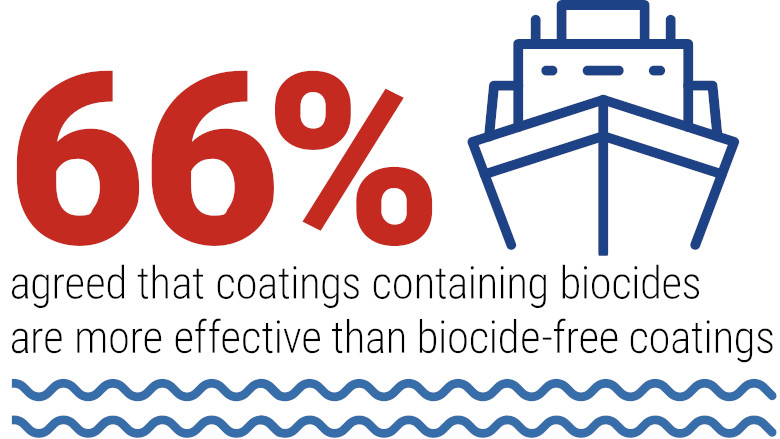
A survey by Jotun on shipowners’ considerations when choosing antifouling coatings revealed that over 66% agreed that coatings containing biocides are more effective than biocide-free coatings. Almost 20% had no strong opinion and just 14% preferred biocide-free coatings.
Clearly, biocides are important to achieving owners’ objectives, but if it did happen that some, or in the worst case all, biocides were restricted or regulated out, the effect would be an increase in greenhouse gas (GHG) emissions and the environment would lose. It is important for stakeholders and regulators to take a holistic approach.
“We firmly believe in taking a holistic view. The best performance is the best for the environment, providing that the ingredients comply with relevant local regulations and an environmental risk assessment has been done,” said Petter Andreassen, R&D chief chemist, Jotun.
For its part, Jotun manufactures a range of products to cover all operators’ antifouling needs and although it is difficult to determine what the impact on biodiversity may be, for emissions reductions a good estimate can be made. In 2024, DNV Maritime Advisory carried out a technical evaluation for the company, which verified that 11.1 million tons of CO₂ was avoided in 2024 for Jotun-coated vessels.
Evolving Technology Offers Multiple Solutions
Preventing organisms from attaching to ships is extremely difficult with current technologies, so the best way to do it effectively and economically is to use a coating on the underwater part of the hull that contains a biocide — a biocidal active substance that controls the growth of unwanted organisms. Such coatings also protect steel ships from corrosion in the same way as conventional coatings used above the waterline. The effect of the biocidal coating can be reinforced by appropriate hull-cleaning technologies.
Biocide use is not confined to protecting ships from biofouling. Indeed, most of the antifouling biocides commonly used today have applications in many other fields, including agriculture, cosmetics, cleaning products and more.
Over time, preventing biofouling has involved the use of many different materials and chemicals, from sheets of copper on wooden vessels to poisonous compounds. Some of these were very successful, but their undesirable side effects attracted the attention of science and the environmental movement, which want to see them controlled or in some cases prohibited from use.
Preventing organisms from attaching to ships is extremely difficult with current technologies, so the best way to do it effectively and economically is to use a coating on the underwater part of the hull that contains a biocide — a biocidal active substance that controls the growth of unwanted organisms.
Unlike much International Maritime Organization regulation, which details what ships must do or carry, the International Convention on the Control of Harmful Anti-fouling Systems (AFS) on Ships, which was adopted in October 2001 but only came into force on September 17, 2008, is geared entirely toward preventing the use of certain products. The convention covers all vessels, including FSUs and FPSOs.
Initially, the product at which the convention was aimed was tributyltin (TBT), a substance developed through the 1960s and first used in the 1970s and which the IMO itself conceded is probably the most effective biocide so far devised for the maritime industry. Since 2023, the IMO has also banned the use of cybutryne, which was used in some antifouling coatings to control algae.
Problems with TBT first surfaced in the 1980s, and within a decade several governments became concerned about its impact on a wide range of marine creatures. In 1990, Japan banned its use on Japanese vessels and the IMO took up the challenge. During the development of the AFS Convention, most coatings manufacturers began winding down TBT production and searched for alternatives, introducing them long before the convention reached the ratification stage. Copper compounds, used extensively well before TBT was developed, appeared to be the best choice, and most antifouling coatings today make use of copper in some form.
Biocides Best Against Biofouling but Under Scrutiny
Combating the impact of biofouling is no longer something shipowners can ignore, even if they wanted to. Coatings manufacturers have developed an array of options, most of which make use of biocides, although a few are biocide-free. The product ranges have been developed and tailored to trades to suit the operational profiles of different vessel types, intended regions of operation and operators’ budgetary restraints.
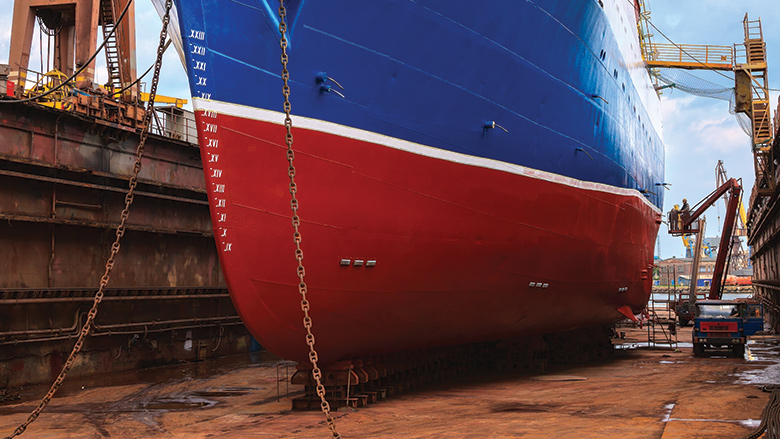
“Coatings containing biocides are designed to remain effective for periods of up to five years or more for premium-priced products and otherwise to give protection at least between dry-dockings,” said Andreassen.
“Although biocides are the most effective weapon against biofouling, it has to be acknowledged that they are hazardous chemicals. Therefore, the level in antifouling coatings should be minimized. However, a product with 5 w% of biocide A is not necessarily better for the environment than a product with 50 w% of biocide B. This is because toxicity and the risks involved in their use also need to be considered. In the above example, biocide A could be 100 times more toxic than biocide B, meaning even though the level in the paint is only one-tenth, the toxicity is higher.”
Comparing the toxicity data of different biocides is a pure hazard assessment. For the exposure assessment in marine environments, there is a need for reliable chemical fate models. Such models must handle the complex transport and exchange processes in coastal environments.
There are computer models in existence that are intended to measure risks according to various factors, such as estimation of hydrodynamical exchange, compound properties and processes, emission estimation based on leaching rates and environmental and hydrodynamical parameters, among others. These models are of use when considering regulations and are helpful to coatings manufacturers in developing sustainable and safer products, but they are likely of little interest to ship operators who only wish to consider the effectiveness and legality of their coating choices.
Biocides and Their Benefits
Copper oxide is by far the most commonly used antifouling biocide, giving protection against most of the 4000–5000 species associated with biofouling, including both hard and soft fouling organisms. Hard fouling is understood as shell-forming organisms, such as barnacles, mussels, oysters and tubeworms. Soft fouling is understood as plants (algae), soft animals (tunicates, soft corals etc.) and slime (microorganisms forming a biofilm on the surface). Some algae are quite tolerant toward copper; hence a co-biocide is often used in combination with copper.

Copper oxide is used by all major coatings manufacturers and is found in >90% of all coatings applied for fouling protection of ships at levels ranging from 20–50 w%. Copper is a naturally occurring substance and is also a micronutrient. It is essential for life and necessary for all living cells. However, at elevated concentrations, notably on the coating surface during idling periods, copper ions (Cu²⁺) are considered toxic. Copper from antifoulings will eventually end up in the sea but for the most part will be confined to the sediment and typically convert to copper sulphide (CuS), which is insoluble and not bioavailable.
There are two alternatives to copper oxide that are effective toward hard fouling organisms, tralopyril and medetomidine. Both are far more potent than copper; hence the volume consumption is lower.
Tralopyril (Econea®) was the first alternative to copper with an effect toward hard fouling organisms. It has been on the market since 2007. Due to reactions with copper oxide, it is primarily used in copper-free products. It requires a co-biocide, typically zinc pyrithione, to give full protection, including against soft fouling. Tralopyril is 6–8 times more potent than copper oxide; hence the use level is 3–6 w% in paints. It breaks down very quickly in seawater by hydrolysis.
Medetomidine (Selektope®). Antifouling paints with medetomidine were launched around 2014. Medetomidine works selectively toward barnacles and tubeworms. It may be used in copper-free paints together with co-biocides but is primarily used in combination with copper oxide as a barnacle fighter. It does not kill fouling organisms but induces a physiological response that repels them from the surface.
Zinc and copper pyrithione (CleanBio®, Omadine®, Pyrion®). The pyrithiones are primarily used against soft fouling. Both were launched during the 1990s, but currently copper pyrithione dominates in volumes, primarily due to the reaction between zinc pyrithione and copper oxide. Both pyrithiones degrade quickly in seawater, primarily via photolysis.
Dichlorooctyl isothiazolinone (Sea-Nine®) has high acute activity toward soft fouling organisms. It was introduced in the early 1990s to replace TBT. DCOIT works well with copper oxide and is typically used at 2–4 w% levels in antifouling paints. It also works well in combination with other biocides in copper-free products. It breaks down rapidly in seawater and sediment, primarily via biodegradation.
Zineb (Zineb Nautec®, Perozin Marine®) has high activity toward soft fouling organisms. It works well in combination with copper oxide. It degrades quickly in seawater.
In addition to the relatively small number of biocides mentioned above, there are some biocides being used on a smaller scale and in local antifouling coatings only. However, the list is getting shorter every year due to a lack of supporting documentation and suppliers.
Looking Ahead
Even though two very effective biocides have now been banned, restrictions on biocides are expected to progressively tighten, and the expectation is that the current assortment of biocides available for use will be reduced in the years to come. The environmental aspect of the six key biocides currently in use is now considered acceptable, as they are all approved by the EU.
The situation is further complicated by a multitude of national and regional regulations that are not aligned, with demands for different approaches to assure compliance. The EU has the strictest regulatory system globally, and it is expected that other markets will follow and implement restrictions should there be any.
There have been suggestions that biocide-free options represent the future, but this view is somewhat speculative given the availability of viable alternatives to biocidal coatings. In 2024, the Washington State Department of Ecology conducted a thorough evaluation of all available technologies for fouling protection of pleasure craft, including copper-free and biocide-free products.
On biocide-free products, the report said these mostly use silicone polymers and sometimes fluorinated chemicals, which may pose their own hazards and for which scientific information on environmental impact is not yet available. Its conclusion was: “Ecology is not able to determine that safer and effective alternatives to copper-based antifouling paints are feasible, reasonable and readily available.”
Other reports have raised questions about the potential for foul-release coatings to release PFAS, sometimes referred to as forever chemicals, and to leach persistent silicone oils into the oceans.
“The issue of biofouling and the means to combat its impact is high on the agenda of the International Maritime Organization and regional and national authorities. Given the IMO’s ambitions around emissions, efficiency and biodiversity, based on current knowledge it is fair to say that the antifouling coating with the best performance is probably the best for the environment, providing that the ingredients comply with relevant local laws and regulations and an environmental risk assessment has been done. Over time, there will no doubt be improvements, with coatings manufacturers at the forefront in this regard,” concludes Andreassen.
This article is part of PCI’s ongoing coverage of evolving regulations, materials and performance considerations shaping the future of Special Purpose Coatings.
Looking for a reprint of this article?
From high-res PDFs to custom plaques, order your copy today!