The Organic Pigment Market
Need to Know
- High-performance organic pigments are gaining market share due to durability, dispersibility and color performance advantages in coatings and printing inks.
- Asia Pacific led the organic pigments market in 2023, supported by growth in packaging, automotive coatings and premium paint demand.
- Restrictions on inorganic pigments in Europe and North America are contributing to increased development and adoption of organic pigment technologies.
- Organic pigments continue seeing strong demand in automotive, decorative, marine and industrial coatings because of vivid color performance and weather resistance.
Organic pigments are organic compounds that change the color of reflected light through selective wavelength absorption. Due to their insoluble properties in coating systems and polymers, organic pigments are widely used across end-use industries. Organic pigments offer higher color strength and gloss compared to inorganic pigments, at the cost of lower covering power. These pigments are mainly classified into three groups: azo pigments, polycyclic pigments and anthraquinone pigments, based on carbon, hydrogen and nitrogen as their basic chemicals.
Revenue Shift of the Organic Pigments Market
The market size of organic pigments was USD 4,015.2 million in 2023; it is projected to reach USD 6,036.6 million by 2029 at a CAGR of 6.5% from 2024. The global organic pigments market declined by around 16.7% from 2022 due to weak demand in the Western market. The Western market was challenged by rising inflation, volatility in commodity prices and disruption in the supply chain, resulting in recessionary trends that hampered demand for organic pigments.
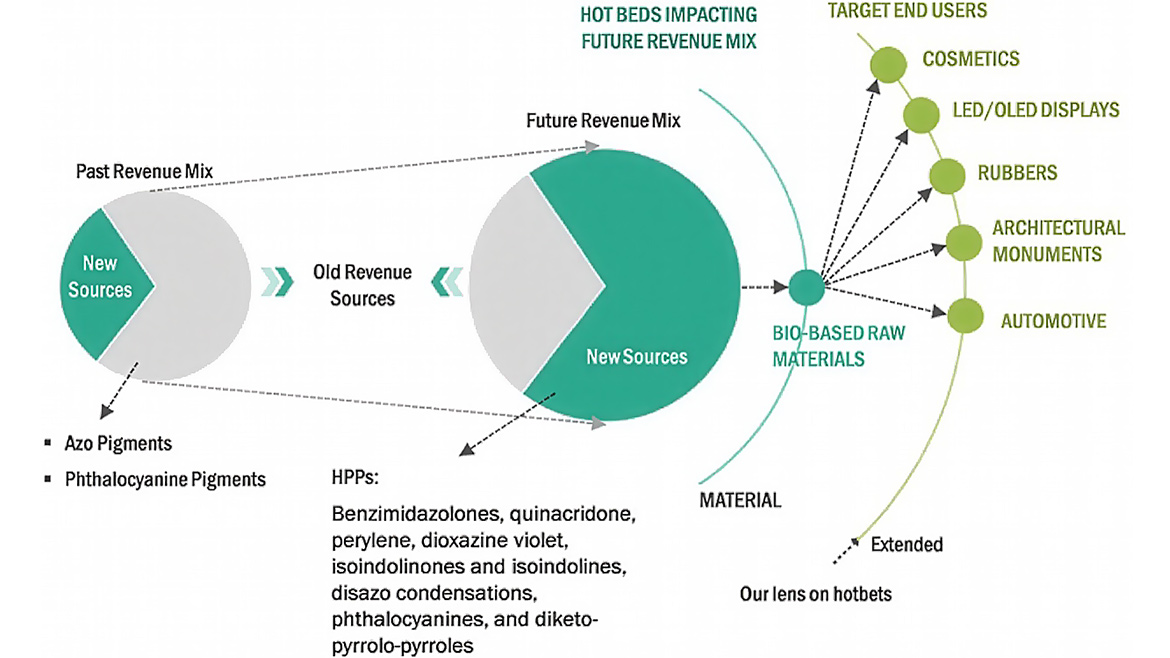
However, the market is expected to witness moderate growth during the forecast period, owing to increasing demand from paint and coatings, printing inks and plastics applications. Most of the demand is for high-performance pigments (HPPs).
HPPs offer excellent durability, high color strength, excellent dispersibility in various resin systems, chemical stability and low solubility. Due to these properties, HPPs command higher prices than standard pigments. HPPs are used in printing and coating applications to provide lasting visual performance.
Organic pigments are widely used in printing ink applications due to regulations and acts such as the Federal Food, Drug, and Cosmetic Act (FFDCA), Code of Federal Regulations (CFR) and Generally Recognized as Safe (GRAS) requirements in food packaging applications. Printing inks utilize the optical density, rub resistance and rheological and flow properties of organic pigments used in jet inks and UV inks. The printing inks market in newspaper and periodical applications has been witnessing a decline due to digitalization; however, demand for printing inks in packaging applications continues to grow at a high rate.
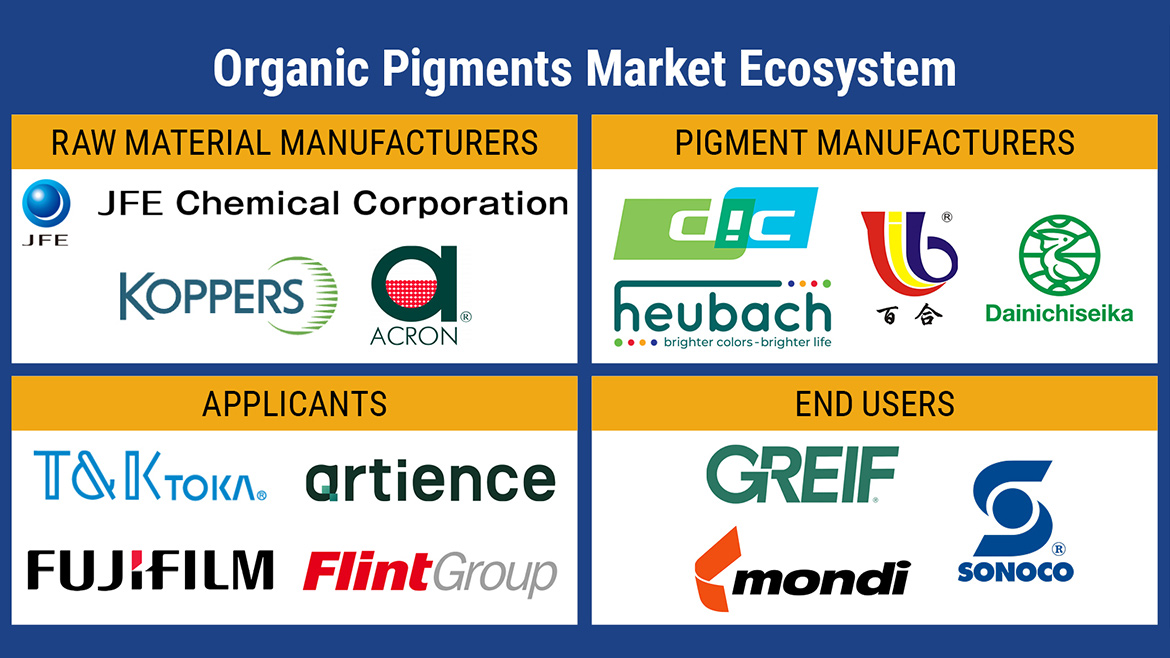
Organic Pigments Market: Key Stakeholders in the Ecosystem
In 2023, Asia Pacific dominated the organic pigments market in printing ink applications. This dominance is attributed to the expansion of the packaging industry in the region. Asia Pacific’s growing packaging sector is one of the major consumers of printing inks, particularly for food and laminated products. Growth in Europe and North America is supported by increasing restrictions on inorganic pigments, particularly in Europe. Manufacturers are developing new products that provide pigments with improved print quality and durability in printing ink applications.
Organic pigments are used in various coating applications owing to their high-performance characteristics, imparting qualities such as good weather fastness, good light fastness, low migration and solvent and bleeding fastness to end products. Paint and coatings are expected to be the fastest-growing application segment for organic pigments during the forecast period. Organic pigments are widely used in decorative coatings, marine coatings, automotive coatings and industrial coatings. The automotive coatings sector is the largest consumer, followed by industrial and decorative coatings. Growth in the construction industry is also expected to increase the use of organic pigments in decorative coatings.
In 2023, Asia Pacific accounted for the largest market share, in terms of both volume and value, of the organic pigments market in paint and coatings applications. The growth is attributed to continued demand for automotive coatings, marine coatings and premium paints. Rising demand is also linked to the improved finish and higher color vividness offered by organic pigments compared to inorganic pigments.
Compared to inorganic pigments, organic pigments offer sharper colors and a broader color range. Although they have lower covering power, they exhibit higher color strength and gloss. They also offer high resistance to chemicals and weathering. Organic pigments are suitable for food-related applications because they are non-toxic and non-reactive to food materials. Another advantage is their insolubility in coating systems and polymers. Due to these properties, these pigments are widely used in the automotive industry to provide vibrant colors to vehicles and plastic parts. Trends in the automotive industry can therefore serve as an indicator of demand for organic pigments.
Read more coverage on trends shaping the pigments market and evolving color technologies in paint and coatings applications.
Looking for a reprint of this article?
From high-res PDFs to custom plaques, order your copy today!