25 Years of Hollow-Sphere Hiding Technology
In both markets, Rohm and Haas has developed a family of hollow-sphere polymers that provide maximum hiding at minimum cost without sacrificing the other performances of the formulations. The use of HSP, which provides value to paints and paper coatings, could be extended to a number of industrial applications such as metal coatings, traffic paints and graphic arts.
In other industrial segments where severe application conditions are required, like in textile or coil coatings, the existing product line was not robust enough. To solve this issue, Rohm and Haas is engineering a new generation of HSP with improved resistance to heat, pressure and solvents.
Hollow Sphere Contribution to Opacity
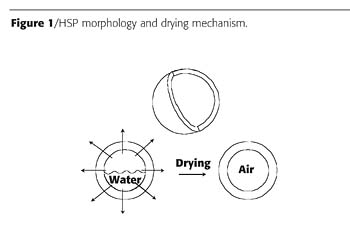
A hollow sphere is prepared through an emulsion polymerization process. In the wet stage, the inner hole is filled with water. On drying, this encapsulated water will diffuse through the polymeric outer shell, and then be replaced by air (Figure 1). Because of the difference in refractive index of the shell (n~1.5) and that of the air (n=1), light scattering becomes effective and the dry HSP appears like a white opaque powder.The polymeric shell consists of a very hard polymer, capable of withstanding the compressive forces that develop during the drying process of a coating film. The HSP has no film-forming capability and the same rules as for common pigments and extenders do apply for the calculation of the formulation parameters (PVC).2
The main contributor to opacity in a coating is titanium dioxide which, due to a high refractive index and an optimized particle size, has a very efficient light scattering. Its efficiency, however, is very much affected by the presence of large particle size extenders in the formulation (crowding effect). It is also, on a dry volume basis, one of the most expensive ingredients in the formulation.
The "pigment crowding" effect normally takes place at high pigment concentrations but is also perceptible at lower levels when coarse extenders are used in the formulation. When increasing the PVC either with extenders or HSP, the pigment particles are forced to pack inside the voids between the coarse extender particles. The inter-particle distance is no longer optimized, thus their hiding efficiency is reduced.
The second contributor to opacity is air. Above CPVC, paint films become more porous and their porosity increases, thus their opacity (dry hiding effect). But, on the other hand, the higher the film porosity, the worse the resistance properties.
The hollow-sphere synthetic pigment concept directly addresses the above problems in the following way.
New Applications for Opacifying Polymers
In architectural coatings, opacifying polymers are well known and widely used for their ability to scatter light and, at the same time, space titanium dioxide without affecting the overall performance. In paper coatings, HSPs not only bring opacity but also excellent gloss and improved printability. All these performance attributes could be of interest for other industrial applications.Traffic Paints
The primary function of road-marking paints is to ensure a satisfactory level of road-marking performance (retro-reflection, skid and wear resistance, luminance) and safety for drivers over a certain period of time (durability, dirt pick-up resistance, hydrophobicity, adhesion, etc.).A traffic paint formulation differs from an architectural paint by two main characteristics: the drying time must be as short as possible in order to quickly re-open a road to traffic after application and a very high volume solids (around 60%) is needed to allow better drying speed and spray application.
In such formulations, the introduction of HSP technology is possible. The use of HSP in a traffic paint formulation permits significant cost savings with better drying behaviour performance without affecting key properties such as the water drop test, dirt pick up resistance, whiteness and scrub resistance.
Graphic Arts
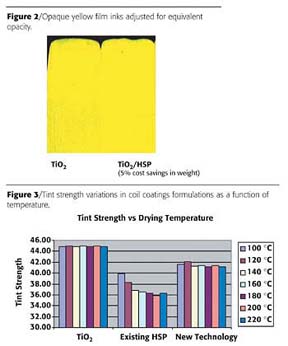
Hollow-sphere synthetic pigments bring a unique set of performance properties in opaque inks. In this application, the use of HSP, in synergy with titanium dioxide, avoids the fact that TiO2 light scattering sites get crowded, leading to a pigment efficiency loss. Moreover, HSP has an inherent light scattering that allows the possibility of reducing the amount of TiO2 (Figure 2).Through pigment reformulation with HSP, the abrasion resistance is drastically improved and the low density of the synthetic pigment leads to improved resistance to sedimentation and consequently to better storage stability. Another advantage of the low density is that the ink formulation will have more volume per unit weight, which will lead to an improved ink milage on a weight basis.1
Metal Coatings
Maintenance Coatings
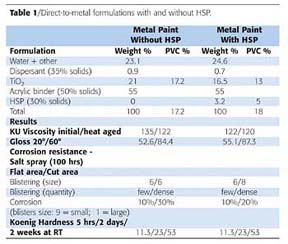
The fact that the HSP additive allows manufacturers to use less titanium dioxide4 can also bring benefits in "direct-to-metal" coatings formulations. More importantly, the spherical morphology and uniform size of the opacifying polymer particles give them less surface area than the pigment and extender they replace. The reformulation permits reducing both the amount of pigment and binder, and thus can lead to significant, attractive cost savings.The cost savings and stabilizing advantages of using HSP can be demonstrated in a typical high-gloss "direct-to-metal" formulation (Table 1). In this formulation, the hollow-sphere synthetic pigment used at 5% PVC allows reducing the amount of TiO2, but it also functions as a stabilizer. With HSP, the rheological profile remains stable, thus maintaining the required high level of performance for "direct-to-metal" coatings, i.e., good Koenig hardness, high gloss level, good adhesion and an enhanced corrosion (salt spray) resistance.
Some industrial applications require very high performance, which can only be achieved through high-temperature crosslinking treatment. In these cases, the existing hollow-sphere family has some limitations. Indeed, most of the commercial HSPs cannot withstand very high temperature (above 80 °C) without showing a collapse of the shell, thus losing all the benefits provided by the void.
Rohm and Haas is engineering a new technology of opacifying polymers with a modified shell composition having more resistance to heat, pressure and solvents, hence more suitable for tough industrial applications.

Coil Coatings
One of the industrial applications requiring heat resistance is coil coatings. Coil coating is a high-speed application to continuous aluminium or steel sheets. It is the most effective method to ensure a high-quality protection and decoration of metal substrates.5Coil coating formulations use high levels of TiO2 (around 30% by weight) and are submitted to severe curing treatments (180 °C for several minutes). Table 2 lists a typical coil coating formulation.
To evaluate the performance of the new HSP technology, several formulations and reformulations with different HSP technologies were tested:
- a formulation with pigment alone (24 weight %);
- a reformulation reducing TiO2 and adding a standard HSP (15 wt% of TiO2 with 12 wt% of HSP); and
- a reformulation replacing, at the same weight, the standard HSP by the new technology.
Compared to the standard generation, the new HSP technology brings better and stable hiding across the tested temperature range. Also, resulting cost savings versus the standard formulation containing only titanium dioxide are significant.
Can Coatings
Can coatings could be an area of interest for the use of this new hollow-sphere synthetic pigment technology. Most packaging coatings use solvent as a medium to carry the paint solids, but due to restrictions on the use of certain raw materials, metal packaging manufacturers had to develop new can systems to reduce VOCs.Three approaches can be found in the packaging coatings market place to reduce VOCs.
Textile
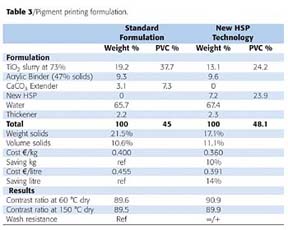
In textile applications, there are several areas where opacity is needed: white pigment printing, crush foam and flocking. To be used in a textile application, an HSP not only should bring opacity but definitively must be heat resistant (at least a few minutes at 150°C), washing resistant and must not affect initial mechanical properties.As an example, the "pigment printing" formulation in Table 3 shows that the new HSP technology does not affect tested performances, even at high temperature, and brings a significant formulation cost reduction (Table 3).
In most of the textile applications, organic opacifiers could significantly reduce the use of titanium dioxide and maintain or improve the substrate properties like tensile strength, hydrophobicity, washing resistance and handle ability/touch.
Conclusion
For the past 25 years, Rohm and Haas has been the leader for opacifying polymers used in the architectural and paper coatings markets. The company has developed a range of products that allow partial replacement of titanium dioxide in architectural coatings, thus reducing formulation costs while maintaining the level of performance. These products also bring opacity and gloss in paper coatings after high pressure calendaring.The current product line already permits the use of hollow-sphere synthetic pigments in various industrial applications like graphic arts or metal maintenance coatings and traffic paints. In these areas the use of titanium dioxide is significant, and the reformulation with a synthetic opacifier not only brings costs savings but also extra performance, like better early block resistance in metal coatings, better dirt pickup resistance and exterior durability in traffic paints and a better abrasion resistance and stability in opaque inks application.
In other industrial segments, the existing products have some limitations due to severe application conditions (e.g., high curing temperatures). Indeed their shell is not strong enough to resist high temperature and has a tendency to collapse, which leads to a loss of efficiency. The recent development of a new technology would allow formulators to get the benefits of conventional hollow-sphere synthetic pigment (costs savings, hiding, hydrophobicity) in a wider range of industrial application conditions where high temperature and pressure are used.
References
1 Brown, J.T. How They Fit Into Graphic Arts. Ink Maker, April 2004.2 Lestarquit, B. Opaque Polymer in High PVC Flat Paints, Internal Publication, 1994.
3 Lestarquit, B. Formulating Cost Effective Paints, Internal Publication, 1993.
4 Hansen, T. Direct To Metal Coatings with High Level of Titanium Dioxide, Internal Publication.
5 Haigh, J.; Bassoua, S. New Applications for Opacity Control Polymers, Internal Publication, August, 2004.
This paper was presented at the 8th Nürnberg Congress, Creative Advances in Coatings Technology, April 2005 in Nürnberg, Germany. The Congress is sponsored by FPL, PRA and the Vincentz Network.
Looking for a reprint of this article?
From high-res PDFs to custom plaques, order your copy today!