Painting & Coating Industry (PCI) logo Powder coating summit logo
search
cart
facebook twitter linkedin youtube
  • Sign In
  • Create Account
  • Sign Out
  • My Account
Painting & Coating Industry (PCI) logo Powder coating summit logo
  • NEWS
    • Latest News
    • Market Trends & Reports
    • Finishing News
    • Price Alerts
    • Subscribe to Newsletters
    • Global Top 10/ PCI 25
    • Weekly Featured Article
    • COATLE Word Game
  • PRODUCTS
    • Product News
    • Must See Products and Services
  • MATERIALS
    • Additives
    • Resins/Polymers
    • Pigments
    • Equipment
    • Distributors
  • TECHNOLOGIES
    • Adhesives
    • Architectural Coatings
    • Finishing Articles
    • Finishing Technologies
    • Finishing Equipment
    • Industrial Coatings
    • Nanotechnology
    • Powder Coatings
    • Solventborne
    • Special Purpose Coatings
    • Sustainability
    • UV Coatings
    • Waterborne
  • RESOURCES
    • Columns
      • Did you know?
      • Distribution Dive
      • Formulating With Mike
      • Innovation Insights
      • Powder Coating Perspectives
      • TiO2 Insider
    • Blogs
      • Editor's Viewpoint
      • Industry Insights
    • Coatings Supplier Handbook
    • Podcasts and Videos
      • COAT-IT! Podcast
      • Videos/PCI TV
    • PCI Store
    • Classifieds
    • eBooks
    • Sponsor Insights
    • White Papers
    • COATLE Word Game
  • EVENTS
    • Coatings Trends & Technologies Summit
    • Paint and Coatings Academy
    • Webinars
    • Calendar of Events
    • Lifetime Achievement Award
  • DIRECTORIES
    • Buyer's Guide
    • Equipment Directory
    • Materials Directory
  • EMAGAZINE
    • Current Issue
    • eMagazine Archive
    • China Issue Archive
    • Editorial Advisory Board
  • CONTACT
    • Contact Us
    • Advertise
    • Subscribe to eMagazine
    • Subscribe to Newsletters
  • SIGN UP!

A Must to Ensure Consistent Quality
September 27, 2000
The surface characteristics of a painted product greatly influence the first impression. For many products, consistent color and uniform gloss are considered to be decorative quality criteria, which play an important role in the decision to purchase. Users should be aware that both effects are overlapping each other and influence the visual perception.

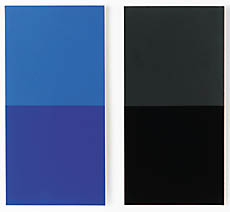
Figure 1 / Different Degrees of Gloss: The High Gloss Side Appears Darker and More Saturated

Color and Gloss Influence the Visual Perception

Figure 1 shows a black paint drawdown with the same pigmentation, but different degrees of gloss. It is obvious that the side with the higher degree of gloss is visually perceived as darker and more saturated than the matte side. For this reason it is very important to measure both surface effects separately. Otherwise, the visible difference may be interpreted as a difference in color, although the real reason is a difference in gloss. This could lead to the wrong conclusion, as the remedies are different. The hue is influenced mainly by the type and/or amount of pigmentation, whereas gloss is dependent on the degree of dispersion, the additives used, and the application parameters, for example.
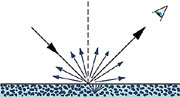
Figure 2 / Direct Reflected Light at First Surface: Gloss Diffuse Reflected Light from the Coating: Color

Color and Gloss Measuring Instruments

How can both effects be measured? On the first surface, part of the incident light is directly reflected following the reflection law: angle of incidence = angle of reflection (see Figure 2). The directly reflected light is responsible for the image forming quality of the surface, such as how glossy and brilliant a surface appears. The other part of the light penetrates the coating and is absorbed or diffusely scattered by the pigments within the bulk of the material. This scattered light exits the coating and is uniformly scattered in all directions. The diffused component causes the color impression.
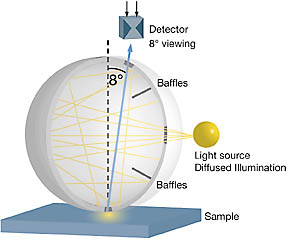
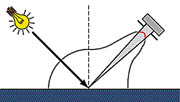
Figure 3 / Principle of a Color Instrument, Sphere Geometry
Until now, two instruments were required to measure color and gloss. To measure only color without any influence from the first surface reflection, color measuring instruments with the so-called sphere geometry are being used. The sample surface is diffusely illuminated by means of a white coated integrating sphere. Baffles within the sphere prevent the incoming light from directly illuminating the sample surface. The reflected light is measured under 8° from the perpendicular (see Figure 3).

Figure 4 / Measurement of Specular Reflection
In practice, the hue and lightness are determined using the standardized CIELab color system. To measure the directly reflected light, e.g., the specular gloss, so-called reflectometers are used. The intensity of the reflected light is measured in a narrow angle range (see Figure 4). The measured values are not related to the amount of incident light, but to a black, polished glass standard with defined refractive index. To obtain a good differentiation for high to low gloss surfaces, three geometries are defined: 20° = high-gloss surfaces; 60° = medium-gloss surfaces; and 85° = matte surfaces.

The table shows the color as well as the gloss values of the matte and the glossy side of the black paint drawdown in Figure 1. The values clearly show that there is no difference in the hue. There is only a very slight total color difference of dE* 0.28. The visible difference is solely caused by the difference in gloss: 90.6 gloss units on the glossy side and 2.5 gloss units on the matte side.

To completely describe and analyze visual mismatches, color and gloss need to be objectively measured. Today’s modern technologies allow us to combine both measuring systems in one instrument. The color-guide gloss simultaneously measures color and 60° gloss according to international standards. This cuts the time for measurement and evaluation in half, and optimizes process control.

Figure 5 / Gloss and Color Values in One Database for Quick Analysis

Color and Gloss Measurement for Weathering Studies

The combined color and gloss measurement plays an important role in weathering studies for the development of new paint systems or for the evaluation of raw material replacement in existing formulations. External influences like UV light, temperature and humidity can cause the raw materials to degenerate. This can lead to changes in color, loss of gloss, embrittlement, flaking and chalking. Weathering tests are conducted outside under natural conditions or in the laboratory using accelerated weathering tests.

Changes in color and gloss are determined by regularly comparing the weathered samples to the original standard. The total color difference, dE*, is usually evaluated. Acceptable changes depend greatly on the hue. Brilliant colors tolerate greater deviations than dark and achromatic colors. In order to obtain additional information about the yellowing of the hue, often the db* is documented. The b* value represents the yellow/blue amount — the greater the deviation on the b* value, the more the paint yellowed. In case of light colors, the dirt pick-up is also rated. For this purpose, the change in lightness (L* value) is recorded. Figure 5 shows the results of an extreme accelerated weathering test with an alkyd resin. It is obvious that the 60° gloss value rapidly decreases and the color deviations dE*, dL*, and db* greatly increase.
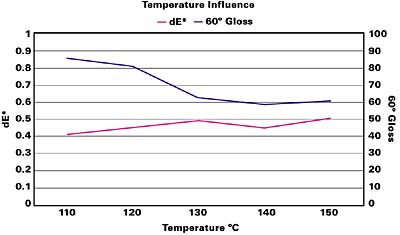
Figure 6 / Influence of Oven Temperature on Color and Gloss

Measurement of Color and Gloss to Analyze and Optimize the Process

Besides raw materials, process parameters in the paint production influence the appearance of the end product. Color, for example, greatly depends on the film thickness. Most of the products are pretreated and get darker thereafter. If the film thickness is too low the substrate will shine through and influence the color. Furthermore, heat-curing systems, such as acrylic, polyester, epoxy or alkyd-resins, are greatly influenced by the baking process. A chemical reaction between the raw materials occurs. Only the appropriate curing process can guarantee an optimally crosslinked paint system with the desired properties. If the temperatures are too high, there will be a yellowing or a change in the hue, because the pigments are only stable up to a certain temperature.

The degree of gloss is greatly influenced by the crosslinking: not enough, optimally or too much. Overcuring will reduce gloss and the surface will appear matte. Figure 6 shows such an example. An industrial paint system was cured at 150°C. The visual comparison to the standard shows a reduced brightness and brilliance — seemingly a color deviation. However, a more detailed analysis with the combined color and gloss measurement showed the following result. The color deviation of dE* = 0.5 measured with a sphere instrument is extremely small and lies within the acceptable tolerance. Visually the sample looks “lighter” caused by the reduced gloss value. That means that the color is off specification, but the gloss changed, which could be adjusted by reducing the oven temperature.

The color-guide gloss can help to determine the cause of a mismatch, optimize the painting process and analyze deviations at the site.

For more information on color-measuring devices, contact BYK-Gardner USA, 9104 Guilford Road, Columbia, MD 21046; phone 800/343.7721; fax 800/394.8215; visit www.byk gardner.com; e-mail custserv@bykgardnerusa.com.

Share This Story

Looking for a reprint of this article?
From high-res PDFs to custom plaques, order your copy today!


Recommended Content

JOIN TODAY
to unlock your recommendations.

Already have an account? Sign In

  • pci1022-Kinaltek-Lead-1170.jpg

    A Novel Pigment Production Technology

    Following an extensive R&D program that demonstrated...
    Paint and Coating Pigments
    By: Jawad Haidar and Nitin Soni
  • pci global top 10

    2025 Global Top 10: Top Paint and Coatings Companies

    The following is PCI’s annual ranking of the top 10...
    Paint and Coating Market Reports
    By: Courtney Bassett
  • 2025 pci 25

    2025 PCI 25: Top Paint and Coatings Companies

    PCI's annual ranking of the top 25 North American paint...
    Global Top 10 and PCI 25
    By: Courtney Bassett
You must login or register in order to post a comment.

Report Abusive Comment

Manage My Account
  • eMagazine
  • Newsletters
  • Online Registration
  • Subscription Customer Service

More Videos

Sponsored Content

Sponsored Content is a special paid section where industry companies provide high quality, objective, non-commercial content around topics of interest to the PCI audience. All Sponsored Content is supplied by the advertising company and any opinions expressed in this article are those of the author and not necessarily reflect the views of PCI or its parent company, BNP Media. Interested in participating in our Sponsored Content section? Contact your local rep!

close
  • colorful building exterior
    Sponsored byDow

    Insights into Exterior Architectural Coating Degradation: Bridging Accelerated and Natural Weathering

  • digital pigments
    Sponsored bySiltech

    The Fourth Dimension of Silicon: Siltech Q Resins

Popular Stories

Company News

What the AkzoNobel–Axalta Merger Means for the Future of Coatings

AkzoNobel and Axalta Headquarters

AkzoNobel and Axalta Announce $25 Billion Merger

Wacker logo

WACKER Plans More Than 1,500 Job Cuts


PCI Buyers Guide

Submit a Request for Proposal (RFP) to suppliers of your choice with details on what you need with a click of a button

Start your RFP

Browse our Buyers Guide for manufacturers and distributors of all types of coatings products and much more!

Find Suppliers

Events

September 4, 2025

N-Butylpyrrolidone (NBP) as a Green Solvent to Replace N-Methylpyrrolidone (NMP) in Industrial Coating Applications

ON DEMAND: EPA published a regulation proposal around N-methylpyrrolidone (NMP) in June 2024 to ban or limit NMP in many applications, such as paints and coatings and their removers. N-butylpyrrolidone (NBP) is a powerful and versatile solvent for a variety of industries looking for alternatives to substance of very high concern (SVHC)-listed solvents.

March 24, 2026

The Manufacturing & Automation eXchange (MAX)

MAX presents a rare opportunity to observe the full scope of manufacturing in one environment. From systems integration and materials handling to automation, quality, safety, and packaging, each discipline is represented through live, operational displays. By experiencing these technologies side by side, as they are on actual production floors, attendees gain a grounded understanding of how manufacturing functions align, overlap, and evolve in practice.

View All Submit An Event

Poll

Longest-running laboratory experiment

What is the longest-running laboratory experiment?
View Results Poll Archive

Products

Automotive Paints and Coatings, 2nd Edition

Automotive Paints and Coatings, 2nd Edition

Now in its second edition and still the only book of its kind, this is an authoritative treatment of all stages of the coating process.

See More Products
pci voices from the top ebook

PCI webinar

Related Articles

  • Higher-Quality, Consistent Drawdown Charts Improve QC Test Results

    See More
  • IndustryNews-493850587.jpg

    Avoid These Five Perils to Ensure a Great Customer Experience Program

    See More
  • Aero Mechanical Conveyor Assures a Dependable and Consistent Flow of Acrylic Powder

    See More

Related Products

See More Products
  • social media

    Optimizing Social Media from a B2B Perspective

See More Products
×

Keep the info flowing with our eNewsletters!

Get the latest industry updates tailored your way.

JOIN TODAY!
  • RESOURCES
    • Advertise
    • Contact Us
    • Directories
    • Store
    • Want More
    • Manufacturing Division
  • SIGN UP TODAY
    • Create Account
    • eMagazine
    • Newsletters
    • Customer Service
    • Manage Preferences
  • SERVICES
    • Marketing Services
    • Reprints
    • Market Research
    • List Rental
    • Survey & Sample
  • STAY CONNECTED
    • LinkedIn
    • Facebook
    • Youtube
    • X (Twitter)
  • PRIVACY
    • PRIVACY POLICY
    • TERMS & CONDITIONS
    • DO NOT SELL MY PERSONAL INFORMATION
    • PRIVACY REQUEST
    • ACCESSIBILITY

Copyright ©2025. All Rights Reserved BNP Media.

Design, CMS, Hosting & Web Development :: ePublishing