Painting & Coating Industry (PCI) logo Powder coating summit logo
search
cart
facebook twitter linkedin youtube
  • Sign In
  • Create Account
  • Sign Out
  • My Account
Painting & Coating Industry (PCI) logo Powder coating summit logo
  • NEWS
    • Latest News
    • Market Trends & Reports
    • Finishing News
    • Price Alerts
    • Subscribe to Newsletters
    • Global Top 10/ PCI 25
    • Weekly Featured Article
    • COATLE Word Game
  • PRODUCTS
    • Product News
    • Must See Products and Services
  • MATERIALS
    • Additives
    • Resins/Polymers
    • Pigments
    • Equipment
    • Distributors
  • TECHNOLOGIES
    • Adhesives
    • Architectural Coatings
    • Finishing Articles
    • Finishing Technologies
    • Finishing Equipment
    • Industrial Coatings
    • Nanotechnology
    • Powder Coatings
    • Solventborne
    • Special Purpose Coatings
    • Sustainability
    • UV Coatings
    • Waterborne
  • RESOURCES
    • Columns
      • Did you know?
      • Distribution Dive
      • Formulating With Mike
      • Innovation Insights
      • Powder Coating Perspectives
      • TiO2 Insider
    • Blogs
      • Editor's Viewpoint
      • Industry Insights
    • Coatings Supplier Handbook
    • Podcasts and Videos
      • COAT-IT! Podcast
      • Videos/PCI TV
    • PCI Store
    • Classifieds
    • eBooks
    • Sponsor Insights
    • White Papers
    • COATLE Word Game
  • EVENTS
    • Coatings Trends & Technologies Summit
    • Paint and Coatings Academy
    • Webinars
    • Calendar of Events
    • Lifetime Achievement Award
  • DIRECTORIES
    • Buyer's Guide
    • Equipment Directory
    • Materials Directory
  • EMAGAZINE
    • Current Issue
    • eMagazine Archive
    • China Issue Archive
    • Editorial Advisory Board
  • CONTACT
    • Contact Us
    • Advertise
    • Subscribe to eMagazine
    • Subscribe to Newsletters
  • SIGN UP!

The Next Generation in Weatherable Hardcoats for Polycarbonate

June 29, 2001


Credit: General Electric Silicones LLC
Table 1 / Selected SAE J576 JUL91 Weathering Regulations for Headlamp Coatings
Editor’s note: This paper received the Best Paper Award at the International Coatings for Plastics Symposium June 4–6, 2001, in Troy, MI.

Polycarbonate is used in many automotive applications due to its excellent properties of impact resistance, high heat distortion temperature and clarity. When used to replace glass or steel, polycarbonate also brings the added benefit of design freedom deriving from injection molding and low part weight. These benefits come at the cost of poor abrasion resistance, weatherability and chemical resistance. To meet application requirements for the first polycarbonate headlamps in the mid 1980s, thermally cured silicone abrasion-resistant hardcoats were developed to augment performance. Coated headlamps were able to meet the Department of Transportation’s minimum requirement of three years’ Florida and Arizona weatherability, as called out in SAE J576 JUL91 (see Table 1).1 In 1989, GE Silicones introduced AS4000 hardcoat and primer SHP401. This system (referred to as AS4000) extended coating delamination in Florida and Arizona testing well beyond the SAE minimum requirements, making it one of the leading coatings in use for headlamps even today, over a decade later. The success of AS4000 led to its expansion into other applications such as sunroofs and pillar posts, which was begun by Lexamar Corp. in 1989.
Credit: General Electric Silicones LLC
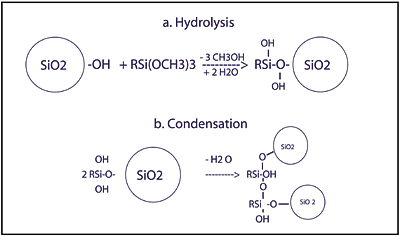
Figure 1 / Schematic of GE Thermal Hardcoat Chemistry

Current Thermal Hardcoat Capabilities

The abrasion resistance and ultraviolet (UV) light protection of the AS4000/SHP401 system derive from the AS4000 topcoat. This type of topcoat, is prepared by the hydrolysis of alkoxysilanes in the presence of water and colloidal silica (see Figure 1), and can contain an alkoxylsilylated UV absorber2 for protection of the polycarbonate. AS4000 is offered at 20% nonvolatile content in aqueous alcoholic solvents.
Credit: General Electric Silicones LLC
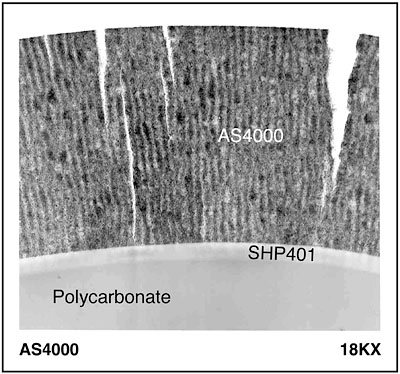
Figure 2 / Transmission Electron Micrograph of AS4000/SHP401
Adhesion of the topcoat to polycarbonate is provided by the SHP401 primer, which is a solution of acrylic polymer tailored to meet the demanding adhesion requirements of the automotive industry. SHP401 is coated on polycarbonate and air dried to a 0.5-micron thick film. The AS4000 topcoat is applied over the primer layer and air dried before curing at 130°C for at least 30 minutes. The cure step involves the condensation of residual silanols to form siloxane bonds. The distinct layers in AS4000/SHP401-coated polycarbonate are clearly observed by transmission electron microscopy (see Figure 2).

Credit: General Electric Silicones LLC
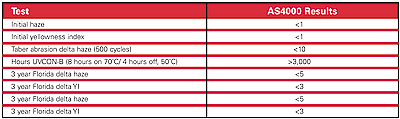
Table 2 / Typical AS4000/SHP401 Performance Properties
AS4000/SHP401 has set an industry benchmark for abrasion resistance and Florida and Arizona exposure (45° angle, south facing) (see Table 2). Coated polycarbonate parts continue to meet yellowness and delamination specifications even after five years of weathering.

Credit: General Electric Silicones LLC
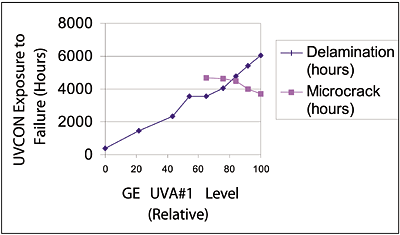
Figure 3 / The Impact on UVCON Weathering of Increased GE UVA #1
To improve even further on this performance, it was necessary to understand the mechanism of failure. The primary concern was that an adequate amount of a suitable UV absorber be present in the coating to protect the polycarbonate for the desired duration of exposure. In the 1980s, this was accomplished by ladder studies where silicone hardcoats containing various levels of UV absorber GE UVA#1 were compared by accelerated weathering techniques and were ultimately correlated with outdoor exposure. The equation y = 0.0009x + 0.4012 was developed experimentally3 to predict the time in years (y) to microcrack failure in Florida exposure based on QUV-B microcrack times in hours (x). (It is important to note that UVCON and other testing using fluorescent UV-B lamps can be seriously misleading. Testing by this method was used to link to historical data and was used as a supplement to presumably more predictive tests such as xenon arc and EMMAQUA. For historical continuity and because we have a large data base, we continue to test by UVCON on thermal cure silicone hardcoats.) As is often the case in coatings development, there is a limit to the amount of UV absorber that can be added. The increase in UV absorber affords better yellowness index (YI) protection, but it also decreases the time to microcrack (see Figure 3).

Credit: General Electric Silicones LLC
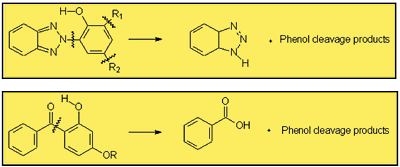
Figure 4 / Photodegradation of UV Absorbers
GE continues to investigate the correlation between accelerated weathering and outdoor exposure for silicone hardcoated polycarbonate. It is known that UV absorbers degrade in outdoor exposure (see Figure 4).4

Credit: General Electric Silicones LLC
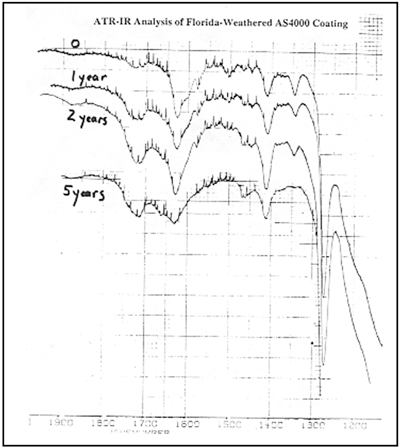
Figure 5 / Chemical Changes of GE UVA#1 Coatings in Florida Weathering
To understand the chemistry that occurs in weathering of coatings containing GE UVA#1, analysis of weathered Florida panels over a five-year period by Attenuated Total Reflectance Infrared (ATR-IR) spectroscopy was conducted. This study indicated that while the silicone matrix remained stable over time, there was a disappearance of a band at 1,340 cm-1 and an appearance of a band at 1,730 cm-1, consistent with UV absorber degradation products (see Figure 5). The indications were that the coating matrix was robust with respect to weathering but that improvements were needed to optimize UV absorber stability.

Credit: General Electric Silicones LLC
Figure 6 / Infrared Analysis of 5 Years’ Florida vs. Accelerated Weathering of GE UVA#1 Coatings
The data in Figure 6 indicates that the same type of chemistry is going on in accelerated methods and at the predicted extrapolated rates, allowing the screening of coatings in accelerated methods such as UVCON, xenon arc and EMMAQUA (see Figure 6).

Credit: General Electric Silicones LLC
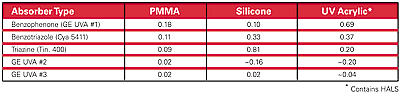
Table 3 / Stability of UV Absorbers in Different Matrices

Improvements in UV Absorber Technology

Pickett followed up on GE UVA#1 degradation data by screening commercially available UV absorbers. Coatings of various proprietary and commercially available UV absorbers dispersed in typical commercial binders were prepared. The change in absorbance at 340 nm was measured as a function of exposure in xenon arc. What he observed was that the UV absorber performance was dependent on the matrix in which it was dispersed (see Table 3).5 Two new types of proprietary UV absorbers demonstrated outstanding stability. We chose to look further at GE UVA #2 for a new acrylic primer and GE UVA #3 for a new silicone topcoat, both with the potential for five times the stability of GEUVA #1.

Product and Process Design

Assessing Needs

The first part of the new product design was to determine what properties were Crucial to Quality (CTQs). Six-sigma based customer needs mapping revealed that a 10-year weatherable coating was desirable. Features of conventional thermal cure hardcoats that could not be lost in the new development were abrasion resistance, transparency and chemical resistance. In addition, the unspoken CTQs — those expected by the customer as a given — were properties such as ease of application and retained impact resistance.

Credit: General Electric Silicones LLC
Table 4 / Weathering Targets for AS4700 / SHP470

Setting specifications

At the next level in product design, the concept of 10-year weatherability was broken down into measurable responses. The customer defined 10-year weatherability as “no more than 5% field failures of parts in service on a vehicle at 10 years.” To measure this CTQ on test panels effectively, a measurable target of a successful seven-year Florida and Arizona exposure was mutually agreed upon. Accelerated weathering targets equivalent to seven years’ outdoor exposure were also set, based on our experience with thermal hardcoats and average UV dosages at 340nm (see Table 4).
Credit: General Electric Silicones LLC
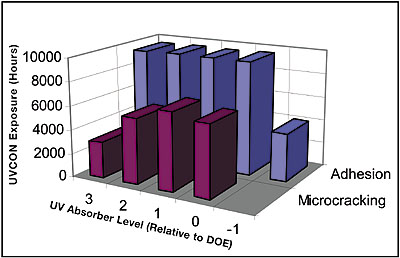
Figure 7 / The Effect of UV Absorber Level in UVCON Weathering on Lexan LS2

Screening Experiments

The new hardcoat technology was based on the strengths of AS4000/SHP401. By starting out with excellent adhesion, the objective became one of retaining that level of adhesion during a lifetime of outdoor exposure. The mechanism of adhesion failure for thermal hardcoats is the degradation of the polycarbonate surface. When this layer degrades, it turns yellow. The degraded, yellow polycarbonate gives a weaker interface, leading first to scribed adhesion loss and finally, to delamination. The novel approach used in developing this hardcoat system was to add enough of the new, highly stable UV absorbers to their respective primer and topcoat matrices to achieve the desired UV protection. The UV absorber level in the primer was adjusted with GE UVA #2 and a ladder experiment was designed around the level of GE UVA #3 in the topcoat to determine what additional UV absorbance would be required. A series of coatings with increasing UV absorber level in the topcoat was prepared and coated on Lexan LS2 polycarbonate. Coated pieces were subsequently exposed in a UVCON. A critical fact observed from this experiment was that having no UV absorber in the topcoat (coded –1 in our subsequent DOE) led to premature adhesion loss and eventually to delamination. At the high end of UV absorber level, (coded +3 relative to our subsequent DOE) we encountered premature microcracking (see Figure 7).

The tendency to microcrack with high levels of UV absorber had been observed earlier with experimental coatings (see Figure 3), so a similar trend here was not unexpected. The other result from the ladder experiment was the preliminary confirmation that the matrix chosen was stable enough to deliver unusually good UVCON results relative to the >3,000 hours afforded by coatings containing GE UVA #1. It would be necessary in the full DOE to confirm this benefit through other accelerated weathering methods and outdoor weathering.
Credit: General Electric Silicones LLC
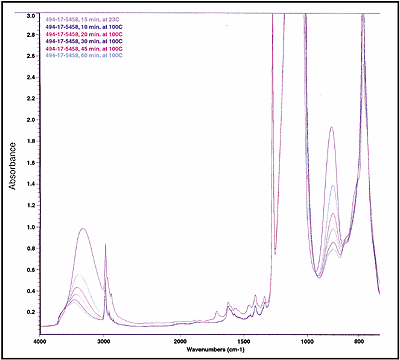
Figure 8 / Infrared Study of Coating Cure at 100°C
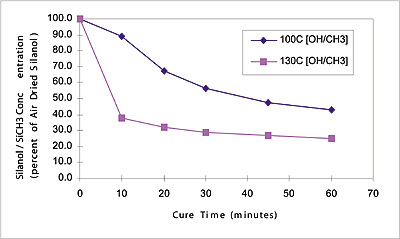
In a second short screening experiment, the decrease in silanol concentration was followed as a function of topcoat cure time. Salt plates were coated, placed in an oven, and the loss over time of the silanol band at 904 cm-1 relative to the constant methyl C-H band at 2,969 cm-1 in infrared was measured at the two extremes of 100°C and 130°C (see Figure 8).

Credit: General Electric Silicones LLC
Figure 9 / Silanol Loss Rate for Cure at 100°C and 130°C
The silanol loss at 130°C is notably faster than at 100°C (Figure 9). Above 130°C, the polycarbonate will distort. We applied the same coatings to polycarbonate panels and looked at Taber haze over the same intervals of time and temperature. Infrared spectroscopy indicates a fast rate of loss of silanol and a low final silanol level. The close correlation between silanol loss and Taber haze are shown in Figure 10 for 100°C cure. Taber data in the range of 10% delta haze at 500 cycles at 100°C cure temperature indicated we should cure at 130°C to robustly meet the secondary CTQ of abrasion resistance similar to AS4000.

Credit: General Electric Silicones LLC
Table 5 / Product and Process DOE for Thickness A

Design of Experiments (DOE)

The next step in the development was to look critically at the components of the ladder study to select candidate factors in addition to UV absorber that might intuitively have an influence on weatherability. Again, drawing upon our experience in hardcoats, five product factors were varied. A sixth factor, the effect of duration of cure at 130°C, was also added. Oven times were chosen at 30 and 90 minutes, including approximately five minutes of heat-up time. To make the scope of this DOE more manageable, a 2(6-2) fractional design, giving 16 runs, was set up. Two center point replicates were added to determine curvature. The whole DOE was then replicated at a slightly greater top coat thickness. The total number of runs was 36).

After the DOE coatings were made, they were coated and cured on clear, Lexan 9030 polycarbonate panels. Panels were then cut into smaller test pieces if required for accelerated and outdoor weathering testing established in Table 4.
Credit: General Electric Silicones LLC
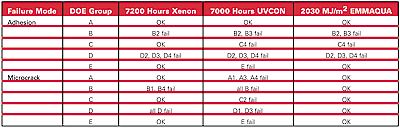
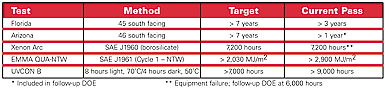
Table 6 / Current Weathering Status of AS4700 / SHP470 DOE
The progress to date for this DOE is shown in Table 6. The optimal portion is identified with the new topcoat AS4700 and the new primer SHP470.

The three-year Florida results are shown in Table 6 relative to the predictions made by accelerated data. The correlation with failed coatings at this point in time is good, although the exact time of failure does vary somewhat. Failures are confined to most of the “D” group from the DOE and coating “C4” which correlate with factor “b” and possibly factor “a” being at the “+1 coded level.
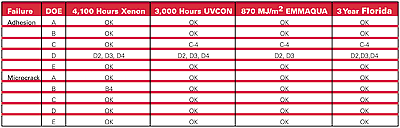
Credit: General Electric Silicones LLC
Table 7 / Accelerated Data Predictions vs. Actual 3 Year Florida Weathering
Since our accelerated weathering tests have exceeded their respective targeted exposures equivalent to seven years’ Florida, a prediction can be made as to what may be observed following four more years of Florida weathering (see Table 7). The accelerated data do not agree as closely with one another at the seven year equivalency point, but the best coatings do consistently appear to be the DOE group A, reinforcing a preference for the low level of factors “a” and “b”. Differentiation in the other major groups indicates a further preference for the high level of factor “c”. The actual analysis is more complicated and is still under assessment.

Credit: General Electric Silicones LLC
Table 8 / Accelerated Data Predictions for Actual 7 Year Florida Weathering
Transfer functions for nine responses including those from 7-year equivalent UVCON and EMMAQUA exposure were simultaneously solved using Design Expert software from Stat-Ease. The graph in Figure 11 indicates the “desirability” of the solution on a 0–1 scale. The design space around the point (-a, -b, +c) is seen as highly desirable, indicating product robustness.

The data for adhesion loss in EMMAQUA at 2,900 MJ/m2 exposure (the equivalent of 10 years’ Florida) give a simplified coded transfer function: EMMAQUA adhesion failure (in MJ/m2) = 2376 – 498a – 299b + 517c – 281d – 335f – 281 af + 169 x coating thickness. This equation says that the coating lasting the longest in EMMAQUA will have low levels of factors a and b, and a high level of factor c as predicted, with d and f plus an interaction term also being significant. The best three coatings from the DOE are A2, C3 and D1. At this time, work continues toward determining the most robust product and process meeting all CTQs.

The underlining impetus in developing the new coating to raise the bar toward 10-year weatherability. In comparing the data to that for the current SAE J576 specification, it is apparent that this new coating excels at both microcracking and adhesion, with accelerated data that is at least twice as good as the specification. The accelerated weathering has progressed to the point where EMMAQUA has reached the 10-year Florida equivalent in weathering (see Table 8).

Credit: General Electric Silicones LLC
Table 9 / Weathering Capability of DOE Coating A2
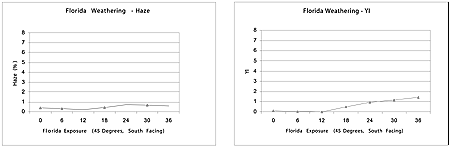
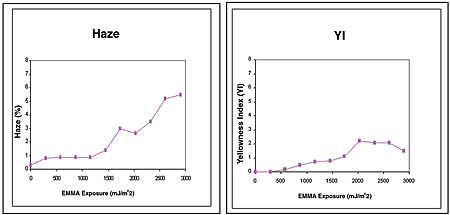
Selective results are seen graphically in Figures 12 and 13.

Credit: General Electric Silicones LLC
Figure 12 / Florida Weathering of DOE Coating A2

Coatings on Black Polycarbonate

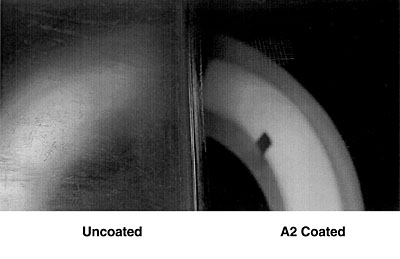
While the work described above was in the early stages of evaluation, a similar DOE was initiated on black polycarbonate. The accelerated weathering data showed the same trends for factors “a”, “b” and “c” as in the first DOE and the best coatings still look good after three years’ Arizona exposure (see Figure 14). The three year Florida panels are expected to be returned shortly. A follow-up DOE involving the processing of coating A2 on black polycarbonate is still in test.

We are currently focusing on optimizing manufacturing parameters during scale-up and application on clear and black polycarbonate, based on data from these several product and process DOEs. Accelerated and outdoor weathering for those studies will be continued until failure.
Credit: General Electric Silicones LLC
Figure 13 / EMMAQUA Weathering of DOE Coating A2

Applications

LexaMar a division of Decoma International, is a leading supplier of hardcoated automotive products and expects to supply more than 6 million parts for automotive use this year. Started in 1985, LexaMar specializes in the design, manufacture and assembly of hardcoated injection molded exterior parts for automotive use. The company started using GE Silicones AS4000 hardcoat in 1989 and presently the facility is in the process of building a state of the art process to apply the new GE Silicones product, AS4700. This product derives from the above described work and is expected to greatly extend part weatherability, approaching the 10-year milestone. The current plan calls for start-up of the new hardcoat system by the end of 2001.
Credit: General Electric Silicones LLC
Figure 14 / Coated vs. Uncoated Black Polycarbonate at 3 Years Arizona

Summary

GE Silicones has developed a new hardcoat for polycarbonate that raises the protection of polycarbonate to a new level. New, highly stable UV absorbers were combined with improvements in existing coating chemistries using DOEs to survey the product and process design spaces. Accelerated weathering tests were conducted using UVCON-B, xenon arc and EMMAQUA to predict the suitability of these new coatings. Outdoor exposure testing shows data at three years in Florida compares favorably with the accelerated weathering predictions. The critical factors for weatherability and abrasion resistance have been identified and an optimized product has been selected. Processing optimization on clear and black polycarbonate is still under investigation.

The International Coatings for Plastics Symposium is an annual event sponsored by PCI Magazine. For more information, contact Harper Henderson at 248/244.6478, visit www.pcimag.com, or e-mail harperh@bnp.com.

For more information on hardcoats, contact George Medford, General Electric Silicones LLC, 260 Hudson River Road, Waterford, NY 12188.

Share This Story

Looking for a reprint of this article?
From high-res PDFs to custom plaques, order your copy today!


Recommended Content

JOIN TODAY
to unlock your recommendations.

Already have an account? Sign In

  • pci1022-Kinaltek-Lead-1170.jpg

    A Novel Pigment Production Technology

    Following an extensive R&D program that demonstrated...
    Paint and Coating Pigments
    By: Jawad Haidar and Nitin Soni
  • pci global top 10

    2025 Global Top 10: Top Paint and Coatings Companies

    The following is PCI’s annual ranking of the top 10...
    Global Top 10 and PCI 25
    By: Courtney Bassett
  • 2025 pci 25

    2025 PCI 25: Top Paint and Coatings Companies

    PCI's annual ranking of the top 25 North American paint...
    Paint and Coating Market Reports
    By: Courtney Bassett
You must login or register in order to post a comment.

Report Abusive Comment

Manage My Account
  • eMagazine
  • Newsletters
  • Online Registration
  • Subscription Customer Service

More Videos

Sponsored Content

Sponsored Content is a special paid section where industry companies provide high quality, objective, non-commercial content around topics of interest to the PCI audience. All Sponsored Content is supplied by the advertising company and any opinions expressed in this article are those of the author and not necessarily reflect the views of PCI or its parent company, BNP Media. Interested in participating in our Sponsored Content section? Contact your local rep!

close
  • colorful building exterior
    Sponsored byDow

    Insights into Exterior Architectural Coating Degradation: Bridging Accelerated and Natural Weathering

  • digital pigments
    Sponsored bySiltech

    The Fourth Dimension of Silicon: Siltech Q Resins

Popular Stories

Company News

What the AkzoNobel–Axalta Merger Means for the Future of Coatings

AkzoNobel and Axalta Headquarters

AkzoNobel and Axalta Announce $25 Billion Merger

Wacker logo

WACKER Plans More Than 1,500 Job Cuts


PCI Buyers Guide

Submit a Request for Proposal (RFP) to suppliers of your choice with details on what you need with a click of a button

Start your RFP

Browse our Buyers Guide for manufacturers and distributors of all types of coatings products and much more!

Find Suppliers

Events

September 4, 2025

N-Butylpyrrolidone (NBP) as a Green Solvent to Replace N-Methylpyrrolidone (NMP) in Industrial Coating Applications

ON DEMAND: EPA published a regulation proposal around N-methylpyrrolidone (NMP) in June 2024 to ban or limit NMP in many applications, such as paints and coatings and their removers. N-butylpyrrolidone (NBP) is a powerful and versatile solvent for a variety of industries looking for alternatives to substance of very high concern (SVHC)-listed solvents.

March 24, 2026

The Manufacturing & Automation eXchange (MAX)

MAX presents a rare opportunity to observe the full scope of manufacturing in one environment. From systems integration and materials handling to automation, quality, safety, and packaging, each discipline is represented through live, operational displays. By experiencing these technologies side by side, as they are on actual production floors, attendees gain a grounded understanding of how manufacturing functions align, overlap, and evolve in practice.

View All Submit An Event

Poll

Longest-running laboratory experiment

What is the longest-running laboratory experiment?
View Results Poll Archive

Products

Automotive Paints and Coatings, 2nd Edition

Automotive Paints and Coatings, 2nd Edition

Now in its second edition and still the only book of its kind, this is an authoritative treatment of all stages of the coating process.

See More Products
pci voices from the top ebook

PCI webinar

Related Articles

  • Engineering the Next Generation of Coatings for the Fast Lane

    Engineering the Next Generation of Coatings for the Fast Lane

    See More
  • Creating Next-Generation Air and Space Coatings in the Modern Age

    Creating Next-Generation Air and Space Coatings in the Modern Age

    See More
  • Sign of the Times: Santa Monica Pier Entrance Refreshed for Next Generation

    Sign of the Times: Santa Monica Pier Entrance Refreshed for Next Generation

    See More

Related Products

See More Products
  • durability.jpg

    Increasing the Durability of Paint and Varnish Coatings in Building Products and Construction 1st Edition

  • Kevin-Biller-PC-BOOK.jpg

    Powder Coatings - Foundation for the Novice Formulator (ebook)

  • Rheological Additives in Latex Paint Formulations (Zoom course - 2/26/26)

See More Products

Related Directories

  • General Carbon Co.

    Lampblack dry black pigment, CAS 1333-86-4, SIC 2816 inorganic pigments, ASTM INT D-209.
×

Keep the info flowing with our eNewsletters!

Get the latest industry updates tailored your way.

JOIN TODAY!
  • RESOURCES
    • Advertise
    • Contact Us
    • Directories
    • Store
    • Want More
  • SIGN UP TODAY
    • Create Account
    • eMagazine
    • Newsletters
    • Customer Service
    • Manage Preferences
  • SERVICES
    • Marketing Services
    • Reprints
    • Market Research
    • List Rental
    • Survey & Sample
  • STAY CONNECTED
    • LinkedIn
    • Facebook
    • Youtube
    • X (Twitter)
  • PRIVACY
    • PRIVACY POLICY
    • TERMS & CONDITIONS
    • DO NOT SELL MY PERSONAL INFORMATION
    • PRIVACY REQUEST
    • ACCESSIBILITY

Copyright ©2025. All Rights Reserved BNP Media.

Design, CMS, Hosting & Web Development :: ePublishing