Painting & Coating Industry (PCI) logo Powder coating summit logo
search
cart
facebook twitter linkedin youtube
  • Sign In
  • Create Account
  • Sign Out
  • My Account
Painting & Coating Industry (PCI) logo Powder coating summit logo
  • NEWS
    • Latest News
    • Market Trends & Reports
    • Finishing News
    • Price Alerts
    • Subscribe to Newsletters
    • Global Top 10/ PCI 25
    • Weekly Featured Article
    • COATLE Word Game
  • PRODUCTS
    • Product News
    • Must See Products and Services
  • MATERIALS
    • Additives
    • Resins/Polymers
    • Pigments
    • Equipment
    • Distributors
  • TECHNOLOGIES
    • Adhesives
    • Architectural Coatings
    • Finishing Articles
    • Finishing Technologies
    • Finishing Equipment
    • Industrial Coatings
    • Nanotechnology
    • Powder Coatings
    • Solventborne
    • Special Purpose Coatings
    • Sustainability
    • UV Coatings
    • Waterborne
  • RESOURCES
    • Columns
      • Did you know?
      • Distribution Dive
      • Formulating With Mike
      • Innovation Insights
      • Powder Coating Perspectives
      • TiO2 Insider
    • Blogs
      • Editor's Viewpoint
      • Industry Insights
    • Coatings Supplier Handbook
    • Podcasts and Videos
      • COAT-IT! Podcast
      • Videos/PCI TV
    • PCI Store
    • Classifieds
    • eBooks
    • Sponsor Insights
    • White Papers
    • COATLE Word Game
  • EVENTS
    • Coatings Trends & Technologies Summit
    • Paint and Coatings Academy
    • Webinars
    • Calendar of Events
    • Lifetime Achievement Award
  • DIRECTORIES
    • Buyer's Guide
    • Equipment Directory
    • Materials Directory
  • EMAGAZINE
    • Current Issue
    • eMagazine Archive
    • China Issue Archive
    • Editorial Advisory Board
  • CONTACT
    • Contact Us
    • Advertise
    • Subscribe to eMagazine
    • Subscribe to Newsletters
  • SIGN UP!

Thermo Control - How to Turn Black into Cool

By Dr. Lutz Frischmann
February 1, 2008

Jumping out of the box is an objective every pioneering and forward-thinking coatings chemist or engineer likes to achieve. Modern and innovative coatings strive for an apparent breakthrough effect that imparts to the coating system an obvious added value. This ambition is driven by the general need for creating more cost-efficient products without turning them into commodities.

To prevail it is essential to focus on the right raw materials! One of the most innovative options is the use of “smart” materials. Smart pigmentation is pigmentation that is capable of responding to changes in its environment or that may also exhibit an unexpected functionality.

One of the most striking challenges of this century is a reduction in energy consumption. For example, Japan’s electrical energy crisis in 2007 was the result of excessive use of air conditioning. If we were able to reduce the heat build-up effect, the energy consumption would have been much lower.

An unexpected functionality that we therefore need is the ability to control the absorption of the solar radiation by pigments without affecting their visible colouristic properties. This is what we call thermo-controlling pigmentation.
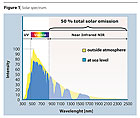


Solar spectrum.

What Does Thermo Controlling Mean?

It is well known, that a white surface remains cool, while a black one heats up. The reason for this is the interaction of the coated object with the near-infrared radiation (NIR) emitted by the sun (Figure 1).

The sun emits almost 50% of its energy as IR-radiation. When this NIR-radiation is absorbed, light is physically converted into heat. A surface interacts not only by absorbing radiation but also by emitting in the far-infrared region until the equilibrium at a certain temperature is reached. By using conventional pigmentation this effect could result in a severe build-up of heat.
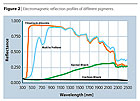


Electromagnetic reflection profiles of different pigments.

Black surfaces strongly absorb NIR and visible light, while white surfaces are effective in reflecting NIR and visible light. But white or pastel colours cannot always satisfy the consumer’s demands.

Differently coloured pigments exhibit different, specific electromagnetic reflection profiles as shown in Figure 2.

Focusing on the IR range (780-2500 nm), a pigment like rutile yellow exhibits the highest reflection followed by titanium dioxide. On the other hand, carbon black benchmarks the lowest reflection. Compared to carbon black a considerably higher reflectance in the NIR region of the solar spectrum can be achieved by a specifically designed IR-reflecting spinel black pigment.
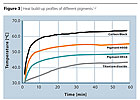

Heat build-up profiles of different pigments. (1,2)

These different and characteristic reflectance curves are also mirrored in different heat build-up curves shown in Figure 3. In the heat build-up experiment a coated panel is exposed to artificial NIR-light in a closed box under defined conditions. The increase in temperature is measured together with the exposure duration.

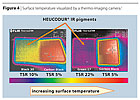
Surface temperature vizualized by a thermo-imaging camera. (1)

By reflecting the NIR-radiation more efficiently, this pigmentation gives coatings the ability to significantly reduce the surface temperature. This effect can be visualized by a thermo-imaging camera as shown in Figure 4.

The thermo images show coated panels pigmented with different IR-reflecting pigments on the left side and with carbon black on the right side respectively. Afterwards the panels were homogeneously irradiated using an IR-lamp under defined conditions.

The advantage we can get from this approach is not only a reduction of the heat build-up that can be correlated with decreased energy consumption, but also an enhanced coating shelf life.

Due to the significant reduction in surface temperature, thermal degradation of the polymeric matrix is reduced. In addition temperature differences between day and night, direct sunlight and shadowed areas etc., will also be levelled out. As a consequence, thermal warping becomes less effective.

This aspect of the use of thermo-controlling pigments is very important, because this effect can be utilized for numerous other applications in addition to housing, roofing and facades.

This is the key reason why this approach truly deserves the label SMART. Not only because it contributes to a more environmentally aware use of resources, but also because of its exceptional ability to extend the shelf life of exterior coatings or polymers.
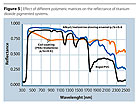


Effect of different polymeric matrices on the reflectance of titanium dioxide pigmented systems.

Smart Complex Inorganic Coloured Pigments

We are looking for efficient IR-reflecting pigments offered in different colour shades, exhibiting outstanding outdoor durability for their intended use in exterior coatings and available on a large scale. In order to select the right pigments we need to dig a little bit deeper into theory.

Comparing pigments with respect to their influence on the heat build-up always depends on the polymeric matrix. Figure 5 shows, as an example, the different reflectance curves of titanium dioxide in different matrices. As a consequence the characteristic absorption of solar radiation needs to be taken into consideration when designing an effective IR-reflecting coating formulation.
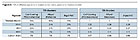
TSR of different pigments in relation to the matrix used and to titanium dioxide. (1)

What is TSR?

When selecting an effective IR-reflecting pigment the most important factor is the TSR value. TSR means Total Solar Reflectance and is the integral total amount of solar energy that is immediately rejected by a surface material (e.g., coating). That means that it includes UV-, visible- as well as NIR-radiation and is thus a key figure to describe the heat build-up of surfaces.

The TSR covers the entire range of radiation between UV and NIR, e.g., black pigments show systematically lower TSR values compared to white pigments for example. Therefore, only TSR values of similar pigments should be compared.

A high TSR value indicates efficient reflection – a low TSR value indicates a strong tendency to absorb NIR-light and therefore induce significant heat build-up. It is helpful to interpret the TSR value in relation to the matrix used and/or a reference pigment (e.g., titanium dioxide) (Figure 6).

Furthermore, it should be considered that even small amounts of impurities can negatively affect the TSR of the coating. Even fillers, which are usually added to the paint, can potentially reduce the resulting reflectance in the near infrared. On the other hand varying the pigment load (10% to 30%) does not generally cause notably different TSR values.

An additional influence on the scattering of electromagnetic radiation is given by the particle size distribution.
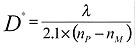
The scattering of electromagnetic radiation can be described using Mie’s theory. The scattering of light of wavelength λ is dependent on the diameter (D*) of a spherical particle and the difference between the refractive indices of the pigment (nP) and the matrix (nM). A first estimation on the interrelation of the refractive indices and particle size is given by the following simple formula:

Comparison of chemically identical Pigment Black 30 pigments with different particle size distribution.

As a consequence, smaller particles selectively reflect short-wave radiation, while larger particles more efficiently reflect long-wave radiation. This effect is used to control and adjust the scattering properties of pigments.

Figure 7 shows two chemically identical pigment black 30 pigments with different particle size distributions. The pigment black 30 with the particle size distribution shifted toward larger particles exhibits a significantly higher reflectance, especially in the long wavelength region, compared to the smaller particle size black 30 pigment.
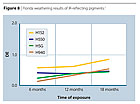


Florida weathering results of IR-reflecting pigments. (1)

The Solution

To achieve maximum reflection of solar radiation, a NIR-reflective pigmentation of exterior coatings is required that provides a high TSR value and the highest outdoor durability. All these requirements can be fulfilled by Complex Inorganic Color Pigments (CICP), which exhibit specially designed reflectance characteristics whilst retaining their excellent weather and light fastness (Figure 8) as well as their exceptional temperature resistance.

Looking at the thermo images in Figure 4 the effect of different TSR values becomes apparent. The difference in the TSR values of approximately 5% on the left panel and 17% on the right panel results in a drastically stronger heat build-up of the carbon black pigmented coil coating.

These novel, IR-reflecting complex inorganic colored pigments offer a wide range of color shades from yellow to black. They allow the formulation of not only architectural, building and construction coatings, tiles, plasters etc., but also automotive exterior and interior applications like dash-boards, fuel tanks, etc.

Because of the reduced surface temperature, the use of these pigments extends the shelf life of the polymeric matrix through a minimization of thermo-induced degradation effects and, of course, substantially reduces the heat build-up.

They therefore take care of the customer’s comfort as a result of reducing the heat build-up and thus their electric bill.


For more information see www.heubachcolor.de or Lutz.Frischmann@heubachcolor.de.

Share This Story

Looking for a reprint of this article?
From high-res PDFs to custom plaques, order your copy today!


Dr. Lutz Frischmann | Heubach GmbH, Langelsheim, Germany

Recommended Content

JOIN TODAY
to unlock your recommendations.

Already have an account? Sign In

  • pci1022-Kinaltek-Lead-1170.jpg

    A Novel Pigment Production Technology

    Following an extensive R&D program that demonstrated...
    Paint and Coating Pigments
    By: Jawad Haidar and Nitin Soni
  • pci global top 10

    2025 Global Top 10: Top Paint and Coatings Companies

    The following is PCI’s annual ranking of the top 10...
    Paint and Coating Market Reports
    By: Courtney Bassett
  • 2025 pci 25

    2025 PCI 25: Top Paint and Coatings Companies

    PCI's annual ranking of the top 25 North American paint...
    Global Top 10 and PCI 25
    By: Courtney Bassett
You must login or register in order to post a comment.

Report Abusive Comment

Manage My Account
  • eMagazine
  • Newsletters
  • Online Registration
  • Subscription Customer Service

More Videos

Sponsored Content

Sponsored Content is a special paid section where industry companies provide high quality, objective, non-commercial content around topics of interest to the PCI audience. All Sponsored Content is supplied by the advertising company and any opinions expressed in this article are those of the author and not necessarily reflect the views of PCI or its parent company, BNP Media. Interested in participating in our Sponsored Content section? Contact your local rep!

close
  • colorful building exterior
    Sponsored byDow

    Insights into Exterior Architectural Coating Degradation: Bridging Accelerated and Natural Weathering

  • digital pigments
    Sponsored bySiltech

    The Fourth Dimension of Silicon: Siltech Q Resins

Popular Stories

Company News

What the AkzoNobel–Axalta Merger Means for the Future of Coatings

AkzoNobel and Axalta Headquarters

AkzoNobel and Axalta Announce $25 Billion Merger

Wacker logo

WACKER Plans More Than 1,500 Job Cuts

pci academy

PCI Buyers Guide

Submit a Request for Proposal (RFP) to suppliers of your choice with details on what you need with a click of a button

Start your RFP

Browse our Buyers Guide for manufacturers and distributors of all types of coatings products and much more!

Find Suppliers

Events

September 4, 2025

N-Butylpyrrolidone (NBP) as a Green Solvent to Replace N-Methylpyrrolidone (NMP) in Industrial Coating Applications

ON DEMAND: EPA published a regulation proposal around N-methylpyrrolidone (NMP) in June 2024 to ban or limit NMP in many applications, such as paints and coatings and their removers. N-butylpyrrolidone (NBP) is a powerful and versatile solvent for a variety of industries looking for alternatives to substance of very high concern (SVHC)-listed solvents.

March 24, 2026

The Manufacturing & Automation eXchange (MAX)

MAX presents a rare opportunity to observe the full scope of manufacturing in one environment. From systems integration and materials handling to automation, quality, safety, and packaging, each discipline is represented through live, operational displays. By experiencing these technologies side by side, as they are on actual production floors, attendees gain a grounded understanding of how manufacturing functions align, overlap, and evolve in practice.

View All Submit An Event

Poll

Longest-running laboratory experiment

What is the longest-running laboratory experiment?
View Results Poll Archive

Products

Automotive Paints and Coatings, 2nd Edition

Automotive Paints and Coatings, 2nd Edition

Now in its second edition and still the only book of its kind, this is an authoritative treatment of all stages of the coating process.

See More Products
pci case ebook

PCI webinar

Related Articles

  • How to Turn Black into Cool

    See More
  • Sugar Beets

    AkzoNobel and Partners Looking to Turn Sugar Beets Into Raw Materials

    See More
  • DistributorsServices-126217275.jpg

    Turn This Year’s Excess Inventory into Next Year’s Tax Deduction While Doing Good

    See More

Related Products

See More Products
  • intelligent.jpg

    Intelligent Coatings for Corrosion Control 1st Edition

  • corrosion.jpg

    Corrosion Control Through Organic Coatings 2nd Edition

See More Products
×

Keep the info flowing with our eNewsletters!

Get the latest industry updates tailored your way.

JOIN TODAY!
  • RESOURCES
    • Advertise
    • Contact Us
    • Directories
    • Store
    • Want More
    • Manufacturing Division
  • SIGN UP TODAY
    • Create Account
    • eMagazine
    • Newsletters
    • Customer Service
    • Manage Preferences
  • SERVICES
    • Marketing Services
    • Reprints
    • Market Research
    • List Rental
    • Survey & Sample
  • STAY CONNECTED
    • LinkedIn
    • Facebook
    • Youtube
    • X (Twitter)
  • PRIVACY
    • PRIVACY POLICY
    • TERMS & CONDITIONS
    • DO NOT SELL MY PERSONAL INFORMATION
    • PRIVACY REQUEST
    • ACCESSIBILITY

Copyright ©2025. All Rights Reserved BNP Media.

Design, CMS, Hosting & Web Development :: ePublishing