
Gaining a Competitive Advantage Using Benchmarking
As the coatings industry has continued to mature, it has become increasingly competitive. Having a manufacturing and distribution network that provides products to customers at the lowest possible cost will be a decisive factor in the success of all companies operating in the coatings industry. Furthermore, a successful strategy to increase market share by delivering preferred products and excellent service will be a key determinant of the winning companies. So how does one determine if his or her company’s costs, products and services are a source of competitive advantage or disadvantage? We believe that a good first step is benchmarking.
Benchmarking
Benchmarking is a process where companies compare business processes and metrics with the expectation of determining what ‘best-in-class’ performance is and how ‘best-in-class’ performance has been achieved. It is not always necessary for the benchmarked companies to be in exactly the same business. For example, it is possible to compare the accounts payable and accounts receivable functions within dissimilar businesses providing they have similar processes in those areas. Measuring and understanding how a business has been able to achieve best-in-class performance is only the first step in benchmarking. It is only by developing and implementing change because of the results of benchmarking that a company is able to achieve best-in-class performance.Benchmarking is too often seen as a one-time event. Continuous benchmarking or repetitive benchmarking will not only provide a snapshot of how you are performing at a particular point in time but how quickly the companies you are comparing yourself against are changing. We know of one segment of the coatings industry that conducts benchmarking every three years. In one instance, after a benchmarking study, one company implemented an extensive program to improve its operations to achieve best-in-class performance. When the next round of benchmarking was completed, the results showed they had improved considerably. However, one of their competitors had improved even more. Without the repetitive benchmarking they would not have had this understanding.
Why Is Benchmarking Important in the Industry?
The coatings industry is a mature industry. Growth rates for the next several years are expected to be in the 1.5% to 3% range, raw material prices continue to climb and margins are expected to continue to be squeezed. Any performance advantage that can be gained becomes a competitive advantage.Many coatings companies operate in isolation. The only cross-pollination of ideas that occurs is when someone leaves one company and joins another. This leads to companies operating as if there is only one way to do a task – their way. There is often a great deal of inertia in companies that prevents them from improving. This can be overcome by showing how other companies have been successful by doing a process a different way.
Many companies will not participate in benchmarking because they fear that they will be providing their competition with key information about their processes and business. When done correctly, benchmarking will not provide to any participant the figures of any competitor. Only the average of the participants and the best-in-class figures should be disclosed.

Two Types Of Benchmarking
There are two key types of benchmarking.Metric Benchmarking
Metric benchmarking is a quantitative assessment of how a company performs against agreed key measures. It allows a company to track its performance over time and to provide a snapshot of how the company performs against other similar companies. Table 1 shows some common metrics that are used when benchmarking.
Process Benchmarking
Measuring how a company performs is only part of the puzzle. Knowing how the best-in-class companies were able to achieve those results is the other part. Process benchmarking maps the different processes, breaks them into the specific steps and compares them with those processes that produce best-in-class performance. For example, in one recent case, benchmarking identified that warehouse cost per order was much higher than the industry average. After mapping the order picking process we determined that the reason for higher order costs was due to the storage method being used: every time a pallet of product was needed, two or three other pallets had to be moved to be able to access the required pallet. By understanding this, the company was able to modify their order picking process to dramatically improve their productivity. Metric benchmarking tells you how you are doing. Process benchmarking tells you why you are achieving those results and how you can improve performance.
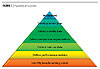
How To Conduct Benchmarking To Guarantee Success
Every benchmarking project should use a seven-step process that we refer to as the Pyramid of Success. This pyramid is shown in Figure 1. Each of the seven levels of the Pyramid of Success is described in more detail below.1. Identify Benchmarking Needs
Benchmarking can be time consuming and expensive if not strictly controlled. Because of this, benchmarking should be limited to metrics and processes that affect the critical success factors of the business. In most cases the sector of the coatings industry that you operate in will determine the critical success factors. For example, if operating in the architectural market, then the critical success factors are likely to be service level, inventory turns and distributions costs. In the coil business, product consistency and application performance are likely to be your critical success factors. Understanding your company’s critical success factors and selecting the key performance indicators that relate to the critical success factors will reduce the cost and effort of completing the benchmarking.
2. Develop Performance Metrics
This stage of the process identifies the metrics that relate to the agreed critical success factors and defines those metrics so that you are able to obtain apples to apples comparisons. It makes little sense for a company that primarily makes batches that are less than 100 gallons to compare their labor cost per batch with a benchmark group that typically makes 10,000-gallon batches.
If the critical success factor is service level, then the appropriate metric might be the number of orders on time and complete. If the critical success factor is cost, then the gallons per direct man hour would be an appropriate measure.
Defining each metric adequately is critical to successful benchmarking. For example, if the correct metric is gallons per direct man hour, which functions within the operations group should be included in the total man hours? In some companies this would include batch makers, milling operators, filling operators and letdown operators. Other companies would include material handling and first line supervision in the direct man hours. The results can be very different depending on who is considered direct. Even a simple metric like gallons per man hour needs to be accurately defined in order to obtain apples to apples comparisons.
When defining metrics ensure that the terminology that is being used is the same. Terms vary from company to company and even from plant to plant. Some companies use the term “milling” to refer to high-speed dispersion processes and the grinding media processes. Others use the term to refer to only the grinding media processes. Process mapping requires attention to detail if the results are to be meaningful.
3. Internal Data Collection
Once the metrics and processes have been defined it is necessary to collect the data from your own organization. Often data is not collected using the same definitions that have been used for the benchmarking. For normal internal reporting, direct man hours may have been defined to include material handlers. In the benchmark definition for direct man hours, you may not wish to include material handlers. This means that it will be necessary to subtract material handling hours from the figures in the standard internal reports.
Once you have started to collect the benchmarking data you may find that you have selected too many metrics or processes to map. Now is the time to review your critical success factors, the metrics and processes to be mapped, and determine if they are all necessary. Remember that any outside companies will also have to collect the same data if the benchmarking is to be meaningful. If you have selected too many processes or metrics, the outside benchmark group may balk at providing the data.
4. Select Comparison Organizations
Finding companies that are willing to share their information with you can be difficult. This is frequently the case when they are direct competitors. Sometimes it is best to find a third party that can act as a data collector and buffer because no one wants to provide financial data to their competition. One way around this is to use a consulting company to collect the data and report only the average and the best-in-class performance figure. The individual values for any of the participants should never be published.
5. Collect Outside Benchmarking Data
Collecting outside data can be difficult. Each organization must agree on the definition of each measure and accurately map each process studied. This can be very time consuming so it is important not to collect too much data. It is also important to remember not to ask for data that you are not willing to provide to the outside participants.
Due to the time-consuming nature of benchmarking, using an outside consultant can be beneficial. The consultant can ensure that the data is truly apples-to-apples comparisons and that the process mapping is done in enough detail to be useful. Using a consultant also gets over the hurdle of having competitors in the plant.
6. Assess The Competitive Gap and Develop an Action Plan
This is a critical step in the benchmarking process. In this step you must:
- make direct comparisons of the metrics;
- assess the gap that exists between your company and the best in class;
- compare the processes that are currently used and are used by the best-in-class companies;
- determine performance goals; and
- formulate a strategy and develop an action plan to achieve those goals.
7. Implement the Action Plan
Nothing will change until you implement your actions plan. The first step is to get everyone in the organization to buy into the action plan. It is also important to have a process for regularly reviewing and measuring progress against the action plan.
Conclusions
To increase your company’s competitiveness, it is necessary to understand how your operations and business processes compare to that of your competitors. Thus, benchmarking can be a very useful technique for identifying opportunities for improvement. Orr and Boss is aware of numerous companies in the coatings industry that have used benchmarking to identify opportunities for improvements. Moreover, these companies have been able to implement action plans to drive real change in their operations and services. These are the companies that have become best in class performers.However, to be successful, careful definitions of the metrics and detailed process maps must be done if you are truly to get apples-to-apples comparisons. Using an outside company to collect data and to be a buffer can help ensure that companies are willing to participate. Unfortunately, benchmarking can become an exercise in collecting data if it does not lead to change. It is critical to develop an action plan from the gap analysis and to implement the plan.
For more information, contact Kevin Reid at 800/869.9401, e-mail kreid@orrandboss.com, or visit www.orrandboss.com.
Looking for a reprint of this article?
From high-res PDFs to custom plaques, order your copy today!