Chain Extender Evaluation for Polyurethanes Derived from Hydroxyl-Terminated Polybutadiene Resins
In addition to the two classic chain extenders recommended for the polyurethane systems derived from hydroxyl-terminated polybutadienes, two more aliphatic diols are identified through extensive testing for the same utility.
Chain extenders play a significant role in enhancing the final mechanical properties of polyurethanes derived from hydroxyl-terminated polybutadiene (HTPB) and 4,4´-methylenebis(phenyl isocyanate) (MDI). Conventionally, N,N-diisopropanol aniline (DIPA) and 2-ethyl-1,3-hexanediol (EHD) are recommended for their compatibility and physical property enhancement of the polyurethane elastomer. By comparison, 1,4-butanediol (BDO), widely employed in polyurethanes based on polyether or polyester polyols, is not a good choice owing to its poor compatibility with HTPB resins. A systematic screening of both aromatic and aliphatic diols as potential chain extenders in standard HTPB-based polyurethane formulations has been carried out. Although a good correlation could not be drawn between the diol structure and mechanical performance, two new aliphatic diols were notable for their superior performance.
Introduction
Polyurethanes based on polybutadiene polyols are known for excellent hydrophobicity, hydrolytic and chemical resistance, electrical insulation properties, and low-temperature flexibility.(1-3) Similar to other polyurethanes, the gum stock formulations based on neat HTPBs and stoichiometric amounts of diisocyanates usually possess inferior mechanical properties. Incorporating chain extenders, such as diols of low molecular weight, in the gum stock formulas enhances the elastomeric properties of the resulting polyurethanes, because the small diols react with diisocyanates and form hard domains to serve as the physical crosslink for the polyurethane systems. Traditionally, 1, 4-butanediol is one of the most important chain extenders used in commercial polyurethane elastomers based on polyether or polyester polyols. Since HTPBs have a completely non-polar backbone structure, many chain extenders designed for polyether or polyester polyols were proven to be unsuitable for the HTPB-derived polyurethanes. The poor compatibility between the chain extenders and the non-polar nature of the polybutadiene backbone was attributed to be the root cause.
Two types of HTPB resins are available commercially. Poly bd® resins are radically polymerized products, having about 2.5 hydroxyl functionalities.(4) Krasol® LBH and LBH-P polybutadiene diols are anionically polymerized products with a very narrow molecular-weight distribution, each containing no species with a functionality higher than 2.0.(4,6) We have shown in previous publications that 2-ethyl-1,3-hexanediol and N,N-diisopropanol aniline (Voranol® 220-530) were excellent chain extenders(1,5) for the polyurethanes derived from either Poly bd or Krasol resins. Because of recurring supply issues, we initiated a search for alternative chain extenders suitable for the polyurethane system based on HTPB resins. This report describes our preliminary findings.
Experimental
Materials
Poly bd and Krasol resins were obtained from Cray Valley USA, LLC. Chain extenders 2-ethyl-1,3-hexanediol (EHD), 1,3-butanediol (1,3-BG), 2-butyl-2-ethyl-1,3-propanediol (BEPG), and 2,4-diethyl-1,5-pentanediol (PD-9) were sampled from Kyowa Hakko U.S.A. Inc. Hydroquinone bis(2-hydroxyethyl) ether, N-phenyldiethanolamine, 4,4´-methylenebis(phenyl isocyanate) (MDI), dibutyltin dilaurate (DBTDL), 1,6-hexanediol, and 2,2,4-trimethyl-1,3-pentanediol (TMPD) were purchased from Aldrich. HER™ HP, i.e., resorcinol di(β-hydroxyethyl)ether was kindly given to us by Indspec Chemical Corporation. All the materials were used in the reaction as is without further purification.
Preparation of Polyurethanes – Lab Procedure
One-Shot Procedure
Krasol LBH-2000 resin was added to a four-necked resin kettle, followed by degassing and dehydrating at 85 ºC in vacuo (<10 mm Hg) for 1.5 h. Diisocyanate MDI flakes and solid chain extenders (CE) were melted in an oven right before usage. Liquid Krasol resin, MDI, CE, and DBTDL catalyst were then charged to a centrifuge cup. The mixture was homogenized in a SpeedMixer™ (model DAC 150), then poured onto a hot metal mold. The sample was initially cured in an oven at 110 ºC for 3.5 h, and then at 65 ºC overnight. The sample was further aged one week at room temperature to ensure complete curing before physical property testing was performed.
Prepolymer Procedure
MDI flakes were charged to a four-necked resin kettle. The kettle was heated with stirring to melt the MDI under nitrogen. To the kettle containing liquid MDI was added warm (65 ºC) Krasol LBH 2000 resin. The reaction was held at 75 ºC for 1.5 h to form the prepolymer, which was then degassed at 75 ºC in vacuo. The prepolymer, liquid CE, and DBTDL catalyst were then charged to a centrifuge cup. The mixture was homogenized in a SpeedMixer (model DAC 150), then poured onto a hot metal mold. The sample was initially cured in an oven at 110 ºC for 3.5 h, and then at 65 ºC overnight. The sample was further aged one week at room temperature to ensure complete curing before the testing of physical properties was performed.
Characterization and Testing
An Instron Materials Tester (model 4301) was used for measuring the physical properties of polyurethane sheets at 22.2 °C (72 ºF) and 60% relative humidity. Tensile strength, elongation and modulus (at 50% strain) were obtained by following the ASTM D 412 protocol. Tear strength was determined by following the ASTM D 624 protocol. For each sample four or five specimens were tested and an average value reported. Sample hardness was determined with a Round Shore Durometer Type A or Type D at room temperature.
 Credit: Cray Valley USA Credit: Cray Valley USA
|
| Table 1 Click to enlarge |
Results and Discussion
A few diols of low molecular weight, including aromatic and aliphatic types, were selected as potential chain extenders. Examining the compatibility of the diols with HTPB resins at various temperatures serves as the initial screening before incorporating them in polyurethane formulations. Two preparative procedures, namely, one-shot and prepolymer, were used to make the polyurethane sheets. The hard domain contents in the polyurethane sheets were set at 30, 35, 40 and 45% for monitoring the concentration effect of the chain extenders on physical properties. As to HTPB resins, both Krasol LBH 2000 and Poly bd R45HTLO resin were examined.
Aromatic Diols as Chain Extenders
The compatibility of the aromatic chain extenders with Krasol LBH 2000 resin was evaluated and the results are listed in Table 1. It is conceivable that the aromatic chain extenders selected have extremely poor compatibility with the Krasol resin. We managed to evaluate 1,3-bis(2-hydroxy ethoxy) benzene and N-phenyldiethanolamine in a prepolymer procedure, hoping that pre-reacting of the diols with MDI would mitigate the compatibility issue. Unfortunately, with the 30%, 35% and 40% hard domain contents, the polyurethanes derived from both chain extenders were inferior to the controls containing EHD. Thus, they were not evaluated further.
Aliphatic Diols as Chain Extenders
 Credit: Cray Valley USA Credit: Cray Valley USA |
| Table 2 Click to enlarge |
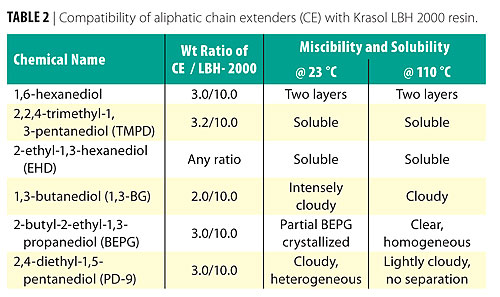
The aliphatic diol candidates were chosen based on their commercial availability and significant hydrocarbon moiety in the molecules. They were submitted for compatibility testing with Krasol LBH 2000 resin and the results are listed in Table 2. There is no strong distinction based on compatibility to favor any one chain extender over the others. Thus, they were all tested in the polyurethane formulations.
 Credit: Cray Valley USA Credit: Cray Valley USA |
| Table 3 Click to enlarge |
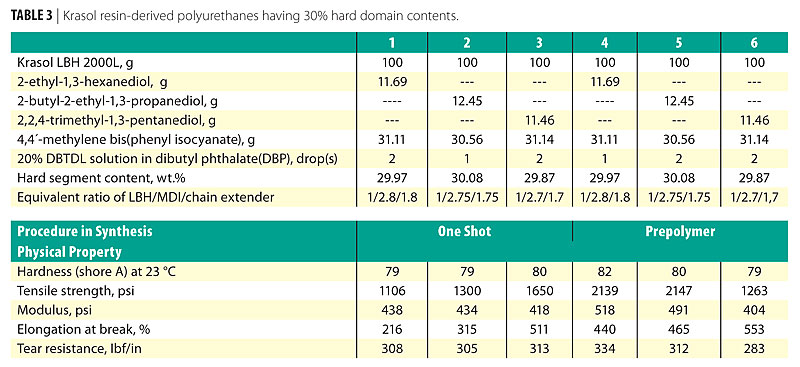
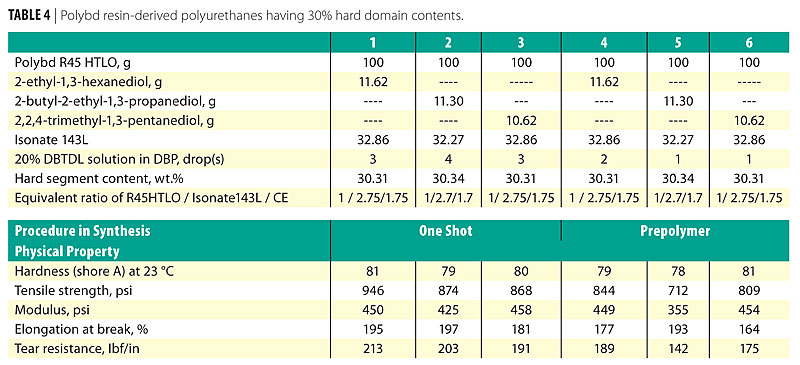
The chain extender 1,6-hexanediol turned out to be too incompatible with the Krasol resin in the one-shot process. The approach was abandoned. Similarly, the chain extenders 1,3-butanediol and PD-9 yielded parts of low hardness, tensile strength and modulus compared with those made using EHD in the one-shot process. Although the prepolymer procedure in general mitigated the compatibility issue to a certain degree, the polyurethane parts made by using 1,6-hexanediol, 1,3-butanediol or PD-9 were still not on a par with the materials containing EHD. On the other hand, the chain extenders TMPD and BEPG yielded excellent polyurethane parts with the hard domain contents ranging from 30 to 45%.
 Credit: Cray Valley USA Credit: Cray Valley USA |
| Table 4 Click to enlarge |
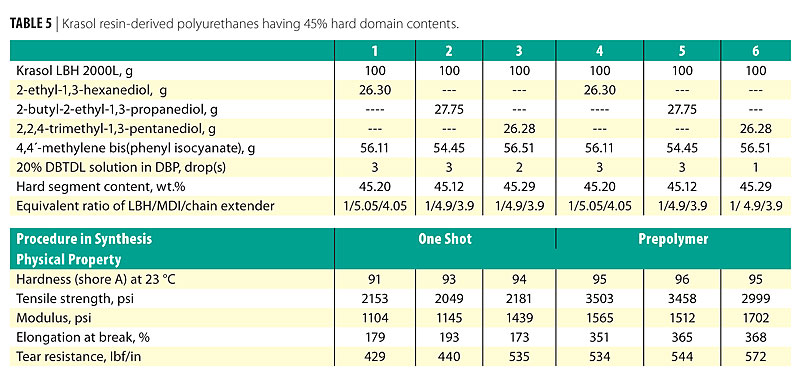
The formulations and physical properties of the polyurethanes having hard domain contents of 30% are listed in Tables 3 and 4, which employ Krasol LBH 2000 and Poly bd R45HTLO resin, respectively, along with three outstanding chain extenders. Since the polyurethanes derived from Krasol resin and 4,4’-MDI should be thermoplastic in nature (Table 3), they have better elongation, tear resistance and tensile strength than those crosslinked polyurethanes derived from Poly bd resin and Isonate 143L (Table 4). However, the differences in physical properties between those derived from Krasol and Poly bd resin (Tables 5 and 6, respectively) are not as significant when the hard domain contents reach 45%.
 Credit: Cray Valley USA Credit: Cray Valley USA |
| Table 5 Click to enlarge |
Based on the limited examples above, it is noted that the good chain extenders, namely, EHD, BEPG, and TMPD are completely soluble in HTPB resins (Table 1). The solubility criterion seems to be a necessary condition for the chain extenders to have before further examining the mechanical properties of the polyurethanes derived from them and HTPB resins. Needless to say, the molecular weight of the chain extenders cannot be excessively large to disrupt the hard domain formation through hydrogen bonding.
 Credit: Cray Valley USA Credit: Cray Valley USA |
| Table 6 Click to enlarge |
Interestingly, EHD was found not to be a suitable chain extender any longer when HTPB resins were blended with polyether polyols, such as polypropylene glycol (PPG) and polytetramethylene glycol (PTMEG), to make polyurethane copolymers. BDO turned out to be outstanding again in those polyol blends.5 Similarly, BDO is a better chain extender than EHD for the polyurethane block copolymers derived from HTPB and polyester polyols7 regarding the mechanical properties enhancements.
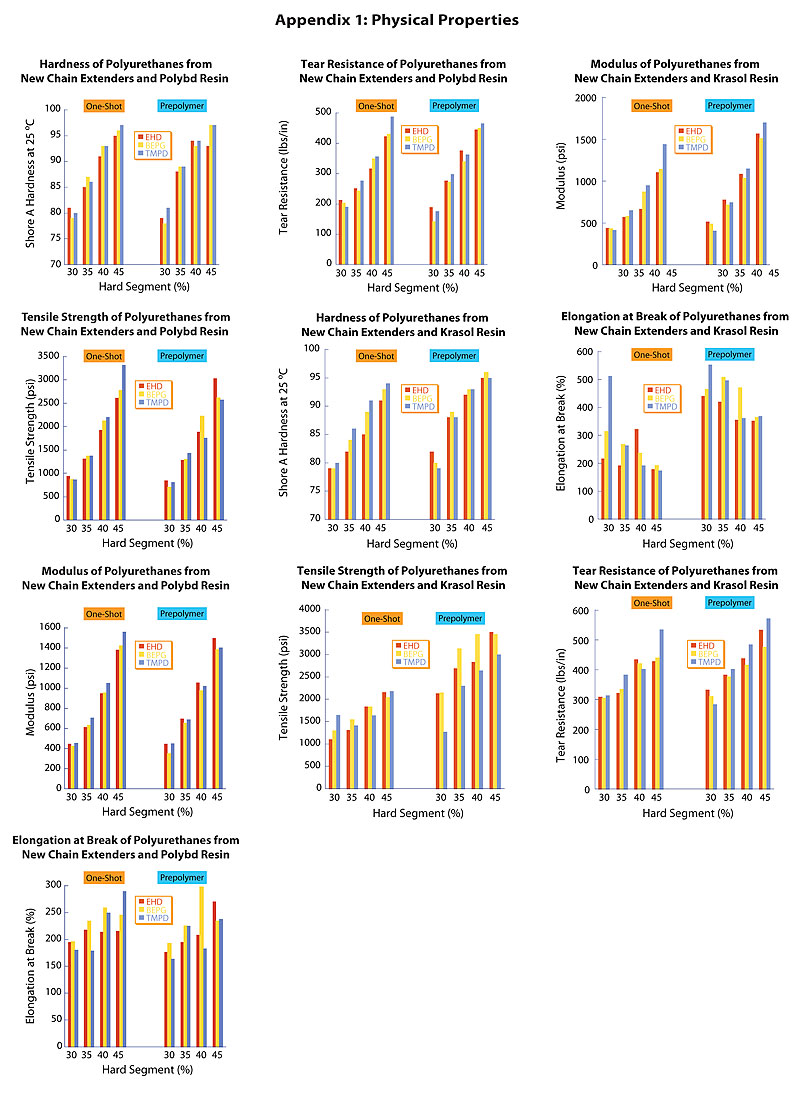
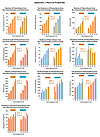
Physical properties are noted in the charts in Appendix 1.
 Credit: Cray Valley USA Credit: Cray Valley USA |
| Appendix 1 Click to enlarge |
Conclusions
In addition to the two classic chain extenders, namely, N,N-diisopropanol aniline and 2-ethyl-1,3-hexanediol, recommended for the polyurethane systems derived from hydroxyl-terminated polybutadienes, two more aliphatic diols are identified through extensive testing for the same utility. These two new chain extenders, 2-butyl-2-ethyl-1,3-propanediol and 2,2,4-trimethyl-1,3-pentanediol are not only miscible with hydroxyl-terminated polybutadienes, but also enhance the mechanical properties in the HTPB-derived polyurethanes, as well as the benchmark 2-ethyl-1,3-hexanediol chain extender.
For more information, contact Herbert.Chao@CrayValleyUS.com.
This paper was presented at Polyurethanes 2009 Technical Conference in Fort Washington, MD on behalf of the Center for the Polyurethanes Industry (CPI).
Looking for a reprint of this article?
From high-res PDFs to custom plaques, order your copy today!