Painting & Coating Industry (PCI) logo Powder coating summit logo
search
cart
facebook twitter linkedin youtube
  • Sign In
  • Create Account
  • Sign Out
  • My Account
Painting & Coating Industry (PCI) logo Powder coating summit logo
  • NEWS
    • Latest News
    • Market Trends & Reports
    • Finishing News
    • Price Alerts
    • Subscribe to Newsletters
    • Global Top 10/ PCI 25
    • Weekly Featured Article
    • COATLE Word Game
  • PRODUCTS
    • Product News
    • Must See Products and Services
  • MATERIALS
    • Additives
    • Resins/Polymers
    • Pigments
    • Equipment
    • Distributors
  • TECHNOLOGIES
    • Adhesives
    • Architectural Coatings
    • Finishing Articles
    • Finishing Technologies
    • Finishing Equipment
    • Industrial Coatings
    • Nanotechnology
    • Powder Coatings
    • Solventborne
    • Special Purpose Coatings
    • Sustainability
    • UV Coatings
    • Waterborne
  • RESOURCES
    • Columns
      • Did you know?
      • Distribution Dive
      • Formulating With Mike
      • Innovation Insights
      • Powder Coating Perspectives
      • TiO2 Insider
    • Blogs
      • Editor's Viewpoint
      • Industry Insights
    • Coatings Supplier Handbook
    • Podcasts and Videos
      • COAT-IT! Podcast
      • Videos/PCI TV
    • PCI Store
    • Classifieds
    • eBooks
    • Sponsor Insights
    • White Papers
    • COATLE Word Game
  • EVENTS
    • Coatings Trends & Technologies Summit
    • Paint and Coatings Academy
    • Webinars
    • Calendar of Events
    • Lifetime Achievement Award
  • DIRECTORIES
    • Buyer's Guide
    • Equipment Directory
    • Materials Directory
  • EMAGAZINE
    • Current Issue
    • eMagazine Archive
    • China Issue Archive
    • Editorial Advisory Board
  • CONTACT
    • Contact Us
    • Advertise
    • Subscribe to eMagazine
    • Subscribe to Newsletters
  • SIGN UP!
Paint and Coatings AdditivesIndustrial CoatingsWaterborne CoatingsGreen Technology

Rheology Additives in Waterborne Basecoats

By Dr. Joe Zhou
waterborne
October 1, 2011
Editor's Note

This is the ninth in a series of articles regarding the ‘Nuts and Bolts’ of formulating. It is intended to help formulators new to the industry,those who have changed jobs within the industry or simply as a refresher.


Volatile organic compound (VOC) regulations are driving changes in coating formulations to waterborne technology or to higher solids in solventborne systems. The first commercial-scale application of the waterborne basecoat in the automotive industry started in the mid-1980s. Since then, the performance and ease of application of waterborne basecoats have improved rapidly; along with the push from regulations, waterborne basecoats now take up more than 80% of the total basecoat market in Western Europe. In North America, roughly 55% of OEM basecoats and 20% of refinish basecoats are waterborne.     

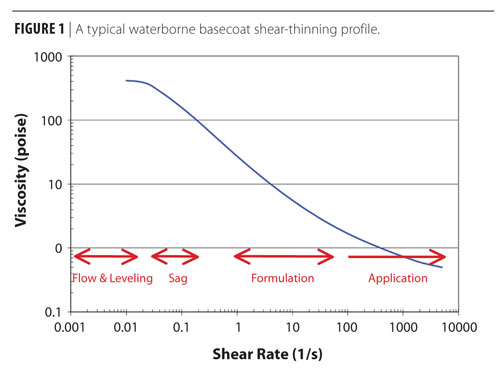
Although waterborne coatings possess some intriguing advantages, there are difficulties that have to be overcome before successful application can be made. One of the most important problems is the control of the rheology, which determines the quality and appeal of the final film. A typical waterborne basecoat shear-thinning profile, and the ranges of shear rate that a basecoat would receive at each coating process are shown in Figure 1.
Figure 1 Click to enlarge

Challenges of Formulating Waterborne Basecoats

Basecoat rheology should be carefully designed for a particular application such that the performance of the paint is superior during the entire handling cycle, from storage to spray application and drying. The required rheology should enable the basecoat to have a high viscosity during storage, which leads to minimal settling. Under moderate agitation and during circulation, the viscosity should be low to allow the basecoat to be easily pumped. At the spraying gun or bell, the viscosity should be very low so that the paint can be properly atomized. As soon as the paint is sprayed on to the target, the viscosity should build quickly to prevent paint from running or sagging. However, the viscosity should still be low enough to enable the paint to level off, providing a smooth film.
Another important role for rheology additives in a basecoat is to help achieve desired colors that give the sharpest aesthetics. A properly designed rheology package should prevent floating/flooding and mottling. In a basecoat containing a specialty pigment such as aluminum flakes or pearlescent pigment, along with binder system, rheology additives are the key tools to help control flake alignment during flash-off and drying periods. Properly oriented pigment flakes not only increase hiding and durability of the coating film, they also bring out the maximum beauty of these expensive pigments: sparkling effect, maximum face brightness and high flop.

Common Rheology Additives in Waterborne Basecoats

It is important to understand that a paint formulation as a whole defines the final paint’s rheological behavior. A polymer solution affects the high-shear rate viscosity. As molecular weight of the polymer increases, high-shear rate viscosity of the system increases. Emulsion-type binders often show more thixotropic behavior as compared to polymer solutions. Their shear rate versus viscosity relations are impacted more by particle size and solids of emulsion solutions rather than molecular weight of the polymer itself. Heavy inorganic pigments tend to raise high-shear rate viscosity;  high pigment loading of organic pigments and carbon blacks tends to raise low-shear rate viscosity. In solventborne basecoats, microgels, waxes, bentonite and cellulose acetate butyrates (CABs) are commonly used as rheology modifiers.

One of the advantages of using microgels is the low viscosity at higher levels of non-volatile content in a coatings formulation. Since microgels are prepared as non-aqueous dispersions (NADs), this is a category not available to waterborne formulations. Different from other rheology modifiers, a CAB solution in a common solvent exhibits near-Newtonian flow behavior. At the moment a basecoat is spray-applied to an object, the Newtonian characteristic of CABs help flow and leveling. Due to a rigid cellulosic backbone, CABs possess extremely high glass transition temperatures (Tg) as compared to other polymers used in coatings.

High Tg of CABs results in a rapid viscosity build-up within a short period after a basecoat is applied, leaving no time for coated film to sag, as well as no room for pigment to swim. The combination of these unique properties provides a basecoat formulation with excellent flake orientation and color uniformity, which leads to quick dry-to-touch time and improved strike-in resistance in a wet-on-wet application. This will enable the basecoat to have superior flow and leveling without compromising sag resistance.

For waterborne basecoats, instead of microgel, there are a variety of alkali-swellable emulsion-type rheology modifiers out there. Wax dispersions and bentonites are also available.
 

Alkali-Swellable Emulsions – Commonly used are hydrophobically modified alkali-swellable acrylic emulsions (HASE) and hydrophobically modified ethoxylate urethanes (HEUR). Viscalex™ HV30 is a very efficient thickener in this category available from BASF. Another type in this category are rheology-modified acrylic core/shell dispersions such as Setalux™ 6803 AQ-24 available from Nuplex. The dispersed particles consist of a hydrophobic core and an acid functional alkali-swellable shell. Upon neutralization with amines, the resin develops its unique, strong pseudo-plastic or thixotropic character essential in a waterborne basecoat.

Wax Dispersions – There are polyamide-based aqueous dispersions such as Disparlon™, available from King Industries; and modified polyethylene dispersions such as Aquatix™ 8421, available from BYK. In general, wax dispersions are not as effective as alkali-swellable types, and they often increase high shear viscosity, which is undesirable.

Bentonite – Bentonite refers to a family of layered silicate clays. Silicate clay is insoluble in water but hydrates and swells to give clear and colorless colloidal dispersion. At very low concentration in water, highly thixotropic gels can be produced. A well-known product in this category is Laponite™ RD, available from Rockwood Additives.

Waterborne Cellulose Ester – Eastman Chemical has recently commercialized a waterborne cellulose ester, Solus™ 3050 performance additive, in an effort to pursue the benefits of CABs in solventborne formulations from waterborne chemistry. Performance benefits of Solus™ 3050 include superior flow and leveling, optimal metallic flake control and better redissolve/strike-in resistance.

Summary

The protective coating industry is in a transition phase geared towards waterborne and high solids formulations. Selecting the right rheology package is the key to formulating optimized waterborne basecoats that possess desirable application fitness and best finishing appearance.
For more information, visit www.eastman.com.

KEYWORDS: Flow Control Low-VOC Protective Coatings Rheology Modifiers

Share This Story

Looking for a reprint of this article?
From high-res PDFs to custom plaques, order your copy today!


Research Associate, Specialty Coatings Technology Division, Eastman Chemical Company, Kingsport, TN

Recommended Content

JOIN TODAY
to unlock your recommendations.

Already have an account? Sign In

  • pci1022-Kinaltek-Lead-1170.jpg

    A Novel Pigment Production Technology

    Following an extensive R&D program that demonstrated...
    Paint and Coating Pigments
    By: Jawad Haidar and Nitin Soni
  • pci global top 10

    2025 Global Top 10: Top Paint and Coatings Companies

    The following is PCI’s annual ranking of the top 10...
    Paint and Coating Market Reports
    By: Courtney Bassett
  • 2025 pci 25

    2025 PCI 25: Top Paint and Coatings Companies

    PCI's annual ranking of the top 25 North American paint...
    Global Top 10 and PCI 25
    By: Courtney Bassett
You must login or register in order to post a comment.

Report Abusive Comment

Manage My Account
  • eMagazine
  • Newsletters
  • Online Registration
  • Subscription Customer Service

More Videos

Sponsored Content

Sponsored Content is a special paid section where industry companies provide high quality, objective, non-commercial content around topics of interest to the PCI audience. All Sponsored Content is supplied by the advertising company and any opinions expressed in this article are those of the author and not necessarily reflect the views of PCI or its parent company, BNP Media. Interested in participating in our Sponsored Content section? Contact your local rep!

close
  • colorful building exterior
    Sponsored byDow

    Insights into Exterior Architectural Coating Degradation: Bridging Accelerated and Natural Weathering

  • digital pigments
    Sponsored bySiltech

    The Fourth Dimension of Silicon: Siltech Q Resins

Popular Stories

Company News

What the AkzoNobel–Axalta Merger Means for the Future of Coatings

AkzoNobel and Axalta Headquarters

AkzoNobel and Axalta Announce $25 Billion Merger

Wacker logo

WACKER Plans More Than 1,500 Job Cuts


PCI Buyers Guide

Submit a Request for Proposal (RFP) to suppliers of your choice with details on what you need with a click of a button

Start your RFP

Browse our Buyers Guide for manufacturers and distributors of all types of coatings products and much more!

Find Suppliers

Events

September 4, 2025

N-Butylpyrrolidone (NBP) as a Green Solvent to Replace N-Methylpyrrolidone (NMP) in Industrial Coating Applications

ON DEMAND: EPA published a regulation proposal around N-methylpyrrolidone (NMP) in June 2024 to ban or limit NMP in many applications, such as paints and coatings and their removers. N-butylpyrrolidone (NBP) is a powerful and versatile solvent for a variety of industries looking for alternatives to substance of very high concern (SVHC)-listed solvents.

March 24, 2026

The Manufacturing & Automation eXchange (MAX)

MAX presents a rare opportunity to observe the full scope of manufacturing in one environment. From systems integration and materials handling to automation, quality, safety, and packaging, each discipline is represented through live, operational displays. By experiencing these technologies side by side, as they are on actual production floors, attendees gain a grounded understanding of how manufacturing functions align, overlap, and evolve in practice.

View All Submit An Event

Poll

Longest-running laboratory experiment

What is the longest-running laboratory experiment?
View Results Poll Archive

Products

Automotive Paints and Coatings, 2nd Edition

Automotive Paints and Coatings, 2nd Edition

Now in its second edition and still the only book of its kind, this is an authoritative treatment of all stages of the coating process.

See More Products
pci voices from the top ebook

PCI webinar

Related Articles

  • Glasurit 100 Line

    BASF Announces New Line of Waterborne Basecoats

    See More
  • pci0223-Lehvoss-157441646-1170.jpg

    Ribbon Polysilicates: An Exciting Family of Rheology Additives

    See More
  • Cognis Consolidates Manufacture of Rheology Additives in Spain

    See More

Related Products

See More Products
  • Rheological Additives in Latex Paint Formulations (Zoom course - 2/26/26)

  • Surfactants and Rheology: Chemistry, Theory, Mechanism and Application (Zoom course 3/26/26)

See More Products

Related Directories

  • BASF Corp., Dispersions, Resins & Additives

    BASF offers a strong portfolio of industry-leading additives for the Coatings Industry to deliver eco-efficient solutions that meet performance requirements. The BASF Performance and Formulation additives portfolio encompasses a technology base of dispersing agents, wetting agents and surface modifiers, defoamers, rheology modifiers, film forming agents, antioxidants, light stabilizers and UV absorbers.
×

Keep the info flowing with our eNewsletters!

Get the latest industry updates tailored your way.

JOIN TODAY!
  • RESOURCES
    • Advertise
    • Contact Us
    • Directories
    • Store
    • Want More
    • Manufacturing Division
  • SIGN UP TODAY
    • Create Account
    • eMagazine
    • Newsletters
    • Customer Service
    • Manage Preferences
  • SERVICES
    • Marketing Services
    • Reprints
    • Market Research
    • List Rental
    • Survey & Sample
  • STAY CONNECTED
    • LinkedIn
    • Facebook
    • Youtube
    • X (Twitter)
  • PRIVACY
    • PRIVACY POLICY
    • TERMS & CONDITIONS
    • DO NOT SELL MY PERSONAL INFORMATION
    • PRIVACY REQUEST
    • ACCESSIBILITY

Copyright ©2025. All Rights Reserved BNP Media.

Design, CMS, Hosting & Web Development :: ePublishing