Painting & Coating Industry (PCI) logo Powder coating summit logo
search
cart
facebook twitter linkedin youtube
  • Sign In
  • Create Account
  • Sign Out
  • My Account
Painting & Coating Industry (PCI) logo Powder coating summit logo
  • NEWS
    • Latest News
    • Market Trends & Reports
    • Finishing News
    • Price Alerts
    • Subscribe to Newsletters
    • Global Top 10/ PCI 25
    • Weekly Featured Article
    • COATLE Word Game
  • PRODUCTS
    • Product News
    • Must See Products and Services
  • MATERIALS
    • Additives
    • Resins/Polymers
    • Pigments
    • Equipment
    • Distributors
  • TECHNOLOGIES
    • Adhesives
    • Architectural Coatings
    • Finishing Articles
    • Finishing Technologies
    • Finishing Equipment
    • Industrial Coatings
    • Nanotechnology
    • Powder Coatings
    • Solventborne
    • Special Purpose Coatings
    • Sustainability
    • UV Coatings
    • Waterborne
  • RESOURCES
    • Columns
      • Did you know?
      • Distribution Dive
      • Formulating With Mike
      • Innovation Insights
      • Powder Coating Perspectives
      • TiO2 Insider
    • Blogs
      • Editor's Viewpoint
      • Industry Insights
    • Coatings Supplier Handbook
    • Podcasts and Videos
      • COAT-IT! Podcast
      • Videos/PCI TV
    • PCI Store
    • Classifieds
    • eBooks
    • Sponsor Insights
    • White Papers
    • COATLE Word Game
  • EVENTS
    • Coatings Trends & Technologies Summit
    • Paint and Coatings Academy
    • Webinars
    • Calendar of Events
    • Lifetime Achievement Award
  • DIRECTORIES
    • Buyer's Guide
    • Equipment Directory
    • Materials Directory
  • EMAGAZINE
    • Current Issue
    • eMagazine Archive
    • China Issue Archive
    • Editorial Advisory Board
  • CONTACT
    • Contact Us
    • Advertise
    • Subscribe to eMagazine
    • Subscribe to Newsletters
  • SIGN UP!
Paint and Coatings AdditivesArchitectural CoatingsIndustrial Coatings

The Next Generation of Condensation and Corrosion Protection

By Peter Pescatore
Next Generation slide1
Credit: Cabot Corp.
Next Generation slide2
Credit: Cabot Corp.
Next Generation slide3
Credit: Cabot Corp.
Next Generation slide4
Credit: Cabot Corp.
Next Generation slide5
Credit: Cabot Corp.
Next Generation slide1
Next Generation slide2
Next Generation slide3
Next Generation slide4
Next Generation slide5
March 1, 2013

Widely known as the world’s best insulating solid material, silica aerogel-enabled coatings are redefining the world of paint with thermal benefits. Recognizing the advantages of a high-performance insulative coating has driven some coatings manufacturers to explore the use of silica aerogel as a paint additive to achieve significantly lower thermal conductivities. This new class of high-performance coatings, called Highly Thermally Insulative Coatings (HiTICs), is now finding opportunities in condensation and corrosion prevention.

Condensation, and the corrosion it causes, is a major issue in many industrial and architectural structures. Condensation occurs when the temperature of a surface drops below the dew point of the surrounding air, causing moisture in the air to condense on that surface. When this takes place, condensate pooling can cause safety concerns. Affected equipment is likely to experience conditions that can cause corrosion, and the possibility of biological growth (mold), resulting in health and asset protection issues.

Traditional insulation can be used to try to reduce the risk of condensation by increasing the surface temperature above the dew point of the surrounding air, but this method is often met with limited success. Since many insulation systems are porous, condensation still occurs on the surface of the substrate or within the insulation layer, resulting in a higher risk of corrosion under insulation (CUI). In addition to the risk of corrosion, the presence of condensed water in the insulation material dramatically limits its thermal effectiveness, thereby increasing energy consumption. Alternatively, surface heaters can be used to warm the substrate above the dew point, but these tend to be energy intensive and are not always practical.

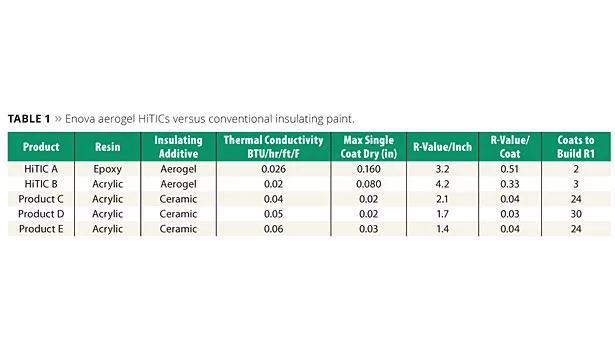
Aerogel-enabled insulative coatings present engineers and designers with a new solution to this old problem. These HiTICs are advantageous because of their extremely low thermal conductivity (a measure of a material’s ability to transfer heat), as well as their high film build (the thickness that can be applied in each coat). These combined material properties allow for superior insulation performance with minimal coats, resulting in lower installation cost. Table 1 demonstrates this performance advantage for aerogel-enabled coatings as compared to conventional insulating paints.

Condensation Testing

To demonstrate the performance gain realized with aerogel-based coatings, two different lab configurations were constructed and tested. The first configuration, shown in Figure 1, consists of an aluminum channel section with a single side of an aluminum window frame system welded onto it. Coolant was run through the channel section to create a temperature profile within the frame that would be representative of a cold winter day (approximately 20 °F). Four coating conditions were then represented on different sections of the aluminum frame:

  • No coating;
  • 40 mils (1 mm) coating;
  • 120 mils (3 mm) coating;
  • 160 mils (4 mm) coating.

Temperature sensors were attached to each of these regions, and temperatures were monitored over time. As seen in Figure 1, the uncoated areas experienced a significant amount of condensation. However, on the areas where the coating was present, condensation did not occur. The surface temperature measurements are shown in Table 2.

The measurements showed a 10.1 °F difference between the temperature of the uncoated surface and the 160 mil coated surface. What this means is the use of the coating has shifted upwards by 10.1 °F – the ambient dew point at which condensation will occur on that surface. For standard room conditions (68 °F), this would mean a shift in relative humidity from 47% to 69% before the onset of condensation on the surface.

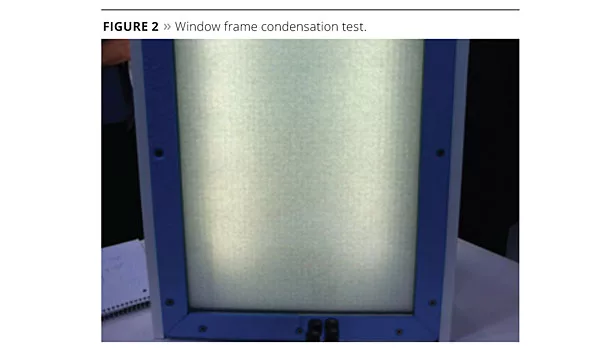
To further demonstrate this phenomenon, a full window frame section was constructed in a similar manner to that described earlier. This system, shown in Figure 2, had an aerogel-based coating (80 mils or 2 mm) on the left half of the aluminum frame and no coating on the right half. A close-up shot of the window, in Figure 3, clearly shows condensation on the uncoated surface and none on the textured, aerogel-coated surface.

Since the benefit HiTICs provide is based on raising the surface temperature of the substrate, the same impact seen in the architectural example is also transferable to the industrial area. For large storage tanks or process piping, the same principle holds true, making aerogel-based coatings an excellent solution for applications where condensation formation and the resulting CUI are a concern.

The Future of Insulative Coatings

With this new generation of HiTICs utilizing aerogel with thermal conductivities comparable to bulk commodity insulation, industries can now consider insulating surfaces that have been difficult to insulate due to topography, humidity, chemical exposure, and maintenance or space requirements to minimize or even eliminate condensation and, thereby, enhance corrosion protection. By combining corrosion protection and thermal resistance into a single product, the issue of trapped moisture within traditional insulation forms is effectively eliminated. n


 For more information, visit www.cabotcorp.com. 

KEYWORDS: Coating Technologies Corrosion Control

Share This Story

Looking for a reprint of this article?
From high-res PDFs to custom plaques, order your copy today!


Peter Pescatore is the Global Lead Application Development Specialist at Cabot Corp., Billerica, MA

Recommended Content

JOIN TODAY
to unlock your recommendations.

Already have an account? Sign In

  • pci1022-Kinaltek-Lead-1170.jpg

    A Novel Pigment Production Technology

    Following an extensive R&D program that demonstrated...
    Paint and Coating Pigments
    By: Jawad Haidar and Nitin Soni
  • pci global top 10

    2025 Global Top 10: Top Paint and Coatings Companies

    The following is PCI’s annual ranking of the top 10...
    Paint and Coating Market Reports
    By: Courtney Bassett
  • 2025 pci 25

    2025 PCI 25: Top Paint and Coatings Companies

    PCI's annual ranking of the top 25 North American paint...
    Paint and Coating Market Reports
    By: Courtney Bassett
You must login or register in order to post a comment.

Report Abusive Comment

Manage My Account
  • eMagazine
  • Newsletters
  • Online Registration
  • Subscription Customer Service

More Videos

Sponsored Content

Sponsored Content is a special paid section where industry companies provide high quality, objective, non-commercial content around topics of interest to the PCI audience. All Sponsored Content is supplied by the advertising company and any opinions expressed in this article are those of the author and not necessarily reflect the views of PCI or its parent company, BNP Media. Interested in participating in our Sponsored Content section? Contact your local rep!

close
  • colorful building exterior
    Sponsored byDow

    Insights into Exterior Architectural Coating Degradation: Bridging Accelerated and Natural Weathering

  • digital pigments
    Sponsored bySiltech

    The Fourth Dimension of Silicon: Siltech Q Resins

Popular Stories

Company News

What the AkzoNobel–Axalta Merger Means for the Future of Coatings

AkzoNobel and Axalta Headquarters

AkzoNobel and Axalta Announce $25 Billion Merger

Wacker logo

WACKER Plans More Than 1,500 Job Cuts


PCI Buyers Guide

Submit a Request for Proposal (RFP) to suppliers of your choice with details on what you need with a click of a button

Start your RFP

Browse our Buyers Guide for manufacturers and distributors of all types of coatings products and much more!

Find Suppliers

Events

September 4, 2025

N-Butylpyrrolidone (NBP) as a Green Solvent to Replace N-Methylpyrrolidone (NMP) in Industrial Coating Applications

ON DEMAND: EPA published a regulation proposal around N-methylpyrrolidone (NMP) in June 2024 to ban or limit NMP in many applications, such as paints and coatings and their removers. N-butylpyrrolidone (NBP) is a powerful and versatile solvent for a variety of industries looking for alternatives to substance of very high concern (SVHC)-listed solvents.

March 24, 2026

The Manufacturing & Automation eXchange (MAX)

MAX presents a rare opportunity to observe the full scope of manufacturing in one environment. From systems integration and materials handling to automation, quality, safety, and packaging, each discipline is represented through live, operational displays. By experiencing these technologies side by side, as they are on actual production floors, attendees gain a grounded understanding of how manufacturing functions align, overlap, and evolve in practice.

View All Submit An Event

Poll

Longest-running laboratory experiment

What is the longest-running laboratory experiment?
View Results Poll Archive

Products

Automotive Paints and Coatings, 2nd Edition

Automotive Paints and Coatings, 2nd Edition

Now in its second edition and still the only book of its kind, this is an authoritative treatment of all stages of the coating process.

See More Products
pci voices from the top ebook

PCI webinar

Related Articles

  • pci0219-Autonomic-148958314-900.jpg

    The Next Generation of Zinc-Rich Coatings

    See More
  • Engineering the Next Generation of Coatings for the Fast Lane

    Engineering the Next Generation of Coatings for the Fast Lane

    See More
  • image of BCFs logo

    BCF Advocates Apprenticeships for Next Generation of the U.K. Coatings Industry

    See More

Related Products

See More Products
  • corrosion of linings.jpg

    Corrosion of Linings & Coatings: Cathodic and Inhibitor Protection and Corrosion Monitoring

  • corrosion.jpg

    Corrosion Control Through Organic Coatings 2nd Edition

  • intelligent.jpg

    Intelligent Coatings for Corrosion Control 1st Edition

See More Products

Related Directories

  • General Carbon Co.

    Lampblack dry black pigment, CAS 1333-86-4, SIC 2816 inorganic pigments, ASTM INT D-209.
×

Keep the info flowing with our eNewsletters!

Get the latest industry updates tailored your way.

JOIN TODAY!
  • RESOURCES
    • Advertise
    • Contact Us
    • Directories
    • Store
    • Want More
    • Manufacturing Division
  • SIGN UP TODAY
    • Create Account
    • eMagazine
    • Newsletters
    • Customer Service
    • Manage Preferences
  • SERVICES
    • Marketing Services
    • Reprints
    • Market Research
    • List Rental
    • Survey & Sample
  • STAY CONNECTED
    • LinkedIn
    • Facebook
    • Youtube
    • X (Twitter)
  • PRIVACY
    • PRIVACY POLICY
    • TERMS & CONDITIONS
    • DO NOT SELL MY PERSONAL INFORMATION
    • PRIVACY REQUEST
    • ACCESSIBILITY

Copyright ©2025. All Rights Reserved BNP Media.

Design, CMS, Hosting & Web Development :: ePublishing