Painting & Coating Industry (PCI) logo Powder coating summit logo
search
cart
facebook twitter linkedin youtube
  • Sign In
  • Create Account
  • Sign Out
  • My Account
Painting & Coating Industry (PCI) logo Powder coating summit logo
  • NEWS
    • Latest News
    • Market Trends & Reports
    • Finishing News
    • Price Alerts
    • Subscribe to Newsletters
    • Global Top 10/ PCI 25
    • Weekly Featured Article
    • COATLE Word Game
  • PRODUCTS
    • Product News
    • Must See Products and Services
  • MATERIALS
    • Additives
    • Resins/Polymers
    • Pigments
    • Equipment
    • Distributors
  • TECHNOLOGIES
    • Adhesives
    • Architectural Coatings
    • Finishing Articles
    • Finishing Technologies
    • Finishing Equipment
    • Industrial Coatings
    • Nanotechnology
    • Powder Coatings
    • Solventborne
    • Special Purpose Coatings
    • Sustainability
    • UV Coatings
    • Waterborne
  • RESOURCES
    • Columns
      • Did you know?
      • Distribution Dive
      • Formulating With Mike
      • Innovation Insights
      • Powder Coating Perspectives
      • TiO2 Insider
    • Blogs
      • Editor's Viewpoint
      • Industry Insights
    • Coatings Supplier Handbook
    • Podcasts and Videos
      • COAT-IT! Podcast
      • Videos/PCI TV
    • PCI Store
    • Classifieds
    • eBooks
    • Sponsor Insights
    • White Papers
    • COATLE Word Game
  • EVENTS
    • Coatings Trends & Technologies Summit
    • Paint and Coatings Academy
    • Webinars
    • Calendar of Events
    • Lifetime Achievement Award
  • DIRECTORIES
    • Buyer's Guide
    • Equipment Directory
    • Materials Directory
  • EMAGAZINE
    • Current Issue
    • eMagazine Archive
    • China Issue Archive
    • Editorial Advisory Board
  • CONTACT
    • Contact Us
    • Advertise
    • Subscribe to eMagazine
    • Subscribe to Newsletters
  • SIGN UP!

Specular Included or Specular Excluded: Which is Best?

By Tim Mouw
Tim Mouw
July 31, 2018

Surface appearance can change your perception of color. Think of a glossy magazine. If the light is shining directly on the page, you may need to tilt the magazine and change the reflection angle to clearly see the colors. Likewise, a textured surface may appear to be a different color than a smooth surface of the same object.
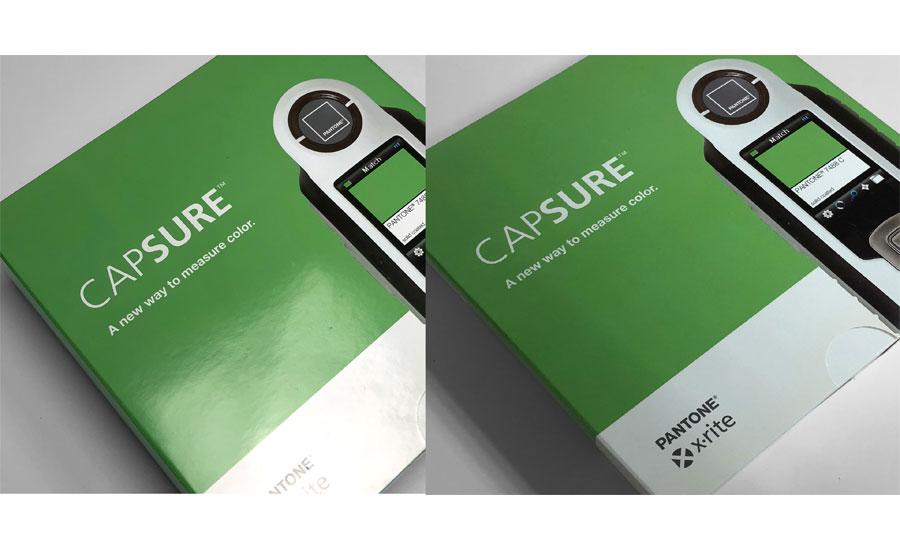
Surface appearance can change your perception of color

Since spectrophotometers determine a color’s spectral values by shining light onto the surface and measuring the reflectance, choosing the right instrument and the proper measurement mode are crucial. These choices will determine what passes and what fails your tolerance, as well as how the results correlate to visual inspection.

Sphere spectrophotometers are the preferred choice for paints, coatings, plastics and textile applications because they can include or exclude the specular component of surface appearance. This ability is critical to being able to evaluate the color only OR the color and appearance of the object being measured.
 

How a Sphere Device Works

The interior of a sphere device is actually spherical in shape. The light source reflects off the white matte surface of the sphere’s interior, causing the light to scatter randomly in all directions. This process repeats itself thousands of times in a fraction of a second, creating a homogenous, diffuse illumination of the object. The detector then receives the reflected light at an 8-degree angle from the object’s surface to accurately measure the color.

There are two ports in a sphere instrument, the Sample Viewing Port and the Specular Port. The Viewing Port contains the receiver and the light sensitive detectors that quantify the light reflecting from the sample’s surface. The Specular Port can either be open or closed to control the type of measurement.
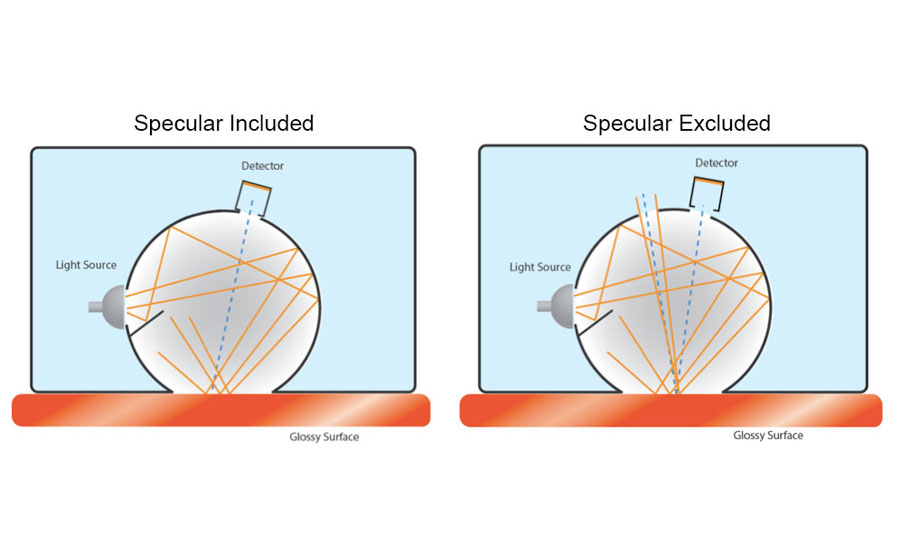
If the port is open, the device will take a Specular Excluded reading. If the port is closed, the device will take a Specular Included reading

If the port is open, the device will take a Specular Excluded reading. If the port is closed, the device will take a Specular Included reading.
 

Specular Excluded INCLUDES Surface Appearance

Measuring Specular Excluded (SPEX) – aka Specular Component Excluded (SCE) – is similar to how your eye perceives color. The surface characteristics become part of the color you see. In other words, a glossy surface will typically measure darker than a matte surface of the same color – just the way you see it. 

When the Specular Port is open, instead of reflecting back onto the surface of the sample, light from that portion of the sphere wall is directed into a black trap and lost from the measurement. The glossier the surface, the less percentage of color will return to the instrument's optical receiver. If the surface of the sample is a perfect mirror (100% gloss), the instrument will read the color as perfect black, no matter the “true” color. 
 

Specular Included EXCLUDES Surface Appearance

Measuring Specular Included (SPIN) – aka Specular Component Included (SCI) will capture true color data from the sample, regardless of surface appearance. Similar to the way your eye would see the magazine picture without the gloss reflection, measuring Specular Included negates the effect of surface appearance to measure only color.

If the Specular Port is closed, the black trap is replaced with a white tile or plate, which is included in the process of lighting the sample. If the sample is glossy, this portion of the sphere will send the gloss signal directly into the viewing port.

Lighting the surface uniformly from all possible directions creates the ideal measurement environment for samples that are either highly polished, like mirrors and metallic packaging, or very textured, such as carpeting and roofing tiles.


Which is Best for Measuring “True” Color?

In these samples you see two swatches, one matte and the other glossy. Although the matte sample appears to be lighter, they are both the same color. Which measurement mode – Specular Included or Specular Excluded – should you use for these samples? 
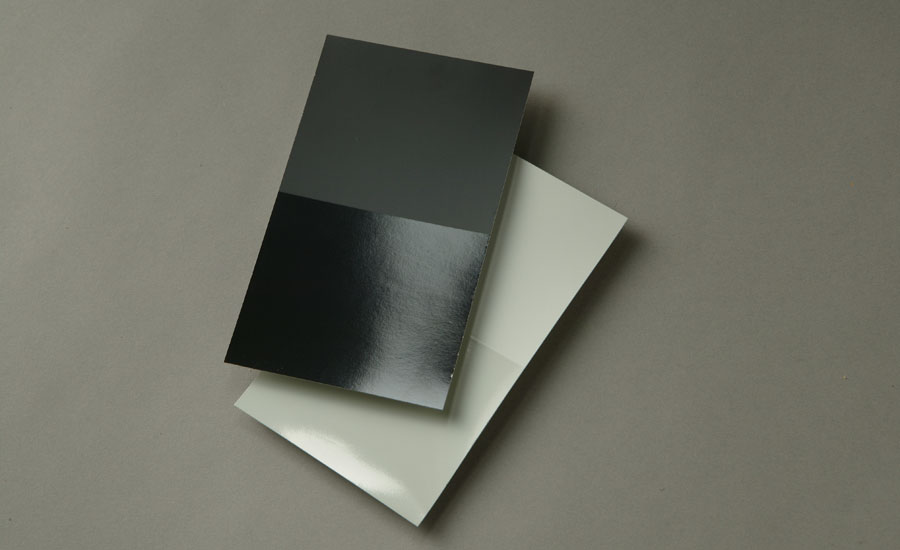
In these samples you see two swatches, one matte and the other glossy. Although the matte sample appears to be lighter, they are both the same color.

For formulation, the industry-accepted answer is Specular Included. If you configure a sphere instrument to collect all reflected light – specular as well as diffuse – then it makes little or no difference if the sample is mirror like or matte in appearance. The recipe controls the final color, and these swatches will measure as the same color black or gray.

While this makes sense in the lab, the goal is slightly different during quality assurance. If a manufacturer uses this black color to coat a metal cabinet, but chooses a glossy finish for the side panels and matte for the drawers, will the final product be appealing to the buyer? Probably not. But if the QA department measures these parts Specular Included, the two blacks will measure as the same color, and this cabinet will be shipped with side panels and drawers that do not match. In this case, measuring Specular Excluded is preferred because it captures color the way the human eye sees it.


To Learn More

Our Color Theory: Understanding the Numbers of Color e-learning course covers this topic and much more. From the physics of color to lighting, spectrophotometers and color data, this module-based course delivers an in-depth understanding of color.

KEYWORDS: color appearance spectrophotometers surface analysis

Share This Story

By Tim Mouw, Applications Engineering & Technical Support Manager, X-Rite Pantone

You must login or register in order to post a comment.

Report Abusive Comment

Blog Topics

Editor's Viewpoint

Journey to Sustainability

Industry Insights

Recent Comments

Great

Great

Enjoy watching your favorite Asian dramas and anime clearly.

Searching through your blog moviebox is always so...

steal a brainrot is a fast-paced and...

Manage My Account
  • eMagazine
  • Newsletters
  • Online Registration
  • Subscription Customer Service

More Videos

Sponsored Content

Sponsored Content is a special paid section where industry companies provide high quality, objective, non-commercial content around topics of interest to the PCI audience. All Sponsored Content is supplied by the advertising company and any opinions expressed in this article are those of the author and not necessarily reflect the views of PCI or its parent company, BNP Media. Interested in participating in our Sponsored Content section? Contact your local rep!

close
  • colorful building exterior
    Sponsored byDow

    Insights into Exterior Architectural Coating Degradation: Bridging Accelerated and Natural Weathering

  • digital pigments
    Sponsored bySiltech

    The Fourth Dimension of Silicon: Siltech Q Resins

Popular Stories

Company News

What the AkzoNobel–Axalta Merger Means for the Future of Coatings

AkzoNobel and Axalta Headquarters

AkzoNobel and Axalta Announce $25 Billion Merger

Wacker logo

WACKER Plans More Than 1,500 Job Cuts


PCI Buyers Guide

Submit a Request for Proposal (RFP) to suppliers of your choice with details on what you need with a click of a button

Start your RFP

Browse our Buyers Guide for manufacturers and distributors of all types of coatings products and much more!

Find Suppliers

Events

September 4, 2025

N-Butylpyrrolidone (NBP) as a Green Solvent to Replace N-Methylpyrrolidone (NMP) in Industrial Coating Applications

ON DEMAND: EPA published a regulation proposal around N-methylpyrrolidone (NMP) in June 2024 to ban or limit NMP in many applications, such as paints and coatings and their removers. N-butylpyrrolidone (NBP) is a powerful and versatile solvent for a variety of industries looking for alternatives to substance of very high concern (SVHC)-listed solvents.

March 24, 2026

The Manufacturing & Automation eXchange (MAX)

MAX presents a rare opportunity to observe the full scope of manufacturing in one environment. From systems integration and materials handling to automation, quality, safety, and packaging, each discipline is represented through live, operational displays. By experiencing these technologies side by side, as they are on actual production floors, attendees gain a grounded understanding of how manufacturing functions align, overlap, and evolve in practice.

View All Submit An Event

Poll

Longest-running laboratory experiment

What is the longest-running laboratory experiment?
View Results Poll Archive

Products

Automotive Paints and Coatings, 2nd Edition

Automotive Paints and Coatings, 2nd Edition

Now in its second edition and still the only book of its kind, this is an authoritative treatment of all stages of the coating process.

See More Products
pci voices from the top ebook

PCI webinar
×

Keep the info flowing with our eNewsletters!

Get the latest industry updates tailored your way.

JOIN TODAY!
  • RESOURCES
    • Advertise
    • Contact Us
    • Directories
    • Store
    • Want More
    • Manufacturing Division
  • SIGN UP TODAY
    • Create Account
    • eMagazine
    • Newsletters
    • Customer Service
    • Manage Preferences
  • SERVICES
    • Marketing Services
    • Reprints
    • Market Research
    • List Rental
    • Survey & Sample
  • STAY CONNECTED
    • LinkedIn
    • Facebook
    • Youtube
    • X (Twitter)
  • PRIVACY
    • PRIVACY POLICY
    • TERMS & CONDITIONS
    • DO NOT SELL MY PERSONAL INFORMATION
    • PRIVACY REQUEST
    • ACCESSIBILITY

Copyright ©2025. All Rights Reserved BNP Media.

Design, CMS, Hosting & Web Development :: ePublishing