Managing Dust Explosion Hazards
Compliance with NFPA 652 DHA Requirements in Powder Coating Operations
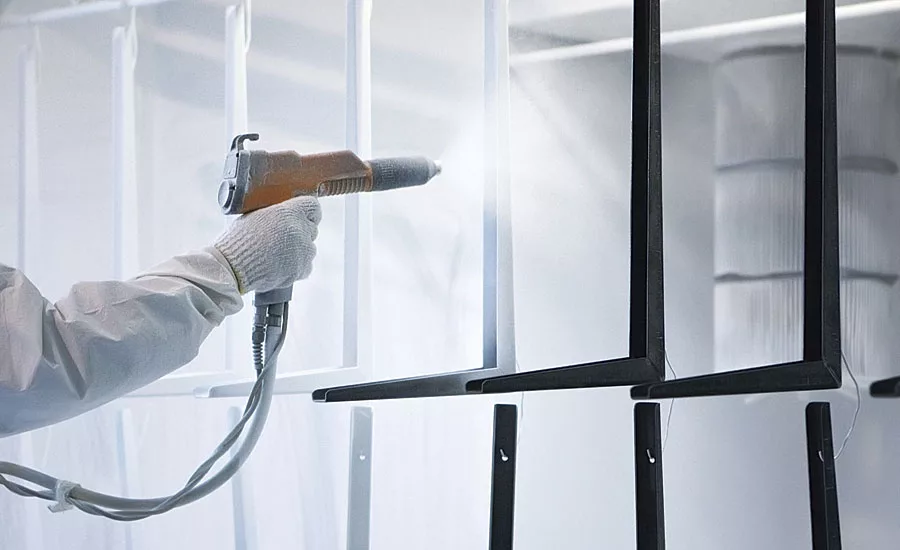
Simply put, powder coating involves the application of electrostatically charged dry powder particles to electrically grounded conductive (metal) objects and then applying heat to cure the powder onto the coated object. Powder coating materials are typically made up of electrically insulating resin (thermoset or thermoplastic polymer) and pigment. The advantages of powder coating compared to (wet) paint include the durability of the finish and the ability to reuse the over-sprayed powder. Today, powder coating is used in a variety of industries including automotive, appliances and construction.
It should be noted however, that the powders usually used in powder coating applications are explosible – meaning that if dispersed in air and subjected to an ignition source, are capable of creating a dust explosion. Both during powder spraying operations and in the downstream dust collection systems, formation of an explosible dust cloud can be expected. Of course, if there is an ignition source present, a dust deflagration or explosion may occur. One typical ignition source during powder coating operations is static sparks from inadvertently ungrounded metal objects that are being coated. It is therefore clearly essential that effective precautions are taken to control the risk and protect employees, contractors, the public and the facility against the effects of fires and explosions.
Over the past few decades, the National Fire Protection Association (NFPA) has published a number of codes and standards to help industry with its efforts to assess and control dust fires and explosions. Although very useful, these publications have also created some confusion regarding consistency and applicability of some of their requirements.
The NFPA 652: Standard on the Fundamentals of Combustible Dust has sought to consolidate the best general practices for all combustible solids, irrespective of industry and powder/dust type. NFPA 652 also directs the user to appropriate NFPA industry- or commodity-specific standards, which for the powder coating industry is NFPA 654 ‘Standard for the Prevention of Fire and Dust Explosions from the Manufacturing, Processing and Handling of Combustible Particulate Solids’.
This article will discuss the requirements of the 2019 edition of NFPA 652 and provides some practical measures for controlling dust flash fire and explosion hazards associated with the handling, processing and storing of combustible powders.
Conditions for Dust Cloud Flash Fires and Explosions
Dust cloud flash fires (deflagrations) must be anticipated when the following conditions are simultaneously present:
- A combustible powder forming a cloud with a concentration above its Minimum Explosible Concentration (MEC). (There needs to be enough dust content and sufficiently small particle size to support flame spread.)
- Sufficient oxidant, which the oxygen in air will usually provide.
- An ignition source with sufficient energy.
It should be noted that conditions 1 and 2 are usually present at least at some point during any powder/dust handling, transfer, mixing, spraying or dust collection operation. The simultaneous existence of an energetic ignition source may then result in a dust cloud flashfire. If the ignition occurs in a closed process vessel or room/building, pressure can build that will be sufficient to rupture the confining enclosure and cause a dust explosion event.
Requirements of NFPA 652
The intended life safety, mission continuity and mitigation of fire spread and explosions objectives of NFPA 652 are as follows:
- To reasonably protect occupants not in the immediate proximity of the ignition from the effects of fire for the time needed to evacuate, relocate or take refuge;
- To reasonably prevent serious injury from flash fires and explosions;
- To reasonably protect adjacent properties and the public from the effects of fire, flash fire or explosion;
- To limit damage to levels that ensure the ongoing mission, production or operating capability of the facility to a degree acceptable to the owner/operator;
- To prevent or mitigate fires and explosions that can cause failure of adjacent buildings, compartments, enclosures, properties, storage, facility’s structural elements or emergency life safety systems.
To achieve these objectives, NFPA 652 requires that the owner/operator of a facility where potentially combustible dusts might be present shall be responsible for the following:
- Determining combustibility and explosibility (Go/No-Go) of materials. It should be noted that the Go/No-Go - as the name implies - would only provide information on whether or not a dust is combustible (would burn) or explosible (deflagrate) under the right conditions. No information would be ascertained regarding the ease of ignition or the severity of the explosion. NFPA 652 permits the determination of combustibility or explosibility (Go/No Go) to be based on laboratory analysis of representative samples from the process or historical facility data or published data – so long as the data is representative of current materials and process conditions. One is also permitted to assume that a material is explosible, forgoing the laboratory analysis. However, absence of previous incidents shall not be used as basis for deeming a particulate non-combustible or non-explosible.
- Conducting a Dust Hazard Analysis (DHA). DHA is a systematic review to identify and evaluate potential dust fire, flash fire and explosion hazards in a process or facility where combustible/explosible powder is handled or processed. DHA must be conducted by someone with proven expertise in hazards associated with handling and processing combustible particulate solids.
- For existing processes, the owner/operator shall schedule the DHA to be completed by September 2020. For new construction or modifications more than 25% of the original cost, DHA shall be completed as part of the project. Finally, DHA must be reviewed and updated at lease every five years.
- Managing identified fire, flash fire and explosion hazards. The owner/operator of the facility shall be responsible for managing the identified fire, flash fire and explosion hazards by considering the building and equipment design, housekeeping, ignition source control, personal protective equipment, dust control, explosion prevention, protection, isolation and fire protection.
It should be noted that a documented risk assessment acceptable to the authority having jurisdiction (AHJ) shall be permitted to be conducted in lieu of prescriptive requirements of NFPA 652 to determine level of design and protection features for the building, protection for the equipment, ignition source control, and explosion protection.
- Establishing written safety management systems. NFPA 652 requires the owner/operator to establish written management systems for operating their facility and equipment to prevent or mitigate combustible dust fires, deflagrations and explosions. These written management systems include operating procedures and practices, training, incident investigation and employee participation. Written management system requirements shall apply to new and existing facilities and processes.
Towards Compliance
Managing dust cloud flash fire and explosion hazards could include:
- Data collection on your powders. Specific testing on representative samples from your facility provides the highest confidence in data compared to those obtained from literature sources. It should be noted that the recycled over-sprayed powder would likely have a higher ignition sensitivity and explosion severity properties than the virgin powder due to its smaller particle size. Typical tests/data to consider for powder coating applications include:
Explosibility Screening (Go/No Go) - ASTM E1226.
If Explosible (Go), then:
Ease of Ignition?
Minimum Ignition Energy (Dust Clouds) - ASTM E2019
Minimum Ignition Temperature (Dust Cloud) - ASTM E 1491
Minimum Ignition Temperature (Dust Layer) - ASTM E2021
Thermal Instability
Explosion Effects?
Maximum Explosion Pressure - ASTM E1226
Maximum Rate of Pressure Rise - ASTM E1226
Controlling Flammable Concentrations?
Minimum Explosible Concentration - ASTM E1515
- Avoidance/control of explosible dust cloud (fuel). Dust accumulations on surfaces of processing equipment/spray booths could result in devastating primary and secondary dust explosions. To the extent possible, one should prevent excessive dust accumulations through effective housekeeping.
- Elimination/control of ignition sources. Ignition sources that could be present during normal and foreseeable upset conditions must be identified and controlled. Common ignition sources include heat sources, friction and impact sparks, electrical arcs and sparks, and electrostatic discharges. Any study aimed at minimizing the risk of ignition from these ignition sources should include:
- Electrically grounding (earthing) all metal (conductive) items of the plant. Where bonding/grounding system is all metal, resistance in continuous ground paths should be less than 10 ohms.
- For locations where an explosible dust cloud or indeed any flammable atmosphere with a Minimum Ignition Energy (MIE) less than 30mJ might exist, operators must be adequately grounded. Static dissipative footwear used together with conductive or static dissipative flooring with a total resistance between 1 Mega ohms and 100 Mega ohms provides a means to control and dissipate static charges from the human body.
- Using appropriately rated electrical equipment and devices in locations where explosible atmospheres are/may be present. This is achieved by conducting a Hazardous Area Classification according to the requirements of Article 500 of the National Electrical Code (NFPA 70). The intent of Article 500 is to prevent electrical equipment from providing a means of ignition for an ignitable atmosphere.
- Performing regular inspection and maintenance of plant to prevent mechanical failure.
- Protecting against the consequences of an explosion. If explosion preventive measures (identification and avoidance of ignition sources or avoidance of explosible dust cloud atmospheres) alone cannot reduce the risk of a dust cloud explosion to an acceptable level, then explosion protection measures must be considered. It must be noted that explosion protection measures should be considered in addition to taking all reasonable steps to reduce the possibility of formation/spread of dust clouds and to exclude potential ignition sources. Explosion Protection measures include:
- Explosion venting to a safe place according to NFPA 68: Guide for Venting of Deflagrations.
- Explosion suppression by injecting a suppressant according to NFPA 69: Standard on Explosion Prevention Systems.
- Containment by explosion resistant construction (Design based on ASME Boiler and Pressure Vessel Code, Section VIII, Division I).
- Explosion isolation (mechanical or chemical) to prevent deflagration propagation between connected equipment and/or work areas.
Conclusion
The effective evaluation and management of dust deflagration and explosion hazards in powder coating operations requires:
- Assessment of explosibility characteristics of dust(s).
- Understanding of your processes and operations.
- Dust flash fire and explosion hazard analysis
- Identifying locations where explosible dust cloud atmospheres are or could be present during normal and abnormal conditions.
- Identifying potential ignition sources that could occur during normal and foreseeable abnormal conditions.
- Evaluating effectiveness of existing safety measures.
- Practical measures for ensuring safety
- 1. Prevention, and/or
- 2. Protection and isolation.
- Written safety management programs.
- Regular inspection and maintenance of equipment and facility.
For more information, call 609/455-0001, e-mail: vahid.ebadat@stonehousesafety.com, or visit www.stonehousesafety.com.
Looking for a reprint of this article?
From high-res PDFs to custom plaques, order your copy today!