PPG Examines Coatings That Power Smart Eyewear
How Optical Coatings are Powering the Future of Smart Eyewear and AR Devices — Enabling Clarity and Performance

Augmented reality (AR) and virtual reality (VR) technologies are transforming how we learn, work and explore. Wearable smart devices, including headsets and eyewear, are being used across a wide range of industries—from gaming and entertainment to education, healthcare and manufacturing. The market for smart glasses, in particular, is expected to grow significantly over the next five years, reaching a value of more than $4 billion by 2030.
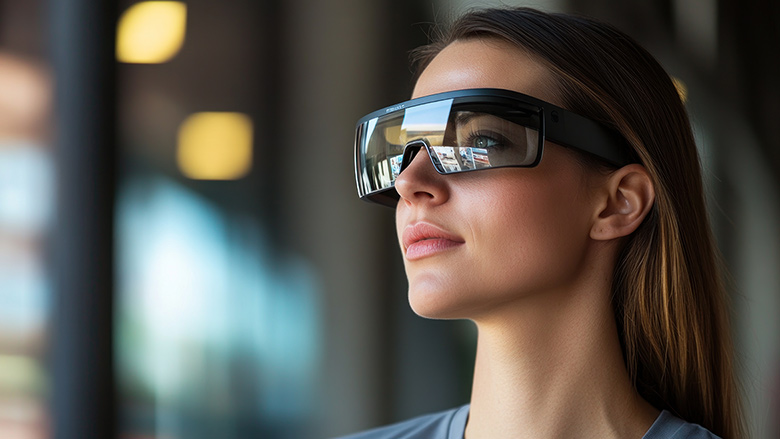
Smart eyewear is being integrated into diverse applications, offering benefits such as hands-free communication, immersive simulations and real-time data overlays. Companies are leveraging AR for workflow optimization, allowing employees to complete training using simulated equipment and environments and to conduct remote inspections. In addition, smart glasses are being used as adaptive devices to promote inclusion and accessibility—enabling sensory-impaired individuals to engage with digital content through features such as live subtitles for the deaf and enhanced vision for users with visual impairments.
 Credit: Chayna – stock.adobe.com
This intersection of optical technologies with AR interfaces is redefining consumer and industrial experiences. With such a wide array of functions, smart eyewear must be designed with a combination of high optical clarity, lightweight comfort and durability. For the paint and coatings industry, the evolution of lens materials and optical coatings represents not only a market opportunity but also a field of manufacturing innovation tied to sustainability, mass customization and advanced engineering.
Lens Considerations for Smart Eyewear
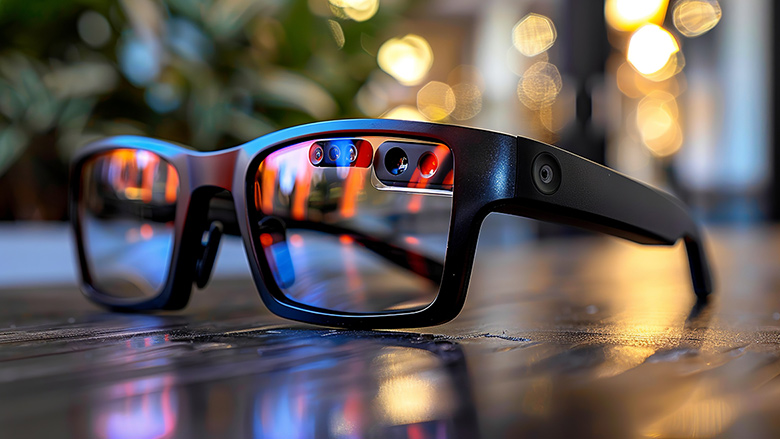
Smart eyewear for AR devices must overcome unique technical challenges to integrate seamlessly into user experiences. These devices use light engines—such as micro-LEDs or liquid-crystal-on-silicon (LCoS) micro-displays—to project digital overlays onto an optical combiner, offering see-through performance for augmented real-world views. Smart glasses must also overcome ambient brightness from interior lighting and sunlight, minimize distortion in small curved lenses, and maintain lightweight builds for compact designs.
The choice of lens material is integral to the design of AR devices. Glass lenses offer high clarity but have low impact resistance and are relatively heavy. Plastic optical monomers are more durable and provide design versatility for unique lens sizes, shapes and embedded technologies. However, variations in plastic lens manufacturing can impact performance.
Residual stress from injection molding and extrusion processes can lead to increased birefringence, which appears as rainbow effects or ghost images. The cast molding process of PPG CR-39® and PPG Trivex® lens materials—thermoset plastics—enables lower optical distortion and offers higher clarity than polycarbonate thermoplastics.
Functional Coatings
Coatings provide essential value-added features for optical lenses. While plastic lenses are impact and shatter resistant, they are prone to scratches and abrasions. Hard coatings add scratch resistance and chemical resistance to common cleaners such as isopropyl alcohol. With PPG Hi-Gard® lens coatings, lenses are four to six times more scratch resistant than uncoated lenses.
Other transparent coatings also provide useful functionality. Easy-to-clean and anti-smudge coatings are important for frequently handled lenses and frames. Anti-glare coatings are essential for AR eyewear, which requires a high degree of light control.
How Coatings and Advanced Materials Will Revolutionize Eyewear
In the past, multilayer lenses have been assembled using traditional techniques such as extrusion or bonding. The next generation of coating technologies, however, is changing how lenses are manufactured and expanding the range of capabilities.
Among the most promising innovations are electrochromic lenses, which enable variable light control and adapt to ambient lighting conditions in real time. In bright settings, display adjustments can quickly drain the battery life of smart eyewear. Dimmable lenses can help achieve better visibility with reduced power draw. Research is exploring efficient manufacturing processes that incorporate traditional vision correction, AR capability and dimming functionality.
Advancements in UV-cure monomers and coatings are transforming lens production. Unlike traditional high-temperature, long-cure manufacturing cycles, UV-curable materials allow for photopolymerization, which reduces energy consumption, minimizes waste and accelerates production. These materials also support the embedding of temperature-sensitive films, electronics and other components directly into the lens—streamlining AR device construction and enhancing overall efficiency.
 Credit: DARIKA – stock.adobe.com
Advances in digital printing combined with ophthalmic coating formulations are also revolutionizing lens construction and customization. PPG has partnered with Flō-Optics, a developer of digital manufacturing technology for the ophthalmic industry, to drive progress in this field. Digitized lens coating solutions can improve application precision and reduce waste while also enabling custom patterns or logos.
Extending digital printing capabilities and combining them with UV-cure monomers is also opening new possibilities in AR optics. Through advanced deposition processes, manufacturers may be able to build multilayer stacks with varying refractive indexes—optimizing light transmission and display quality in smart eyewear.
Optical coatings are poised to become a cornerstone of innovation in the smart eyewear and extended reality (XR) industries. They enable new functionalities, support sustainable practices and advance manufacturing methods that will redefine how optical devices are designed and built. PPG is leading research into novel lens materials and coatings that deliver high-performance displays and vision correction capabilities while maintaining clarity and lightweight design. As these technologies evolve, coatings will be indispensable to the development of next-generation lenses and wearable optical devices.
Explore more articles about smart surfaces and cutting-edge coatings innovation in our Nanotechnology topic hub.
Looking for a reprint of this article?
From high-res PDFs to custom plaques, order your copy today!