Powder Coating Resins from Recycled PET
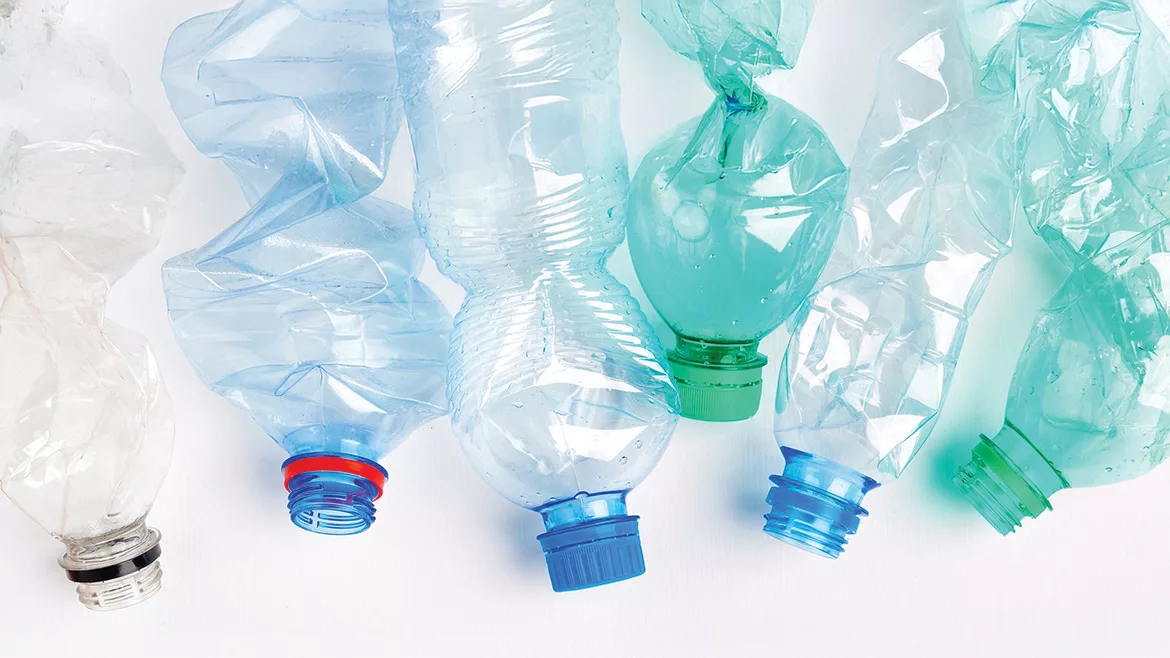
Polyethylene terephthalate (PET) is a polyester resin first discovered by two scientists from the United States and the U.K. in the 1940s. The first patent on PET was filed by J.R. Whinefield of Calico Printers Association (CPA) in Accrington, U.K., while E.F. Izard of DuPont USA also discovered PET independently around 1944. By the late 1940s, the worldwide rights (with the exception of the United States) for PET was held by Imperial Chemical Industries (ICI) of the U.K., which the company obtained from CPA on a royalty basis. In the United States, the patent rights were held by DuPont, which it outright purchased from CPA. Following the invention and the commercialization of PET, many other semi-aromatic polyesters similar to PET were invented and patented, yet none has achieved the widespread use and exceptional commercial success of PET.1
PET is made of two monomeric components, purified terephthalic acid (PTA) and ethylene glycol (EG), and the origins can be traced back to p-xylene and ethylene respectively. PTA is predominantly produced from p-xylene by the Amoco process where p-xylene is converted into PTA by a catalytic oxidation. EG is produced first by converting ethylene to ethylene oxide and then to EG. Both p-xylene and ethylene are products of the petrochemical industry.
The commercial production of PET is done either by esterification of PTA or transesterification of dimethyl terephthalate (DMT) in the presence of EG. Between these two methods, direct esterification has become the more prevalent method of choice due to the abundant availability of PTA. The esterification method also comes with other advantages over transesterification such as higher reaction rate, lower storage cost, preferred condensation byproduct of water as opposed to methanol, absence of a transesterification catalyst and the possibility of producing higher molecular weight PET. During the polycondensation step, the excess EG is removed from the polymer melt by intensive stirring at high temperatures under vacuum or inert gas. Once the desired viscosity is achieved, the polycondensation is terminated by removing the vacuum, polymer melt is expelled from the reactors, quenched with water and formed into chips or pellets. Next, the PET is dried at 80-130 °C to reduce the water content and to crystalize the PET. This step also helps in reducing the agglomeration of the particles and to enhance the storage stability of the PET.2
Why the Interest in Recycled PET?
The primary driver for recycling PET is to reduce the plastic waste that goes to the landfills. The accumulation of plastic in the environment is a huge global issue. As of 2015, the world has generated 6,300 million metric tons of plastic waste, and 79% of it has ended up in landfills or the natural environment.3 Secondly, recycled PET (rPET) can be an alternative to the PET made from virgin raw materials. The virgin raw materials for PET are derived from petroleum, which is a finite and diminishing resource. Recycling of PET reduces the consumption of petroleum, reduces greenhouse gas emissions and uses less energy. According to a life cycle analysis done by the National Association for PET Container Resources (NAPCOR), each unit of rPET that replaces virgin material results in 40% less process and transport (expended) energy, 75% lower total energy demand and 60% reduction in greenhouse gas emissions.6 Finally, with the use of new and cheaper technologies, rPET could be a more economical alternative to virgin PET.7
Recycling PET offers significant environmental and economic benefits, but it also presents several challenges. The primary concern is the effective separation of polymers, especially since post-consumer plastic streams contain various types of plastics.8 Even after separation of plastics based on the chemistry, polymeric impurities can remain, leading to phase separation of resins, which results in poor mechanical properties and surface imperfections of the plastics.8 Another common issue associated with recycling plastics is contaminants. These can be acidic contaminants such as polyvinyl chloride (PVC), adhesives, ethylene vinyl acetate (EVA) and paper, or basic contaminants such as sodium hydroxide (NaOH) and alkaline detergents from the label-removing and washing steps. Water from the washing step can also be a contaminant in rPET.7,8 All these contaminants cause hydrolysis of rPET during reprocessing, which degrades the material and reduces its melt viscosity.
Colored impurities from plastics and labels can produce undesirable color effects in rPET. Additionally, yellowing, caused by intramolecular crosslinking and oxidation reactions, is a significant concern in bottle production with rPET.7
PET Recycling Process/Applications
Since plastic recycling began in the 1980s, it has mainly focused on nonfiber plastics, with limited efforts to recycle plastic fibers.3 Most plastic fibers are either incinerated or sent to landfills. Despite this, PET is also the most recycled plastic in the world, primarily in the form of bottles and packaging.9 Recycling of PET can be done in two main approaches; physical recycling where PET is sorted, cleaned, reground, remelted and reformed, and chemical recycling where PET is broken down to monomeric components by chemical means for reuse. Lastly, PET can also be incinerated to harvest the energy content of the plastic.3
There are many varieties of rPET available from commercial suppliers. These different rPET types can be broadly classified into two categories based on their origin: post-industrial rPET and post-consumer rPET. The main source of post-industrial rPET is the PET scraps directly obtained from the industrial manufacturers. These PET scraps mostly in form of films and sheets are collected at the industrial sites and bought by the PET recyclers to convert back into pellets via a densifying and extruding process. Compared to post-consumer rPET, this post-industrial (or pre-consumer) rPET is the closest to the virgin material as it is largely free of external contaminants such as labels, metals and other plastics. However, there can be instances where the original PET scraps may have contained pigments such as titanium dioxide, carbon black and other organic or inorganic pigments, which will give a white, black or multicolor appearance to the resulting rPET pellets.
The post-consumer rPET is originated from curbside collection and mostly consists of recycled plastic bottles. Once the end-of-use PET bottles are collected by the local governments or the collection agencies along with other recyclable materials such as paper, cardboard and glass, they are transported to a material recovery facility (MRF). At the MRF, the PET is separated from other materials, sorted by color, crushed and baled. These PET bales are then taken to a PET reclaimer. At the PET reclaimer these bales are broken, manually sorted, and labels are removed. After that, they are automatically sorted to remove any metals or non-PET materials and ground to recycled PET flakes. Next, these rPET flakes are washed and further separated from any non-PET particles such as cap and label pieces at a float/sink tank. Later, these clean flakes are dried, sieved to separate fines and either sold as flakes or extruded to produce pellets. During the extrusion, this rPET can be further purified via a melt filtration prior to pelletizing.10 Various forms of rPET can be obtained in multiple steps of this process.

rPET is used to manufacture new products, thereby giving it a second life. It can be made into clothing such as T-shirts, athletic shoes and sweaters, as well as household items like carpets, upholstery and curtains. Some of the rPET can be used to produce food containers, and beverage and water bottles. In addition, rPET is also used in industrial applications such as industrial strapping, automotive parts, sheet and film and coating resins.9
New Developments and Benefits
As a leading global resin supplier and a major powder coating resin manufacturer, allnex is committed to enhancing the green footprint of its resin portfolio. Powder coatings are inherently greener than traditional liquid coatings due to the absence of solvents, making them free of volatile organic compounds (VOCs).11 The main component of polyester powder coatings is polyester resin, which is typically manufactured without organic solvents, further enhancing its green credentials.12 Using rPET as an alternative to virgin raw materials can further boost the greener footprint in powder coatings. Recently, allnex has developed expertise in incorporating rPET into powder coating resins.12,13
Using rPET in powder resin manufacturing significantly benefits the environment and aligns well with the concept of circular economy, one of the sustainability pillars defined by allnex as a focus area.14 Some of the major circular economic principles include minimizing resource use, keeping resources in circulation, maximizing their value, and recovering and regenerating products. Incorporating rPET in powder coating resin production supports these principles to varying degrees. Both post-industrial rPET and post-consumer rPET have seen the end of their first lifecycles; one as industrial waste and the other as consumer waste. When used as raw materials for powder coating resin manufacturing, these waste products that would otherwise end up in landfills are transformed into high-tech coating resins. This essentially upcycles a recycled single-use plastic article such as a plastic water bottle to a coating resin with better quality, environmental value and a longer service life.
The allnex process of using rPET in the powder polyester production is related to that of the chemical recycling. Yet, it is unique in the sense that the allnex process directly uses the rPET in the resin synthesis without going through a separate step to break down and purify the monomers as in a typical chemical recycling process of PET. This approach is greener and more cost-effective, reducing the number of reaction steps and chemical usage. The process also has the advantages of reduced cycle time and reduced energy use compared to chemical recycling.
This versatile resin synthesis process can be employed to produce rPET resins for a multitude of powder polyester chemistries. Based on the experience gained from multiple lab, pilot and production trials, we have the capability and the know how to run this process at any scale without increase of cycle time or process complexity. The rPET resins developed could contain rPET content varying from 10-50%. The quality and the performance characteristics of these rPET powder polyester resins are similar to those of standard resins.
Conclusion
Every day, huge quantities of plastic waste ends up in landfills and the natural environment all over the world, and this is a major global issue. As PET accounts for 70% of the global synthetic fibers and approximately ¼ of all packaging materials, recycling PET would significantly reduce the plastic waste that ends up in the environment. Moreover, rPET will also reduce the use of virgin raw materials that originate from the diminishing petroleum resources and reduce greenhouse gas and carbon emissions. In recent years, allnex has successfully developed the capabilities and the experience to use rPET in powder coating resins. The use of rPET in powder coating resins will essentially upcycle a raw material typically used in single-use containers with a short product lifetime, such as a plastic water bottle, to a high-tech coating with a longer product lifetime.
References
1 Grubbles, E. Polyesters. Ullmann’s Encyclopedia of Industrial Chemistry; Wiley-VCH Verlag: Weinheim, 2018; pp 1-28.
2 McIntyre, J. E. The Historical Development of Polyester. Modern Polyesters: Chemistry and Technology of Polyesters and Copolyesters; John Wiley & Sons Ltd: Chichester, 2003; pp 1-28.
3 Polyethylene Terephthalate (PET): A Comprehensive Review. Omnexus SpecialChem. (accessed March 19, 2021).
4 Pawlak, A.; Pluta, M.; Morawiec, J.; Galeski, A.; Pracella, M. Characterization of Scrap Poly(ethylene terephthalate). Eur. Polym. J. 1999, 36 (9), 1875-1884.
5 Geyer, R.; Jambeck, J. R.; Law, K. L. Production, Use, and Fate of All Plastics Ever Made. Sci. Adv. 2017, 3 (7), e1700782.
6 Al-Sabagh, A. M.; Yehia, F. Z.; Eshaq, G.; Rabie, A. M.; ElMetwally, A. E. Greener Routes for Recycling of Polyethylene Terephthalate. Egypt. J. Pet. 2016, 25 (1), 53-64.
7 Gioia, C.; Vannini, M.; Celli, A.; Colonna, M.; Minesso, A. Chemical Recycling of Post-Consumer Compact Discs Towards Novel Polymers for Powder Coating Applications. RSC Adv. 2016, 6, 31462-31469.
8 Gioia, C.; Paola, M.; Celli, A.; Colonna, M.; Minesso, A.; Cavalieri, R. Powder Coatings for Indoor Applications from Renewable Resources and Recycled Polymers. J. Coat. Technol. Res. 2015, 12 (3), 555-562.
9 Gioia, C.; Vannini, M.; Marchese, P.; Minesso, A.; Cavalieri, R.; Colonna, M. Sustainable Polyesters for Powder Coating Applications from Recycled PET, Isosorbide, and Succinic Acid. Green Chem. 2014, 16, 1807-1815.
10 Our Sustainability Philosophy and Strategy. allnex. (accessed October 17, 2024).
11 PET Is the Most Widely Recycled Plastic in the World. NAPCOR. (accessed October 17, 2024).
12 Code of Federal Regulations. (accessed October 17, 2024).
13 Life Cycle Analysis. NAPCOR. (accessed October 17, 2024).
14 Recycled rPET Facts. International Bottled Water Association. (accessed October 17, 2024).
Looking for a reprint of this article?
From high-res PDFs to custom plaques, order your copy today!