
Optimizing Open Time
Evaluating OTE Additives and Their Effects on Key Architectural Coating Properties
- Open Time Control in Latex Paints
- Wet-Edge Performance in Waterborne Coatings
- Rheology and Viscosity Drift Impacts
- Gloss and Surface Appearance Changes
- Blocking Performance in Wood Coatings
- Additive Selection for Formulators
Waterborne dispersion paints based on polymer dispersion, both architectural and wood, are applied in most cases to the ground with some absorbency, usually at temperatures above 59 °F (15 °C) and varied air humidity depending on the climate zone. Often the application is carried out at elevated temperatures, for example above 77 °F (25 °C) and low humidity, which significantly accelerates the process of water evaporation from a wet layer and drying, hindering the painting process and retouchability, which can be particularly troublesome for nonprofessional painters (DIY applications). On the other hand, quick drying is in many cases desirable, for example for the application of another layer without having to wait many hours, as well as in the case of application outside where it is necessary to obtain early resistance to rain without the need for covers.
Balancing the elongated drying time by balanced open time is a formulator task that can be obtained by many treatments. One of them is the use of open time extending additives (OTE additives). They can be dedicated to the intentional mixture of fatty compounds, waxes or oleochemical components whose task is to extend water retention, slow down its evaporation and maintain a wet layer longer. In the past, propylene glycol was used for this purpose, which can be found in some countries to this day; however, it is classified as VOC and is not a desirable component of the formulation of modern waterborne paints. OTE additives are designed to balance too-fast drying causing the problem with touch-up, wet edge and too-slow drying causing risk of rinsing the coating by rain, leaching, traces of insects, flies, etc.
To choose the OTE additives in terms of type and doses you need to know how they work, that is, how they affect the efficiency of extending open time (OT) in the forms, how they affect wet edge and whether they also cause disturbances in other key formulation parameters, for example blocking, water resistance, gloss, etc. To this end, I invite you to the world of additives from the side of their application studies performed in the lab in which new raw materials are developed and the existing ones are already tested.
Article prepared on the basis of a presentation by A. Palasz, Evaluation of the Performance of Open Time Extending Additives in Architectural Paints and the Importance of Side Tests, 36th Biennial Western Coatings Symposium, Las Vegas, NV, US, October 16, 2023. The article contains selected results of application studies.
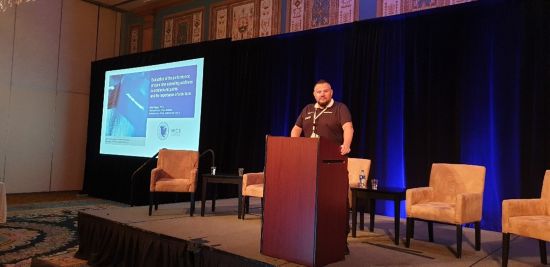
Figure 1. Artur Palasz, technical director of Spektrochem, during a presentation at WCS 2023 in Las Vegas.
 Credit: Spektrochem
Key Performance Features
The key parameter in the evaluation of OTE additives is open time and wet edge. These two parameters determine the efficiency of the additive used to extend them. The selection of such additives involves preparing control paints, usually without OTE or with the previously used OTE additive that we want to change, and then paints with new OTE additives, usually in ladder dosing to learn their dosing efficiency. OTE additives, depending on the composition, consist of 30–80% of active ingredients (typically), which are converted into dosages in the formulation according to the recommended dosages determined by laboratory investigations. In the Spektrochem laboratory, such in-depth analysis is also carried out in terms of OTE additives, which determines the doses and their efficiency in the formulations. This article discusses how to use the recommendations we prepare for OTE-additive producers as well as how important it is for additive producers to have such data.
During such application studies, not only open time and wet edge are assessed, which are known to be crucial. It is also about providing the formulator with data on the potential impact of OTE additive on other parameters, the so-called secondary or side parameters. We are talking about the impact on the properties of coatings or liquid paints, which at first glance is not taken into account and the impact of OTE additives on them is not considered. Well, who would assume in advance the influence of an additive intended to extend the open time to gloss or rheological properties? It should be remembered that OTE additives contain various types of surfactants, so they may cause a drift in the parameters for which surfactants are responsible, for example increasing the sensitivity of coatings to water. Due to the content of various types of oleochemical compounds, they may cause changes in rheological properties (interfering with the efficiency of thickeners) even though they are not rheological additives, and finally, due to the frequent content of waxes, they may reduce the gloss.
Therefore, OTE additives cannot be treated only as additives for which two key performance parameters are assumed: open time and wet edge. Key performance parameters are also those that can potentially be changed by the participation of OTE additives in the formulation and the formulator must be provided with knowledge about this in the form of application studies, which we present in this article.
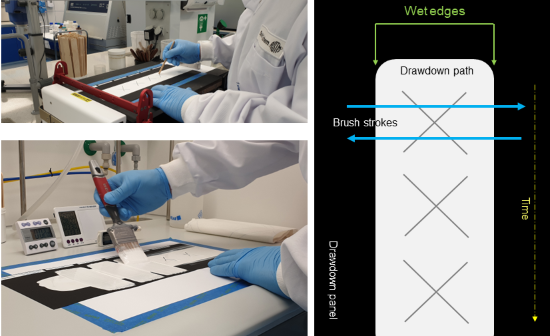
But let’s start with open time and wet edge. The test to assess these parameters is performed in a laboratory according to ASTM D7488 (Figure 2). This is a seemingly simple test, but its correct execution involves many conditions that must be met to obtain repeatable and reliable results.
Figure 2. Illustrative performance of the ASTM D7488 test.
 Credit: Spektrochem
This test allows you to evaluate the open time and wet edge in time intervals by assessing the possibility of making a correction on the still wet paint layer on which the X-mark was made. The time during which a retouch is possible after the paint application, making the X-marks invisible, is the open time. Wet edge, in turn, is the visibility of the edge when making a correction, which is assessed at the junction of the panel on which the drawdown was made and the paint layer.
This test is performed manually by a laboratory technician; therefore it must be performed by appropriately qualified personnel (participating in ILC, having a high repeatability rate). Due to the dependence of the results on many other factors, such as temperature and humidity in the laboratory room during the test, the test must be conducted in a laboratory with a high standard of maintaining constant environmental conditions. It is also necessary to properly prepare the brush to ensure consistent paint loading during subsequent painting sessions. Meeting these conditions is necessary for the repeatability of the test, which is why it is especially important to perform the test in laboratories with a high-quality standard. Otherwise, the results will be subject to high error, especially when repeating samples tested at different times.
Experimental
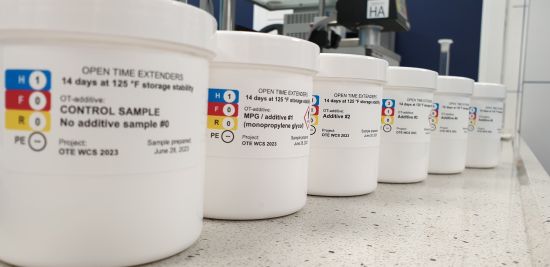
In order to show how OTE additives work in formulations, application studies were carried out on the formulations of wall paints and wood and trim enamels. Tests were carried out on five OTE additives, the effectiveness of which was compared with paint samples without additives. The OTE additives used in the tests were additives diversified in terms of chemical composition and content of active ingredients intended to extend the open time. Samples were numbered from #1 to #5 (sample #1 being MPG (monopropylene glycol) and further samples #2 to #5 being advanced non-VOC OTE additives).
Application studies were carried out in paint formulations developed in the Spektrochem laboratory. The first formulation was latex wall paint PVC 31 %, and the second was wood and trim enamel PVC 18 %. Each sample was prepared in the lab scale with OTE additives dosed with 1.5 wt % active substances on total formulation (replaced by water, adding during let-down as post-addition). Control samples did not contain OTE additives (sample #0). The prepared samples were tested. First, open time and wet edge were determined, and then a number of secondary parameters were assessed to determine the impact of the same dose of OTE additives, calculated on the active parts in the formulation, on other key parameters.
Figure 3. Paint samples containing OTE additives ready for testing.
 Credit: Spektrochem
Open Time and Wet Edge
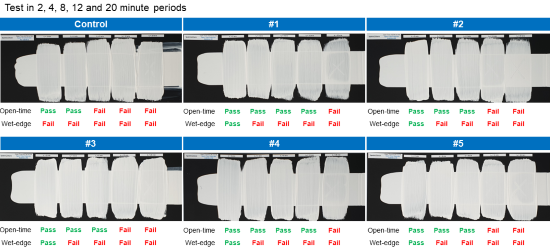
Open time and wet-edge tests were conducted in full compliance with ASTM D4788 in laboratory conditions at a constant controlled temperature of 73.5 °F ± 3.5 °F (23 °C ± 2 °C) and a relative air humidity of 50 % ± 5 % recorded throughout the test using a NIST-traceable logger. The results are shown in Figure 4 for wall paints PVC 31 %.
Figure 4. Results of open-time and wet-edge determinations for prepared OTE-additive samples.
 Credit: Spektrochem
As can be seen in the test results, a significant increase in the possible open time can be seen for sample #1 with MPG. The open time was increased from 4 minutes (control sample) to 12 minutes. This result was also achieved by the sample from OTE additive #4. The remaining samples allowed the open time to be extended from 4 minutes to 8 minutes. In the case of wet edge, the control sample containing no additive did not test positive even at 2 minutes. The addition of each of the tested OTE additives allowed for a slight extension of the wet-edge preservation time to 4 minutes. It should be noted that the dosage of OTE additives was relatively small and amounted to 1.5 wt % of active ingredients for the entire formulation. The addition of such an amount was purposeful to show the impact of a small amount of OTE additives on the remaining parameters described below as secondary parameters.
Secondary Parameters
Despite the relatively low dosage, OTE additives showed performance demonstrating that the effectiveness of MPG (tested additive #4) can be matched and that the open time extension and keeping the wet edge are indeed visible when used in the formulation. However, what is the impact of the used OTE additives on other parameters in paints in which, apart from open time and wet edge, other parameters are also crucial? Let’s analyze and discuss the test results.
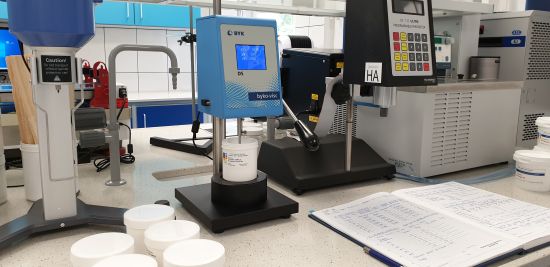
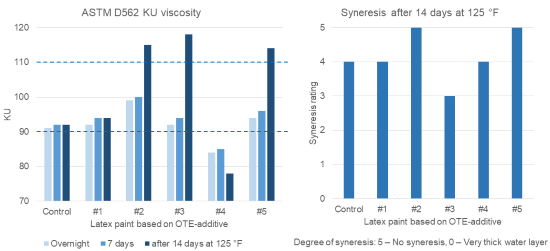
The first test was to determine the effect of OTE additives on viscosity stability over time. Each of the prepared samples was obtained from the same formulation in which the viscosity was not adjusted depending on OTE additives. Overnight viscosity and viscosity after 7 days were determined using a Stormer viscometer according to ASTM D562 method B (Figure 5). Samples were additionally placed for 14 days at 125 °F (52 °C) to determine the effect of OTE additives on viscosity drift and syneresis in wall paint samples. The results are shown in Figure 6.
Figure 5. KU viscosity measurement using a Stormer viscometer.
 Credit: Spektrochem
As you can see in the graph, the viscosity of the samples changes with the added OTE additives. For the control sample, the viscosity was deliberately set at approximately 90 KU to better observe the possible influence of OTE additives. Sample #1 MPG, as well as samples #2, #3 and #5, show a slightly higher viscosity than the control sample, however in the range of 90–110 KU. Sample #4 shows a drastic drop in initial viscosity below 90 KU, demonstrating the need to adjust the viscosity of paints using this OTE additive. These test results show that it was reasonable to assume that the interaction of OTE additives with other ingredients may affect the rheological properties.
After storage stability tests, as seen in the graph, samples #2, #3 and #5 show a drastic increase in viscosity above 110 KU. Sample #1 MPG shows no effect on viscosity after storage stability. In turn, the OTE additive #4 sample shows an even greater decrease in viscosity after 14 days at 125 °F (52 °C), dropping below the initial viscosity. The second graph in Figure 5 also shows the effect on syneresis after the storage stability test. OTE additive samples #2 and #5 show no syneresis, while MPG #1, #4 and control samples show slight syneresis (rating 4). Sample #3 shows the highest tendency to syneresis (rating 3). These results show the importance of additional testing to determine useful recommendations for the formulator regarding the need to take into account viscosity corrections, the impact of the ingredients present in OTE additive on viscosity and storage stability.
Figure 6. Results of viscosity, viscosity changes and syneresis.
 Credit: Spektrochem
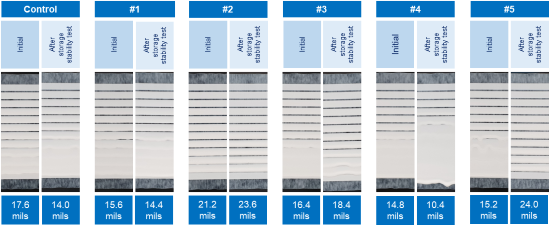
Since rheological properties are not only KU viscosity, Figure 6 shows the influence of OTE additives on sagging resistance and the changes in sagging resistance after the storage stability test, illustrating what effect the changing viscosity resulting from the use of OTE additives and not adjusting the viscosity can have. The sagging resistance test was performed in accordance with ASTM D4400 (procedure for waterborne paints) and the results are presented in Figure 7 as Anti-Sag Index expressed in mils (0.001 in.).
Figure 7. Resistance to sagging (ASTM Anti-Sag Index) and changes due to viscosity changes.
 Credit: Spektrochem
In the pictures presented after the sagging resistance tests, you can clearly see where the viscosity increased and improved the sagging resistance results. Please remember, however, that an uncontrolled increase in viscosity leading to improved sagging resistance is not necessarily good, as it may impede the workability of the paint. It can also be noticed for sample #4 how the decrease in viscosity translated into a deterioration of the sagging resistance.
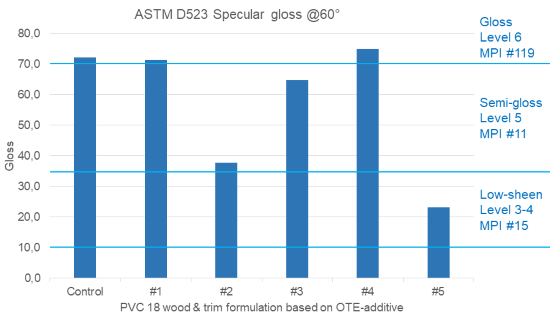
In the case of low pigment volume concentration, for example for wood coatings where we are dealing with coatings with the desired high gloss, the effect of OTE additives on gloss was tested on the wood and trim enamel formulation (PVC 18 %). The wood and trim formulation also uses 1.5 wt % OTE additives, calculating the active ingredients for the entire formulation. Gloss measurements were made on the coatings after 7 days using a Novo-gloss Trio gloss meter from Rhopoint at an angle of 60° and the classification was made in accordance with the MPI criteria. The results are shown in Figure 8.
Figure 8. The influence of OTE additives on gloss.
 Credit: Spektrochem
Assessment of the impact of OTE additives on gloss in coatings with a desired specific gloss level is crucial due to the ingredients present in such additives. Waxes, various types of fatty components and others can drastically reduce the gloss, as shown in Figure 8. The control formulation has a gloss slightly above 70 (gloss, MPI level 6), as does the sample from OTE #1 MPG, showing no effect of this additive on gloss. In turn, samples #2 and #3 containing further OTE additives show a decrease in gloss to MPI gloss level 5 (semi-gloss), obtaining a differentiated semi-gloss (OTE sample #2 reduces the gloss much more). The greatest reduction in gloss, down to MPI level 3–4 low-sheen, was achieved by OTE additive #5. In turn, the OTE additive #4 sample allows for a slight increase in gloss compared to the control sample and maintaining the results in the MPI level 6 classification.
It should be emphasized that the dose of 1.5 wt % used in the formulations is a relatively low dosage level which, if increased, would have an even greater impact on the test results obtained. This approach to developing documentation for the formulator in the form of guideline formulations showing, on the example of case studies, how OTE additives behave in terms of their impact on gloss can be extremely valuable for reducing the time spent on open-time effectiveness assessments when the goal is to develop formulations with increased gloss, and it will already be known in advance that a given additive will not be suitable for such formulations. On the other hand, such data show that you can use OTE additives a bit more consciously in formulations that are to be designed as semi-gloss, velvet-like or eggshell-like and use them to boost the formulations not only in terms of open time but also use them for optimization of matting agents.
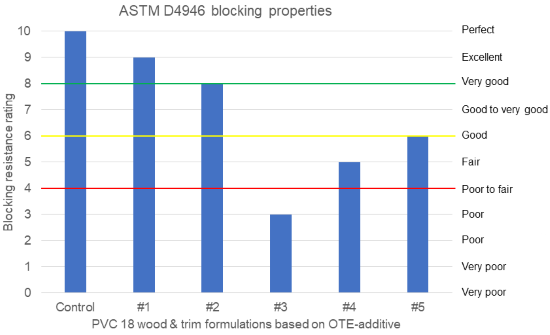
In the case of wood coatings for application on window or door frames, it is important to ensure appropriate blocking properties. Can the influence of OTE additives be noticeable here? OTE additives are prepared using various surfactants and components that can migrate to the coating surface and remain on its surface, affecting the blocking properties of the coatings. Therefore, this parameter was also tested in the application studies for the wood and trim formulation. The results are shown in Figure 9.
Figure 9. The influence of OTE additives on blocking properties.
 Credit: Spektrochem
The blocking properties test was performed in accordance with ASTM D4946 on the coatings after 7 days of conditioning. As you can see, the control coating (without OTE additive) shows the best result. Each subsequent OTE additive has an impact on the blocking properties, starting from a slight decrease in this property for coating samples with OTE additives #1 and #2, through a further reduction up to the level of good for sample #5, through fair for sample #4 and to the lowest result (poor) for sample #3. The presented results show that the impact of OTE additives may be so drastic that the designed formulation may not be suitable for use in joinery, as it will cause blocking of elements that have face-to-face contact with each other, for example windows or doors, but also other woodwork such as furniture cabinets. Increasing the stickiness of the coating by migrating surfactants or fatty compounds to its surface may increase the tendency to retain dirt.
Summary
The results of application studies presented in this way are an example of a guideline for the formulator on how to choose a given OTE additive for his designed formulation, but also extremely valuable knowledge for the manufacturer of such additives for their appropriate recommendation for glossy coatings, for coatings in which blocking properties are important and also where it is necessary to adjust the viscosity because the additive affects its drift. These results are an excerpt from a presentation given at the Western Coatings Symposium 2023 in Las Vegas which discussed in detail these and other unpublished test results. This approach to the issue of promoting OTE additives and their use in formulations allows for their more effective use, more conscious selection and easier work of the formulator.
Learn more about formulation strategies and performance testing across architectural and wood systems on PCI’s architectural coatings topic page.
Looking for a reprint of this article?
From high-res PDFs to custom plaques, order your copy today!