High-Quality Cross-Sectioning for Automotive Body Paints
Why Delivering Quality Coatings Takes a Multilayered Approach

- Automotive body paints rely on multiple functional coating layers to balance corrosion protection, durability and visual appearance.
- Microscopic cross-sectioning is required to evaluate layer thickness, uniformity, adhesion and defect formation in automotive coatings.
- Traditional mechanical polishing and focused ion beam methods face limitations when analyzing thick multilayer automotive paint systems.
- Femtosecond laser ablation enables rapid, noncontact cross-sectioning of complex automotive paint structures with minimal surface damage.
- Combining laser ablation with SEM and EDS supports both structural imaging and chemical verification within a single analytical workflow.
Henry Ford once famously said, “Any customer can have a car painted any color that he wants, so long as it is black,” a statement that underscored his commitment to efficiency and cost control in the production of the Model T. In reality, automotive body paint is far more complex. Modern multi-layer coatings must not only deliver durability and protection but also meet increasingly high aesthetic standards, a combination that is not easy to perfect. In this context, Kiren Kang, Business Development Manager EMEA (Electron Microscopy/XPS) at Thermo Fisher Scientific, explains how laser ablation offers a precise, high-quality method for cross-sectioning automotive paints.
Automotive paints are designed to serve a dual purpose: protecting the vehicle body from corrosion while delivering a visually appealing finish. Meeting these demands requires the precise formulation and application of multi-layer coatings, with each layer engineered to perform a distinct role.
Automotive coatings can comprise five or more distinct layers, each contributing to the overall performance and appearance of the finish. A pretreatment layer and an electrodeposition layer form the foundation, promoting adhesion and providing essential corrosion resistance. These are followed by layers of primer, basecoat and clearcoat, which together deliver color, durability and a high-gloss finish. Given their intricate application process and the need for rigorous quality control and inspection, automotive body paints represent a significant cost in vehicle manufacturing, a cost that can rise sharply when quality standards are not met.
To prevent issues such as peeling, rust, inconsistent paint thickness, UV degradation and surface defects, automotive body paints must be analyzed at the microscopic level before being approved for production.
Determining Automotive Paint Quality
Many commonly used methods for analyzing coating samples come with limitations. One of the most traditional approaches involves embedding paint samples in polymer resin blocks. The samples are then mechanically polished in multiple steps to create a cross section of the paint layers on a steel substrate. While widely used, this method is time-consuming and often struggles to achieve the ultra-smooth surfaces required for high-resolution analysis.
Another common technique is gallium focused ion beam (FIB) milling, which uses a concentrated beam of gallium ions to precisely cut and mill cross sections of a sample. This method is highly effective for imaging and analysis, as it produces exceptionally accurate cross sections and allows for detailed inspection of structures at various depths. However, its capabilities are limited. Gallium FIB can typically create cross sections only about 20 µm wide and deep, which is insufficient for analyzing automotive paint layers that often exceed 100 µm in thickness.
Even xenon plasma FIB, which is better suited for milling thicker layers, becomes time-consuming when creating high-quality cross sections beyond a few hundred microns. This is due to the need for low-current polishing and the application of a protective layer before milling.
For those analyzing automotive body paints, relying on a single method may not be sufficient. Traditionally, combining multiple techniques requires several instruments and a significant time investment. It is now possible to streamline both sample preparation and analysis using a single integrated solution.
Creating Cleaner Cross Sections
To begin, consider the optimal method for sample preparation. Given the complex, multilayered structure of automotive paints, femtosecond laser ablation presents clear advantages over traditional cross-sectioning and ion beam techniques.
Unlike conventional mechanical polishing, which involves embedding samples in resin and grinding them down, femtosecond laser ablation enables direct, noncontact material removal. This results in cleaner, more precise cross sections without the risk of mechanical damage. The laser’s highly localized action allows for selective layer removal while preserving the integrity of underlying structures.
What sets femtosecond lasers apart is their speed. They can cut through a wide range of materials at rates orders of magnitude faster than typical FIB systems, making it possible to produce large, high-quality cross sections in under five minutes.
In most cases, the resulting laser-milled surfaces are clean enough for direct imaging using scanning electron microscopy (SEM) and are also suitable for surface-sensitive techniques such as energy-dispersive spectroscopy (EDS).
Combining Capability
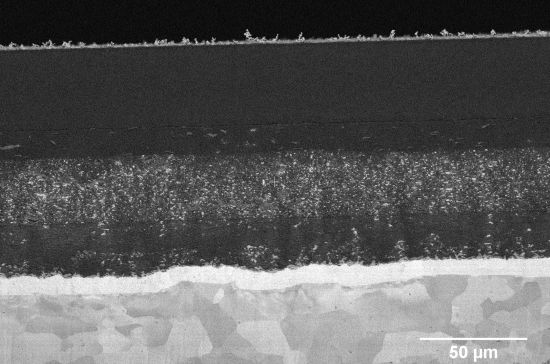
Automotive body paint analysis is further enhanced by the ability to perform both SEM and EDS on a single instrument. SEM plays a vital role in the process, delivering nanoscale imaging to reveal fine structural details of each coating layer, including thickness, uniformity and potential defects.
Figure 1. SEM backscattered electron image of an automotive body coating cross section.
 Thermo Fisher Scientific
When combined with EDS, the system also provides precise chemical analysis of the cross section. This allows verification of pigment distribution, detection of impurities and confirmation that paint formulations meet required specifications. Such insights are especially valuable in quality control, enabling manufacturers to ensure that each layer, whether a corrosion-resistant primer, metallic basecoat or protective clearcoat, contains the correct materials.
The Helios 5 Laser Plasma FIB from Thermo Fisher Scientific is designed to overcome the challenges of traditional sample preparation methods by integrating multiple capabilities into a single instrument. By combining femtosecond laser ablation with FIB milling, it offers a more precise means of sample preparation that is 15,000 times faster than using FIB alone.
With integrated SEM and EDS capabilities, the Helios 5 Laser Plasma FIB enables both structural and chemical analysis within a single streamlined system. By combining laser ablation, plasma FIB, SEM and EDS into one instrument, manufacturers gain an all-in-one solution for evaluating automotive body coatings. This comprehensive approach enhances quality control and long-term coating performance while minimizing production downtime and material waste.
Creating automotive body paints involves far more than selecting the right color. Striking a balance between visual appeal and functional performance requires meticulous formulation, in-depth testing and detailed material analysis. By advancing the way coatings are prepared and examined, manufacturers can detect issues earlier, reduce inefficiencies and ensure that every layer performs as intended.
Learn more by visiting the Thermo Fisher website.
Advanced analytical techniques play a critical role in evaluating film integrity and performance across modern Industrial Coatings applications.
Looking for a reprint of this article?
From high-res PDFs to custom plaques, order your copy today!