Cutting Through Complexity
DOE in Powder-Coating Optimization
Image credit: cgtoolbox / Creatas Video via Getty Images.
The formulation and application of powder coatings are complicated processes. In formulation, each ingredient has a purpose, but it also interacts with all the other ingredients in the formulation. Similarly, when applying powder, dozens of variables in the process both have an effect and interact with each other. These interactions make it extremely difficult and time-consuming to approach R&D and manufacturing problems through a traditional “change one factor at a time” methodology.
In contrast, design of experiments (DOE) allows for the manipulation of multiple factors and enables researchers to see how the various interactions impact the desired end result. DOE is an efficient way to tackle R&D or manufacturing problems that have many input variables, cutting through complexity to make a daunting task much simpler. A case in point is the optimization of powder coating spray application parameters to hit specific targets and minimize out-of-spec coatings.
DOE in Action
One such project was undertaken by Karaoglan et al., which will serve as an example of how DOE can be used to simplify a high-complexity problem.¹ In order to meet ISO 12944 C5 marine specifications, the powder coating in this case needed to be 75 μm thick. The company was unexpectedly struggling to meet the target film build for this new coating and specification, and their reject rate was unacceptably high.
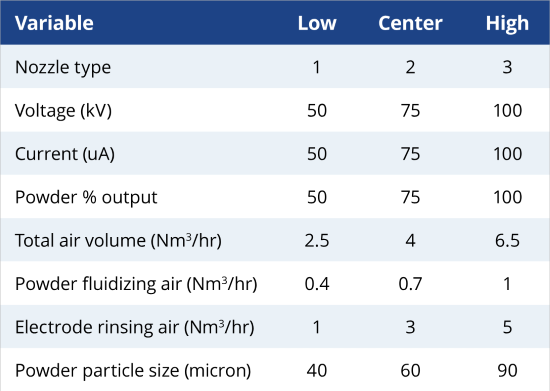
The team faced an issue with the number of input variables when attempting to solve the problem, as many factors can affect dry film thickness (DFT). They focused on eight adjustable variables for their spray application, and they wanted to test each variable at three levels to determine its response for DFT.
TABLE 1 | DOE input variables, run 1.
 Source: ChemQuest
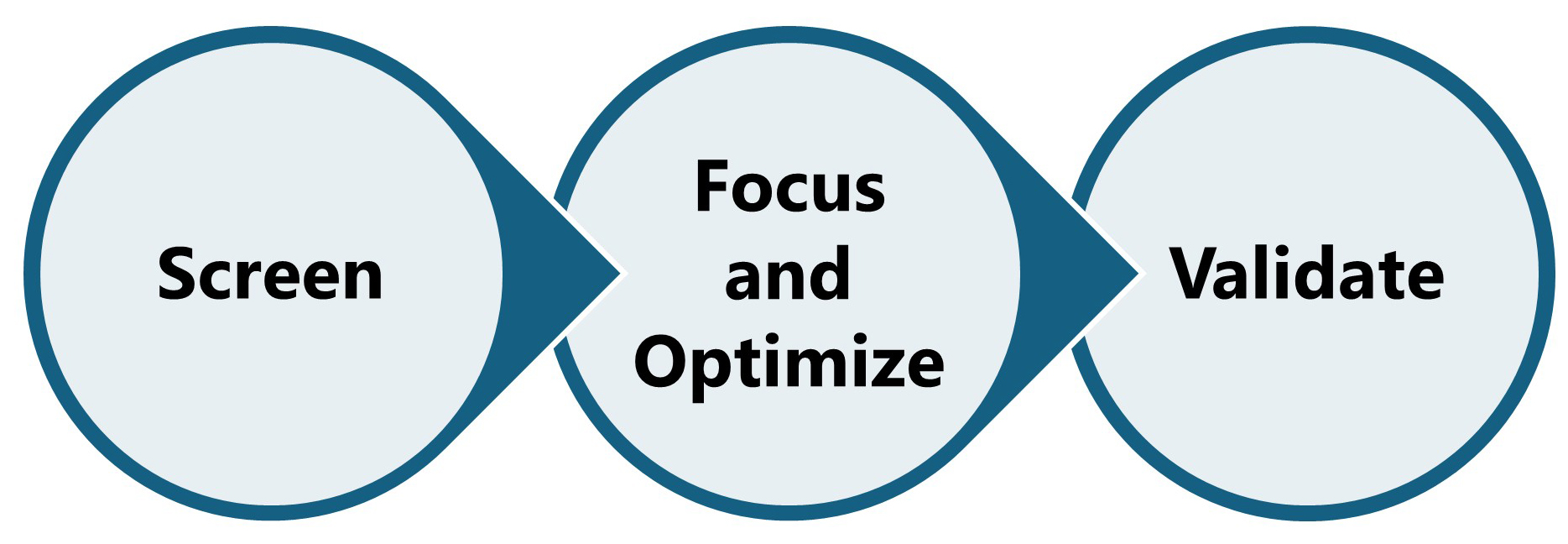
If they had run a brute-force approach and tested every combination of variables, the result would have been 3⁸ experiments (6,561 runs), which is completely unmanageable. Instead, they used a DOE approach, as illustrated in Figure 1.
FIGURE 1 | DOE approach.
 Source: ChemQuest
Conceptually, this type of DOE approach has three phases of evaluation. The first phase is to screen all input variables to determine which have a statistically significant effect on the desired property (in this case, DFT). In the second phase, the levels of the statistically significant input variables are adjusted appropriately and reevaluated. The result is a “prediction” of the correct levels for each input to meet the DFT specification. The final phase is to validate the prediction from the second phase, and then fine-tune as necessary.
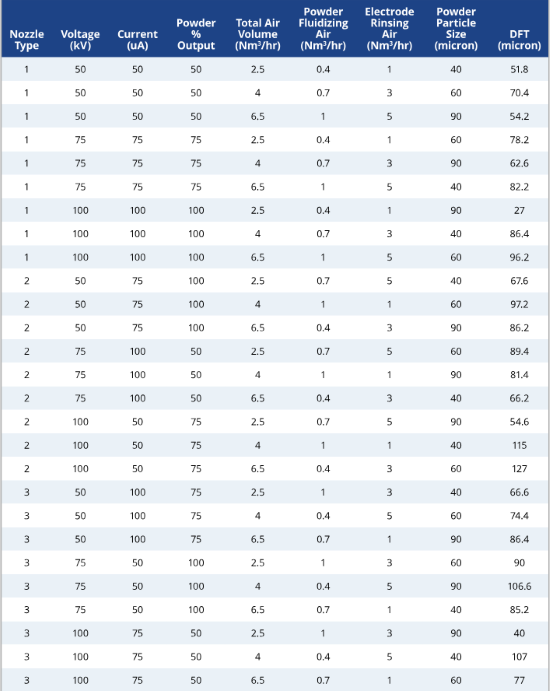
For screening, Karaoglan used a DOE technique known as a Taguchi design, which is a statistical design approach that is highly effective at identifying important variables and selecting the range of each variable to focus on.² It is beyond the scope of this article to fully explain the Taguchi design process, but consulting resources and software are available. The Taguchi design and the measured DFTs are shown in Table 2.
TABLE 2 | DOE Taguchi design, run 1.
 Source: ChemQuest
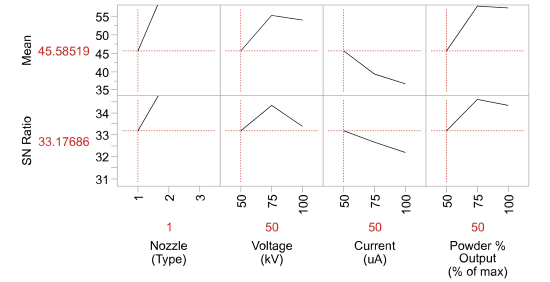
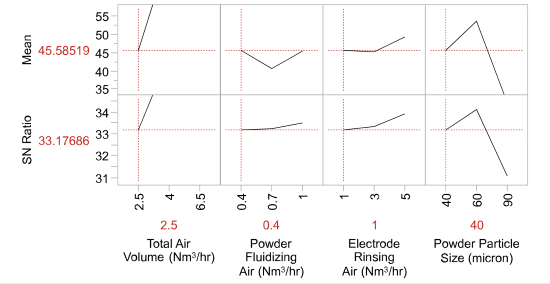
When analyzed, Karaoglan was able to eliminate many variables and focus on tighter ranges for optimization (see Figure 2). The graphs in the top row show the mean DFT that correlates with the level for each variable, and the graphs in the bottom row show the signal-to-noise (SN) ratios. Since the team was looking to maximize process control, higher SN is desired.
FIGURE 2 | Output from analysis using JMP software (original authors used Minitab).
 Source: ChemQuest
 Source: ChemQuest
Conclusions drawn from this evaluation and adjustments made for the next phase included:
- Nozzle type — Nozzle 2 had the highest DFT and best SN ratio.
- Voltage — A 50 kV voltage setting did not deliver high DFT; the optimization range was set to 75–100 kV for the next phase.
- Current — The authors decided to widen the range due to the highest DFT being at 50 μA. The new range was adjusted to 40–100 μA.
- Powder % output — The new range was set to 75–100%.
- Total air volume — The new range was set to 3.5–6.0 Nm³/h.
- Fluidizing air and electrode rinsing air did not show a significant response and were eliminated.
- Powder particle size — Set to 60 μm for the second phase.
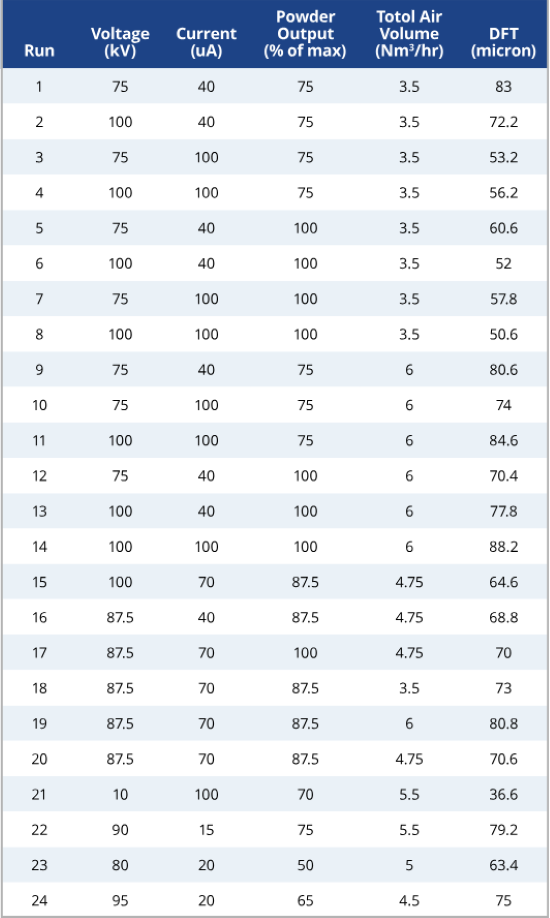
The optimizing DOE that was run was a response surface design (RSD), which is one of the traditional design approaches used to optimize processes where the variables interact with each other. Where the Taguchi design run in the first phase was able to identify which inputs were important and adjust the levels, the RSD with the refined levels enables identification of the optimum levels to achieve the desired response. Again, it is beyond the scope of this article to fully explain the mechanics and calculations behind this process, but consulting resources and software are available. The data collected are shown in Table 3.
TABLE 3 | Response surface design DOE, run 2.
 Source: ChemQuest
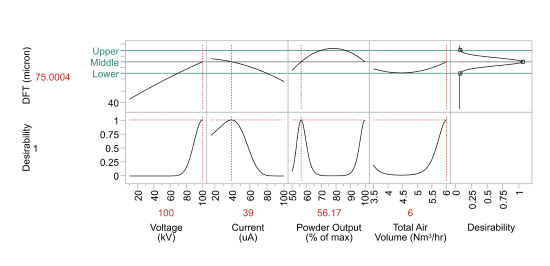
The results of the second DOE are shown in Figure 3. Readers will notice that the responses from the RSD are curved (as opposed to linear). This is often the case with isolated inputs, and responses become even more complex when inputs interact with one another; RSDs detect and account for these interactions and curvature.
FIGURE 3 | DOE analysis, run 2.
 Source: ChemQuest
The graphs also show a vertical red dashed line indicating “desirability,” which correlates with the mean DFT value of 75 μm. These are the optimized levels given by the RSD and show that the target of 75 μm DFT is best achieved with 100 kV gun voltage, 39 μA current, powder output at 56% of maximum, and total air volume of 6 (unit as defined in earlier ranges).
For confirmation, these parameters were used to paint three metal plates. After curing, each plate was measured at nine locations. The average DFT was 74.8 μm, validating the responses from the RSD.
Efficient Optimization
Rather than the daunting task of over 6,000 runs, DOE was used to efficiently optimize the powder booth in this example in just 57 runs. This case provides an excellent illustration of how design of experiments can be used to improve throughput and significantly reduce reject rates in powder coating production lines. Similar approaches can be used to simplify experiments related to polymer design, coating formulation and many other situations where input variables interact to create an unwieldy number of variations.
To learn more, reach out to the author at gwebster@chemquest.com or visit https://chemquest.com.
References
1 Karaoglan, A. D.; Ozden, E. Electrostatic Powder Coating Process Optimisation by Implementing Design of Experiments. Trans. IMF 2021, 99 (1), 46–52.
2 Wikipedia Contributors. Genichi Taguchi. https://en.wikipedia.org/wiki/Genichi_Taguchi (accessed Nov 3, 2025).
Looking for a reprint of this article?
From high-res PDFs to custom plaques, order your copy today!