Achieving Durability Through Powder Coating
Key Principles and Practices
Image credit: cgtoolbox / Creatas Video via Getty Images.
Inside this Article:
- Durability in powder coatings depends on balancing corrosion resistance, flexibility, abrasion resistance and weathering performance.
- Different powder chemistries and coating systems are selected based on environmental exposure and end-use requirements.
- Two-layer and direct-to-metal systems provide varying levels of protection depending on application severity.
- Industry standards such as AAMA classifications help define performance expectations for outdoor durability.
Durability can take on a variety of meanings in different applications. For some, it may mean exceptional corrosion and chemical resistance in the environment where the coating will be used. For other applications, durability may mean exceptional flexibility and abrasion resistance. In still others, it also frequently means exceptional weathering resistance. The truth is, for most applications, durability is a combination of these properties.
Corrosion Resistance
Corrosion has a major impact on global economies. In the United States, a combined NACE and NASA study found that the cost of corrosion in the United States was $279 billion/year.¹
Powder coatings provide corrosion resistance in systems that comprise either two layers or one. Very high levels of corrosion resistance can be achieved with a two-layer system using a powder primer and a powder topcoat. Two-layer systems are generally used in highly aggressive environments such as the seacoast or above-ground petroleum piping; the primer provides the corrosion resistance while the topcoat provides weathering resistance.
Alternatively, powder coatings can be a single-layer direct-to-metal coating. Single-layer systems are typically used in less aggressive environments and are more cost effective than their two-layer counterparts but still can provide a significant amount of corrosion resistance.
As previously mentioned, coatings for many applications require chemical resistance and or weathering resistance in addition to corrosion resistance. For a powder coating to impart both corrosion and chemical resistance, it must have exceptional adhesion and good barrier properties. In powder coating formulations, this is achieved mainly by using resins with high aromatic content to minimize moisture and chemical penetration.
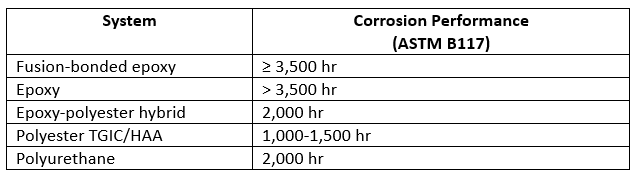
Table 1. Corrosion-resistant powder coatings.
 The ChemQuest Group, Inc
Fusion-Bonded Epoxy
These powder coatings use bisphenol-A-based epoxies as the main resins and are crosslinked with dicyandiamide. They are generally cured above 200 °C on preheated metals.
Fusion-bonded epoxy powders are used extensively in protecting concrete rebar, pipelines, water and sewage systems and chemical processing plants. As these coatings are not weatherable, they require a weatherable topcoat for applications that will be exposed to sunlight for prolonged periods of time.
Epoxy-Polyester Hybrid Coatings
Epoxy-polyester hybrid coatings use a blend of bisphenol-A-based epoxy resins with acid functional polyester resins. These resins react with each other during the curing cycle.
These coatings are generally used where weathering resistance is not required. Electrical enclosures, HVAC equipment, automotive interior parts, office furniture, lighting fixtures and appliances are examples where hybrid powder coatings are used.
Polyester Coatings
Polyester powder coatings generally use carboxy functional polyester resins and are crosslinked with PrimidTM (hydroxy alkyl amid) or TGIC (triglycidyl isocyanurate). These coatings provide good corrosion resistance while offering improved weathering performance compared to fusion-bonded epoxies or hybrid coatings. Lawn furniture, lawn equipment and bicycles are typical examples of applications where polyester coatings are used.
Polyurethane
Higher-end polyurethane powder coatings provide good weathering along with good direct-to-metal corrosion resistance and chemical resistance. For improved weathering, predominately aliphatic polyester or acrylic polyol resins are cured with blocked isocyanate crosslinkers. These powder coatings are used in applications such as window frames, automotive wheels and trim, agricultural and construction equipment and premium outdoor furniture.
Flexibility and Abrasion Resistance
Durability can also mean flexibility along with impact and chemical resistance. In automotive powder primer surfacers, powder coatings are used to improve stone-chip resistance at temperatures as low as −20 °C. These systems are generally polyester-epoxy formulations cured with epoxy crosslinkers. Adhesion and impact resistance are critical in these applications. The epoxy provides adhesion while the polyester component provides impact resistance.
For agricultural, construction and earth-moving equipment, resistance to impacts, abrasion, chemicals, weathering and corrosion are all critical. These applications typically involve a two-coat primer and topcoat system where the primer may be liquid or powder. When powder primers are used, they are commonly polyester-epoxy hybrids or epoxy-based powder coatings. Because the powder topcoat must provide weathering, chemical and chip resistance, it is usually a polyester-based coating cured with TGIC, hydroxy alkyl amide or blocked isocyanate crosslinkers.
Powder coatings for appliance applications must resist corrosion, mar and scratch damage and chemical exposure, particularly from detergents, oils, alcohol, bleach and other household chemicals. In appliance interiors such as washer drums, epoxy powders are typically used for corrosion and abrasion resistance under wet conditions. For appliance shells, polyester and polyester-epoxy hybrids are used to provide improved UV resistance and chemical and abrasion resistance.
Weathering Resistance
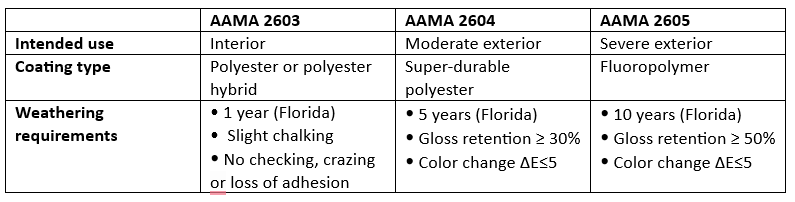
Weathering resistance is a critical performance characteristic for powder coatings exposed to outdoor environments. The required level of weathering performance depends on the application and many outdoor uses require certification.
In North America, the Fenestration & Glazing Industry Alliance establishes the standards commonly referred to as AAMA standards. AAMA 2603, 2604 and 2605 are the primary weathering classifications for coatings.
 The ChemQuest Group, Inc.
 While not all applications require certification, these standards provide a useful framework for categorizing powder coating weathering performance.
Achieving the Ideal Durability Balance
Few powder coating applications require only one category of durability. Many AAMA 2605 coatings are direct-to-metal systems and must also provide corrosion and chemical resistance. AAMA 2604-type coatings often require balanced weathering, corrosion and chemical resistance, particularly in agricultural, construction and earth-moving equipment applications. Achieving the ideal balance of durability properties requires careful formulation design followed by rigorous testing to validate performance for the intended application.
For more information, contact the author at gwebster@chemquest.com or visit https://chemquest.com.
References
- NACE, “Corrosion costs and prevention strategies in the United States,” 2002.
Durability requirements continue to shape formulation strategies and performance expectations across powder coatings and industrial finishing applications.
Looking for a reprint of this article?
From high-res PDFs to custom plaques, order your copy today!