VOCs in Paint and Coatings: Sources, Risks and Benchmarks

- VOCs are emitted from common paint and coatings raw materials used in indoor and outdoor environments.
- Indoor VOC concentrations can significantly exceed outdoor levels with prolonged exposure risks.
- Low-VOC paint formulations reduce human health and environmental impacts when properly specified.
- Measurement of VOC content in g/L provides a benchmark for evaluating paint and coating emissions.
In a general sense, common people consider pollution to be soil, water, noise and air pollution. Many of us are unaware of the nature and extent of pollution in a broader sense. Some pollutants work silently and can have long-term effects with prolonged exposure. One of them is VOC pollution, which acts as a silent killer, and we are frequently affected by it. These compounds have toxic effects not only on the human body but also on the environment. Volatile organic compounds are increasing the risk of global warming day by day.
What Are VOCs
Volatile organic compounds are a class of chemical and organic compounds that have a high vapor pressure at room temperature. High vapor pressure correlates with a low boiling point, which relates to the number of a sample’s molecules present in the surrounding air, a trait known as volatility.
Sources of VOCs
Indoor Sources
Components include benzene, ethylene glycol, formaldehyde and methylene chloride. Common products and areas include latex and oil-based paints, varnishes, cleaning products, personal care items, carpets, furniture and processed wood and board materials.
Outdoor Sources
Components include benzene, formaldehyde and other hydrocarbons. Primary contributors include industrial emissions, vehicle exhaust and combustion processes.
VOCs mainly come from indoor and outdoor sources, most of which are man-made, with significant contributions from industrial and household products. Common examples of VOCs that may be present in daily life include benzene, ethylene glycol, formaldehyde and methylene chloride. These compounds are primarily found in paints, varnishes, cleaning products, personal care items, fuels and building materials such as carpets and furniture. In outdoor environments, industrial emissions, vehicles and combustion processes are the primary sources.
Health and Environmental Impact of VOCs
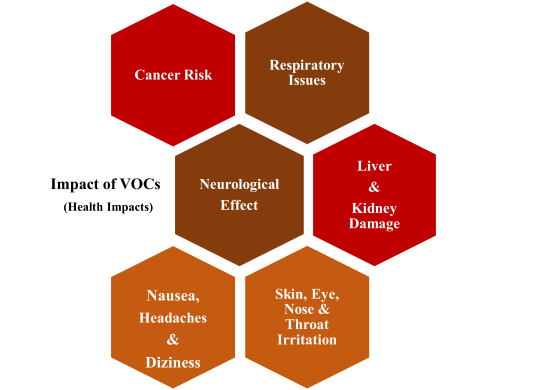
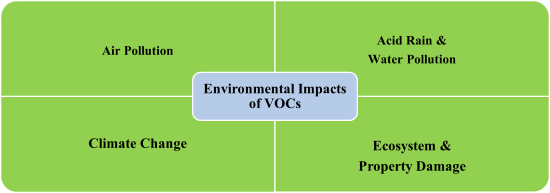
Humans are continuously exposed to VOCs both indoors and outdoors, posing health and environmental risks. Volatile organic compounds enter the air from paint, varnish, personal care products, cleaning materials, tobacco smoke, fuel and thousands of other products and processes. Exposure can increase the risk of airway problems and other health and environmental concerns.
Figure 1. Impact of VOCs.
 Credit: Berger Paints Bangladesh Ltd
Figure 2. Environmental impacts of VOCs.
 Credit: Berger Paints Bangladesh Ltd
 Reducing VOCs in Paint Applications
Paints are used for both beautification and protection in residential environments. When exposed to air, VOCs released from paint films can disperse throughout indoor spaces. All occupants of a home may be affected, particularly children and elderly individuals. According to the Environmental Protection Agency, indoor VOC levels can be up to 10 times higher than outdoor concentrations. For this reason, raw materials responsible for VOC emissions in paint production should be avoided or maintained within acceptable limits. When purchasing paint products, quality should be verified through low-VOC labeling or certification.
VOC Measurement for Paint and Coatings
VOC content in paint and coatings is commonly measured in g/L and categorized as follows:
Table 1. Common measurement labels of VOC content in paint and coatings.
| Severe High |
High |
Medium | Low | Very Low |
| More than 250 g/L |
100–249 g/L |
50–99 g/L |
Less than 50 g/L |
Less than 5 g/L |
Low-VOC Paint Performance
Berger Paint (BD) Limited controls a large share of the paint market in Bangladesh, and its water-based products fall within the low-VOC category. Over the past decades, the company has worked with eco-friendly paint technologies and sustainability initiatives aimed at reducing VOC emissions. Other local and multinational companies will similarly need to transition products toward lower VOC levels over time.
VOC Test Report and Industry Oversight
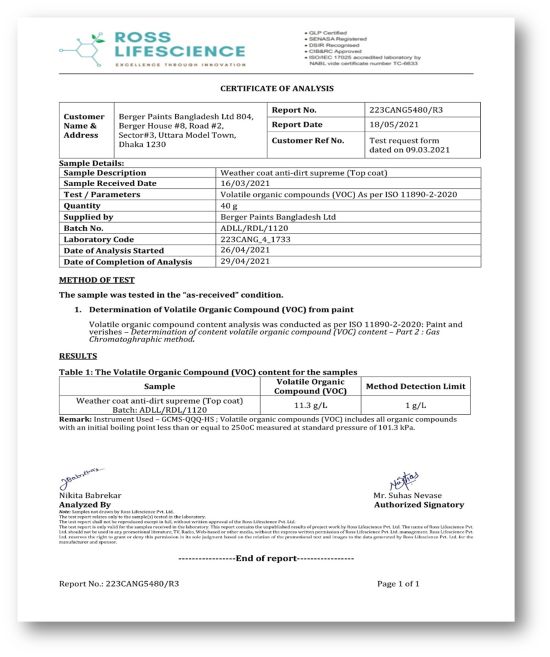
A test report from Ross Life Science, India indicates that the VOC content of Berger Weather Coat Anti-Dirt Supreme measured 11.3 g/L, placing it within the low-VOC paint category defined as less than 50 g/L.
Figure 3. Test report from Ross Life Science.
 Credit: Berger Paints Bangladesh Ltd
Industry organizations such as the Bangladesh Paint Manufacturing Association and the Bangladesh Standards and Testing Institution play a role in establishing VOC standards for paint products and monitoring compliance. In parallel, increased customer awareness regarding VOC emissions remains important. Similar attention is also required for other VOC-emitting materials including cleaning products, personal care items, pesticides, building and furniture materials, adhesives and fuel combustion sources. Collective action remains necessary to reduce pollution and limit long-term environmental and health impacts.
Looking for a reprint of this article?
From high-res PDFs to custom plaques, order your copy today!