
Copper-Anodized Sun Shading and Curtain Wall Systems Shape New Chemistry Lab
Inside this Article
- Copper-anodized aluminum can deliver metallic aesthetics without patina or ongoing maintenance.
- Electrochemically anodized finishes form a durable oxide layer that protects aluminum from corrosion and environmental exposure.
- Fluoropolymer coatings meeting AAMA 2605 support long-term color retention and weather resistance in architectural applications.
- Integrated sun shading and curtain wall systems can balance daylight access, glare control, and energy performance.
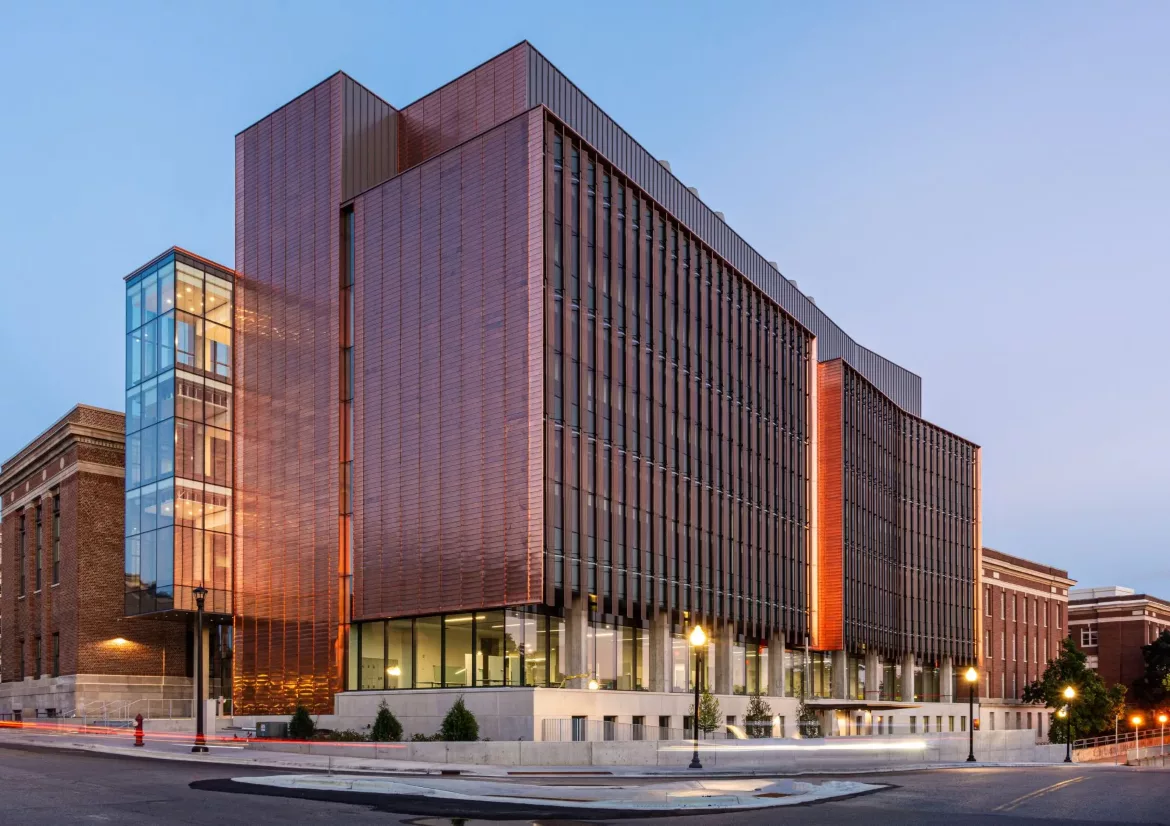
With views of the Mississippi River and the Twin Cities campus, the nearly 100-year-old building underwent a complete redesign by VJAA and BWBR Architects. For its five-story addition, M.G. McGrath fabricated and installed a custom sun-shade system finished in Copper Anodize by Linetec, along with a structural silicone-glazed curtain wall and entrance doors by EFCO. EFCO and Linetec are both part of Apogee Architectural Metals.
The completed 117,435-square-foot facility houses 18 active learning labs, a new tutoring center, informal student collaboration spaces and general-purpose classrooms. It improves accessibility and consolidates general, life and organic chemistry science programs from two other buildings, providing a more centralized learning environment.
As a state-funded project, Fraser Hall aligns with Minnesota’s Buildings, Benchmarks and Beyond (B3) Guidelines and the Sustainable Building (SB) 2030 Energy Standards to improve initial and long-term operations. The building’s combination of high-performance systems, daylight, passive solar shading and high-efficiency mechanical systems is anticipated to achieve an 80% reduction in energy use.
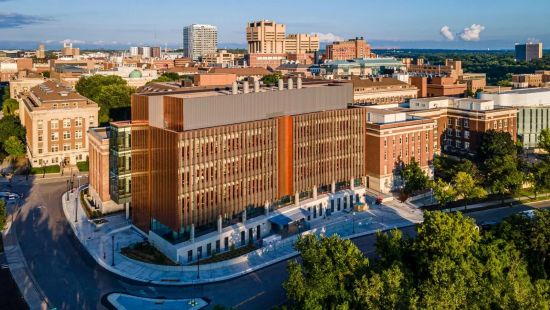
Built in 1928, Fraser Hall’s original architect, Clarence H. Johnston Sr., designed the building as a two-story law library set within the campus plan created by Cass Gilbert. No significant structural upgrades had been made since its expansion in the 1950s, prior to its repurposing for science and engineering studies. In its new form, the building continues to serve as a contributing property to the Northrop Mall Historic District, which is listed on the National Register of Historic Places.
 Joe Brennan | Brennan Photo + Video
The grand reopening was held Oct. 29, 2025, two years after Mortenson Construction began the renovation and construction. To create the updated, unified and expanded Fraser Hall, older additions and a portion of the existing building were demolished. Renovations were made to the remaining 23,500 square feet, and a 94,000-square-foot, five-floor addition with a penthouse was newly constructed. Construction was completed in August 2025, ahead of the 2025–26 academic year.
Copper-Colored Signature Sun Shades
“There’s a shiny, new building in Minneapolis overlooking the banks of the Mississippi River that is more than just beautiful,” announced the University of Minnesota CSE website. “The new Undergraduate Chemistry Teaching Laboratories in Fraser Hall will transform the way chemistry is taught at the University of Minnesota and fuel the state and nation’s high-tech workforce.”
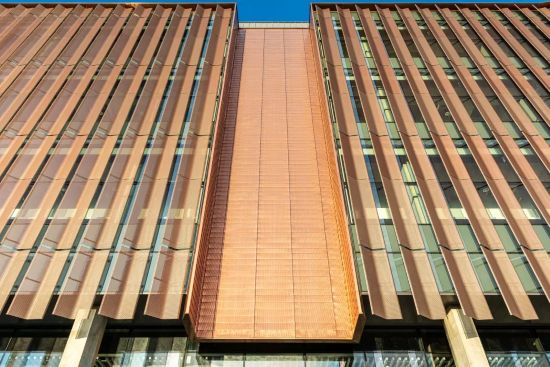
Linetec’s Copper Anodize finish helps give Fraser Hall’s aluminum façade its shine. More than 1,000 square feet of suspended shade fins showcase Linetec’s specialty copper-colored finish. This proprietary formulation will not patina over time, ensuring the building retains its rich metallic, modern yet timeless appearance.
The copper-anodized shading system was custom fabricated and installed by M.G. McGrath. The aluminum shade fins feature a curved profile with perforations. Each fin composes a vertical blade attached directly into the glass and aluminum curtain wall.
 Joe Brennan | Brennan Photo + Video
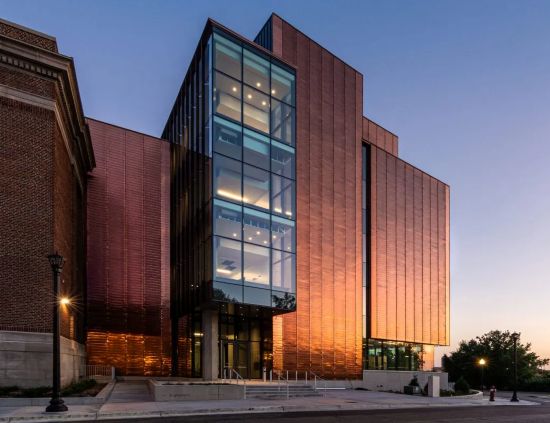
Shaded by the copper screen, the EFCO curtain wall offers prime views of the Mississippi River and surrounding campus, welcoming natural light deep into the interior core without inviting glare on monitors and screens. The high-performance, thermally improved aluminum framing system and low-e glass further contribute to comfortable learning spaces where students can concentrate and collaborate.
Blending Art, Science and Sustainability
“Ideally suited for this building, Linetec’s Copper Anodized finish blends art and science for a lasting luster with minimal maintenance and sustainable benefits,” said Tammy Schroeder, marketing director for Apogee Architectural Metals.
The anodize finish is an integral part of the aluminum substrate, created through the process of electrochemically controlling, accelerating and enhancing oxidation. Linetec’s environmentally responsible process produces a uniform oxide film of exceptional hardness that protects the aluminum from deterioration.
After anodizing is completed, Linetec’s proprietary three-step electrolytic coloring method includes depositing small amounts of real copper in the anodic pores by means of an electric current. The resulting finish remains a bright copper color that does not patina over time and does not require a clear coat or ongoing treatment to maintain color stability.
Further contributing to Fraser Hall’s long lifecycle, its copper-anodized aluminum resists the ravages of time, temperature, corrosion, humidity and warping, meeting the industry-leading AAMA 611 Class I specification. Protecting and maintaining the structural integrity of the aluminum, it retains exceptional hardness and lasting durability. Anodized aluminum is an inert, noncombustible material that is 100% recyclable and poses no health risks.
“The finished aluminum is readily available, easily formed, extremely durable and can be recycled at the end of its long life on the building,” Schroeder added.
Recognizing these sustainable attributes, Linetec’s anodize finishing for aluminum has earned a Declare Label as Living Building Challenge™ Red List Free. This designation indicates that Linetec’s anodize finishing, including Copper Anodize, complies with the highest level of Living Building Challenge criteria established through the International Living Future Institute. The Declare Label indicates there are no applicable VOCs or other harmful chemicals associated with the product and lists a life expectancy of 40 years.
Complementing its distinctive metallic aesthetic, a custom “Fraser Gray” painted finish was specified for additional building envelope components, including the curtain wall.
Curtain Wall, Coatings and Color
On-site installation began in October 2024 and was completed through the winter months. M.G. McGrath installed nearly 25,000 square feet of EFCO curtain wall and 14 door leafs.
EFCO Durastile D518 swing entrance doors integrate into the curtain wall for a complete building envelope system. These aluminum doors include 10-inch bottom rails designed to withstand continuous high-traffic use. The 2½-inch aluminum-framed system is tested to meet thermal, acoustic, structural and air, water and condensation resistance criteria.
Matching the finish on the EFCO curtain wall framing members and entrance doors, Linetec painted the sun-shade attachments and brake-metal components in Fraser Gray and Ultra Cool Gray colors. These high-performance 70% fluoropolymer coatings meet the AAMA 2605 standard. Using environmentally responsible, quality-controlled factory finishing processes, VOCs present in liquid paint coatings are safely managed and destroyed before the finished material arrives at the jobsite.
Adding to the curtain wall’s functionality, a combination of art glass and bird-friendly glass coatings was incorporated. The colorful vertical glass mural by artist Dyani White Hawk, titled Through the Pursuit of Understanding Our Connectivity, We Care for Our World, was hand-painted and digitally printed onto the glass.
Daylight-Fueled Learning Spaces
“In the new building there’s lots of windows compared to the last,” said Julia Emila Toledo, a chemistry and pre-med undergraduate student. “That’ll make it really motivating to learn with all of the sunlight coming in when you’re learning both in lecture and lab, as opposed to just staying in a large lecture hall without any windows.”
“Equipping our students with the skills required to make an impact is important for the future of our state, region and nation,” said Andrew Alleyne, dean of the University of Minnesota CSE. “This project puts us on the leading edge of instruction and will fuel generations of change-makers who support innovation and industry.”
 Joe Brennan | Brennan Photo + Video
“This new building shows how much people care about students and their futures,” said Talia Glinberg, a chemistry undergraduate student. “This building changes the way students learn, makes them feel they belong and shows we’re all in this together.”
“The new building is tangible proof that the University is interested in modernizing education for undergraduate students,” said Tucker Besel, a Ph.D. candidate in chemical physics and chemistry teaching assistant. He emphasized the generous use of glass, which creates flexible spaces that maintain connection and transparency.
“This space is built for how students actually learn today,” Besel said. “The old chemistry labs were crowded, noisy and outdated.” He added, “The new design encourages teamwork and critical thinking. It’s a space that reflects the caliber of science, teaching and innovation at the University of Minnesota.”
About one-third of University of Minnesota undergraduates, approximately 5,000 students from 120 different majors, will take classes in Fraser Hall’s new chemistry labs.
This article was originally published by Apogee Architectural Metals here.
Looking for a reprint of this article?
From high-res PDFs to custom plaques, order your copy today!