PFAS: A Novel Path to Breaking Down “Forever Chemicals”
A new catalyst developed at Goethe University Frankfurt can cleave strong carbon-fluorine bonds and may also support pharmaceutical production.
Chemists at Goethe University Frankfurt have developed a catalyst capable of breaking down per- and polyfluorinated organic substances (PFAS), also known as “forever chemicals,” in a targeted manner. PFAS are widely used to make surfaces resistant to dirt and water, but their extreme persistence in the environment and potential health risks have made them a growing concern. What sets this new catalyst apart is that it does not rely on costly or toxic heavy metals such as platinum, palladium or iridium. Beyond its ability to degrade PFAS, the catalyst could also be used in pharmaceutical synthesis.
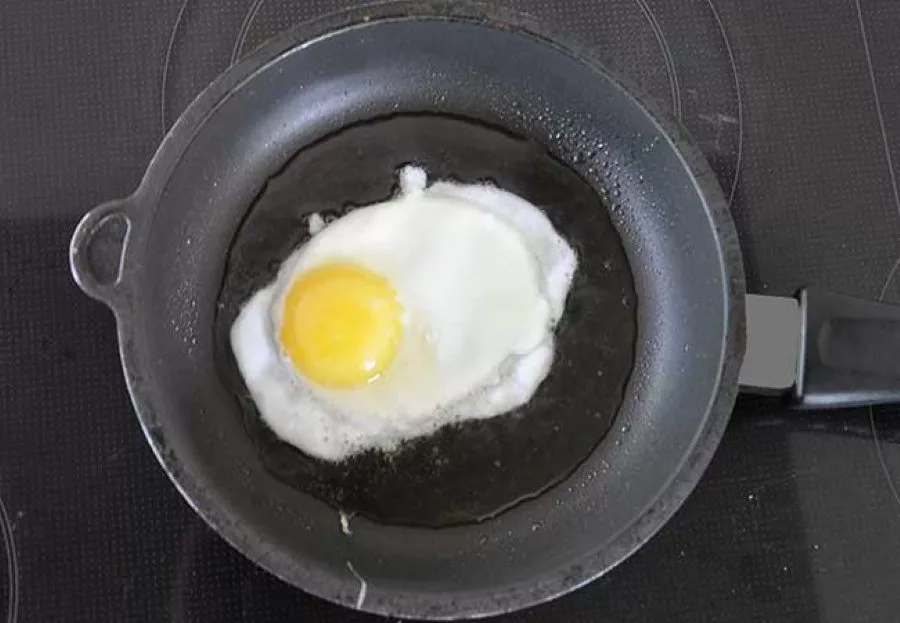
PFAS are, in many ways, remarkable molecules. Even a thin layer can repel water, oil and dirt. They are also highly resistant to heat and UV light, which makes them ideal for coating breathable outdoor clothing, stain-resistant carpets, disposable tableware, irons and nonstick pans. Industrially, PFAS are used as lubricants, surfactants, wetting agents, in chrome plating and in firefighting foams. The list goes on: PFAS are nearly everywhere.
But these benefits come at a cost. Because PFAS are so resilient, they persist in the environment long after their intended use. While they can be nearly completely destroyed in waste incineration plants, they may accumulate in the material cycle during recycling, including in textiles or sewage sludge, and then enter the environment. PFAS can be found in water, soil, plants and even the human body. This is particularly concerning because some of the approximately 4,700 known PFAS compounds are suspected to be carcinogenic or to cause other health issues.
The key to both PFAS effectiveness and their environmental persistence lies in their extremely stable molecular structure, especially the carbon-fluorine (C-F) bonds. Now, a team of chemists led by Professor Matthias Wagner at Goethe University’s Institute of Inorganic and Analytical Chemistry has developed a catalyst that can cleave these C-F bonds within seconds and at room temperature. The heart of the catalyst consists of two boron atoms embedded in a carbon framework in a manner that makes them resistant to air and moisture, a rare and highly practical property for boron compounds.
Christoph Buch, a doctoral researcher in Wagner’s group and first author of the study, explains: “To break C-F bonds, we need electrons, which our catalyst transfers with exceptional efficiency. So far, we’ve been using alkali metals such as lithium as the electron source, but we’re already working on switching to electrical current instead. That would make the process both much simpler and more efficient.”
Figure 1. Two boron atoms, shown in green, are embedded in a carbon framework, shown in black. The electrons required to cleave C-F bonds currently come from lithium, shown in pink. The research team is working toward using electrical current instead.
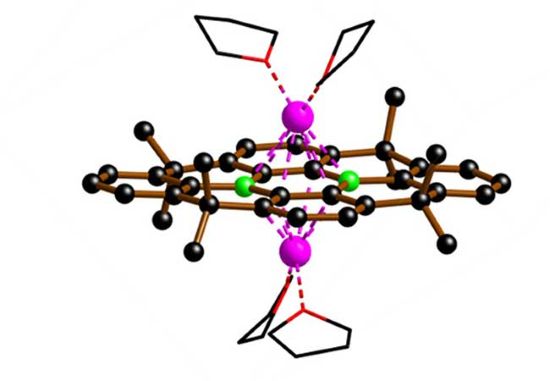 Image courtesy of the Matthias Wagner Group, Goethe University Frankfurt.
Beyond PFAS degradation, Wagner sees broader applications for the catalyst: “Many pharmacologically important substances contain fluorine atoms to increase their physiological stability and enhance their effect. Fluorine atoms can also improve drug uptake. With this catalyst, we now have a tool that allows us to precisely control the degree of fluorination in such compounds.”
References
Buch, Christoph D.; Virovets, Alexander; Peresypkina, Eugenia; Endeward, Burkhard; Lerner, Hans-Wolfram; Fantuzzi, Felipe; Yamaguchi, Shigehiro; Wagner, Matthias. “Planarity Is Not Plain: Closed- vs. Open-Shell Reactivity of a Structurally Constrained, Doubly Reduced Arylborane Toward Fluorobenzenes.” Journal of the American Chemical Society, 2025. https://doi.org/10.1021/jacs.5c05588
Reprinted with permission from Goethe University Frankfurt. Original article can be viewed here.
Looking for a reprint of this article?
From high-res PDFs to custom plaques, order your copy today!