Polyurea vs. Polyurethane Chemistry for Concrete Waterproofing
Performance Trade-Offs for Formulators
The Chemistry Decision
Continuous immersion concrete assets (clearwells, reservoirs, basins) push coatings into conflicting requirements: fast return to service, crack bridging, long-term adhesion, resistance to chlorination and pH excursions and—in potable service—NSF/ANSI/CAN 61 limits. The chemistry choice—polyurea vs. polyurethane—sets nonnegotiable boundaries: polyurea’s amine–isocyanate reaction delivers near-instant gel and high hardness, while polyurethane’s hydroxyl–isocyanate path provides workable pot life and a lower effective modulus. The sections below distill what those differences mean on concrete.
Fundamental Chemistry Comparison
Polyurea Formation (Amine + Isocyanate → Urea)- Reaction: R–NCO + R′–NH₂ → R–NH–CO–NH–R′ (urea).
- Kinetics: Gel 3–10 s at 150–160 °F (65–71 °C); single-pass high build with low exotherm.
- Levers: (1) Isocyanate functionality (~2.7 MDI) → cross-link density; (2) Amine equivalent weight → hardness (Shore D ~45–65); (3) Polyether MW (1,000–4,000) → elongation.
- Reaction: R–NCO + R′–OH → R–NH–CO–O–R′ (urethane).
- Kinetics: Pot life 20–90 min (catalyst and temperature dependent); hand or spray application.
- Levers: (1) Polyol type (polyether vs polyester); (2) OH number (28–56 mg KOH/g) → softness and flexibility; (3) Catalyst (tertiary amines vs bismuth or zinc); (4) Reactive diluents for viscosity control.
Mechanical Property Comparison
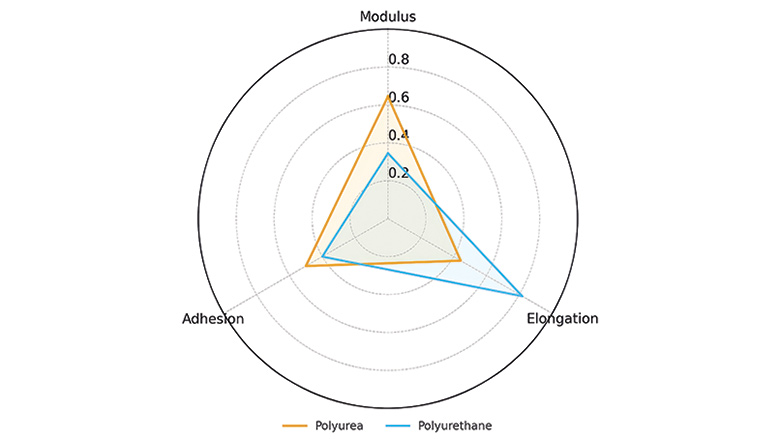
Laboratory testing per ASTM D412 (tension and elongation) and ASTM D624 (tear) shows distinct profiles (see Figure 1; Table 1).
Polyurea Performance Profile
- Hardness: Shore D 50 ± 5
- Tensile: 2,700–3,000 psi (18.6–20.7 MPa)
- Elongation: 225–400%
- Tear: 400–450 pli (70–79 kN/m)
- Abrasion (D4060): 28–33 mg
- Interpretation: High cross-link density → abrasion and impact strength; higher modulus concentrates interfacial peel stress at the concrete interface.
Formulation Insight: Hardness vs. Peel Stress
Raising hard segment content increases chemical and abrasion resistance but raises elastic modulus and interfacial peel stress during thermal cycling and movement. A Shore D ~60 polyurea film can impose ~2x the peel stress of a Shore A ~80 polyurethane at comparable strain.
Mitigations: reduce hard segment content, raise soft segment MW (2,000–4,000) or add 5–15 phr plasticizer (with some chemical resistance trade-off).
Polyurethane Performance Profile
- Hardness: Shore A 70–90 (~Shore D 20–40, approximate)
- Tensile: 1,800–2,500 psi (12.4–17.2 MPa)
- Elongation: 400–600%
- Tear: 200–350 pli (35–61 kN/m)
- Abrasion: 50–80 mg loss (higher than polyurea)
- Interpretation: Lower modulus accommodates movement with reduced peel stress; softer films are more vulnerable to puncture and abrasion in traffic.
Application Characteristics and Field Constraints
Polyurea (Spray Only, Fast Gel)
- Equipment: Heated plural-component (e.g., Reactor), ≥2,000 psi, hoses 150–160 °F (65–71 °C), purge gun. Capex $25,000–$45,000.
- Process sensitivities: Component viscosities at temperature (A: 100–160 cP; B: 40–50 cP); component ΔT ≤ 10 °F. Moisture less critical than PU; overspray waste 15–25%.
- Schedule: Return to service ~4–6 h (light).
Polyurethane (Hand or Spray, Workable Pot Life)
- Equipment: Spray at 120–140 °F or roller (3,000–8,000 cP) or trowel (20,000–40,000 cP). Capex $8,000–$45,000.
- Process sensitivities: Moisture critical—RH >85% or slab >4% (ASTM F2170) risks CO₂ foaming. Pot life 30–90 min typical.
- Schedule: Light service 24–48 h; full cure and disinfection 3–7 days.
Quick Levers to Reduce CO₂ Foaming at High RH
- Moisture scavenger: p-toluenesulfonyl isocyanate 0.5–2 wt% in A side.
- Catalyst strategy: reduce amine 30–50%; bias to bismuth or zinc.
- Hydrophobic fillers: treated CaCO₃ or fumed silica 1–3%. Expect 15–40% slower cure; verify in field mockups.
Chemical Resistance Performance (ASTM D543 Guidance)
- pH exposure: Polyurea excels from pH 2–13 (chalks at long acidic exposure); polyurethane (polyether) is excellent in neutral pH 6.5–8.5 and good in alkaline, with risks above pH 12. Polyester polyurethanes are less hydrolytically stable.
- Chlorine and oxidizers: Municipal residuals 0.2–4.0 ppm are generally tolerated by both chemistries. Short-duration shock events can reach 4–10 ppm—aromatic polyurea may surface oxidize (shallow), while polyether polyurethane holds well; aliphatic systems avoid UV yellowing at higher cost.
Adhesion to Concrete (ASTM D7234 Pull-Off)
- Polyurea (CSP 3–4): initial 500–900 psi (3.4–6.2 MPa); after 5 yr immersion 400–700 psi (2.8–4.8 MPa); after thermal cycling 350–600 psi (2.4–4.1 MPa).
- Polyurethane: initial 400–800 psi (2.8–5.5 MPa); 5 yr 350–650 psi (2.4–4.5 MPa); thermal cycling 300–550 psi (2.1–3.8 MPa).
- Formulation and installation factors: low-viscosity epoxy primers (200–800 cP) for pore wetting; maintain primer tack and recoat window 12–24 h for polyurea; moisture-tolerant PU can sometimes bond direct at RH <75%.< li>
- Decision tip: If moisture control is difficult (tight schedules, RH >80%), PU with MVB primer is lower risk. Polyurea demands tighter moisture control but yields higher ultimate adhesion.
NSF/ANSI/CAN 61 for Potable Water (Overview)
- Polyurea: MDI-based prepolymer, amine-terminated polyether, no tin catalysts, minimal free NCO (<0.5%); extraction at maximum SA V. Fast cure without restricted catalysts requires careful amine reactivity and NCO functionality tuning.< li>
- Polyurethane: Aliphatic prepolymer (HDI/IPDI) for UV; polyether polyol; bismuth or zinc catalysts; controlled free NCO. Longer pot life aids degassing, mixing and surface quality.
Final requirements depend on product category and test plan; examples above are typical, not universal.
Field Performance (Condensed Case Studies)
Case 1 — Wastewater Activated Sludge Basin (11 Years)
- System: Aromatic polyurea 60 mil over epoxy primer (8–10 mil); geotextile at joints; plural-component spray.
- Service: pH 5.8–8.2; seasonal 40–75 °F; H₂S 5–50 ppm; continuous immersion.
- Results (10 yr inspection): Adhesion 520 psi (3.6 MPa) avg/12 pulls; cohesive concrete failure; no delamination or holidays (ASTM D4787); minor chalking above waterline; Shore D rose 50 → 55; elongation held ~380%.
- Takeaway: High cross-link density handled variable pH; joint reinforcement prevented stress concentration.
Case 2 — Potable Water Clearwell (7 Years)
- System: Aliphatic polyurethane 40 mil (NSF 61) over MVB epoxy (10–12 mil); spray walls and roller details.
- Service: 0.5–2.5 ppm free chlorine; pH 7.2–8.0; underground 45–68 °F; 2.3 in differential settlement over 5 years.
- Results (5 yr inspection): Full continuity across movement joints; adhesion 480 psi (3.3 MPa) avg/8 pulls (100% cohesive); no UV yellowing; 72 h hydrostatic test at design head (12 ft): no leakage.
- Takeaway: Lower modulus and high elongation accommodated settlement without adhesion loss; aliphatic premium justified for UV and appearance.
Cost–Performance Analysis for Formulators
| Parameter | Aromatic Polyurea | Aromatic Polyurethane | Aliphatic Polyurea | Aliphatic Polyurethane |
|---|---|---|---|---|
| Raw material cost | $4.00-$5.50/lb | $3.00-$4.50/lb | $5.25-$7.00/lb | $4.00-$6.00/lb |
| Typical DFT | 60-80 mils | 40-60 mils | 60-80 mils | 40-60 mils |
| Material cost at 60 mils | $4.80-$6.60/ft² | $3.60-$5.40/ft² | $6.30-$8.40/ft² | $4.80-$7.20/ft² |
| Abrasion loss (ASTM D4060) | 28-33 mg | 50-80 mg | 28-35 mg | 45-75 mg |
| Shore hardness | D 50±5 | A 80±10 (D 30±5 equiv) | D 45±5 | A 75±10 (D 25±5 equiv) |
| Typical elongation | 225-400% | 400-600% | 200-350% | 400-600% |
| Equipment investment | $25K-$45K (spray) | $8K-$45K (hand to spray) | $25K-$45K (spray) | $8K-$45K (hand to spray) |
Note: Coverage assumes 100% solids, density 8.8–9.5 lb/gal and 1 gal = 1,600 ft²·mil. “Material cost @ 60 mils” is raw materials only (no waste, consumables or labor). Installed costs are typically ~15–25% higher for polyurea (overspray) and ~5–10% for polyurethane.
Application Labor Impact (Quick View)
- Polyurea: 1,500–2,500 ft²/day; higher equipment care; 15–25% waste; RTS 4–6 h.
- Polyurethane: 800–1,500 ft²/day (hand) or 2,000–3,000 ft²/day (spray); 5–10% waste; RTS 24–48 h; full 3–7 days.
Selection Criteria (At a Glance)
- Favor polyurea when: fast RTS, high abrasion and impact, extreme pH, spray-viable scope, single-coat high build 60–125 mil needed.
- Favor polyurethane when: hand work or complex details, significant movement (soft soils, seismic or thermal), longer working time, lower raw material cost, superior aliphatic color retention.
- Hybrid approaches: urea-rich hybrids (~70–80% urea/20–30% urethane) blend fast set with improved elongation and cost balance.
Future Formulation Signals (Brief)
- Sustainability: Bio-based polyols (10–50%), zero VOC at 100% solids; viscosity management is the challenge.
- Regulation: Diisocyanate training and exposure rules (EU); scrutiny of certain aromatic diamines; evolving NSF 61 extractables.
- PFAS removal: Reformulating wetting and leveling packages without fluorinated additives.
Conclusions
Polyurea and polyurethane each solve different concrete immersion problems. Polyurea’s fast gel and higher hardness favor rapid turnarounds, high-build single passes and aggressive pH; polyurethane’s workable pot life and lower modulus favor complex detailing, movement and potable water aesthetics. With appropriate primers, moisture control and QC, both chemistries routinely exceed 20-year service life in immersion.
For formulators, anchor decisions to: (1) cure kinetics vs schedule, (2) modulus and elongation vs movement, (3) chemical profile vs pH and chlorination, (4) moisture conditions vs primer strategy, (5) installed cost vs equipment and waste. Use Figure 1 and Table 1 as quick proxies when aligning chemistry to service conditions.
References and Standards Cited
- ASTM D412 — Tension properties of elastomers
- ASTM D624 — Tear strength of elastomers
- ASTM D2240 — Durometer hardness (Shore)
- ASTM D4060 — Abrasion (Taber)
- ASTM D4541/D7234 — Pull-off adhesion (including concrete)
- ASTM D4787 — Continuity verification of linings on concrete
- ASTM F2170 — In situ RH of concrete floor slabs
- ASTM D543 — Chemical reagent resistance of plastics
- NSF/ANSI/CAN 61 — Drinking water system components
- ICRI 310.2R — Concrete surface preparation (CSP)
Looking for a reprint of this article?
From high-res PDFs to custom plaques, order your copy today!