
Materials of Concern
PFAS Update 2026
Emerging Clarity Despite Mixed Signals from Multiple Sources

Need to Know
- PFAS regulation remains fragmented, but U.S. states, federal agencies and the EU are moving toward broader restrictions and reporting requirements.
- Coatings, adhesives and sealants producers face increasing use-based visibility, supply-chain documentation and product-category compliance requirements.
- The EU proposal centers on a broad PFAS restriction with time-limited derogations and possible controlled-use pathways for selected sectors.
- The year 2026 is a key compliance period as multiple reporting deadlines, consultations and product restrictions overlap.
The latest, albeit certainly not the most apposite, information in the ongoing PFAS saga is that Chemours has reached a settlement with the U.S. Environmental Protection Agency (EPA) to resolve the claims that the company discharged PFAS compounds across three currently operating sites. Under this agreement, Chemours is expected to pay EPA and the West Virginia Department of Environmental Protection (WVDEP) a $22.5 million civil penalty over a three-year period (2026 to 2028) and also fund $90 million in additional mitigation projects over the coming 15 years to further reduce PFAS emissions and enhance certain existing off-site drinking water programs. Simple . . . clean . . . not all that much cost . . . .
What, if anything, does this mean for the producers of products that contain PFAS components: paint and coatings, sealants, adhesives, household, industrial and institutional (HI&I) cleaners, lubricants, personal care items and a multitude of others that use one or more of the thousands of PFAS compounds in their formulations?
The answer to that question can be chosen from a range of options, depending upon who the questioner is, why they are asking the question, in which country or global region they are producing PFAS-containing products and the identity of the specific PFAS compounds being used in those products. Following a five- to six-year period during which the topic of “PFAS” has been surrounded by a combination of legal and regulatory actions, proposed legal and regulatory actions, rumors of actions, speculation about actions, ignorance of actions, discussions of actions and attempts to avoid actions, we are finally beginning to see the dust settle, at least to a more substantial degree than has hitherto been the case.
At the very least, we are now seeing some trends dealing with issues such as which chemicals to classify as PFAS; which PFAS to ban outright; which PFAS to restrict; in which product categories all or certain PFAS should be restricted; to what levels any restrictions should be set; and in which product and/or end-use categories restrictions are not currently possible and for which exemptions (more common in the U.S.) or derogations (seemingly favored in the EU) must be made, often for a finite period of time with the understanding that it may need to be extended at some point in the future.
Moreover, as we take a look at the global regions in which significant PFAS regulatory activity (ranging from discussions through proposals and legal fiat) is taking place, we can make five general statements that do much to characterize the overall state of this issue:1
- The “definition problem” isn’t resolved; it’s expanding. Different countries, global regions, organizations, jurisdictions, individual states, et al. use different structural criteria, lists and definitions and continue to add to the lack of agreement as scientific and regulatory understanding continues to develop.
- Regulatory fragmentation is getting harder to manage. From individual states in the U.S. to individual countries in APAC, the world is playing a variation on Abbott and Costello’s immortal “Who’s on First” routine.
- Compliance scope is extending beyond the product. For much of PFAS regulatory history, the central question has been: Can this product be placed into commerce? This is no longer the only question.
- Use-based visibility is becoming a compliance requirement. ECHA’s use-mapping guidance, developed as part of the proposed EU PFAS restriction, asks companies to understand PFAS across use categories, applications and exposure pathways. TSCA reporting requirements in the U.S. require detailed information on uses, volumes and activity categories. Use-based visibility is becoming a compliance requirement, not just good practice.
- Multiple PFAS regulatory milestones are arriving in the same window in 2026, affecting the same companies from different directions at the same time. The left hand and the right hand are likely to be headed on a collision course within certain companies and industry sectors.
All this being said, this is an appropriate point of departure for a high-level discussion of “what’s being either discussed or actually done, and where.”
A High-Level View of PFAS Within North America and the EU/EEA
Because a broad range of different actions with regard to the entire PFAS topic are planned for implementation during 2026 on a global basis, but especially in the U.S. and the EU, now is a good time to take a look at “what’s on the books,” so to speak, and what it will mean to producers of specialty chemicals, with emphasis on formulated products such as paint and coatings, sealants and adhesives.
United States
More states that appeared to be taking a “wait-and-see” posture are starting to join with states that have been actively involved over the past three to six years in legislative and regulatory activity with the intention of either banning or limiting the use of selected PFAS in a range of products. While these products have varied somewhat from state to state up until now, we are starting to see a degree of agreement about which PFAS, and in which applications, should be banned, restricted or exempted. By no means does the U.S. have any sort of uniform agreement on the topic of PFAS, but it does appear to be drawing closer to such an ideal in 2026 than has been the case up to this year. Exactly how things will shake out is anybody’s guess, but it seems likely that the U.S. is headed, by 2030, toward bans of all PFAS compounds in:
- Children’s products
- Food-contact articles and materials
- Cleaning products
- Textiles
- Cosmetics
- Cookware
- Floor waxes
It also appears likely that many products (perhaps even “most” or possibly “all”) used in building and construction may be required to be PFAS-free:
- Adhesives
- Sealants
- Architectural paints
- Anti-graffiti coatings
- Fire-resistant coatings
Such actions will not, of course, come about without a significant amount of hand-wringing, name-calling, recriminations, tales of woe, accusations of governmental and regulatory overreach and the like. The truth is, however, that it is difficult to swim against the tide, and an increasing number of hitherto less active states are now joining states like California, New York and Minnesota that have been actively addressing PFAS issues for the past many years. In 2026, 33 states are now either considering or enacting PFAS policies. This will almost undoubtedly lead to a de facto “U.S. PFAS Policy,” insofar as attempting to abide by a mishmash of different laws and regulations across 50 states plus the federal government would be an impossible situation, one fitting anyone’s definition of the phrase “nightmare scenario.” Optimistically, this could be substantially the case by 2030; realistically, however, it is likely to be 2035 before the U.S. has some version of a uniform legal and regulatory framework for addressing PFAS.
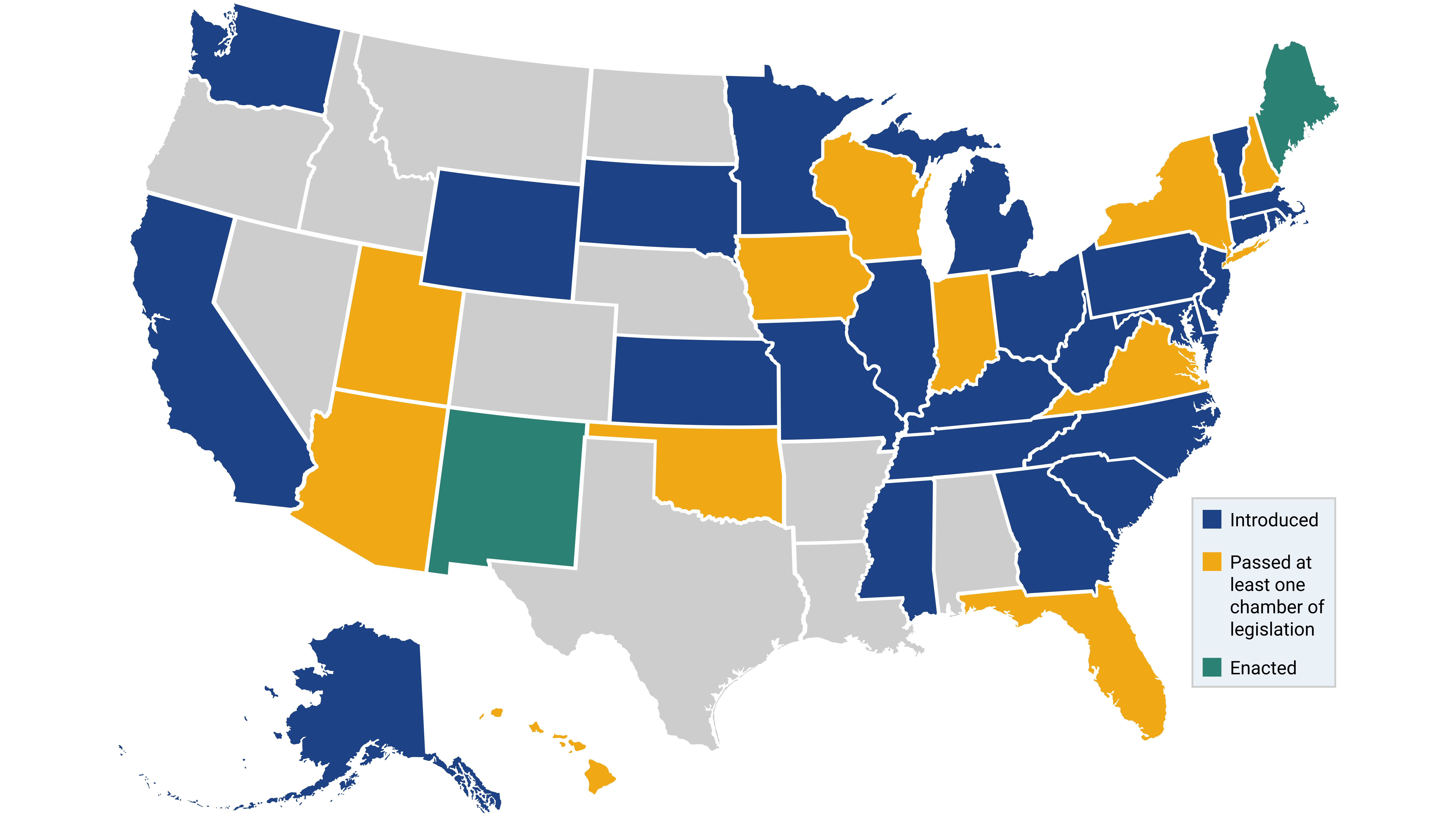
Taking a look at current U.S. federal activities, we should acknowledge right out of the gate that the majority of the changes appear to be driven by a shift in federal enforcement focus in addition to a steady increase in state-level bans. Looking at U.S. federal regulations, which are issued under the authority of EPA, we see:
-
The Safe Drinking Water Act (SDWA): EPA has affirmed the limits of 4 parts per trillion (ppt) for PFOA (perfluorooctanoic acid) and PFOS (perfluorooctane sulfonate) in drinking water. The compliance deadline, however, has been extended from 2029 to 2031. Standards for four other PFAS are currently expected to be rescinded and “reconsidered,” including:
- PFHxS (perfluorohexane sulfonic acid)
- PFNA (perfluorononanoic acid)
- HFPO-DA (hexafluoropropylene oxide dimer acid)
- PFBS (perfluorobutane sulfonate)
- Comprehensive Environmental Response, Compensation and Liability Act (CERCLA): PFOA and PFOS will remain designated as hazardous substances under CERCLA (aka the Superfund law). Current enforcement efforts are aimed at “significant” polluters, while EPA encourages Congress to provide liability protection for the “passive receivers” such as water utilities and landfills.
- Toxic Substances Control Act (TSCA): Since 2011, the one-time reporting rule has required companies to report PFAS use. Most manufacturers must report by Oct. 26, 2026, though small-business article importers have until April 13, 2027.
- Toxics Release Inventory (TRI): Nine additional PFAS were added to the TRI for reporting year 2025, raising the total of reportable chemicals to 205. Reporting forms for these were due July 1, 2026.
Canada
Sept. 26, 2025, saw the publication of a “Consultation Document on Phase 1 of the Risk Management of Per- and Polyfluoroalkyl Substances (PFAS), Excluding Fluoropolymers: Prohibition of the Use of PFAS, Not Currently Regulated, in Firefighting Foams.”2 The main purpose of this consultation document, prompted by the March 2025 issuance of the “State of Per- and Polyfluoroalkyl Substances (PFAS) Report and the Risk Management Approach for Per- and Polyfluoroalkyl Substances (PFAS), Excluding Fluoropolymers” report, is to inform interested parties and solicit comments on the proposed regulatory approach to prohibit the manufacture, import, use and sale of PFAS in firefighting foams for those PFAS that are not already regulated. It also aims to invite comments about concentration thresholds for the incidental presence of PFAS in Class B firefighting foams being sold and those contaminated by PFAS that originate from and are present in firefighting systems that have undergone decontamination. Comments will be considered in the development of proposed regulations.
Based on the conclusions of the State of PFAS Report, the government published a Risk Management Approach for PFAS excluding fluoropolymers. This proposed a three-phase prohibition approach under CEPA. This consultation document focuses on Phase 1. Consultations on subsequent phases will follow, with consultations on Phase 2 anticipated in 2027.
Mexico
Mexico does not yet have a national PFAS restriction effort comparable to Canada, the U.S. or the EU, but it does participate in regional chemical-safety harmonization with the U.S. and Canada through trade and environmental cooperation mechanisms. This will in all probability lead to lagged adoption of PFAS controls similar to CEPA and EPA frameworks.
Europe (EU + EEA)
Despite the fact that the Europeans were “first out of the gate” in 2019 to 2020 to begin addressing the overall PFAS issue, there have been a number of stops, starts, pauses and suggestions of changing directionality in the years through 2023. The year 2023 marked a qualitative shift, however: the submission to the European Chemicals Agency (ECHA) of a universal restriction proposal covering all PFAS simultaneously, the broadest regulatory action of its kind attempted anywhere in the world. Three years on, the proposal is still moving through ECHA’s scientific evaluation process. The timeline has extended, the number of proposed exemptions has grown substantially and industry engagement has been intense. What has not materially changed is the body of evidence on which the restriction case rests.3 The original 14 sectors targeted for regulation in 2023 were expanded to the following 15 sectors by 2025 and are the subject of current regulatory inquiry and activity:4
- PFAS manufacturing
- Textiles, upholstery, leather, apparel and carpet (TULAC)
- Food-contact materials and packaging
- Metal plating and manufacture of metal products
- Consumer mixtures
- Cosmetics
- Ski wax
- Applications of fluorinated gases
- Medical devices
- Transport
- Electronics and semiconductors
- Energy sector
- Construction products
- Lubricants
- Petroleum and mining
Currently, the EU PFAS restriction proposal is moving in the direction of a three-pronged approach:
- Restriction Option 1 (RO1), also known as the “full blanket ban” under the proposed EU REACH framework, would prohibit the manufacture, placing on the market and use of over 10,000 PFAS substances. It includes an 18-month transition period and virtually no long-term derogations. It currently seems unlikely that this will be the preferred approach.
-
Restriction Option 2 (RO2): Time-Limited Derogations. The standard transition period is 18 months, but sectors without a viable alternative are granted 5-year or 12-year derogations.
- 5-year (until approximately 2032): Includes specific industrial bakeware, certain medical device components and flexible plastic film extrusion
- 12-year (until approximately 2039): Reserved for “critical” uses such as specialized medical devices (stents, pacemakers), certain petroleum and mining applications and specific green energy initiatives
- Restriction Option 3 (RO3): Conditional Continued Use. This is a new “controlled use” derogation being evaluated for sectors where risks can be managed with a ban. It is specifically targeted at semiconductors, electronics, energy, transport and machinery sealing.
- Firefighting Foam Exemption: Under separate rules effective beginning in October 2026, a general ban applies to most foams, but “critical” applications (military, offshore oil and gas and civilian ships) had limited derogations available through 2025.

Sitting here in 2026, there doesn’t appear to be any doubt that the EU is back in a leadership position with regard to the direction in which they are heading in dealing with the PFAS issue, and that direction can best be summarized in a single phrase that would do Alice in Wonderland’s Queen of Hearts proud: “Off with [its] head.” Yes, Europe is on a path leading to a sweeping, virtually complete ban on the manufacturing and use of PFAS in a huge variety of products and articles:
- The proposed restrictions cover all PFAS with at least one fully fluorinated methylene (-CF2-) or methyl (CF3-) carbon atom (without any hydrogen, chlorine, bromine or lithium atoms attached to it),5 which essentially covers all surfactants, waxes, binders and side-chain fluorinated polymers.
- There will certainly be certain exemptions, but they are unlikely to be permanent. Current thinking is that they will be sector-specific and last from five to 12 years, depending upon the technical feasibility of replacing the specific PFAS compound(s) with acceptable non-PFAS products. This is still under negotiation, however.
- Polymer exemptions will apply only if no low-molecular-weight PFAS fragments (i.e., no fractions <1,000 Da [daltons]) are present.
- The new EU “rules ’n’ regs” are expected to go into effect in 2027 to 2028, with paint and coatings having a compliance window of approximately five years. This is not settled policy yet, however, and could change; counting upon that to be the case would be an extremely risky proposition.
Following its review of more than 5,600 comments in August 2025, ECHA issued an updated document to restrict the use of PFAS under the EU’s REACH regulations.6 This is expected to exercise significant influence on developments going forward in 2026 and resulted in a “second public consultation” conducted under the authority of the Committee for Socio-Economic Analysis (SEAC). This second public consultation began in March, was open for 60 days and closed on May 25. SEAC’s final opinion is anticipated by the end of 2026. “Public Consultation Period #2” focused on the original 15 sectors, although the update in 2025 mentioned eight new sectors:
- Seating applications
- Printing applications
- Technical textiles
- Broader industrial uses (e.g., solvents and catalysts)
- Machinery applications
- “Other medical uses,” such as pharmaceutical packaging and excipients
- Military applications
- Explosives
ECHA aims to transmit both committee opinions to the European Commission by late 2026 or early 2027. The Commission will then prepare a restriction regulation for vote in the REACH Committee of EU member state representatives, a step that, given the “political economy” of the proposal, is expected to involve significant further negotiation.
ECHA will also be evaluating options that would allow PFAS-related activities to continue where “risks can be adequately managed.” These are likely to include:
- PFAS manufacturing
- Electronics and semiconductors
- Energy sector uses
- Sealing applications
- Transport
- Technical textiles
For many EU member countries, the main regulatory activities have thus far involved firefighting foams, with multiple phaseout dates, although many members are implementing more rapidly than some, while others are taking advantage of certain extensions. The most current restrictions on PFAS in firefighting foams are set to take effect after transition periods ranging from one to 10 years for different uses.7
A High-Level View of PFAS Outside of North America and the EU/EEA
-
APAC: PFAS regulatory activity is accelerating in the Asia-Pacific region, with substantial activity occurring between 2024 and 2026. Australia, Japan and China are leading the way with respect to controls on PFAS in products, supply chains and environmental releases. In general, however, the APAC region significantly lags activity in the EU + EEA.
- Australia is the most aggressive APAC nation with regard to PFAS restrictions, the closest parallel to what is taking place in the EU. It has taken the broadest PFAS regulatory moves outside the EU by prohibiting three PFAS regulatory classes and more than 500 related substances.
- Japan began escalating PFAS controls across multiple product categories during 2024 and 2025, centered on both consumer products and industrial applications. Up until now, Japan has tended to regulate via substance-by-substance bans, but it now seems to be moving toward product-specific PFAS restrictions, which are likely to affect fluorinated surfactants, oil- and water-repellent coatings and specialty fluoropolymers used in coatings for electronics.
- China has not yet shown an appetite for EU-type PFAS group bans, much less total PFAS bans. It is, however, increasingly targeting PFAS presence in broader chemical-safety regulatory activity and is expected to include PFAS restrictions on electronics and electrical equipment.
- GCC (Gulf Cooperation Council): The GCC countries (Saudi Arabia, Kuwait, the United Arab Emirates, Qatar, Bahrain and Oman) are expected to come into alignment with the final EU policies, but adoption will be slower, via supply chains. GCC importers are increasingly requiring EU-compliant SDS.
- United Kingdom: The UK is very likely to align with the stance of the EU, although at a slower pace, following the EU rather than paralleling it.
- Türkiye: The new Turkish REACH Regulation (KKDIK) is highly likely to mirror the final EU-adopted policies with regard to PFAS restrictions and regulations. Türkiye is currently lagging the various aspects of the EU regulations/proposed regulations by one to three years.
- Israel: Israel is currently only monitoring PFAS, with no current bans; it is expected to begin incremental tightening on use of PFAS, albeit slowly.
-
Africa: There are currently no PFAS bans in Africa, just discussion; adoption will be slow and driven by global suppliers.
- South Africa has the most advanced chemical regulatory system (NEMICMA), but no PFAS-specific restrictions have yet been promulgated, although PFAS appears in water-quality monitoring programs.
- Egypt, Morocco and Tunisia (collectively “North Africa”) have no PFAS bans in effect at present; the focus in North Africa is on pesticides, BOCs and general industrial chemicals in common use. Ultimately, North Africa is expected to follow EU trends, but with significant delay.
- Sub-Saharan Africa: PFAS regulation is minimal; environmental agencies are beginning to adopt UNEP (United Nations Environmental Programme) guidance but are not enforcing bans yet.

A Brief Word About PFAS and the Adhesive Industry
While much of the emphasis in the U.S., EU and APAC has been on restriction of PFAS in paint and coatings, specialty chemicals and HI&I (household, industrial and institutional cleaners), surprisingly little has been turning up in the literature with regard to adhesives and, by extension, sealants. More to the point, as many adhesives and sealants companies also produce packaging coatings and components, they will be further impacted by PFAS legislation. One is forced to assume, without knowing for sure, that this is because the other market spaces that have been so heavily targeted are so much larger and have a higher potential for consumer exposure. As a result, they have therefore received higher priority from the “powers that be.” Regardless of the reasons, however, 2026 is shaping up to be the year when the adhesive and sealants market spaces will be facing a dual challenge of complying with the strict new reporting mandates and navigating bans on consumer products where adhesives are critical components.8
Internationally, restrictions imposed by EU REACH are causing the adhesive industry to monitor the RO2 framework. The year 2026 will be one in which global adhesives manufacturers, importers, distributors and users will need to be on their toes. . . .
Going Forward . . . What Should We Expect?
PFAS materials are essentially used everywhere, from household cleaners to the most sophisticated aspects in the manufacturing of microchips, with paint and coatings, adhesives, sealants, lubricants, personal care items (lotions, shampoos and hairsprays), self-cleaning surfaces and a vast number of other products, processes, articles and market sectors and subsectors in between. While broad bans on PFAS usage are pending, specific compounds like PFHxA, which is often found in both specialty coatings and adhesives, will face restrictions starting in April 2026,9 and this is just the tip of the iceberg. So . . . what’s next?
The short, and at least for now, the best answer is: “More of the same, but with greater willingness to take an approach more nuanced than ‘it’s either in or it’s out.’” The work done over the recent past by the U.S. federal and state governments, as well as by the EU, has at least exposed the exceptionally complex nature not only of banning PFAS outright but even the difficulty of banning a variety of members of the PFAS family tree. It isn’t just the scientists and technologists who are faced with this harsh reality; so, too, are legislators and regulators. They have done a remarkable job, thus far, of “getting it right” (at least in the U.S. and Canada), and there are hopeful signs the same will be true in the EU. This hasn’t stopped a shudder from going through the global building and construction industry, however, at the thought of the possibility that poly(vinylidene)dichloride (PVDF) polymer, used in premium coatings for metal roofing systems, might be permitted for use in the U.S. but not in the EU. Such concerns are shared by virtually all other manufacturers in all end-use sectors. It would be nice if complex problems admitted of simple solutions, but this is seldom the case. The truth is that complex problems more often than not require complex solutions; complex solutions typically involve applying Edison’s Dictum of “1% inspiration, 99% perspiration” to the problem-solving process.
The only aspect of the PFAS controversy about which we can be absolutely certain is that there is no turning back at this point.
To learn more, reach out to the author at gpilcher@chemquest.com or visit https://chemquest.com.
References
1 Bowers, S.; McLoughlin, C.; Milosev, K. PFAS 2026: 5 Regulatory Shifts Shaping Compliance. Enhesa 2026 PFAS Guide. https://www.enhesa.com/resources/ebook/pfas-2026-guide/.
2 Per- and Polyfluoroalkyl Substances (PFAS). Government of Canada. https://www.canada.ca/en/health-canada/services/chemical-substances/other-chemical-substances-interest/per-polyfluoroalkyl-substances.html.
3 Marchetti, E. Forever Chemicals: Where EU PFAS Regulation Stands in 2026. Healthy Europe, February 6, 2026. https://healthyeurope.eu/pfas-regulation-europe/.
4 Bergeson, L. L.; Hutton, C. RAC and Draft SEAC Opinions Support REACH PFAS Restriction with Targeted Derogations: Comment Draft SEAC Opinion Due May 25. Bergeson & Campbell, P.C. Memorandum, March 2026. https://www.lawbc.com/rac-and-draft-seac-opinions-support-reach-pfas-restriction-with-targeted-derogations-comments-on-draft-seac-opinion-due-may-25/.
5 ECHA Publishes Updated PFAS Restriction Proposal. Exponent, October 2025. https://www.exponent.com/article/echa-publishes-updated-pfas-restriction-proposal.
6 Dilkova, P. ECHA Publishes Updated PFAS REACH Restriction Proposal. Jones Day Insights, September 2025. https://www.jonesday.com/en/insights/2025/09/echa-publishes-updated-pfas-reach-restriction-proposal.
7 EU to Transition Away from PFAS in Firefighting Foams. American Industrial Hygiene Association, November 2025. https://www.aiha.org/news/251106-eu-to-transition-away-from-pfas-in-firefighting-foams.
8 Pilcher, G. R. PFAS Update 2026: Continued Refinement of U.S. and Global Strategies and Greater Focus on Adhesives and Sealants. Adhesives & Sealants Industry, April 2026. https://digitaledition.adhesivesmag.com/april-2026/strategic-solutions/.
9 EPA Announces Release of IRIS Toxicological Reviews for PFHxA and PFDA. Association of State Drinking Water Administrators, April 2023. https://www.asdwa.org/2023/04/13/epa-announces-release-of-iris-toxicological-reviews-for-pfhxa-and-pfda/.
Evolving restrictions on PFAS are creating new considerations for paint, coatings, adhesives and sealants manufacturers. Read more about materials of concern in the coatings industry.
For additional background on how PFAS are defined, grouped and used across coatings and other industries—and why broad restrictions present complex technical and regulatory challenges—read George R. Pilcher’s earlier PCI article, “The PFAS Uproar.” This article builds on that foundation with an updated look at the regulatory direction taking shape in 2026.
Looking for a reprint of this article?
From high-res PDFs to custom plaques, order your copy today!