Leveraging Horizontal Innovation
The Next Breakthrough Coating May Not Come from the Coatings Industry

For more than a century, most major innovations in paints and coatings originated within the industry itself. New resin chemistries emerged from paint and polymer manufacturers, pigment technologies were developed by pigment suppliers, and additives were optimized specifically for coatings applications. The innovation ecosystem was largely self-contained, with breakthrough technologies typically flowing from raw material suppliers to formulators and ultimately to the marketplace.
Today, however, material science innovation is occurring everywhere, and some of the most promising technologies that may shape the future of coatings are emerging from industries with little apparent connection to paint and coatings. For example, battery developers are creating novel ion-transport materials, biomedical researchers are engineering antimicrobial surfaces, semiconductor manufacturers are pioneering atomic-scale deposition techniques, aerospace companies are developing self-healing materials, and packaging innovators are advancing fluorine-free barrier technologies. Many of these technologies were never intended to become coatings, yet history suggests that some of tomorrow's most disruptive coating innovations will originate outside our industry.
This shift reflects a broader trend in which technology development increasingly occurs at the intersection of materials science, biotechnology, nanotechnology, artificial intelligence, electronics, and advanced manufacturing. As a result, breakthrough technologies often emerge in one industry before migrating into others. For coatings companies seeking their next competitive advantage, the challenge is no longer simply developing better coatings. The challenge is identifying where the next generation of coating technologies will come from and adapting those innovations to create value within the coatings industry.
This practice, often referred to as horizontal innovation, recognizes that the future of coatings may be shaped as much by discoveries made outside the industry as by those developed within it. The question is no longer whether adjacent industries matter, but which adjacent industries should be monitored most closely.
Batteries: A New Frontier for Functional Coatings
The rapid growth of energy storage technologies has created one of the most active materials innovation ecosystems in the world. Battery researchers are solving challenges remarkably similar to those faced by coating formulators:
- Corrosion prevention
- Moisture management
- Thermal control
- Ion transport
- Surface adhesion
- Barrier performance
One particularly interesting area involves ion-selective membranes developed for redox flow batteries.1 These membranes are designed to precisely control the movement of ions while resisting chemical degradation in harsh environments. Similar concepts could eventually influence next-generation corrosion-resistant coatings, smart barrier coatings, or controlled-release coating systems.
 Credit: phonlamaiphoto - stock.adobe.com
Battery researchers are solving challenges remarkably similar to those faced by coating formulators, such as corrosion prevention, moisture management, thermal control, and others.
Battery developers are also advancing self-healing polymers capable of restoring conductivity after mechanical damage. While these technologies are intended to extend battery life, they offer intriguing possibilities for self-healing anticorrosion coatings and protective architectural systems. As battery investments continue worldwide, coatings companies should recognize that some of tomorrow's most valuable coating technologies may emerge from energy storage laboratories rather than traditional coatings research centers.
Adhesives: The Hidden Innovation Engine
While coatings and adhesives are often treated as separate industries, they are increasingly converging through a common foundation of advanced materials science. Adhesive developers face many of the same challenges as coating formulators, including adhesion to difficult substrates, environmental durability, rapid curing, sustainability requirements, and performance under extreme conditions. As a result, the adhesives industry has become a powerful source of technologies that may ultimately influence the future of coatings.
One area of particular interest is the development of structural adhesives capable of replacing mechanical fasteners with automotive, aerospace, construction, and electronics applications. These materials deliver exceptional bond strength while reducing weight, improving energy efficiency, and enabling the use of advanced composite materials. The polymer chemistries, adhesion promoters, and cure technologies developed for these demanding applications often have direct relevance to protective coatings and primers.
The adhesives industry is also leading innovation in reactive hot melts, moisture-cure systems, UV- and LED-curable technologies, bio-based polymers, and PFAS-free formulations. In addition, significant advances are being made in smart adhesives that can debond on demand with light, self-heal after damage, or provide sensing capabilities that monitor bond integrity over time.2 These technologies could eventually influence future generations of coatings designed for easier removal, recyclability, predictive maintenance, or enhanced durability.
Perhaps most importantly, adhesive manufacturers are experts in understanding and manipulating the interface between two surfaces. As coatings continue to evolve from decorative finishes to multifunctional surface technologies, many of the most valuable innovations may come from industries that specialize in controlling adhesion at the molecular level. For coatings technology scouts, the adhesives sector represents not merely an adjacent market, but one of the richest sources of future innovation opportunities.
Advanced Packaging: The Race Beyond PFAS
Perhaps no adjacent market offers a more immediate opportunity for coatings innovation than advanced packaging.3 Packaging companies face many of the same challenges confronting coating manufacturers:
- PFAS replacement
- Barrier performance
- Sustainability requirements
- Regulatory pressure
- Circular economy goals
As a result, enormous resources are being devoted to developing fluorine-free technologies capable of delivering water resistance, grease resistance, and stain resistance. Researchers are exploring:
- Chitosan-based barriers
- Cellulose nanomaterials
- Bio-derived polymers
- Hybrid inorganic-organic systems
- Novel surface treatments
Many of these technologies could eventually migrate into architectural, industrial, and protective coatings. The packaging industry is effectively serving as a large-scale development laboratory for next-generation barrier technologies. Coatings companies that closely monitor these developments may identify valuable solutions long before they become mainstream within coatings.
Aerospace: Where Failure Is Not an Option
Aerospace remains one of the world's most demanding environments for materials performance.4 Aircraft, spacecraft, and defense systems routinely encounter extreme temperatures, ultraviolet radiation, corrosive environments, mechanical fatigue and severe weather exposure.
To address these challenges, aerospace researchers are developing highly advanced materials systems, including self-healing composites, multifunctional surfaces, thermal management coatings, and structural health monitoring technologies. One particularly promising area involves embedded sensing technologies. Researchers are creating materials capable of detecting damage, corrosion, stress, and environmental changes in real time.
 Credit: xiaoliangge - stock.adobe.com
Aerospace researchers are developing highly advanced materials systems, including self-healing composites, multifunctional surfaces, thermal management coatings, and structural health monitoring technologies.
Imagine future coatings capable of reporting their own condition before visible failure occurs. Such technologies could transform maintenance practices across infrastructure, transportation, marine, and industrial markets. What appears futuristic today may become commercially viable sooner than many expect.
Semiconductor Manufacturing: Precision at the Atomic Scale
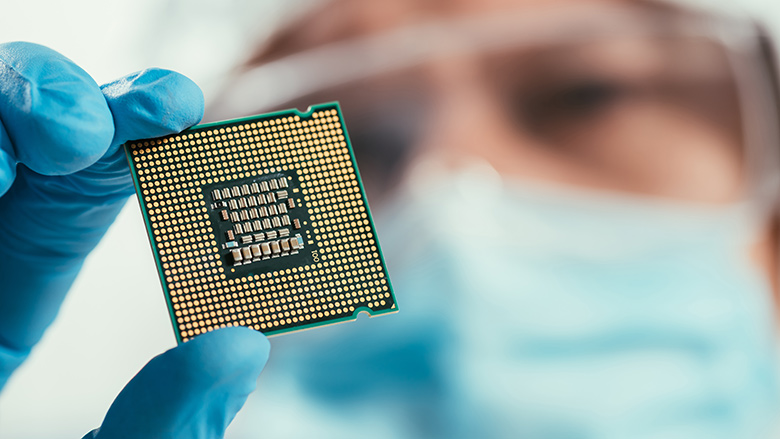
The semiconductor industry may seem far removed from paint manufacturing, yet it is producing some of the most sophisticated surface technologies ever developed. Semiconductor fabrication relies on atomic-level control of material deposition and surface interactions. Techniques such as atomic layer deposition (ALD), molecular layer deposition (MLD), nanostructured surface engineering, and thin-film functional coatings enable unprecedented performance characteristics.5
 Credit: LIGHTFIELD STUDIOS - stock.adobe.com
The semiconductor industry is producing some of the most sophisticated surface technologies ever developed.
Historically, these technologies were too expensive for widespread coatings applications. However, as manufacturing scales improve and costs decline, some concepts may migrate into high-value coatings markets. Potential opportunities include:
- Transparent conductive coatings
- Ultra-thin barrier coatings
- Anti-fingerprint surfaces
- Optical coatings
- Advanced corrosion protection
Many coating companies currently view semiconductor technologies as unrelated to their business. Yet similar assumptions were made about nanotechnology two decades ago. The lesson is clear: industries operating at the frontier of materials science deserve attention.
Biology: The Emerging Manufacturing Platform
Perhaps the most disruptive long-term opportunity lies within biotechnology. Increasingly, researchers are using biological systems to manufacture materials that previously required petrochemical processes. Examples include:
- Engineered proteins
- Fermentation-derived polymers
- Bio-based adhesives
- Chitosan-based coatings
- Lignin-derived materials
- Cellulose nanocrystals
Unlike traditional sustainability initiatives that focus primarily on replacing ingredients, biotechnology has the potential to fundamentally alter how materials are produced.6 Future coatings may incorporate materials grown rather than synthesized. Some experts believe biology could become a primary manufacturing platform for advanced materials during the next several decades. Whether or not that prediction proves correct, coatings companies would be wise to monitor developments in synthetic biology and bio-manufacturing.
Biomedical Surfaces: Rethinking Antimicrobial Technologies
Healthcare has become a major driver of advanced surface engineering. Medical device manufacturers increasingly focus on preventing bacterial adhesion rather than simply killing microorganisms.
This shift has led to the development of sophisticated surface architectures that physically discourage microbial attachment. Some technologies mimic natural structures found in shark skin, insect wings, or plant surfaces. Others employ nanoscale topographies that make colonization difficult. These approaches represent a significant departure from traditional antimicrobial coatings that rely heavily on silver, copper, or organic biocides.
 Credit: gpointstudio - stock.adobe.com
Medical device manufacturers increasingly focus on preventing bacterial adhesion rather than simply killing microorganisms.
For coatings manufacturers, this raises an important question: Can physical surface design become as important as chemistry? Future antimicrobial coatings may rely less on active ingredients and more on engineered surface structures that inherently resist contamination. This concept could eventually influence applications ranging from healthcare facilities and food processing equipment to transportation systems and public infrastructure.
Cosmetic Chemistry: Engineering Surfaces Consumers Can Feel
At first glance, the cosmetics industry may seem far removed from architectural and industrial coatings. Yet cosmetic formulators are among the world's leading experts in surface modification, dispersion technology, sensory engineering, and advanced particle design. Every day, cosmetic scientists work to control how products spread, adhere, resist water, manage gloss, modify texture, and interact with complex biological surfaces. In many respects, these are the same challenges coating formulators address when designing paints, stains, and protective finishes.
Recent innovations in cosmetic chemistry include encapsulation technologies, bio-based polymers, rheology modifiers, structural color pigments, self-assembling surface treatments, and advanced silicone alternatives.7 Particularly intriguing is the industry's work in engineered sensory surfaces, where microscopic particle design influences how a product feels and performs. These technologies are increasingly being developed using sophisticated materials science approaches rather than traditional formulation methods.
The cosmetic industry is also advancing fluorine-free water repellency systems, renewable ingredients, and novel film-forming technologies that could have applications in architectural, wood, and industrial coatings. Structural color technologies inspired by butterfly wings and other natural systems are creating vibrant visual effects without conventional pigments, while encapsulation platforms are enabling controlled release of active ingredients—an approach with potential implications for corrosion inhibitors, antimicrobials, and self-healing coatings.
As consumer brands invest billions of dollars annually in materials innovation, cosmetic chemistry has become an unexpected source of technologies that may ultimately find their way into the coatings industry. For technology scouts, the beauty aisle may prove to be an unlikely but valuable innovation laboratory.
Building an External Innovation Radar
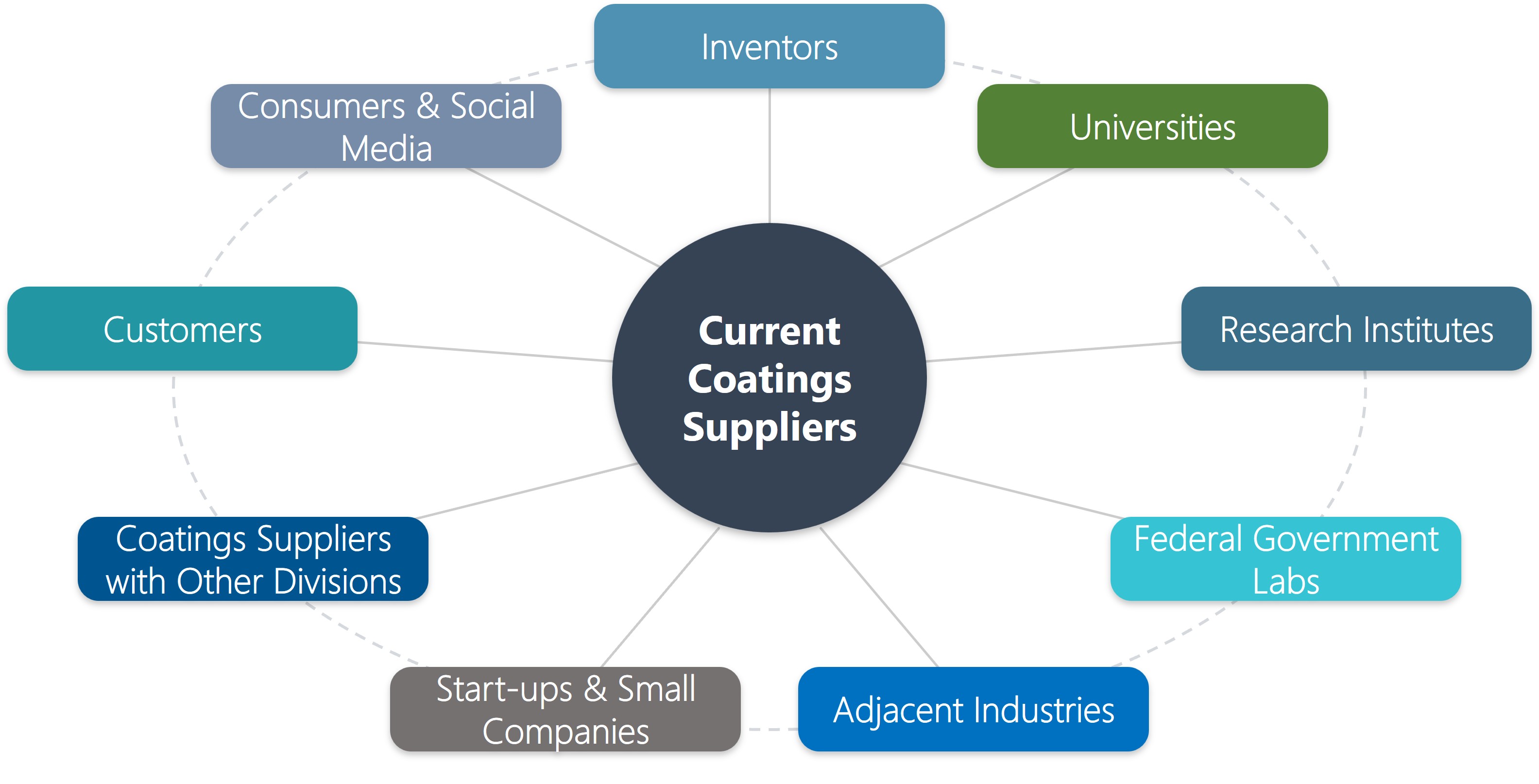
The coatings industry has never had access to more technology information than it does today. Ironically, this abundance creates a new challenge. How do organizations identify which technologies matter? Leading innovators increasingly establish external technology scouting programs focused on universities, startup companies, national laboratories, venture capital groups, and the previously mentioned adjacent industries (see Figure 1).
Figure 1. The technology scouting universe.
 The ChemQuest Group, Inc.
 Rather than waiting for suppliers to introduce new technologies, these organizations actively search for emerging innovations before competitors recognize their potential. The goal is not to predict the future perfectly. The goal is to increase the probability of identifying transformative technologies early enough to create meaningful competitive advantage.
The Future Belongs to Horizontal Innovation
The next breakthrough coating may not emerge from a coatings laboratory. It may originate in a battery startup developing ion-selective membranes. It may come from a medical researcher studying bacterial adhesion. It may arise from a packaging company seeking PFAS alternatives. It may be inspired by aerospace engineers building self-healing materials or semiconductor scientists manipulating matter at the atomic scale.
The organizations that benefit most from these innovations will not necessarily be those that invent them. They will be the organizations capable of recognizing their relevance first. In an increasingly interconnected material science innovation economy, competitive advantage belongs to the connectors, those who can identify ideas, technologies, and capabilities emerging outside their industry and adapt them to solve challenges within it. For coatings companies seeking the next generation of growth opportunities, the future may be found by looking beyond coatings altogether.
To learn more, reach out to the author at vscarborough@chemquest.com or visit https://chemquest.com.
References
1. “Lithium Battery Separator Coatings: 2026 Patent Trends,” PatSnap, April 23, 2026, www.patsnap.com/resources/blog/articles/lithium-battery-separator-coatings-2026-patent-trends.
2. Edward Petrie, “Smart Pressure Sensitive Adhesives – A Current Review,” SpecialChem, April 29, 2022.
3. Motunrayo Ogunmola, “Engineered Nanomaterial Coatings for Food Packaging: Design, Manufacturing, Regulatory, and Sustainability Implications,” Micromachines, February 2024, 15(2), 245.
4. Phiri R, et al., “Advances in lightweight composite structures and manufacturing technologies: A comprehensive review,” Heliyon, 2024, 10.
5. Tzu Yi Lee et. al., “Advances in lightweight composite structures and manufacturing technologies: A comprehensive review,” Nanoscale Advances, Issue 10, 2025.
6. Lijian Xia et al., “Bio-based Coatings: Progress, Challenges and Future Perspectives,” Polymers, 2025, 17(24, 3266.
7. Anna Erat, “Advancements in Cosmetic Science: A review of Ingredients and Technologies for Holistic Health and Longevity,” Cosmetics, 2025, 12(5), 202.
Looking for a reprint of this article?
From high-res PDFs to custom plaques, order your copy today!