Attapulgite Thixotropic Thickeners
Need to Know
- This article evaluates the performance of an attapulgite-based thixotropic thickener in both aqueous and solvent-based systems.
- Testing focuses on dispersion behavior, viscosity development, syneresis control and sag resistance in representative paint formulations.
- Results are compared against a competitive attapulgite product and an existing commercial benchmark to assess relative performance.
- Findings demonstrate improved rheological efficiency and suspension stability with potential for reduced additive loading levels.
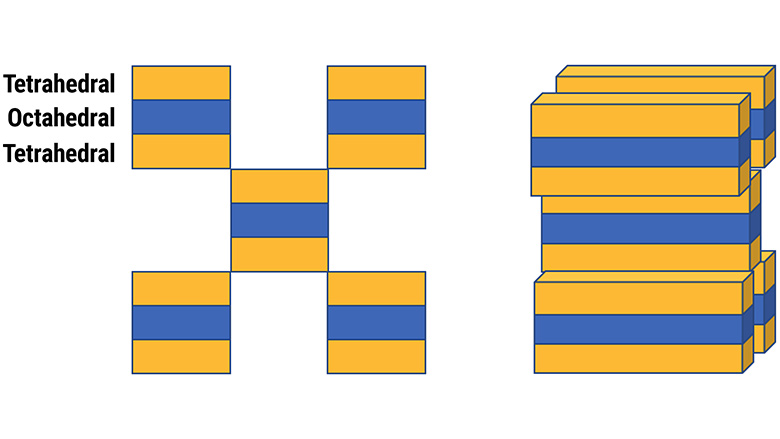
Natural attapulgite, also known as palygorskite, is a hydrous magnesium aluminosilicate clay mineral with a chain crystal lattice that is structurally different from other clays such as montmorillonite or bentonite. The tetrahedral sheets of attapulgite are divided into ribbons by inversion, as adjacent bands of tetrahedra within one tetrahedral sheet point in opposite directions rather than in a single direction. This structure creates ribbons of 2:1 layers joined at their edges, while the octahedral sheets are continuous in only two dimensions (Figure 1). Unlike the layered crystal structures found in montmorillonite or bentonite, where water molecules can easily infiltrate between layers and cause swelling, the ribbon-like crystal structure of attapulgite remains stable in water with no swelling.
This article highlights the performance of a new attapulgite-based thixotropic thickener product, Min-U-Gel® 500+, developed by Active Minerals International for use in paint and coatings applications.
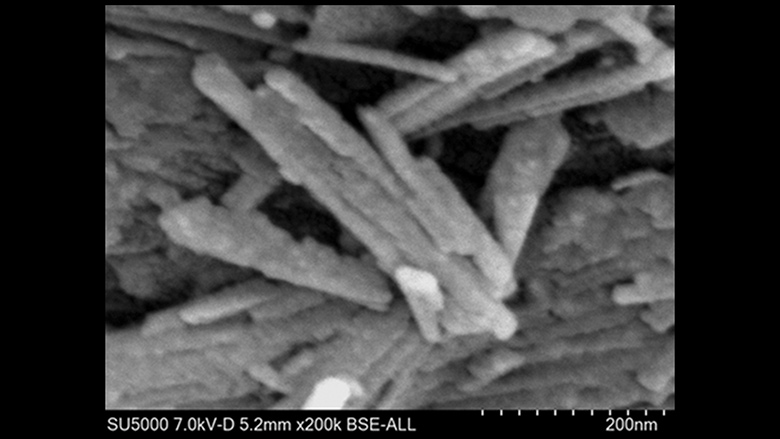
The unique nanorod structure (Figure 2) and weak surface electrical charges enable the formation of a colloidal gelling structure. In paint and coating formulations, gel-grade attapulgite functions as an effective rheology modifier and suspending agent, enhancing flow and leveling while minimizing settling and sagging. Versatile performance in both aqueous and solvent systems is desirable for broad formulation applicability. The new attapulgite thickener was developed from natural attapulgite using a proprietary process designed to improve the efficiency of the three-dimensional chain colloidal gelling structure, thereby enhancing thixotropic thickener performance.
Development Performance Testing
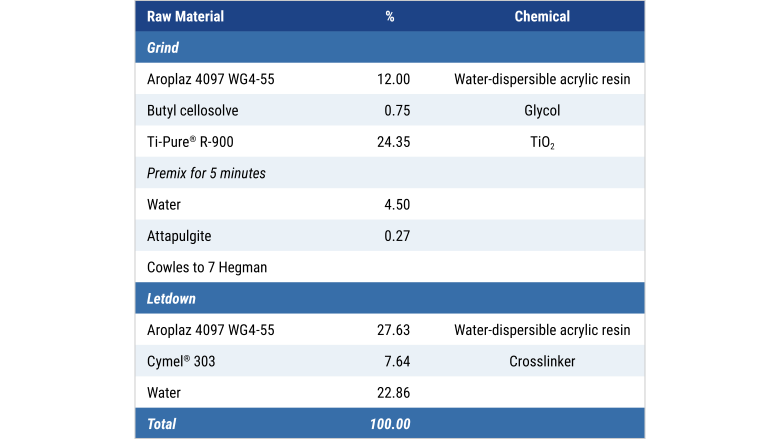
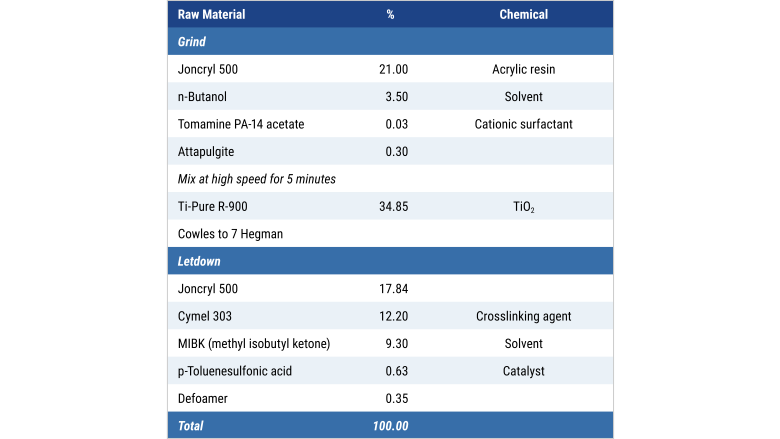
Real-time viscosity during dispersion was measured by placing both a viscometer and mixer in a vessel containing either a 5.4% attapulgite water slurry or a 20% attapulgite solvent slurry. Syneresis over time was measured by recording the percentage of clear liquid volume relative to the total volume of the 5.4% attapulgite water slurry or the 20% attapulgite solvent slurry. Performance in paint was evaluated using a water-reducible alkyd baking enamel paint formulation (Table 1) and a solvent-based high-solids baking enamel paint formulation (Table 2). Sag resistance was measured using the ASTM D4400 test method.
Results and Discussion
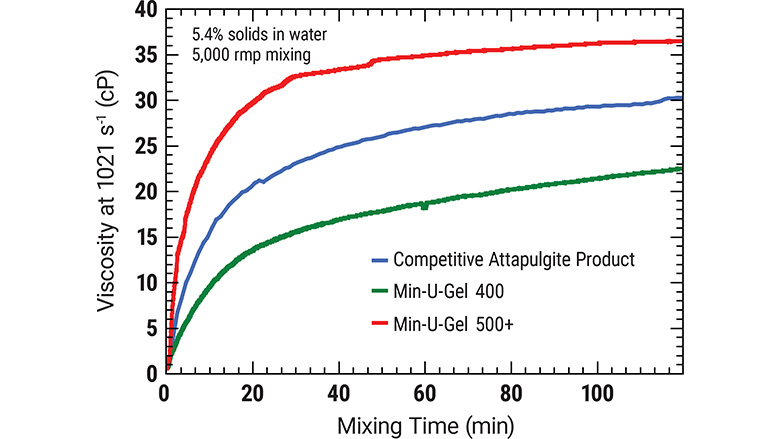
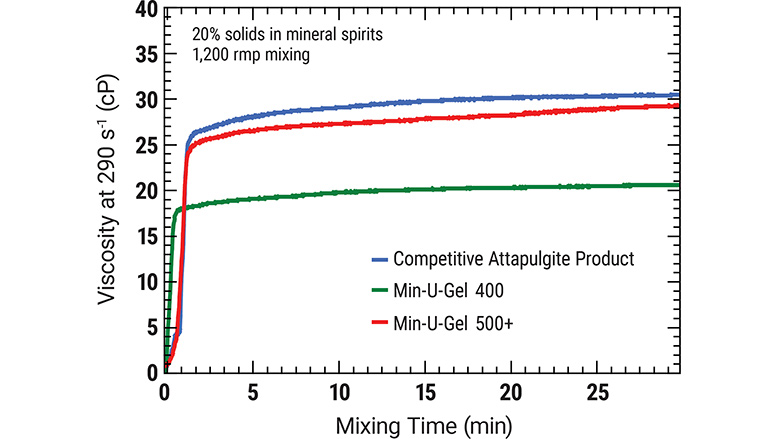
As shown in Figure 3 and Figure 4, the new attapulgite thixotropic thickener can be easily dispersed in both aqueous and solvent systems. This behavior is attributed to the smaller attapulgite particle size and the proprietary process, which facilitates formation of a three-dimensional attapulgite colloidal gel structure. When tested alongside a competitive, commercially available, high-performance attapulgite product, the new thickener exhibits higher viscosity in water and comparable viscosity in solvent systems. The new product also demonstrates a significant improvement in viscosity compared with the existing commercial product Min-U-Gel® 400.
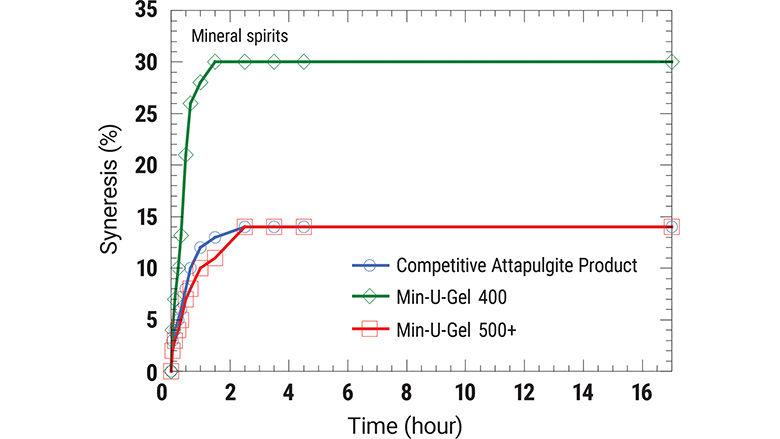
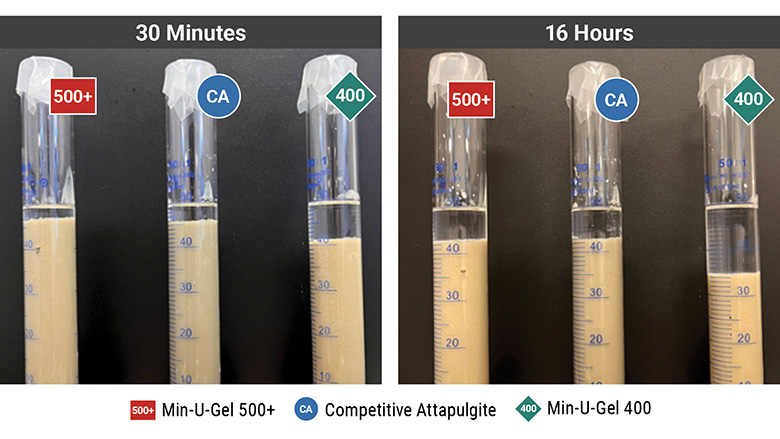
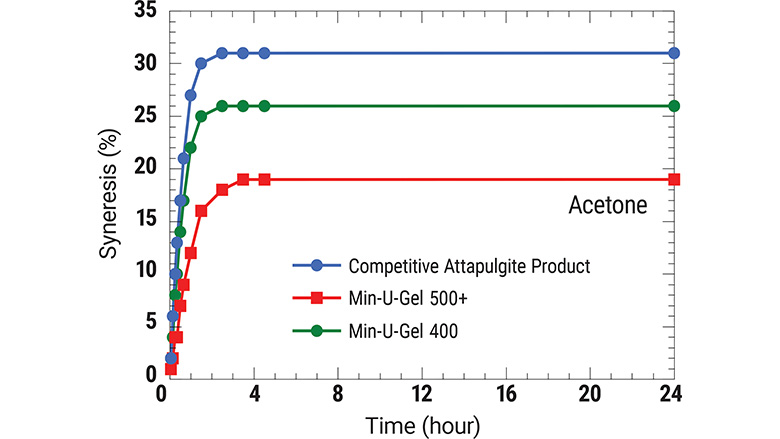
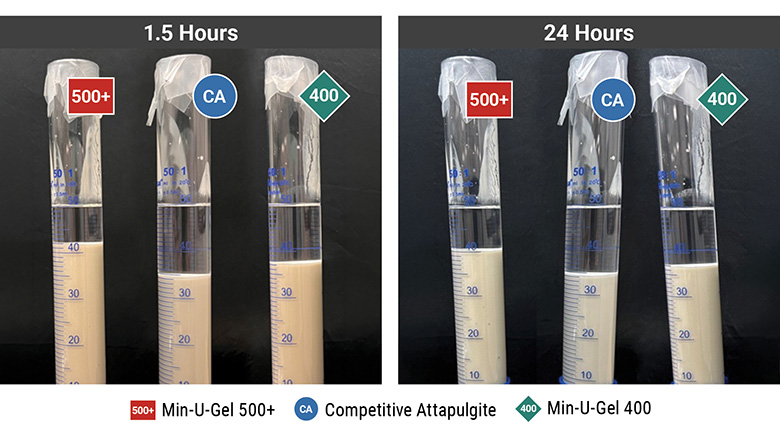
The testing confirms that the new attapulgite thickener exhibits superior suspension and syneresis control characteristics in both aqueous and solvent systems. As shown in Figure 5, syneresis in mineral spirits is similar to that of the competitive attapulgite product and represents a significant performance improvement over the earlier-generation commercial grade. In acetone, the new product exhibits markedly lower syneresis than both the competitive attapulgite product and the company’s previous standard-grade benchmark (Figure 6). All three products demonstrate the expected high performance in water, with no syneresis observed after 24 hours.
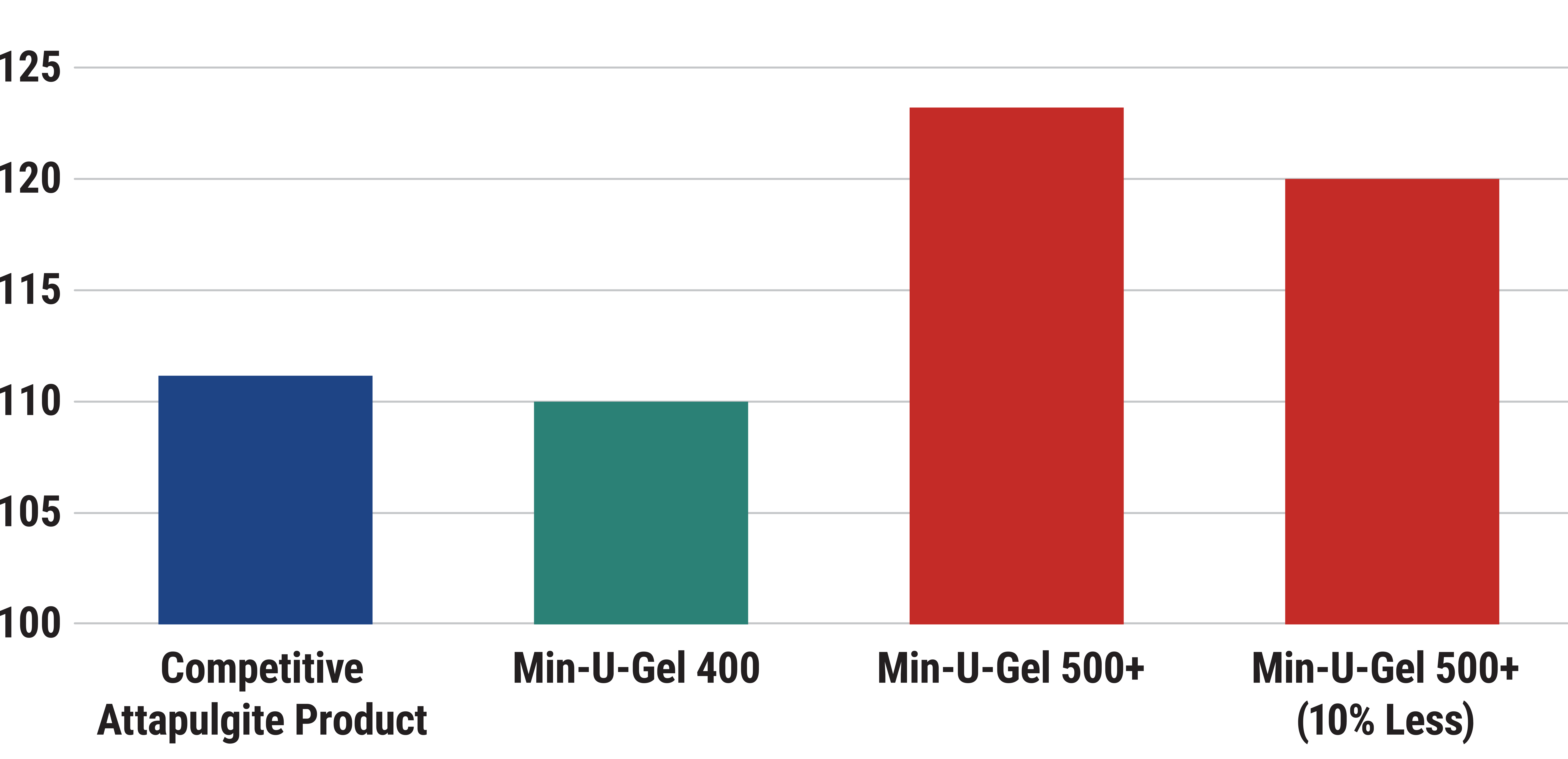
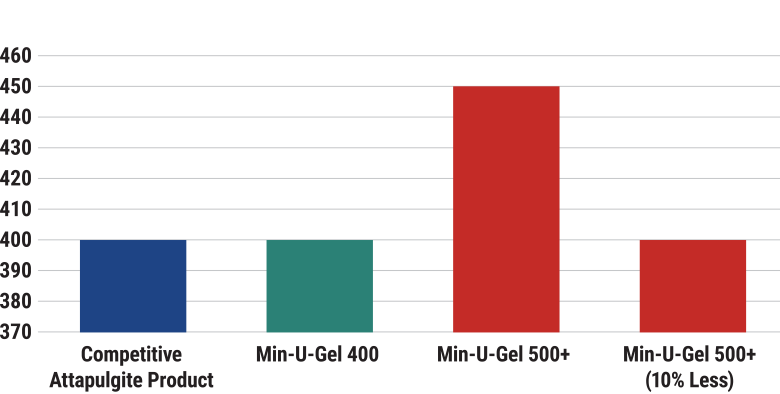
As shown in Figure 7, in the water-reducible alkyd baking enamel paint formulation, the new attapulgite thickener exhibits higher viscosity than both the competitive attapulgite product and the earlier-generation commercial grade. Even at 10% lower loading, the new product maintains higher viscosity. This result is consistent with the higher viscosity measured during dispersion in water.
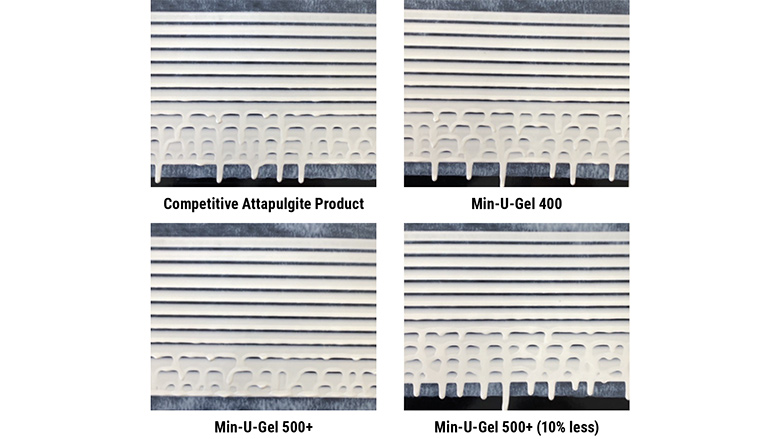
As shown in Figure 8 and Figure 9, the new attapulgite thixotropic thickener exhibits better sag resistance than both the competitive attapulgite product and the existing commercial product Min-U-Gel® 400. Even at 10% lower loading, sag resistance of the new product is comparable to that of the competitive attapulgite product. This improved performance is achieved with no significant differences in other paint properties, including color, opacity and gloss. These paint test results indicate improved performance in the water-reducible alkyd baking enamel formulation with the potential for lower loading levels.
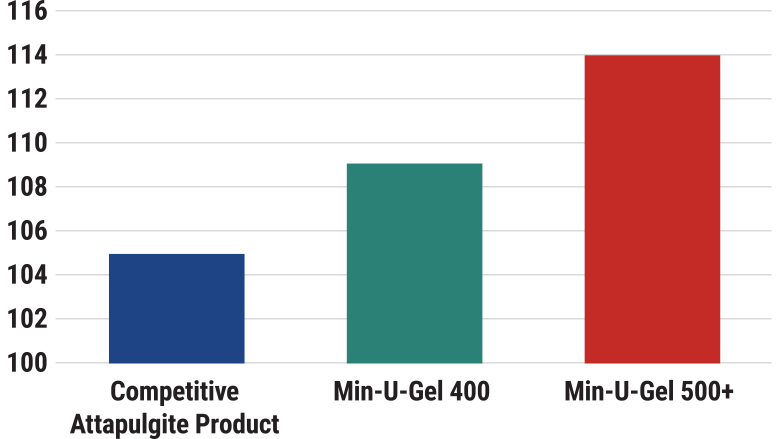
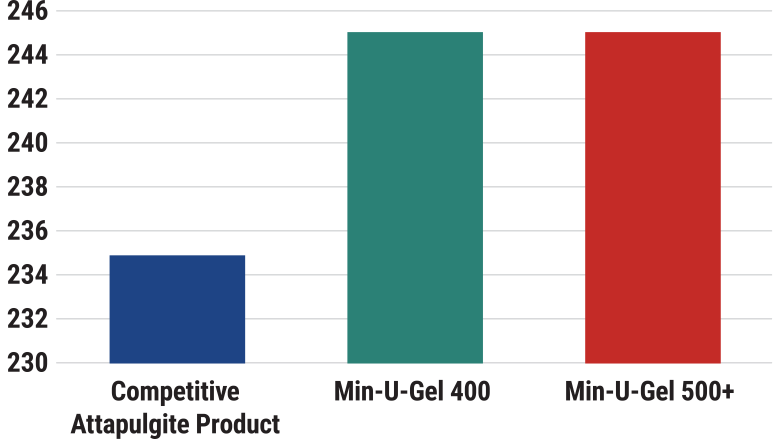
Similar to the results observed in the water-reducible alkyd baking enamel paint, the new attapulgite thickener exhibits higher viscosity and improved sag resistance compared with the competitive attapulgite product in the solvent-based high-solids baking enamel paint (Figure 10 and Figure 11). Consistent with the other tested system, no significant differences were observed in other paint properties, including color, opacity and gloss.
Conclusion
The new attapulgite thickener can be easily dispersed in both aqueous and solvent systems and exhibits superior suspension and syneresis control characteristics. It also demonstrates higher viscosity and improved sag resistance in both water- and solvent-based paints. The enhanced performance is attributed to the smaller attapulgite particle size and proprietary process, which facilitates and stabilizes the three-dimensional chain colloidal gelling structure. This versatile thixotropic thickener can be used in various applications, including paint and coatings, adhesives and agriculture. In aqueous and solvent paint and coating systems, it stabilizes the media, prevents settling, controls flow and redFor more information on Min-U-Gel® 500+ high-performance attapulgite, contact Active Minerals International, a Huber company, at info@activeminerals.com or 410-825-2920.uces syneresis.
For more information on Min-U-Gel® 500+ high-performance attapulgite, contact Active Minerals International, a Huber company, at info@activeminerals.com or 410-825-2920.
Acknowledgements
The author thanks Active Minerals International research scientists Dr. Nestor Cruz and Tyler Pulling for conducting testing and contributing results to this report, and Marketing Manager John Goosman for reviewing the manuscript.
Learn more about how rheology modifiers and other performance-enhancing Additives are shaping formulation strategies in modern paint and coatings systems.
Looking for a reprint of this article?
From high-res PDFs to custom plaques, order your copy today!