VOC Control in Coatings Manufacturing: Planning Beyond Today’s Permit
Selecting capture and abatement systems with room for growth can support compliance, energy management and long-term operating flexibility.
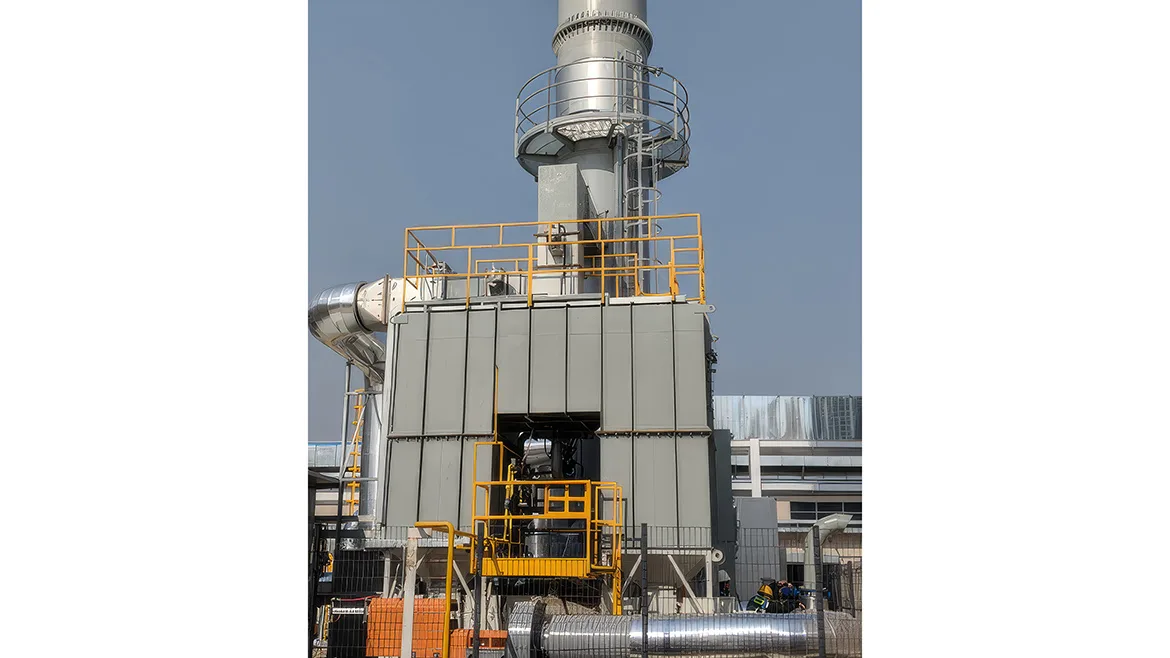
A regenerative thermal oxidizer and concentrator system installed at a coatings facility, sized to treat 1,000 scfm of VOC-laden exhaust.
Need to Know
- VOC emissions can arise from mixing, storage, application, curing and fugitive releases, so effective control begins with capture.
- RTOs are common for high-volume coating operations, while catalytic oxidizers, concentrators, scrubbers and carbon adsorption fit different exhaust profiles.
- EPA Method 204 allows 100% capture efficiency to be assumed for an enclosure that meets its criteria when all exhaust is ducted to a control device.
- Heat recovery, electrification and realistic production-growth margins can influence the economics and service life of an abatement system.
Every coatings manufacturer, and every plant that applies coatings to metal, plastic, wood or composite parts, deals with a version of the same problem: what to do with the solvents that leave a coating the moment it is mixed, sprayed or cured. Those vapors are volatile organic compounds, or VOCs, and they are one reason coating operations receive close attention under state and federal air programs.
I have spent more than two decades designing air pollution control systems for coatings manufacturers, automotive and appliance paint shops, metal furniture and coil coating lines and general industrial finishing operations across the United States, Canada, Europe and Asia. One thing has held true across that work: VOC control in this sector is not a passing phase of tighter enforcement. It is a permanent feature of how a coatings business runs, and the facilities that plan for it tend to run leaner than those that treat it as an afterthought.
Where Coating VOC Emissions Occur
Coatings, primers, topcoats, inks and adhesives rely on solvents to keep resins and pigments workable until application, and those solvents appear as VOC emissions at more points in the process than the spray gun. Coating mixing and blending release vapors as raw materials are combined. Storage tanks holding solvents and finished coatings lose VOCs gradually through breathing and working losses as temperature and liquid levels change. Spray booth exhaust often carries the largest and most closely regulated share because booths are ventilated continuously to protect workers from airborne contaminants and keep overspray off the finish. Bake ovens and curing lines add another substantial load, especially in higher-volume operations. Fugitive emissions, or VOCs that leak or pool within a building rather than exiting through a stack, are as much a fire and life-safety issue as an air-quality issue because accumulated solvent vapor can be combustible.
Several compounds commonly found in coating operations, including toluene, xylene, glycol ethers and methyl isobutyl ketone, are classified as hazardous air pollutants. EPA’s standards for miscellaneous coating manufacturing note that exposure to these substances can cause lung, eye and mucous membrane irritation, central nervous system effects and cancer.1,3 Beyond the plant boundary, VOCs react with nitrogen oxides in sunlight to form ground-level ozone, the main ingredient in smog. EPA identifies children, older adults and people with asthma or other lung disease as especially vulnerable to ozone-related health effects.2 For a coatings facility, VOC management is therefore more than a permitting exercise. It touches worker exposure, community health near the plant and the level of scrutiny a facility may draw when it applies for an expansion permit.
A Layered Regulatory Landscape
Coatings are among the most closely regulated categories of industrial VOC sources, and the rules stack at more than one level of government.
At the federal level, EPA regulates coatings manufacturing through National Emission Standards for Hazardous Air Pollutants, or NESHAP, such as the Miscellaneous Coating Manufacturing standard. The standard covers the blending of paints, inks and adhesives and was most recently amended in 2023.1,3 Separate NESHAP and New Source Performance Standards apply to plants that apply coatings, with distinct requirements for automobile and light-duty truck assembly lines, metal furniture, metal coil, plastic parts and miscellaneous metal parts and products, among other categories.4 On the formulation side, EPA’s national Architectural Coatings Rule sets VOC content limits across dozens of product categories, and a separate national rule caps VOC content in automobile refinish coatings.5,6
States layer additional requirements on top of the federal floor. The California Air Resources Board maintains a Suggested Control Measure for architectural coatings that is generally stricter than the federal rule. The SCM is a model rule that local air districts may adopt, and its limits have influenced requirements beyond California.7 Oregon’s 2025 rulemaking process illustrates the broader trend: DEQ evaluated tighter VOC limits for consumer products and architectural and industrial maintenance coatings based on models used in other states and jurisdictions.8 For a coatings manufacturer selling into multiple states, the strictest applicable product rule often becomes the practical formulation target. Finishers must likewise account for site-specific state and local permitting requirements.
What I see in client conversations is that a fair number of coating lines are still running control equipment sized to standards that are 10 or more years old. That gap is worth taking seriously because a system that once cleared its permit condition with room to spare may now be running close to the line, and the cost of a failed stack test or permit violation is almost always higher than the cost of upgrading ahead of it.
Matching Abatement Technology to the Coating Line
No single VOC control technology fits every coatings operation. The right choice depends on exhaust volume, VOC concentration and how heat-sensitive the coating or substrate is.
For high-volume lines, such as automotive OEM paint shops and large appliance or metal furniture coating operations, the regenerative thermal oxidizer, or RTO, is the workhorse technology. RTOs heat VOC-laden exhaust to roughly 1,400–1,800 °F, depending on the application, destroying the organic compounds in the process. EPA’s air pollution control technology fact sheets place typical RTO destruction efficiencies in the 95%–99% range, with well-designed thermal oxidizers of any configuration capable of 98%–99.99% when combustion temperature, residence time and mixing are properly controlled.9,10 The regenerative design recovers heat through ceramic media beds and reuses it to preheat incoming exhaust. That allows a well-configured RTO on a solvent-heavy coating line to run largely on heat released by the VOCs themselves rather than continuous gas firing.
Catalytic oxidizers are a common alternative on lines that run cooler or carry a lighter VOC load because a catalyst bed allows oxidation at lower temperatures. EPA’s technology fact sheets place typical regenerative catalytic oxidizer destruction efficiencies in the 90%–99% range.9 The tradeoff is that catalysts can be poisoned or masked by certain compounds, including some silicon-containing materials and heavy metals found in specialty coatings. The catalyst must therefore be matched to the coating chemistry and monitored over its service life rather than treated as a set-and-forget component.
Scrubbers can address acid gases and water-soluble solvents, while carbon adsorption can capture selected VOCs for control or recovery. In a coatings plant with a mixed solvent profile, the practical answer is often a hybrid system that combines capture, concentration and more than one control technology rather than a single catalog product.
Capture Comes Before Control
An oxidizer, whatever type sits at the end of the line, only destroys VOCs that reach it. Getting the emissions there is a design problem in its own right, and a facility can install a high-efficiency RTO and still miss its permit condition if the capture system feeding it is inadequate. That means ductwork sized correctly for the exhaust volume and hoods or enclosures positioned to pull vapors away from mixing tanks and application equipment rather than letting them drift into the plant.
For facilities with meaningful fugitive emissions, that can mean building to EPA’s specification for a permanent total enclosure, or PTE. A PTE is not simply a walled-off room. EPA Method 204 sets criteria covering the size and placement of openings and the minimum airflow drawn through them. If an enclosure meets those criteria and all exhaust gases are ducted to a control device, VOC capture efficiency can be assumed to be 100% without separate capture-efficiency testing.11 For coating operations where fugitive emissions are a fire or compliance risk, meeting the PTE criteria up front is usually more practical than trying to demonstrate capture efficiency after the fact.
On lower-concentration exhaust streams, some facilities pair an oxidizer with a concentrator, typically a rotating zeolite wheel that adsorbs VOCs from a large, dilute airflow and desorbs them into a smaller, more concentrated stream headed to the oxidizer. That combination can make sense when spray booth makeup air dilutes the VOC load below what a stand-alone RTO would handle efficiently.
Heat Recovery Belongs in the Design Conversation
The oxidation of VOCs is exothermic, and that heat does not have to be wasted. Facilities that treat abatement purely as an exhaust-handling cost are leaving a design opportunity on the table.
Steam-generating thermal oxidizers can route that heat back into the plant for process use or space heating. Waste-heat exchangers can preheat incoming makeup air for a paint booth or curing oven, reducing fuel demand for both the oxidizer and the process equipment it serves. EPA describes regenerative and recuperative heat recovery as standard design options for thermal oxidizers, with achievable thermal efficiency depending on the configuration and inlet VOC concentration.9,10,12 What that translates to in dollars varies by facility because it depends on exhaust volume, solvent loading and how the recovered heat is used elsewhere in the plant. It is a case-by-case engineering calculation rather than a figure that carries from one coating line to the next. The direction is consistent: a properly designed system can reduce net fuel demand rather than simply add to it.
Electric Oxidizers and the Decarbonization Question
A newer option in this space is the electric regenerative thermal oxidizer, or E-RTO, which replaces gas combustion with electric heating elements. For coatings manufacturers and finishers working toward net-zero targets or Scope 1 emissions reductions, or operating where gas infrastructure is limited, an E-RTO removes direct combustion emissions from the abatement system itself.
Scale remains the limitation. E-RTOs today are best suited to smaller exhaust volumes and lighter solvent loads, such as a specialty coatings line or smaller finishing operation, rather than a high-volume automotive paint shop. For large-volume coating lines, conventional gas-fired RTOs generally remain more cost-effective under current energy-price conditions. That balance may shift as regional grids add lower-carbon generation. Coatings manufacturers planning new capital projects should at least evaluate E-RTO compatibility now, even when a gas-fired system remains the right choice for the current investment.
Designing for the Regulation You Don’t Have Yet
The pattern worth flagging for any coatings plant manager or environmental compliance lead is this: build in margin, and be honest about the direction the industry has been moving. VOC content limits for coatings have tightened in many jurisdictions over the last two decades, and additional states have considered or adopted architectural and industrial maintenance coating rules. A system engineered to the exact letter of today’s permit condition, with no headroom, is more likely to need a retrofit within a few years. A retrofit is almost always more disruptive and expensive than building in capacity from the start.
The same logic applies to production growth. A coating line sized precisely to today’s throughput, with no allowance for planned expansion, forces a later choice between replacing the abatement system and capping production. Neither is comfortable to negotiate mid-project.
None of this argues for overengineering every system to the maximum theoretically achievable specification. Oversizing carries its own cost in capital, footprint and operating expense for capacity the facility may never use. The goal is a system sized to a realistic five-year view of the business, not either extreme.
What’s Ahead for Coatings and Finishing Operations
The next several years are likely to bring more regulatory attention to nitrogen oxides, or NOx, and to the specific pollutant mix coming off coating lines as agencies continue periodic reviews of existing standards. Coatings manufacturers serving renewable-energy markets, including solar-panel and wind-blade coatings and battery-enclosure finishing, are also working through emission profiles with limited historical permitting data. That makes conservative engineering margins more valuable.
Facilities that navigate this well tend to treat VOC control as an engineering problem tied to their specific coating chemistry, exhaust characteristics and growth plans rather than a compliance checkbox to clear once and revisit only when forced to. Technology capable of 98% or higher destruction efficiency while recovering process heat is already established and documented in EPA assessments.9,10,12 What most coating operations still have to determine is sizing: how much margin to build against a regulatory trend that has moved in one direction for two decades, weighed against the real cost of a system that is larger than necessary. That is a plant-by-plant engineering decision, which is why it deserves attention at the capital-planning stage rather than after the next permit renewal forces the issue.
Learn more at shipandshore.com.
References
- U.S. Environmental Protection Agency. Miscellaneous Coating Manufacturing: National Emission Standards for Hazardous Air Pollutants (NESHAP). https://www.epa.gov/stationary-sources-air-pollution/miscellaneous-coating-manufacturing-national-emission-standards (accessed 2026-10-12).
- U.S. Environmental Protection Agency. Ground-Level Ozone Basics. https://www.epa.gov/ground-level-ozone-pollution/ground-level-ozone-basics (accessed 2026-10-12).
- U.S. Environmental Protection Agency. Final Amendments to Air Toxics Standards for Miscellaneous Coatings Manufacturing: Fact Sheet; February 2023. https://www.epa.gov/system/files/documents/2023-02/Fact%20Sheet_MCM%20TR%20Final.pdf (accessed 2026-10-12).
- U.S. Environmental Protection Agency. Clean Air Act Guidelines and Standards for Solvent Use and Surface Coating Industry. https://www.epa.gov/stationary-sources-air-pollution/clean-air-act-guidelines-and-standards-solvent-use-and-surface (accessed 2026-10-12).
- U.S. Environmental Protection Agency. Architectural Coatings: National Volatile Organic Compounds Emission Standards. https://www.epa.gov/stationary-sources-air-pollution/architectural-coatings-national-volatile-organic-compounds (accessed 2026-10-12).
- U.S. Environmental Protection Agency. Automobile Refinish Coatings: National Volatile Organic Compound Emission Standards. https://www.epa.gov/stationary-sources-air-pollution/automobile-refinish-coatings-national-volatile-organic-compound (accessed 2026-10-12).
- California Air Resources Board. Architectural Coatings Program. https://ww2.arb.ca.gov/our-work/programs/coatings/architectural-coatings (accessed 2026-10-12).
- Oregon Department of Environmental Quality. July 10–11, 2025 Environmental Quality Commission Meeting, Item H: Volatile Organic Compounds 2025 Rulemaking. https://www.oregon.gov/deq/about-us/eqc/Pages/202507.aspx (accessed 2026-10-12).
- U.S. Environmental Protection Agency. Air Pollution Control Technology Fact Sheet: Regenerative Incinerator; EPA-452/F-03-021; 2003. https://downloads.regulations.gov/EPA-R08-OAR-2024-0622-0016/content.pdf (accessed 2026-10-12).
- U.S. Environmental Protection Agency. Air Pollution Control Technology Fact Sheet: Thermal Incinerator; EPA-452/F-03-022; 2003. https://www.epa.gov/sites/default/files/2020-11/documents/fthermal.pdf (accessed 2026-10-12).
- U.S. Environmental Protection Agency. Method 204: Criteria for and Verification of a Permanent or Temporary Total Enclosure. https://www.epa.gov/emc/method-204-permanent-pte-or-temporary-total-enclosure-tte-determining-capture-efficiency (accessed 2026-10-12).
- U.S. Environmental Protection Agency. Monitoring by Control Technique: Thermal Oxidizer. https://www.epa.gov/air-emissions-monitoring-knowledge-base/monitoring-control-technique-thermal-oxidizer (accessed 2026-10-12).
VOC-control decisions affect coatings manufacturers and finishers at the intersection of formulation, process design, regulatory compliance and operating cost. Matching capture and abatement equipment to coating chemistry, line volume and future growth can help facilities manage emissions while improving energy and production planning.
Looking for a reprint of this article?
From high-res PDFs to custom plaques, order your copy today!